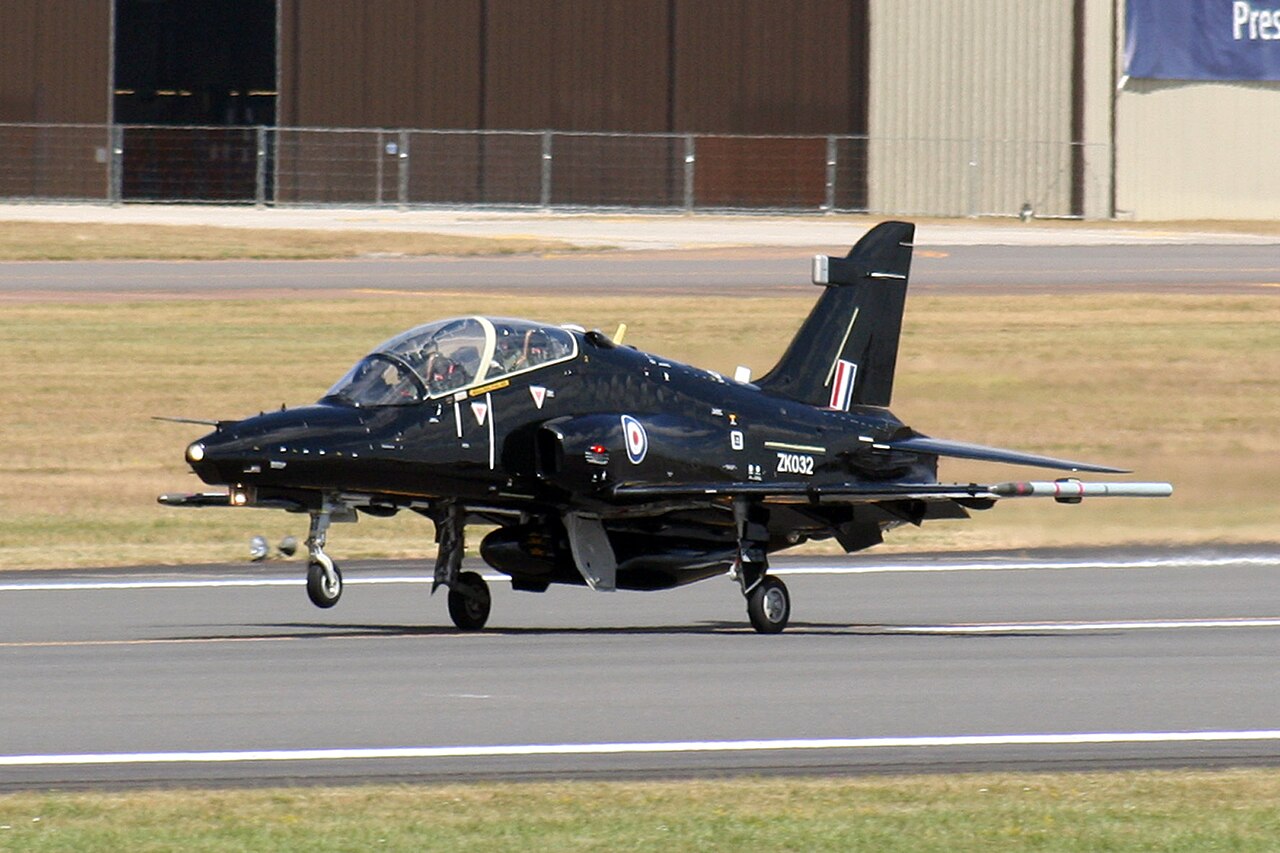
On Wednesday afternoon, September 23, 2026, a Royal Air Force Hawk T2 advanced jet trainer crashed in the Pencarnisiog area near RAF Valley on the Isle of Anglesey, North Wales, shortly after take-off. Both pilots ejected and were found quickly. North Wales Police said the two pilots were “being treated for what are thought to be minor injuries” and that “at this stage there are no reports of any wider damage or injuries.” Video published by Sky News shows the jet pitching violently, the canopy blowing open, both crew ejecting, and the aircraft nosing into a field and erupting into a huge fireball. By Wednesday evening the RAF announced it had “decided to temporarily pause Hawk T1 and T2 operations, as a precautionary measure, whilst investigations are ongoing.”
Why this matters
The Hawk is the RAF's fast-jet training funnel: every British pilot destined for Typhoon or F-35 fast jets learns the trade at RAF Valley. Grounding the entire Hawk fleet — both the modern T2 trainers and the older T1s — even temporarily, touches the pipeline that produces the RAF's combat aircrew. It is also the second Hawk lost at this same base in eight years, and the contrast between the two endings — two ejections that worked this week, one that did not in 2018 — will frame every question investigators are now asked.
What happened: a timeline
The Hawk T2 departed RAF Valley on Wednesday. Eyewitness Pete Bennett, watching the take-off, told North Wales Live he knew immediately something was wrong: “Right on take-off there was an orange flame and as it accelerated it was basically on fire.” The flame disappeared as the jet gained altitude, but the aircraft “climbed at an aggressive pitch… pitched twice violently in the air and then there were two clear loud bangs. The pilots ejected and both parachutes opened.” The account was reported by LADbible, citing North Wales Live. North Wales Police, the RAF, North Wales Fire and Rescue Service, the Welsh Ambulance Service and the air ambulance attended; the fire at the crash site was brought under control, and the public was asked to avoid the Pencarnisiog area.
The footage appears to show the jet narrowly missing residential properties before impact — a detail investigators will study frame by frame, because where a stricken jet comes down near homes is never luck alone: ejection timing, terrain, and the crew's last inputs all matter.
The official response
The RAF's first statement was spare: “An incident involving an RAF T2 Hawk aircraft, flying out of RAF Valley, occurred near Anglesey. An investigation is underway and we will not comment further at this time.” Hours later came the update that matters: both pilots were receiving medical treatment, their families were being supported, and Hawk T1 and T2 flying was paused. Defence Secretary Wes Streeting posted that his thoughts were “first and foremost with the pilots” and that updates would follow “in due course.”
Wales's First Minister, Rhun ap Iorwerth, said he was “very pleased and relieved” the pilots had not been seriously injured and wished the crew a swift recovery. Helen Jenner of Reform UK in Wales said she was “deeply concerned,” adding: “RAF Valley is part of the fabric of Anglesey. It has trained generations of fast-jet pilots, and our island is proud to be home to the men and women who serve there.”
RAF Valley and the Hawk T2: what this jet actually does
RAF Valley, which doubles as Anglesey Airport, is home to No. 4 Flying Training School — the RAF's fast-jet finishing school, where the Prince of Wales once served three years as a search-and-rescue pilot. The Hawk T2 is the advanced trainer: the last classroom before a pilot graduates to the Typhoon or F-35. Low-level training happens across 20 designated low-flying areas in the UK, according to the Ministry of Defence — Anglesey's coastline and empty skies make it ideal, and that is precisely why a crash here rattles the local community that lives under the flight paths.
A base that knows this grief: the 2018 crash
RAF Valley has been here before. On March 20, 2018, a Red Arrows Hawk T1A crashed at the base at around 13:25 during a practice engine-failure-after-take-off exercise. The pilot, Flight Lieutenant David Stark, ejected half a second before impact and survived; the engineer in the rear seat, Corporal Jonathan Bayliss, 41, did not eject and was killed. The RAF and Ministry of Defence confirmed Bayliss's death. The Service Inquiry found the aircraft had stalled with insufficient height to recover, and the coroner's 2021 prevention-of-future-deaths report recommended urgent work on artificial stall warning for the Hawk Mk 1.
Two crashes, same airfield, eight years apart — one crew saved by their seats, one man lost because his could not save him. That history will shadow this investigation.
What the numbers really say
Start with the scoreboard that matters most: two ejections, two parachutes, two pilots alive with minor injuries. Martin-Baker ejection seats have saved thousands of aircrew, and this week they did exactly what they are designed to do. But the RAF's decision to pause both the T1 and T2 fleets is the detail to watch. A precautionary fleet-wide pause is not routine; it means investigators want to rule out anything systemic — an engine issue, an airframe or maintenance pattern — before the rest of the fleet flies again.
The T2 has been in RAF service for well over a decade; the T1s still flying are essentially the Red Arrows' display fleet. Grounding both generations at once signals that the RAF would rather absorb a training backlog than risk a second accident. No one on the ground was hurt — and given the footage of the fireball near homes, that is the statistic the investigators, the base, and the village will all keep returning to.
Who feels the pause
The two pilots and their families first — the best possible outcome from the worst few minutes of a pilot's career. Then the training pipeline: every week the Hawks sit idle is a week of fast-jet courses delayed, with knock-on effects for Typhoon and F-35 squadrons waiting for new pilots. The Red Arrows, whose display season depends on the older T1s, will be watching the pause's duration closely.
The community around Pencarnisiog and RAF Valley — proud of the base, shaken by the fireball — will want answers about what flew over their homes. And the taxpayer and the critics of the ageing Hawk fleet will ask the uncomfortable question: after 2018's fatal stall and now a T2 lost on take-off, is the trainer fleet getting the investment and attention a front-line air force's schoolhouse needs?
What happens next
The investigation — expect a formal Service Inquiry led by the Defence Safety Authority — will recover the wreckage, examine the engines, pull flight data, and interview the crew and witnesses. The RAF will decide when Hawk flying resumes, likely in stages. The families of the two pilots will be supported through their recovery. And the footage — the orange flame on take-off, the violent pitching, the two bangs — will be analysed against the jet's data recorders to answer the central question: was this a machine failure, a maintenance issue, or something in those final seconds no checklist could catch?
Until then, the fleet stays on the ground — which is exactly where a cautious air force puts it when it does not yet know why one of its jets fell out of the sky.
The best crashes are the ones where the crew walks away, and by that measure Wednesday was a success story written in ejection-seat rocket smoke. But a grounded trainer fleet is the RAF telling the truth about risk: two pilots lived, and the service will not fly again until it understands why they had to eject. The investigation will take weeks; the questions about the Hawk fleet's future will last longer.
- Sky News report carried by Radio X: crash footage, police statement and RAF fleet pause
- The Scottish Sun: emergency response, eyewitness accounts and official reaction
- LADbible: eyewitness account attributed to North Wales Live
- Royal Air Force: 2018 RAF Valley crash and the death of Corporal Jonathan Bayliss
- UK government: Ministry of Defence confirmation of the 2018 fatality
- Judiciary of England and Wales: Jonathan Bayliss prevention-of-future-deaths report