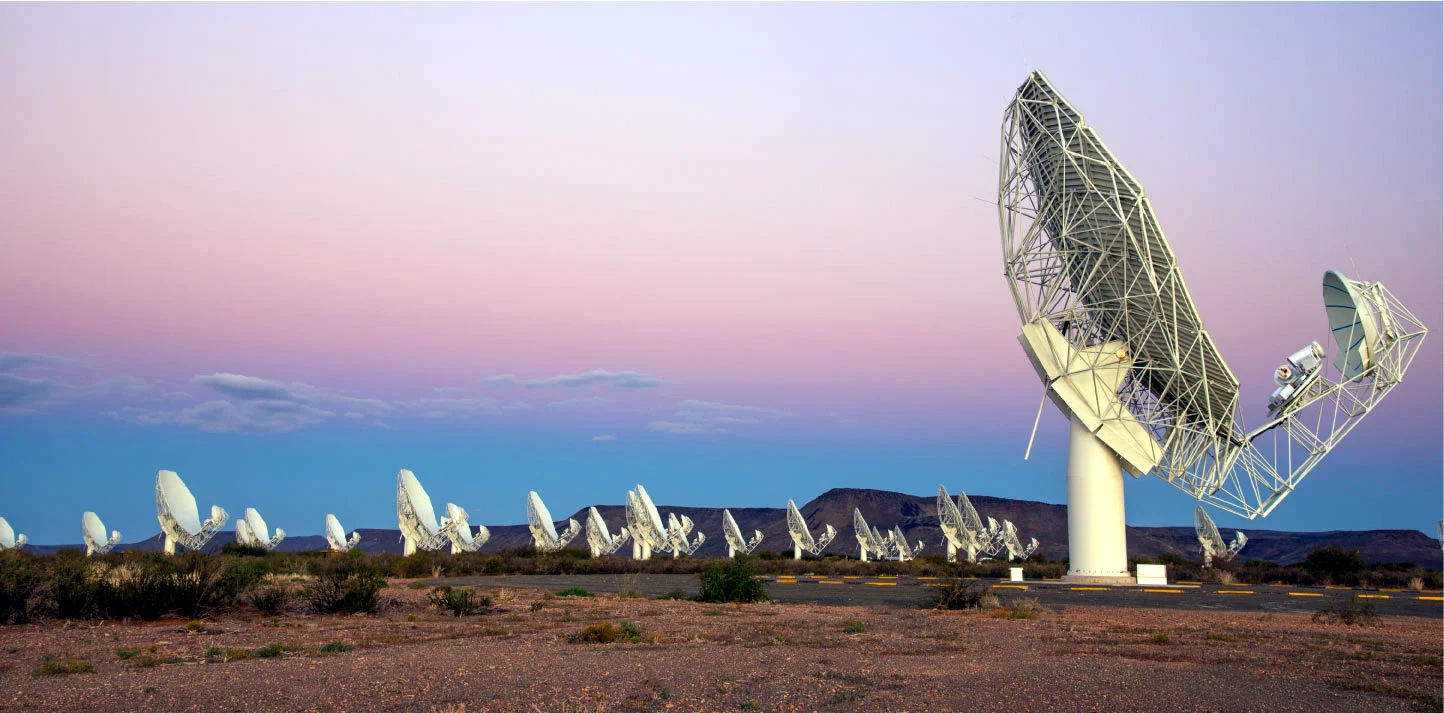
Astronomers have detected radio signals from an exoplanet for the first time, tracing rapid, repeating bursts to Beta Pictoris b, a giant world about 64 light-years from Earth. The team led by Kevin Ortiz Ceballos at the Center for Astrophysics | Harvard & Smithsonian used South Africa's MeerKAT telescope to distinguish the planet's emission from its bright host star and from another planet in the same system.
The signal is not a message and does not indicate technology or life. It is natural auroral radio emission: radiation produced when charged particles interact with a planet's magnetic environment. That distinction makes the result scientifically valuable. Magnetic fields are otherwise difficult to measure on distant worlds, yet they shape atmospheres, radiation exposure and the long-term evolution of planets.
How MeerKAT localized the first radio signal from an exoplanet
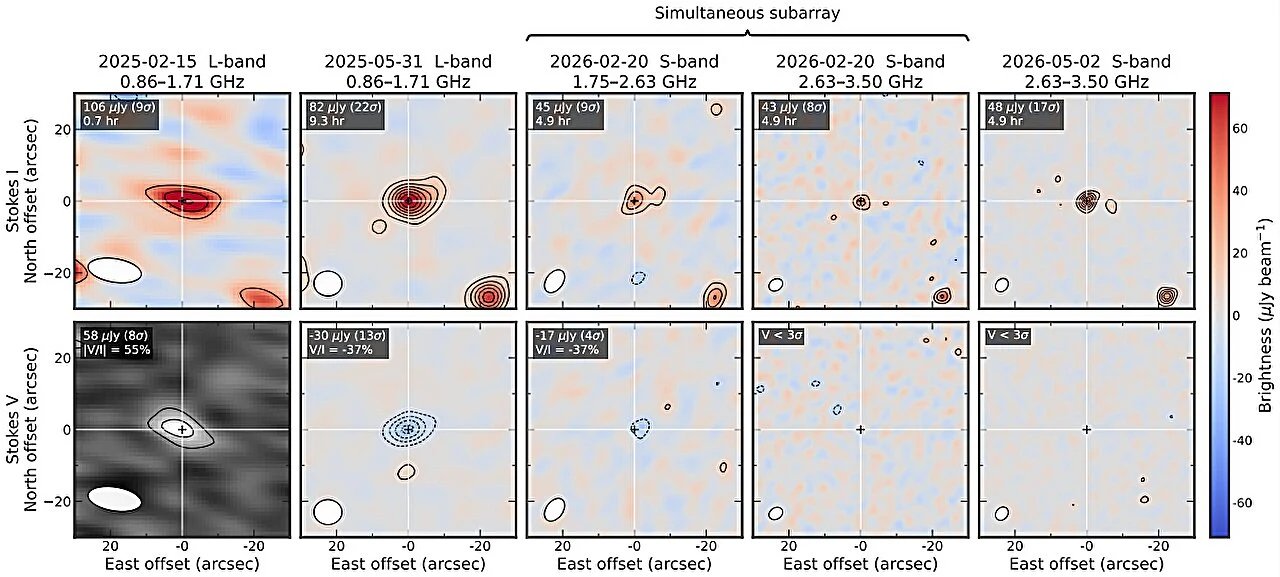
The researchers observed the Beta Pictoris system in four sessions during 2025 and 2026, using two frequency bands. They identified recurring bursts across roughly 0.85 to 3.5 gigahertz and found that the emission was highly circularly polarized, a defining property of coherent auroral radio processes.
Localization is the crucial advance. Stars can produce radio flares of their own, and earlier searches for exoplanet radio waves have often been unable to separate a candidate planet from its host. Here, the radio source moved with Beta Pictoris b's expected position. The team reported it was inconsistent with the star at 4.4 sigma and with Beta Pictoris c at 4.8 sigma.
The bursts showed about 40 to 70 percent circular polarization. Taken with their timing, frequency and position, that signature led the authors to interpret them as auroral emission from the planet rather than background noise or stellar activity. The finding has been posted as a preprint and should still be read in that context while the broader scientific community examines the analysis.
What Beta Pictoris b radio emission reveals
The highest detected frequencies imply an exoplanet magnetic field of at least 1.25 kilogauss, or 1,250 gauss, at the emitting region. That is far stronger than Earth's surface field and provides the first direct magnetic-field-strength measurement reported for an exoplanet.
Beta Pictoris b is a young, massive gas giant orbiting a nearby star whose planetary system has long served as a laboratory for studying how worlds form. A powerful field is plausible for a young giant still radiating heat from formation, but a direct measurement lets researchers test models of its internal structure rather than inferring magnetism only from mass, age and brightness.
The result also demonstrates that a planet's magnetosphere can be observed across interstellar distance. Radio emission carries information about field strength, charged particles and rotational or orbital geometry that optical images cannot provide.
Exoplanet aurora radio waves and the search for habitable worlds
A magnetic field is not proof of habitability, and a stronger field is not automatically better. Magnetospheres can deflect some charged particles, but atmospheric survival also depends on stellar radiation, gravity, chemistry and geological activity. Beta Pictoris b itself is a hot gas giant, not an Earth analogue.
Still, the technique matters for future searches. Around active stars, planets can face intense stellar wind and eruptions. Measuring their magnetic fields would help researchers estimate how exposed their atmospheres are and whether conditions remain stable over billions of years. For smaller rocky planets, such measurements will be much harder because the signals are expected to be weaker.
The discovery therefore changes the problem from whether exoplanet auroral radio waves can be detected at all to which systems can be measured next, at what sensitivity and with what biases.
Why the exoplanet magnetic field is a bigger discovery than a single burst
Most exoplanet measurements tell astronomers about a world's exterior: its radius, mass, temperature, orbit or atmosphere. Magnetism reaches inward. A dynamo depends on conducting material moving inside a planet, so field strength can constrain interior heat flow, rotation and composition.
That makes radio astronomy complementary to the transit and direct-imaging methods that built the exoplanet census. It may eventually help distinguish worlds that look similar in visible or infrared light but have very different internal engines and space-weather environments.
MeerKAT's role is equally important. The array was built for sensitive radio imaging, and the Beta Pictoris result shows it can track a moving planetary source near a radio-active star. Future facilities with greater collecting area and resolution could expand such work from exceptional young giants to a broader population.
What the figures mean — and what they do not
The 4.4-sigma and 4.8-sigma comparisons quantify how poorly the star and planet c fit the radio source's position relative to Beta Pictoris b. They strengthen the localization claim, but they are not percentages of certainty and should not be presented as a guarantee against every systematic error.
Likewise, 1.25 kilogauss is a lower bound inferred from the highest observed emission frequency under the auroral interpretation. It is not necessarily the planet's average surface field. The 40–70 percent polarization range describes the detected bursts, not a permanent state across the entire magnetosphere.
The paper's importance rests on several lines of evidence converging: repeated detection, broad frequency coverage, strong polarization and positional agreement with the planet. Replication by other instruments and observations at more orbital phases would make the case stronger and reveal how variable the source is.
Who benefits and what happens next
Planetary scientists gain a direct observational handle on magnetism. Radio observatories gain a new class of target, and theorists gain a measurement capable of rejecting models. The immediate losers are simpler interpretations that treat young giant planets only as infrared objects.
Next, teams will try to confirm Beta Pictoris b independently, determine whether the bursts follow the planet's rotation or interaction with surrounding plasma, and search other nearby young giants. They will also refine methods for subtracting stellar radio activity, likely the main obstacle in less favorable systems.
A first detection rarely becomes a mature field overnight. But this one supplies a concrete signal, a location and a magnetic constraint. Radio astronomers now have a demonstrated route to studying an aspect of exoplanets that had remained almost entirely theoretical.
Sources
Phys.org, September 2026: Astronomers detect radio signals from an exoplanet
Ortiz Ceballos et al., arXiv:2609.16720v1: Auroral radio emission localized to Beta Pictoris b
iHeart 991 WQIK, September 23, 2026: Report on the first exoplanet radio detection
Reporting basis: Fixed September 23, 2026 snapshot. The study is an arXiv preprint; its interpretation and significance should be reassessed as independent observations and peer review arrive.