According to senior Polish security sources speaking to Rzeczpospolita, Russian intelligence prepared a sabotage provocation on Poland’s border with the Kaliningrad exclave for late October or early November — an operation the sources say was meant to kill, and to be blamed on Kyiv. Poland’s defence minister has now confirmed the reporting in general terms. The gravest details, however, rest on anonymous sourcing that no Polish official has confirmed on the record, and Russia has not commented. This article sets out what is alleged, what is confirmed, and what remains unverified.
Track it live: Live wars tracker · Ukraine war map tracker
November 18, 2026 — The Poland Russian false flag plot described by Polish security sources to the newspaper Rzeczpospolita is, if the account is accurate, the most serious provocation Poland says it has faced since Russia’s full-scale invasion of Ukraine: a sabotage operation allegedly prepared by Russian intelligence near the border with Russia’s Kaliningrad exclave in late October or early November, designed from the outset to be attributed to Ukraine. Rzeczpospolita reported on Wednesday, citing senior sources linked to Poland’s uniformed and security services, that the alleged plan could have involved crossing the border and staging an attack on a facility inside Russia itself, carried out under a foreign flag so that blame would fall on Kyiv. The sources told the newspaper they had information about specific sites where an attack was supposed to take place, and that the planners were counting on a large number of casualties. The targets have not been named, and no Polish official has confirmed the mass-casualty element on the record.
That distinction — between what anonymous senior sources have told a newspaper and what the Polish government has confirmed in its own name — runs through every part of this story, and this article keeps it visible throughout. What is confirmed by named officials is substantial on its own: Poland detected what it describes as a planned Russian sabotage provocation near Kaliningrad, mobilised police, Border Guard and elite military units against it, and says it prevented the provocation from happening. Prime Minister Donald Tusk said as much on November 3, in narrower terms. Defence Minister Władysław Kosiniak-Kamysz went further on Wednesday, confirming Rzeczpospolita’s reporting that the services, police and elite units had thwarted a Russian sabotage provocation near Kaliningrad in late October and early November, with advance knowledge of what was planned. What neither man confirmed is the part of the account that makes it extraordinary: the alleged expectation of mass casualties, and the alleged design of a staged attack on Russian soil dressed up as a Ukrainian operation.
What Rzeczpospolita reported
Rzeczpospolita’s account, published on November 18, rests on senior sources the newspaper describes as linked to Poland’s uniformed services and security establishment and familiar with a preventive operation conducted over the preceding weeks. According to those sources, Russian intelligence services planned a sabotage action in Poland near the Kaliningrad border at the turn of October and November. The reported design had several elements: a possible crossing of the border; a simulated or staged attack on a facility, including the possibility of a facility located inside the Russian Federation; and a false-flag construction throughout, so that responsibility would be pinned on Kyiv rather than Moscow. The sources said specific sites were known to Polish services, but the newspaper did not name the targets, and it remains unclear from the reporting which facilities, on which side of the border, were allegedly at risk.
The sources also described an expected human cost. “We had information about specific sites where the attack was supposed to take place. The Russians were counting on a large number of casualties,” one senior source told the newspaper, in the account relayed internationally. In the most extreme version of the scenario described in the sourcing, the operation’s own saboteurs could have been killed and evidence fabricated around them — a detail that appears in the reporting as a scenario the sources outlined, not as an established fact, and one that no named official has endorsed publicly. The composition of the alleged team is likewise uncertain in the newspaper’s own telling: Rzeczpospolita reported that it was not established whether those involved would have been Ukrainian citizens resident in Poland or people brought in from elsewhere — a detail that matters, because a team built from Ukrainian residents would itself have been part of the alleged deception, manufacturing the appearance of Ukrainian responsibility from the inside.
One source reached for the heaviest comparison available in Polish historical memory. The alleged plan, the source told Rzeczpospolita, was supposed to resemble the Gleiwitz provocation — the staged attack on a German radio station at Gleiwitz, now Gliwice, on August 31, 1939, carried out by German operatives posing as Polish attackers on the eve of the Second World War. The reported purpose, as the sources framed it, was political rather than purely military: to turn Polish and Western public opinion against Ukraine and to halt or slow the flow of military aid to Kyiv. That framing is the sources’ interpretation of intent, and it is carried here as such.
Warnings, and the response on the border
According to Rzeczpospolita, the first warnings did not originate in Warsaw. Partner intelligence services alerted Poland to the alleged preparations, and analysts inside Polish intelligence agencies independently flagged the same risk. Similar warnings, the newspaper reported, were passed to the intelligence services of Lithuania, Latvia and Estonia — the three Baltic states that, with Poland, form NATO’s northeastern flank along Russia and Belarus. The alleged trigger for action on the ground was the detection of Russian intelligence officers, described as coordinating sabotage activity, on the Russian side of the border near Kaliningrad.
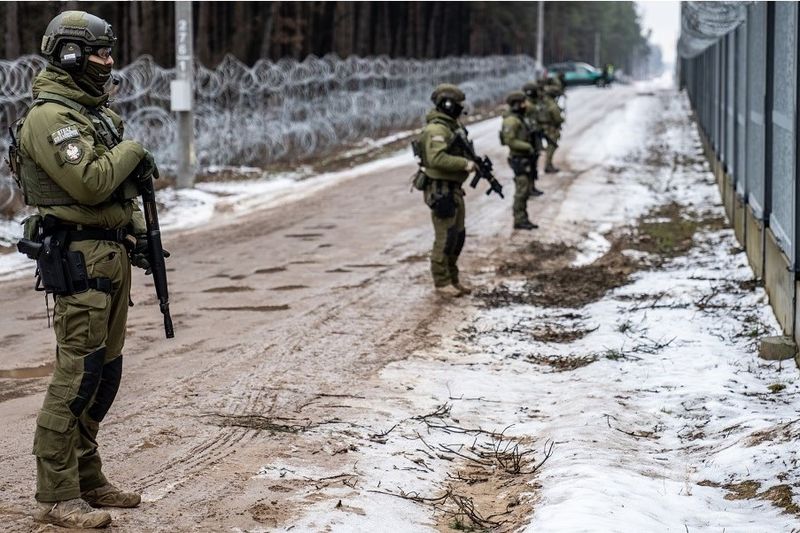
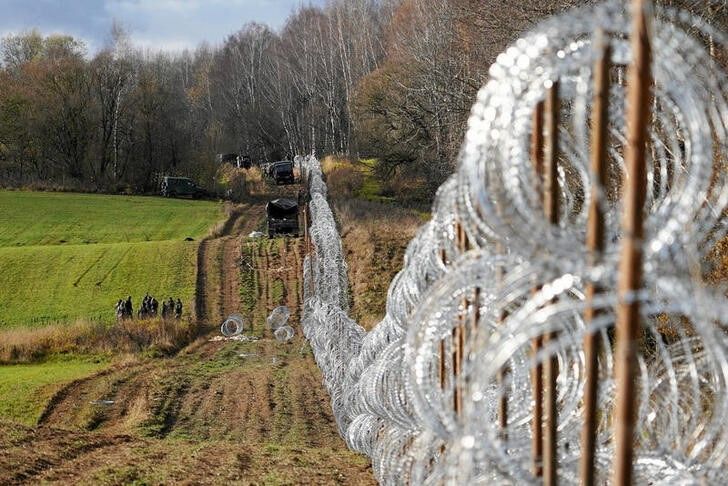
The Polish response, as reported, was large and fast. Around 180 additional police officers, including counter-terrorism specialists, were deployed to the border region in late October. Border Guard formations were reinforced. Poland’s GROM special forces unit — and, in relayed reporting of the Rzeczpospolita account, fellow special units exercising in the region — deployed in the Warmian-Masurian voivodeship, the northeastern province that borders the Kaliningrad exclave. In early November, a special operations headquarters was established at National Police Headquarters in Warsaw to run the operation across two voivodeships, Warmian-Masurian and neighbouring Podlaskie, which borders Belarus. National Police chief Marek Boroń publicly confirmed a preventive operation in the border area in early November, telling RMF FM that officers were securing the region against possible sabotage — a confirmation of the deployment, offered before Rzeczpospolita published the alleged reason for it.
What officials have confirmed — and what they have not
Tusk, November 3: a provocation prevented, details withheld
The first on-the-record account from the top of the Polish government came from Prime Minister Donald Tusk on November 3, a fortnight before Rzeczpospolita published its reporting. Tusk told a Cabinet meeting that he had received a report from the Border Guard shortly after midnight describing suspicious movement on the northern, Polish-Russian stretch of the border — people with flashlights, in his description. Forces were mobilised quickly, he said, and “we managed to prevent the provocation.” That statement confirms, from the prime minister himself, that Poland believed it faced a provocation on the Kaliningrad border that night and acted to stop it. It does not confirm — and Tusk did not claim — the mass-casualty design, the staged attack on a Russian facility, or the false-flag attribution plan that Rzeczpospolita’s sources later described. Readers should hold those two layers apart: the prevented provocation is officially confirmed; the alleged architecture of the plot is, so far, sourced reporting.
Siemoniak: a credible threat, operational secrecy
Tomasz Siemoniak, the minister coordinating Poland’s special services, confirmed to Rzeczpospolita that security measures had been taken near the border in recent weeks and that the services treated the threat as credible. When the newspaper put the sharpest version of the allegation to him directly — whether Russia had planned a terrorist-style attack at a place where large numbers of people might be present — he declined to confirm those specifics, citing operational secrecy. That refusal cuts in two directions, and it is reported here without resolving it: it is consistent with a government protecting a live counter-intelligence picture, and it also means the most alarming element of the story has not been confirmed by the minister responsible for the services making the claim.
Kosiniak-Kamysz, November 18: confirmation in general terms
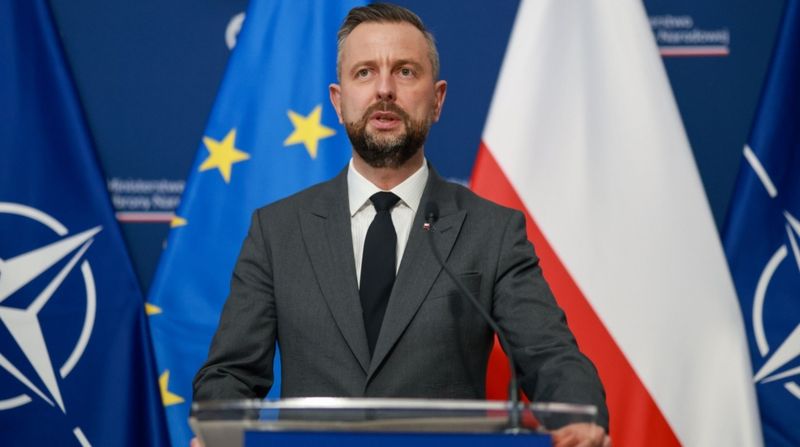
The strongest official confirmation came on Wednesday from Defence Minister Władysław Kosiniak-Kamysz, speaking in Jarosław in southeastern Poland. Kosiniak-Kamysz confirmed Rzeczpospolita’s reporting that Polish special services, police and elite military units had thwarted a Russian sabotage provocation near the Kaliningrad border in late October and early November, and said the services had advance knowledge of the planned action and reacted in time. He gave no operational details. He placed the episode inside a wider pattern of Russian activity against Poland that he enumerated himself: violations of Polish airspace, attempted derailment and arson attacks on trains, sabotage directed at defence-industry plants, and cyberattacks. He also noted the warning dimension beyond Poland’s own borders, and announced a concrete policy step: he will ask the prime minister to request that the president extend Operation Horyzont, the military operation under which Polish armed forces help secure critical infrastructure, including railway lines.
The other side: an FSB counter-claim, and silence from the Kremlin
Russia has not commented on the false-flag allegation itself in the reporting available at publication. The Kremlin offered no response to Rzeczpospolita’s account, and Kyiv has likewise issued no reported response to this specific allegation. What Moscow has produced instead is a mirror-image claim. On November 11, Russia’s Federal Security Service, the FSB, announced that it had broken up what it called a “Polish special services network” in Kaliningrad and detained two people. Polish government spokesman Jacek Dobrzyński dismissed the FSB announcement as propaganda, disinformation and an attempt at provocation. The sequence is worth stating plainly, because each side’s claim now exists in public without independent verification: Poland says Russia prepared a provocation on Polish soil and was stopped; Russia says Poland ran an intelligence network inside Kaliningrad and was caught. Neither claim has been accompanied, in public, by evidence that outside observers can test.
Context: a hybrid-war pattern, not an isolated scare
The allegation lands in a country that has spent three years treating Russian sabotage as a standing condition rather than a hypothetical. Poland is the principal logistics corridor for Western military aid to Ukraine, and its services have repeatedly announced arrests they attribute to Russian-directed networks. This month, Polish authorities arrested six people on suspicion of spying for Russia involving military components, as Signal Post News reported in its coverage of the arrests of six people accused of spying for Russia. The alleged methods in the wider pattern Kosiniak-Kamysz described — arson, rail sabotage, attacks or attempted attacks on defence plants, cyber operations and airspace violations — are individually deniable and collectively corrosive, which is precisely the logic of hybrid warfare: pressure applied below the threshold that would trigger a collective NATO response.
The alleged Kaliningrad plot, as sourced, would represent an escalation in kind rather than degree. Deniable sabotage damages property and nerves; a mass-casualty attack constructed to be blamed on Ukraine would aim at the political foundation of the Western war effort — Polish public support for hosting, transiting and financing aid to Kyiv. Poland is not the only state reporting pressure of this kind: French troops have been operating inside Ukraine on a confidential training and maintenance mission reported this month, a reminder of how directly European states are now involved on the ground, as covered in the report on French troops’ secret Volia mission in Ukraine. And Warsaw has been planning openly for the harder scenarios: Britain and Poland set out a joint Warsaw defence plan in October in discussions involving Kosiniak-Kamysz, covered in the UK–Poland Warsaw defence plan. The foiled-provocation claim will be read in allied capitals against that backdrop — as one more data point in an argument about how far Russian covert action against NATO territory may now extend.
The Gleiwitz parallel, as the sources drew it
The comparison Rzeczpospolita’s source offered deserves separate handling, because it is doing rhetorical as well as analytical work. On the night of August 31, 1939, German SS operatives dressed as Polish insurgents seized the German radio station at Gleiwitz, broadcast a brief anti-German message in Polish, and left behind bodies presented as evidence of a Polish attack — part of a wider series of staged border incidents, codenamed Operation Himmler, that Nazi Germany used to justify its invasion of Poland the following morning. The parallel the Polish source drew is structural: an attack manufactured by the state that would claim to be its victim, built to redirect blame onto a neighbour and to licence a political course already chosen. In the alleged 2026 version, the direction of the deception is different — the reported aim was not to justify an invasion of Poland but to poison Poland’s relationship with Ukraine — and the comparison is a source’s characterisation, not a finding. But in Poland, where Gleiwitz is taught as the opening lie of a war that killed millions of Poles, the choice of analogy signals how seriously the officials briefing Rzeczpospolita want the allegation to be taken.
Why this matters
Analysis: even stripped to its officially confirmed core — a detected provocation, a midnight mobilisation, roughly 180 additional police including counter-terrorism officers, GROM on the border, a special operations headquarters covering two voivodeships, and a defence minister confirming a thwarted Russian sabotage provocation on the record — this episode matters for reasons that do not depend on the unverified details.
The escalation question
The first reason is the alleged target set. Every prior element of the pattern Kosiniak-Kamysz listed — airspace violations, train arson and derailment attempts, defence-plant sabotage, cyberattacks — is calibrated to impose costs while preserving deniability and avoiding mass death on NATO territory. An operation designed, as the sources allege, to produce large casualties and attribute them to Ukraine would cross from harassment into something categorically different: an attempt to manufacture a political rupture inside the alliance’s supply coalition by an act of mass violence. If the allegation is accurate, it suggests a willingness in Moscow to accept risks that the sabotage campaign so far has carefully avoided. If it is not accurate in its details, the fact that Poland’s defence minister chose to confirm the core of it publicly still tells allied governments that Warsaw wants the threat registered at the highest level. Either way, the signal has been sent, and it will be priced into allied planning.
The numbers in context
The measurable facts are the deployments. Roughly 180 additional police, among them counter-terrorism specialists, is a large reinforcement for a rural border voivodeship; GROM is Poland’s premier special-mission unit, not a border-patrol reserve; and a standing special operations headquarters at National Police Headquarters, spanning Warmian-Masurian and Podlaskie, indicates the services were preparing for a campaign of incidents rather than a single night’s alarm. Set against that, the evidentiary ledger on the other side is thin in public: no named targets, no published forensic material, no arrests announced in direct connection with the alleged plot, and no casualty figure beyond the sources’ phrase “a large number.” A data-driven reading therefore lands in an uncomfortable but honest place: the scale of the Polish response is itself evidence that Warsaw’s services believed the warning; it is not, by itself, proof of what the alleged operation would have done.
The Baltic dimension
The reported warnings to Lithuania, Latvia and Estonia widen the story beyond one border. All three states border Russia or Belarus, all three host allied forces, and all three have reported their own sabotage and airspace incidents. If partner services were circulating warnings of a provocation campaign across the northeastern flank simultaneously, then the alleged Polish plot may have been one element of a regional design — or the warnings may reflect a shared intelligence picture of a threat that never fully materialised anywhere. The distinction matters for NATO’s response: a coordinated multi-state provocation campaign argues for a collective counter-hybrid posture; a single-country scare argues for national reinforcement of exactly the kind Poland has already carried out.
The doubts, recorded in Rzeczpospolita’s own pages
Balance requires noting that scepticism about this story does not come only from Moscow’s silence. Rzeczpospolita itself published, on November 4 — the day after Tusk’s statement — an examination of the provocation claims that recorded expert doubts, and that examination was updated on November 18 alongside the new reporting. Analysts quoted in that scrutiny raised the obvious questions that attach to any claim of this kind: an operation of the alleged scale would be exceptionally difficult to mount undetected in one of the most heavily surveilled border zones in Europe; anonymous sourcing, however senior, cannot be independently checked by readers; and governments facing genuine threats also have political incentives to publicise them, particularly when seeking allied support and domestic backing for security spending and deployments such as Operation Horyzont. None of those doubts disproves the allegation. They define what would be needed to move it from sourced reporting to established fact: named evidence, judicial proceedings against identified participants, or corroboration from an allied service speaking in its own name. None of those has appeared yet.
What happens next
Three developments will test this story in the coming weeks. First, the Operation Horyzont extension: Kosiniak-Kamysz said the request will travel from him to the prime minister and then to the president, a path that will force the allegation’s policy consequences into formal decisions and, likely, into public debate about how long Poland’s military should be committed to guarding railways and infrastructure. Second, the evidentiary question: any arrests, charges or published forensic findings connected to the alleged plot would materially change its status; continued silence on that front will keep it in the category of confirmed deployment and unconfirmed design. Third, the Russian track: the FSB’s Kaliningrad counter-claim, with two detainees announced, may develop into proceedings of its own, and Warsaw’s characterisation of it as disinformation will be tested by whatever Moscow chooses to publish. Two scenarios bracket the range. In one, allied services corroborate the warning picture and the episode becomes a reference case in NATO’s counter-hybrid doctrine, cited the way Gleiwitz is cited now — as the moment a pattern revealed its intent. In the other, no further evidence emerges, the deployments wind down, and the story settles into the contested category occupied by many hybrid-war claims: believed in Warsaw, denied or ignored in Moscow, and unresolvable from the public record.
What can be said without taking a side is narrower, and it is enough. Poland’s government, at prime-ministerial and defence-ministerial level, has stated on the record that it detected and prevented a Russian sabotage provocation near Kaliningrad in late October and early November, and it moved police, Border Guard and special forces on a scale consistent with that belief. Senior Polish security sources have described something far graver behind that deployment — a false-flag operation built to kill and to blame Ukraine — and that description remains, at publication, an allegation: attributed, plausible to the services that acted on it, doubted in print by experts in the same newspaper that reported it, and unanswered by the state it accuses. Signal Post News will update this story if evidence, charges or an official Russian or Ukrainian response changes that balance.
Sources
Sources: Rzeczpospolita, November 18, 2026, reporting based on senior sources linked to Poland’s uniformed and security services, as relayed by Meduza, November 18, 2026 — “Russia planned ‘false flag’ operation with mass casualties on Polish territory, Rzeczpospolita reports” (meduza.io): the alleged late-October/early-November sabotage plan near the Kaliningrad border; the possible border crossing and staged attack on a facility inside Russia; the false-flag design to blame Kyiv; the sources’ statements on specific sites and expected large casualties; the Gleiwitz comparison and the reported aim of halting aid to Ukraine; the partner-service warnings and parallel warnings to Lithuania, Latvia and Estonia; the detection of Russian coordinating officers; the deployment of around 180 additional police including counter-terrorism officers, Border Guard reinforcements and GROM in Warmian-Masurian; the early-November special operations headquarters at National Police HQ for Warmian-Masurian and Podlaskie; Tusk’s November 3 account; and Siemoniak’s confirmation of measures with operational details withheld. The same Rzeczpospolita reporting as relayed by European Pravda / Ukrainska Pravda and republished in English (europesays.com): the false-flag design, the Gleiwitz parallel, the hybrid-warfare context and the border deployments. Kosiniak-Kamysz confirmation reporting, November 18, 2026 (securitysignal.ie): the defence minister’s confirmation in Jarosław that services, police and elite units thwarted a Russian sabotage provocation near Kaliningrad with advance knowledge; the wider pattern of airspace violations, train derailment and arson attempts, defence-plant sabotage and cyberattacks; and the planned request to extend Operation Horyzont via the prime minister to the president. EUalive / European Pravda partners, November 3, 2026 (eualive.net): Tusk’s account of the after-midnight Border Guard report, the people with flashlights, the mobilisation and the statement that “we managed to prevent the provocation,” and Police chief Marek Boroń’s confirmation of the preventive operation. The FSB’s November 11 claim of a broken-up “Polish special services network” in Kaliningrad with two detained, and spokesman Jacek Dobrzyński’s dismissal of it as propaganda, disinformation and provocation, are carried from the November 18 reporting chains above; the Kremlin’s absence of comment on the false-flag allegation and the absence of a reported Kyiv response to this specific allegation are stated as they stand in that reporting. Expert doubts are as recorded in Rzeczpospolita’s own November 4 examination of the provocation claims, updated November 18. Photographs: Polish Border Guard (file photo), Reuters (file photo) and Polish Ministry of National Defence / gov.pl (file photo), credited in the captions; none depicts the alleged late-October/early-November operation.