PEN America book bans report · school book bans 2026
A record year for school book removals — and a parallel fight over whether "ban" is even the right word.

The PEN America book bans report released October 5 counts 11,982 books banned in U.S. public schools during the 2025-26 school year — the highest number since the free-expression group began tracking school book bans in 2021. The report, "Banned in the USA: A Spotlight on School Book Bans," arrives during Banned Books Week and lands in a debate where the two sides cannot even agree on what the word "ban" means. This is the number, the fight behind the number, and what both sides are really arguing about.
Why this matters
Start with the scale, because it is genuinely new. The 11,982 bans are nearly double the 6,870 recorded the previous year and surpass the 10,046 of 2023-24. That is not a plateau — it is an acceleration, and it comes at a moment when reading for pleasure is declining across all ages. PEN America's Freedom to Read director Kasey Meehan put it plainly: "This year just really feels like we're at a crisis point." But the number that makes the report powerful is also what makes it contested. PEN counts any content-based action — from a parent challenge to a state law — that removes a book from students or restricts access to it. Critics say that definition sweeps in routine curation and turns a smaller phenomenon into a headline. So the fight is happening on two levels at once: over the books, and over the ruler being used to measure them. Any honest reading of this report has to keep both levels in view.
The numbers: a record year
How the count grew
The headline figure breaks down into records inside the record. Of the 11,982 bans, 7,370 were unique titles — the most ever — affecting the work of more than 4,000 authors, illustrators, and translators. More than 4,500 of those titles were new to PEN's Index of School Book Bans, the largest single-year addition since tracking began. And 114 school districts banned books this year, also a record. The trend lines all point the same direction: more books, more titles, more districts, more first-timers on the list.
Where the bans are
Geography is the strangest part of the data. More than 8,100 of the bans — over two-thirds of the national total — were recorded in Texas, which displaced Florida as the top state after Florida held the No. 1 spot for three consecutive years. Florida still recorded more than 3,200. No other state recorded more than 200. That distribution is so lopsided it demands an explanation, and the report offers two: state laws that pressure districts to remove books, and better documentation. Texas and Florida have, in PEN's words, the most complete records of book bans, thanks to public-records requests from grassroots groups — the Florida Freedom to Read Project and the Texas Freedom to Read Project. In other words, part of the Texas-Florida dominance may be a measurement effect: states that document removals look worse than states that do not. That caveat does not erase the bans, but it should temper any claim that the map proves where censorship is "worst."
How books get removed: laws, lists, and AI
The report points to organized pressure and legislation as the engines of the increase. In Texas, a 2025 law (SB 13) bans certain categories of books in public schools. In Florida, a 2023 law (HB 1069) mandated restrictions that removed thousands of books — though a federal judge struck the law down as unconstitutionally vague, and the case is now on appeal. Similar laws are spreading: Utah's HB 29 requires a book found objectionable by any three districts to be removed statewide; South Carolina and Tennessee have enacted their own statewide removal mechanisms. PEN also warns that districts may treat the published lists as a de facto statewide blacklist, removing books preemptively before any objection is filed.
The AI accelerant
The report's most novel claim is that artificial intelligence is now speeding up removals. In Texas, where the state legislation was difficult to interpret and apply, AI tools were used to identify books for removal — and in several cases the AI recommended banning books precisely because they had been banned elsewhere, creating what the report calls a snowball effect for frequently banned titles while, in its words, the expertise of librarians and the communities they serve are ignored. If true, this is a structural shift: bans that once required a complaint, a meeting, and a vote can now be generated at software speed.
What is being banned
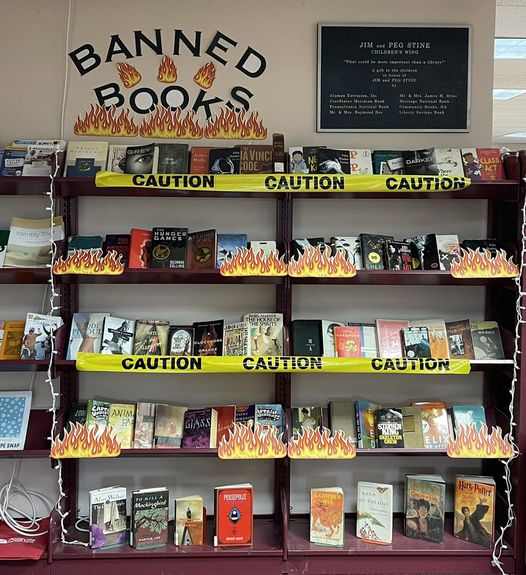
Young adult literature is the epicenter: 58% of banned titles were YA books, and more than 80% of all bans were works of fiction — with over 90% of the banned YA titles being fiction. The most-banned single title was Patricia McCormick's 2006 young-adult novel Sold, and the most-banned individual author was Stephen King. Newly appearing on banned lists were mainstream titles including Bonnie Garmus's Lessons in Chemistry and Charlotte Brontë's Jane Eyre — a 19th-century classic now sharing list space with contemporary YA. Free-speech advocates note that many removed books deal with LGBTQ+ or racial-justice themes, a pattern visible in state after state. Meehan's broader warning was about timing: "When reading for pleasure is in decline across all ages, bans on popular and engaging titles are exceptionally tragic. Schools should be doing everything possible to connect kids with reading."
The definition fight: what counts as a "ban"
The critics' case
Florida governor Ron DeSantis has called the book-ban narrative a "hoax," arguing that books are removed when they contain "pornographic content and other types of violent and age-inappropriate content" — in other words, that this is curation, not censorship. The definitional critique goes further. PEN's index counts books removed without any formal parent challenge, books restricted by grade level, and books that require parental permission — all logged as "bans." American Enterprise Institute fellow Max Eden, testifying before the Senate Judiciary Committee, argued the word itself misleads: the "most banned" books remain available for purchase, so in the ordinary sense of "made unavailable," he said, "books aren't being banned" — schools are deciding what belongs in a school library, which every library does daily. The Heritage Foundation has similarly disputed PEN's tallies, and the American Library Association uses a different methodology entirely, counting challenges across all libraries by calendar year rather than school bans by academic year.
What the evidence actually supports
Both sides have a point, and the honest position is uncomfortable for each. Critics are right that the number is definition-dependent: narrow the definition to permanent, district-wide removals after formal challenges and the 11,982 shrinks dramatically. But advocates are right that something real is being measured: the removals disproportionately affect books with certain themes, they increasingly happen through state laws and software rather than local deliberation, and the trend is accelerating even on PEN's own consistent methodology year over year. The definitional choice moves the number more than any single year's events do — which is exactly why the fight over the word matters as much as the fight over the books.
Who benefits, who loses
The winners in the removal wave are organized parents' groups that sought greater oversight of school libraries, and the politicians who answered them — in several states, book policy has become a reliable applause line. The losers are concrete: more than 4,000 authors, illustrators, and translators whose works were pulled; school librarians whose professional judgment the report says is being bypassed by algorithms; and students, who get fewer choices at the exact moment educators are struggling to get them reading at all. There is also a legal counteroffensive underway: six major publishers and authors including John Green, Julia Alvarez, and Angie Thomas have sued Florida over what they call unconstitutional book banning, and one school district was forced to return banned books to shelves as part of a settlement. The courts, not the culture war, may end up writing the final definition.
What happens next
The courts will narrow the question
The appeal over Florida's HB 1069 will test how vague a removal law can be before it violates the Constitution. Utah's three-district trigger, South Carolina's statewide board authority, and Tennessee's commission model are largely untested in court. Each ruling will effectively legislate the boundary between curation and censorship for the states watching.
The blacklist dynamic
PEN's warning about a "de facto statewide blacklist" describes a feedback loop worth watching: published ban lists feed AI screening tools, which generate new removals, which generate longer lists. Breaking that loop would require what the report says is currently missing — librarians and local communities back in the decision chain. Meanwhile the counter-movement is adapting too, with libraries expanding free digital access to challenged titles. The 2026 numbers will be read, on both sides, as a scoreboard. The more important question is whether anyone is still arguing about the rules of the game.
For the broader picture on American schools this fall, see our explainer on France's school crisis — a different country's answer to the same question of what schools owe their students — plus the DOJ's move to end 50 school desegregation cases and Columbia's journalism school admissions pause.
Sources: PEN America, "A Spotlight on School Book Bans", USA Today, Kirkus Reviews, Pensacola News Journal, AEI / Max Eden Senate testimony.