World
Novaya Gazeta, the Moscow newspaper that outlived bans, raids and the murder of six of its journalists, says Russia’s authorities and security services have forced it to close — ending 33 years of independent reporting inside Russia.
Track it live: Live war and conflict tracker — the war in Ukraine, whose censorship laws made Novaya Gazeta’s position untenable, continues to reshape what Russians are allowed to know.

Novaya Gazeta shuts down on November 9, 2026 — and with that date, a 33-year experiment in telling Russians the truth about their own country comes to an end. The Moscow newspaper, founded in 1993 and widely described as Russia’s last independent newspaper, announced on Friday, October 30, that it will cease operations after Russian authorities evicted it from its headquarters, cut off the reader donations that kept it alive and designated its entire editorial operation a “foreign agent.” The paper’s own headline for its ending was not a euphemism. It read: “We were killed.” Or, as it has been rendered in English: “They killed us.”
Editor-in-chief Sergei Sokolov set out the ending in a video statement and in a farewell letter published by the French newspaper Le Monde. “On November 9, we will turn off the lights in the home where we have lived for 30 years,” he wrote. “We will shut down our servers and leave. The newspaper no longer exists. The Russian authorities and the Russian security services have forced our editorial team to cease its operations.” It is difficult to improve on that as an obituary, and the paper’s journalists did not try: the statement explained, flatly, that the newsroom had been evicted from the Moscow offices it had occupied for three decades, that the platform through which readers donated to it had been cut off, and that it had been “stripped of all our resources.”
‘We were killed’: an announcement, not a retirement
Newspapers die in many ways — slowly, through indifference, or suddenly, through bankruptcy. Novaya Gazeta is insisting, in its final act of reporting, that its death be recorded accurately: not a commercial failure, not an editorial decision, but the terminal point of a years-long campaign by the Russian state. The authorities announced the closure of the paper’s headquarters on October 28, two days before the paper went public with its decision. The eviction and the donations cutoff landed at the same moment, and that simultaneity is the story in miniature. A newsroom can survive losing its building. It can survive, for a time, losing its money. It cannot survive losing both at once while every bank in the country is forbidden, in effect, from touching it.
The announcement also lands at a moment when the war that made the paper’s position impossible is still generating the news it can no longer cover. Ukrainian drones are again striking deep inside Russia — Kyiv’s forces hit two Su-34 jets at the Marinovka airbase in the Neptune strike on Marinovka this week — while in Washington the Pentagon has been privately urging European allies to cool their rhetoric about Russia as a new peace push takes shape. Inside Russia, none of that can now be reported by a domestic newsroom that answers to its readers rather than to the Kremlin. That is precisely the condition the closure creates, and, the paper’s editors argue, precisely the condition it was designed to create.
The squeeze, step by step
No single order killed Novaya Gazeta. What killed it was a sequence, each step defensible in the bureaucratic language of its authors and devastating in combination. First, its website was blocked inside Russia, cutting it off from most of its domestic audience. Then its printing press was taken away, and other presses refused to print it — a quiet form of censorship that never needs to ban a word, only the machinery that carries it. Its media registration was revoked: the Basmanny district court cancelled its print licence in September 2022, and Russia’s Supreme Court revoked its online licence soon after. A newspaper without registration, printing or a reachable website is already a ghost. What remained was its people and its readers’ money.
In September 2026, the state moved on both. The entire editorial operation was designated a “foreign agent” — Amnesty International dates the designation to September 4, 2026 — and more than 100 of its journalists and contributors were added, by name, to the Justice Ministry’s register. Co-founder Dmitry Muratov had already been listed individually, on September 1, 2023, as entry No. 665 in the register. The foreign-agent label in today’s Russia is not a disclosure requirement; it is a contamination mark. Once the whole newsroom carried it, banks refused to process the reader donations that were the paper’s main funding. The designation was, in retrospect, the kill switch: it converted a legal stigma into a financial blockade without a single further order needing to be signed.
Raids, searches and the law used as a weapon
Running alongside the administrative squeeze was direct police pressure. On April 9, 2026, police raided the newsroom for 13 hours. On October 15, investigators searched Sokolov’s Moscow home and then questioned him for about three hours at the Investigative Committee. Sokolov himself had been arrested in 2024 and prosecuted for “discrediting the armed forces” — the elastic offence through which wartime Russia criminalises accurate reporting about its own army. Oleg Roldugin, a senior figure in the newsroom, is under house arrest awaiting trial over alleged misuse of personal data, an offence carrying a sentence of up to 10 years. Each case was presented by the authorities as an ordinary criminal matter. Together, they taught every journalist in the building the same lesson: staying was not brave neutrality, it was exposure.

A newspaper bought with a Nobel prize
To understand what is ending, start with how improbable its beginning was. Novaya Gazeta was founded on April 1, 1993, by journalists who had walked out of Komsomolskaya Pravda, the vast Soviet-era youth paper, determined to build something that answered to readers instead of the state. Its first computers were bought with part of Mikhail Gorbachev’s 1990 Nobel Peace Prize money; the last Soviet leader later held a 10 percent stake in the paper. It was, from birth, an artefact of the brief Russian decade in which a free press seemed like a permanent acquisition rather than a loan.
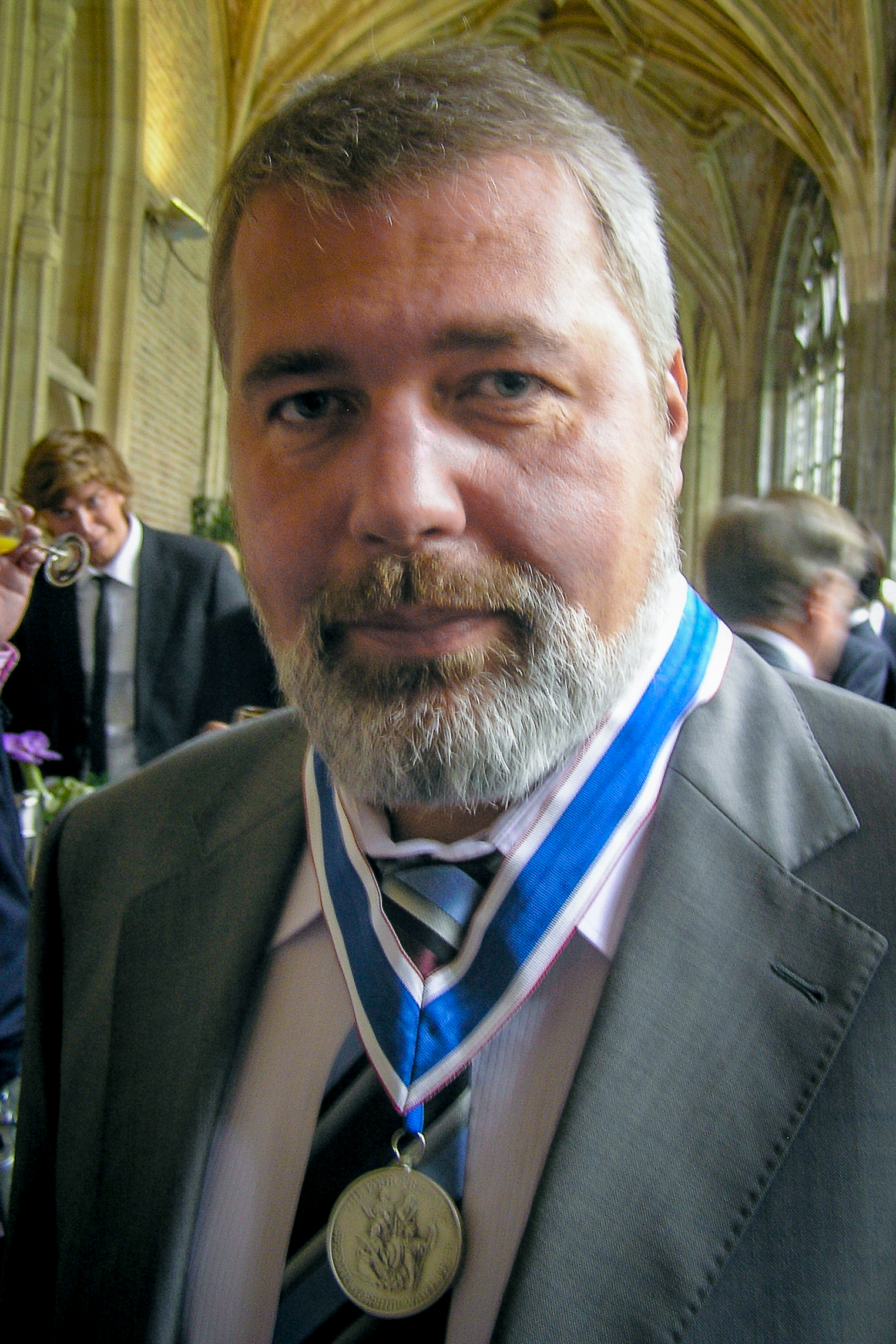
Its defining editor was Dmitry Muratov, editor-in-chief from 1995 to 2017 and again from 2019. Under Muratov the paper specialised in the reporting nobody else in Russia would touch: corruption at the top of the state, the wars in Chechnya, the torture and disappearance of civilians, the poisoning of critics. In 2021 Muratov shared the Nobel Peace Prize with the Filipino journalist Maria Ressa, honoured “for their efforts to safeguard freedom of expression.” A year later he auctioned the medal itself, raising $103.5 million for Ukrainian refugee children — a Russian editor selling his Nobel to shelter the victims of his own country’s invasion. In April 2022, weeks after that invasion began, Muratov was attacked on a train with red paint mixed with acetone and nearly lost his sight; American officials said Russian intelligence had organised the attack. The paint, like the register and the eviction, was a message. This time, finally, the message has been received.
Six names on the wall
Every account of Novaya Gazeta eventually arrives at the same list, and any honest one must print it in full. Six of its journalists were murdered for their work. Igor Domnikov was beaten to death in 2000. Victor Popkov, a contributor, was shot and died of his wounds in 2001. Yury Shchekochikhin, who investigated corruption and the Chechnya war, died in 2003 in circumstances his colleagues and family believe was poisoning. Anna Politkovskaya, the paper’s great chronicler of Chechnya, was shot dead in the entrance of her Moscow apartment block on October 7, 2006. Anastasia Baburova was shot in 2009, alongside the human-rights lawyer Stanislav Markelov. Natalia Estemirova, the paper’s correspondent in Chechnya, was abducted and murdered the same year. Muratov dedicated his Nobel Peace Prize to all six. Their photographs hung in the newsroom that will now be emptied. When the lights go off on November 9, they go off in a room that functioned, among other things, as a memorial its staff reported beside every day.
The war turned the screw
The full-scale invasion of Ukraine in February 2022 was the beginning of the end, and the paper knew it at once. Novaya Gazeta responded in the only way consistent with its history: it published editions in Russian and in Ukrainian. Within weeks, Russia’s March 2022 “fake news” law made that kind of honesty a crime punishable by up to 15 years in prison for anything deemed discrediting to the army. After a second warning from the regulator Roskomnadzor, the paper suspended publication inside Russia on March 28, 2022. What followed was a four-year exercise in diminished survival: a reduced online presence, and occasional print runs kept deliberately below 1,000 copies, under the threshold at which registration is required — a newspaper whispering to stay technically legal.
Its exiled journalists, meanwhile, built a second life. On April 7, 2022, staff who had left Russia launched Novaya Gazeta Europe from Riga, Latvia — an autonomous outlet that continues to publish and, importantly, will continue after November 9. Russia designated it an “undesirable organisation” in June 2023, which makes working for it or sharing its material a criminal risk inside Russia. The distinction matters for what follows: the brand, the craft and many of the journalists survive abroad. What dies next month is the institution at home — the Moscow newsroom, the domestic legal entity, the physical place where a Russian reader, a Russian whistleblower or a Russian court reporter could walk through the door.
‘This is not a suspension. This is a closure’
That sentence, from the paper’s farewell communications, is the one its journalists most want understood. In 2022, Novaya Gazeta suspended; it adapted, shrank and endured, and there was always a plausible path back if the war ended or the laws softened. The farewell letter published by Le Monde closes that path explicitly. It invokes, against the state that is killing the paper, Article 29 of Russia’s own constitution: “Censorship is prohibited.” Muratov had already said the quiet part aloud in Paris on October 20, at a tribute to Politkovskaya organised by Le Monde: “We can no longer exist.” More than 30 journalists from various outlets are currently in prison in Russia, a figure the farewell coverage noted — the context in which the remaining staff weighed whether a newsroom that cannot publish, cannot bank and cannot keep its people safe is a newsroom at all. The paper plans one last act of defiance in the oldest form available to it: a final issue, to appear before November 9.
Sokolov, speaking to CNN, described the landscape the closure completes. “The information space in Russia has disappeared,” he said. His point was not only about politics at the level of presidents and wars. It was that Russians now have no reliable way of finding out even what is happening on the next street, because what remains is state propaganda — a media environment in which the weather is reported honestly and almost nothing else is.
Reaction: ‘a devastating blow’
The international response was swift and, in its own way, underlined how few levers outsiders have left. Volker Türk, the United Nations high commissioner for human rights, said on Friday that he was “deeply concerned” and called the closure “yet another devastating blow for remaining independent media in the Russian Federation.” Amnesty International’s Denis Krivosheev called it “a devastating loss for everyone in Russia who turns to independent, investigative journalism to uncover the truth.” The European Federation of Journalists and the International Federation of Journalists condemned the forced closure. None of it will reopen a single server in Moscow, and everyone issuing the statements knows that. Their audience is no longer really the Kremlin; it is the historical record, and the Russians who will one day reconstruct how their country’s information space was dismantled, step by documented step.
Why this matters
Three things about this closure deserve more than an obituary’s sadness. The first is the mechanism, because the mechanism is the template. The Russian state did not storm Novaya Gazeta with a single dramatic ban, the way it shut Echo of Moscow and drove TV Rain abroad in the first weeks of the invasion in 2022. It spent four years converting law into attrition — registration, printing, blocking, registration again — and then, this September, reached for the one instrument that could finish the job without a headline-friendly raid: the foreign-agent designation of the entire newsroom. Designation severed donations; severed donations made eviction survivable arithmetic rather than a choice. Any government studying how to kill a newspaper without being seen to kill it now has a worked example, complete with paperwork.
The second is what, specifically, is being lost, because exile media — excellent as much of it is — cannot replace it. A newsroom in Riga can analyse Russia. It cannot sit in a Russian courtroom every day, cultivate a source in a regional administration, receive a frightened whistleblower in person, or knock on a door in a town where something has happened and the state would prefer it unrecorded. Novaya Gazeta’s Moscow remnant was the last newsroom of its kind still physically inside the country, and physical presence is not a sentimental detail; it is the technology by which facts about a closed society reach the outside world at all. After November 9, Russia becomes, for independent reporting purposes, a country observed from outside its borders.
Who gains, who loses
The gains are concentrated and obvious. The Kremlin gains a domestic information environment with no remaining institutional challenger: state television for the loyal, pro-war Telegram channels for the engaged, and silence where the questions used to be. The security services gain the removal of the one newsroom that documented their methods for three decades and named their officers. The losses are diffuse, which is why they were politically affordable: 140 million Russians lose the last domestic source that treated them as citizens entitled to verified facts rather than an audience to be managed. The paper’s own six dead lose the institution that kept their cases in print. And the outside world loses its best window into a nuclear-armed state at war — at exactly the moment when Western governments are negotiating, blind in new ways, over that war’s future.
What happens next
Watch four things between now and the new year. The first is the final issue: what a newsroom with nothing left to lose chooses to print, knowing it is the last edition, will be read in Russia for years in samizdat-like circulation whatever the censors do. The second is the staff. Some journalists will join Novaya Gazeta Europe or other exile outlets; some, like Roldugin, remain entangled in prosecutions at home; the diaspora of Russian journalism, already one of the largest in the world, is about to absorb its most decorated newsroom. The third is the brand: Novaya Gazeta Europe will continue under the name abroad, and the contest over whether that name still means a Russian newspaper, or has become a memorial to one, will shape how exile media understands itself. The fourth is the signal. States telegraph their intentions in what they tolerate; a Russia entering 2027 with no independent newsroom left standing is a Russia whose leadership no longer feels any need to perform openness for any audience, foreign or domestic. That, more than the eviction notice or the banking blockade, is the fact other governments should price in.
On November 9, the lights go off in a Moscow office where a newspaper survived the collapse of one empire, the authoritarian reconstruction that followed it, and the first four years of a major European war. It printed the names of the murdered on its own staff and kept reporting. Its farewell was four words long in spirit, and they were accurate: they were killed. What was killed with them was the last organised means by which Russians could read, in Russian, from Russians in Russia, what their state was doing in their name.
Sources
- Reuters, reporting on Novaya Gazeta’s closure announcement, October 30, 2026.
- CNN, interview with editor-in-chief Sergei Sokolov, October 30, 2026.
- Le Monde, Novaya Gazeta’s farewell letter, October 30, 2026.
- UN News, statement by UN human rights chief Volker Türk, October 30, 2026.
- Amnesty International, statement on the forced closure of Novaya Gazeta, October 30, 2026.
- Novaya Gazeta, the newspaper’s own statement, “We were killed,” October 30, 2026.
- Photos: Wikimedia Commons, as credited in the captions — file photographs of Dmitry Muratov in 2018, of Muratov interviewing President Dmitry Medvedev in 2009 (Kremlin / Wikimedia Commons), and of Muratov receiving the Four Freedoms Award in 2010.