War · World · Korean Peninsula
North Korea says its defence science research institutes spent Saturday testing a cluster-bomb warhead built for its tactical ballistic missiles — and says one Standard Type 2 warhead, at its densest, can destroy a target area of 12 to 13 hectares. South Korea’s military says it tracked the launch itself, a missile fired toward the Yellow Sea from around Chongju, and Pyongyang says all four of its cluster-warhead types will be in units’ hands by the end of 2026.
Track it live: Live Global Trackers — Wars
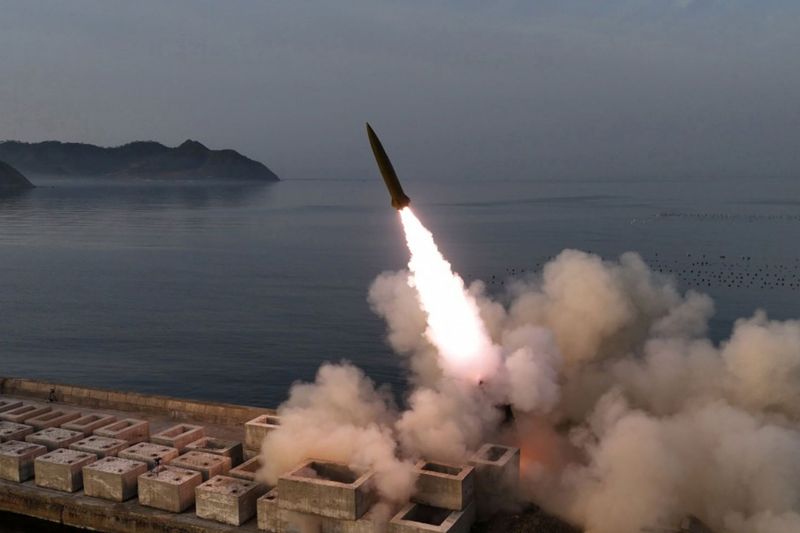
SEOUL, October 31, 2026 — The North Korea cluster bomb test announced by Pyongyang on Sunday was a trial of a cluster-bomb warhead designed to be tipped on tactical ballistic missiles, North Korea’s state media KCNA reported, in what it described as a test by the country’s defence science research institutes to assess the warhead’s adaptation to combat and its power. KCNA said a Standard Type 2 cluster-bomb warhead can destroy a target area of 12 to 13 hectares at its highest density. South Korea’s Joint Chiefs of Staff independently confirmed the launch behind the announcement, saying the missile was fired toward the Yellow Sea from an area around the northwestern county of Chongju.
The announcement, carried by KCNA on Sunday, November 1, said the test itself took place on Saturday, October 31, and was conducted by the research institutes under North Korea’s Missile Administration, according to Yonhap News Agency’s report of the KCNA dispatch. The performance figures and the fielding timetable in the announcement are North Korea’s own claims, attributed to KCNA throughout this article; the launch, by contrast, was tracked and confirmed by South Korea’s military, which said Seoul and Washington had followed the relevant activities before the launch and maintained a readiness posture.
What KCNA said
KCNA framed the trial as an assessment of a major weapon system: a test, in its words as reported by Reuters, “to assess combat adaptation and power of a cluster-bomb warhead to be tipped on tactical ballistic missiles.” The institutes reported that the Standard Type 2 cluster-bomb warhead is capable, at its highest-density setting, of destroying a target area of 12 to 13 hectares — a figure KCNA presented as a confirmed result of the test. Signal Post News has no independent verification of that performance claim, and it is reported here as Pyongyang’s claim, not as a measured fact.
The warheads themselves fall into four categories by purpose, a Missile Administration official said, according to KCNA. The administration’s general director was quoted by Yonhap as saying: “Within this year we will enable units to select and use all those types according to operational aims and specific features of targets.” Reuters reported the same commitment in summary form: North Korea will enable its military units by the end of 2026 to use all types of the warheads depending on their operational purposes. KCNA did not, in the reporting carried by either agency, publish the missile’s flight distance or a full technical description of the four categories.
That timetable is the detail that lifts Saturday’s trial out of the long list of North Korean test announcements. A test evaluates a weapon; a fielding deadline assigns it to units. If the Missile Administration’s stated schedule holds, the cluster-bomb warhead moves during the remaining weeks of 2026 from a research-institute programme to an inventory item that North Korean missile units can select for a mission — the distinction the general director’s quote was careful to draw, tying each type to “operational aims and specific features of targets.”
What South Korea’s military confirmed
South Korea’s Joint Chiefs of Staff said it tracked the launch independently of Pyongyang’s announcement. In a statement on Sunday reported by Yonhap, the Joint Chiefs said the missile was fired toward the Yellow Sea from an area around Chongju, a county in North Korea’s northwest, and that South Korea and the United States had tracked the relevant activities before the launch under close information sharing. The military said it maintained a readiness posture — Seoul’s standard formulation after a North Korean launch, signalling that surveillance was raised and no gap in preparedness was acknowledged.
On the missile’s identity, the available assessment is an analyst’s, not an official finding. Shin Jong-woo of the Korea Defense and Security Forum told Yonhap the missile appeared to be from the Hwasong-11 family — North Korea’s line of short-range tactical ballistic missiles. That is an expert assessment based on the test’s profile, presented here as such; neither Seoul nor Pyongyang has formally identified the missile used on Saturday, and the Hwasong-11 attribution should be read as informed analysis rather than confirmation.
The direction of Saturday’s launch is itself a piece of information. The missile flew toward the Yellow Sea, on North Korea’s western side, rather than from the east coast toward the sea off it — the pattern of the much larger salvo three days earlier. A westward shot from around Chongju is consistent with a warhead trial conducted over home waters at controlled range, though neither the Joint Chiefs nor KCNA stated the purpose of the trajectory, and that reading remains inference.
The April precedent — and a crowded October
Saturday’s trial was not the first time Pyongyang has put cluster munitions on this missile family. In April, North Korea said it had tested cluster bombs mounted on the Hwasong-11 Ra tactical ballistic missile, in a launch overseen by Kim Jong Un and his daughter Ju-ae, Yonhap reported. The April test established the pairing — a short-range ballistic missile scattering submunitions — as a declared programme rather than a one-off experiment; Saturday’s announcement, with its four warhead categories and its end-of-year fielding pledge, reads as the same programme moving toward service.
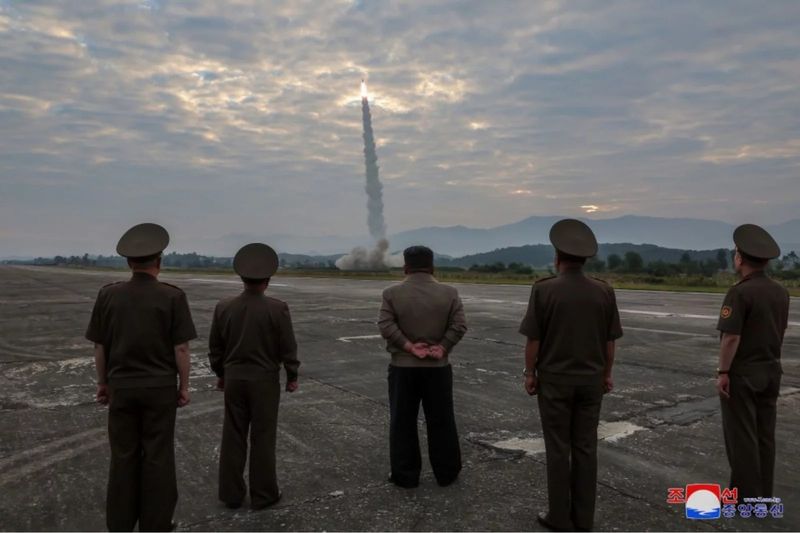
The test also landed at the end of an unusually dense fortnight of North Korean military activity. Pyongyang has ramped up its shows of force in recent weeks with multiple missile tests and a drone exhibition, Reuters reported. On Thursday, October 29, North Korea test-fired around 10 ballistic missiles from its east coast toward the sea — a salvo that coincided with German Chancellor Friedrich Merz’s visit to South Korea, and which we covered in our report on North Korea’s Wonsan salvo. Saturday’s single, purposeful warhead trial is a different kind of event from Thursday’s volume firing: one was a demonstration of numbers, the other a step in a weapons programme with a stated delivery date.
A test that landed in the middle of diplomacy
The timing placed the trial between two diplomatic signals pulling in opposite directions. The test came amid renewed calls by the top diplomats of South Korea, the United States and Japan — meeting in trilateral talks in Atlanta — for the complete denuclearization of North Korea, Yonhap reported. That formula, restated by the three allies, remains the formal objective of their North Korea policy, and a new warhead fielding programme is, on its face, a move in the opposite direction: not a freeze or a rollback, but an expansion of the tactical arsenal.
On the same day as the test, Saturday, October 31, U.S. Secretary of State Marco Rubio said President Donald Trump remains open to talks with Kim Jong Un if Pyongyang is willing to discuss issues of concern — while noting that no meeting is scheduled. The two statements, read together, describe the current geometry of the issue: Washington’s door is described as open, the allies’ stated price is denuclearization, and Pyongyang’s answer, delivered the same weekend, was a warhead test and a fielding deadline. None of the governments involved linked its statement directly to Saturday’s test, and this article does not claim they did; the juxtaposition is the calendar’s, not a quoted response.
What a cluster bomb is — and where the law stands
A cluster bomb is a munition that opens in flight and releases dozens to hundreds of smaller submunitions — bomblets — over a wide area, rather than delivering a single explosive charge to a single point, as Yonhap’s explainer puts it. Mounted on a ballistic missile, the warhead carries those submunitions to a target area at missile speed and scatters them across it, which is why the performance measure KCNA chose to publish was not a point target destroyed but an area — 12 to 13 hectares — covered at the warhead’s highest density.
Cluster munitions are banned under the Convention on Cluster Munitions for the states that are party to it; the treaty’s parties have undertaken not to use, produce or stockpile them. North Korea, South Korea, the United States and Russia are not parties to the convention. That is the factual legal landscape in which Saturday’s test sits: the weapon is prohibited for a large group of states by a treaty they chose to join, and it is not prohibited by that treaty for the states most directly involved in the Korean Peninsula’s military balance, none of which joined it. Signal Post News states that position without taking a side in the argument over it, which the analysis section below sets out as its participants make it.
Why this matters
An area weapon on a short-range missile
Analysis: tactical ballistic missiles of the Hwasong-11 type are battlefield weapons — short-range systems intended, in North Korea’s order of battle, for targets on the Korean Peninsula itself rather than for distant strikes. A unitary warhead on such a missile threatens a point: a headquarters, a radar, a single installation. A cluster-bomb warhead threatens an area: an airfield’s parked aircraft and fuel, an artillery position spread across a field, a logistics yard. Pairing the two therefore changes what a single North Korean missile launch can credibly hold at risk in the opening hours of a conflict, and it does so with a missile family South Korea’s military already tracks as a front-line threat. That is the military meaning of the KCNA cluster bomb announcement, separate from its signalling value.
What 12 to 13 hectares actually means
KCNA’s headline number deserves translation into ground a reader can picture. Twelve hectares is 120,000 square metres; thirteen hectares is 130,000. In land terms, that is roughly 30 to 32 acres. In sporting terms, it is the ground of about 17 to 18 standard football pitches, covered — on KCNA’s claim — at the warhead’s highest density of submunitions. An area that size is a large airbase apron, a port storage yard, or a regimental assembly area. The qualifier matters as much as the number: “highest density” describes the densest part of a submunition pattern, not uniform coverage of every square metre, and the figure is Pyongyang’s own test claim, unverified independently. Read with both qualifiers, it still describes an area weapon of substantial footprint arriving on a ballistic trajectory that gives defenders minutes, not hours, of warning.
Fielding all four types by the end of 2026
The second number in the announcement is a date, and it may matter more than the hectares. Four warhead categories, selectable by units “according to operational aims and specific features of targets” by the end of 2026, describes a menu, not a prototype: different submunition loads for different target sets, held at unit level. Programmes that reach that stage have passed the question of whether the weapon works and arrived at the question of how it will be used — which is a question for South Korean and U.S. planners, exercised against exactly this class of threat, rather than for test-watchers counting launches. It also sets a verifiable marker: if the fielding happens, evidence of it — unit exercises, further firings of the remaining types, state-media coverage of deliveries — should appear within weeks, and its absence would be informative too.
Deterrence, escalation, and the argument over the weapon
The stated views around a test like this are well rehearsed, and each side makes its case in its own terms. Pyongyang’s presentation, through KCNA, is of defence science: research institutes assessing a weapon’s combat adaptation — sovereign weapons development, framed as strengthening deterrence. Seoul’s stated response is procedural and military: tracking shared in advance with Washington, a readiness posture maintained, no gap conceded. The allied diplomatic position, restated in Atlanta, is that the destination remains complete denuclearization — a goal a new tactical warhead programme does not approach. Critics of cluster munitions, a category that includes the governments that negotiated the Convention on Cluster Munitions, argue the weapon class is inherently indiscriminate in effect and leaves unexploded submunitions as a hazard after fighting ends; the states that stayed outside the convention, including the ones on both sides of the Korean armistice line, have historically argued that the weapons retain military utility and that their decisions are matters of national defence policy. Saturday’s test does not settle any of those arguments. It does move the Korean Peninsula’s version of them from the hypothetical — a warhead North Korea might build — to the scheduled: a warhead its Missile Administration says units will hold by December 31.
What happens next
Four developments will show what Saturday’s trial actually started. First, the remaining warhead types: a four-category programme with a year-end deadline implies further tests or announced trials of the other types, and each will be tracked by the same Seoul-Washington apparatus that followed this one. Second, fielding evidence: deliveries to units, exercises using the warheads, or state-media reporting of either would corroborate the Missile Administration’s timetable; silence past the deadline would undercut it. Third, the allied response: whether the Atlanta trilateral’s denuclearization language is followed by concrete steps — statements at the United Nations, new sanctions designations, or visible readiness measures — will indicate how the three governments price the programme. Fourth, the diplomacy Rubio described: an open U.S. door and no scheduled meeting is a stable posture only until one side moves, and North Korea’s weapons calendar has historically been one of the things that moves it.
Until one of those developments lands, the established facts of the weekend are these: a cluster-bomb warhead for tactical ballistic missiles was tested on Saturday, October 31, according to KCNA, which claims a Standard Type 2 warhead can destroy 12 to 13 hectares at its highest density and that all four warhead types will be available to units by the end of 2026; and a missile launch toward the Yellow Sea from around Chongju was tracked and confirmed by South Korea’s Joint Chiefs of Staff, with the United States sharing the tracking. The claims are Pyongyang’s; the launch is confirmed; the deadline is now on the calendar.
Related coverage: North Korea Fires Around 10 Ballistic Missiles From Wonsan in First Salvo in 17 Days · North Korea Submarine Cruise Missile Test Fires Two Missile Types From an East Sea Submarine · FBI Blames North Korea for the $6.3 Billion Binance Hack, the Largest Crypto Theft Ever Recorded
Sources
- Reuters, November 1, 2026 (Seoul) — KCNA’s report that defence science research institutes tested a cluster-bomb warhead for tactical ballistic missiles on October 31; the Standard Type 2 warhead’s claimed 12-to-13-hectare destruction area at highest density; the four warhead categories and the end-of-2026 fielding commitment; and the context of recent shows of force, including the October 29 salvo of around 10 ballistic missiles during Chancellor Merz’s visit to South Korea.
- Yonhap News Agency, November 1, 2026 (Seoul), via K-Vibe — the Missile Administration’s conduct of the test and its general director’s statement on fielding all warhead types within the year; the Joint Chiefs of Staff confirmation of a launch toward the Yellow Sea from around Chongju, with prior Seoul-Washington tracking and a maintained readiness posture; analyst Shin Jong-woo’s assessment of a Hwasong-11-family missile; the April Hwasong-11 Ra cluster-bomb test overseen by Kim Jong Un and Ju-ae; and the Atlanta trilateral and Rubio diplomacy context.