newcastle car hits crowd october 2026
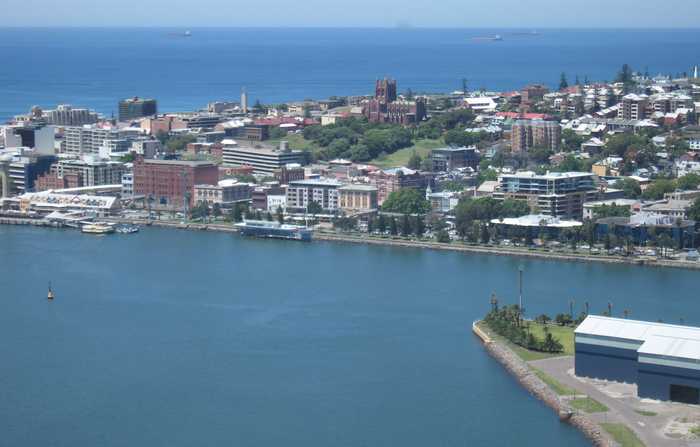
WALLSEND, NSW — At about 9.30am on Saturday, around 1,000 Newcastle Knights fans were lining Newcastle Link Road at the Transfield Drive roundabout in Wallsend, in Newcastle's west, to farewell the team's bus as it departed for Sydney ahead of Sunday night's NRL Grand Final against the Sydney Roosters. A car driven by an 18-year-old man struck the crowd.
The Newcastle car hits crowd October 2026 toll evolved through the morning: NSW Ambulance first reported nine injured, and NSW Police later updated the figure to ten. Two people are in critical condition — a five-year-old girl and a 67-year-old man. The eight others are listed as stable: a second five-year-old girl, a two-year-old girl, women aged 31 and 63, and men aged 24, 25, 48 and 57, according to NSW Police figures reported by the Sydney Morning Herald. (Some early wire reports described an "infant girl" among the casualties; the ages released by police indicate that child and the five-year-old in intensive care are the same patient.) The Sun reported that the critically injured five-year-old had been placed in an induced coma.
The injured were treated at the scene by NSW Ambulance paramedics before being taken to John Hunter Hospital. One patient was airlifted. The emergency response was enormous: NSW Ambulance sent between 12 and 15 ambulances plus multiple helicopters to the scene. The 18-year-old driver — a P-plater — was arrested at the scene and taken to hospital for mandatory drug and alcohol testing. Newcastle Link Road was closed in both directions, and the Knights' team bus was diverted from its planned route.
Why this matters
This is not just a road crash with a high casualty count. It is a mass-casualty event at a communal sporting ritual — the roadside farewell — that sits at the emotional heart of rugby league culture in the Hunter. The Knights are Newcastle's civic institution as much as its football team, and the Grand Final send-off is the week the whole city exhales together. That a celebration built on collective joy produced broken collarbones, fractured spines and a child in an induced coma is why the shock has travelled well beyond the Hunter: it strikes at the assumption that gathering peacefully by a roadside to cheer your team is safe.
It also matters because of what it forces onto the agenda. Every vehicle-into-crowd incident, whether deliberate or a loss of control, reopens the same unresolved question in every Australian city: how do you protect crowds that gather spontaneously, on open roads, without turning every celebration into a fortified zone? The answer Newcastle reaches in the coming weeks will be studied by every council and sporting code in the country.
The morning the farewell became a crime scene
The plan was simple and joyful. Thousands of Novocastrians had been cheering the team all week as the Knights trained ahead of Sunday's decider at Accor Stadium. On Saturday morning, supporters — families with children, many in blue-and-red — lined the roads for kilometres along the bus's planned route out of town, as the Sydney Morning Herald reported. The bus never came past them. At about 9.30am, at the Transfield Drive roundabout on Newcastle Link Road, a car entered the crowd.
Eyewitnesses described chaos. Chris Clancy, 48, told the Sydney Morning Herald he thought he was "going to die": "No-one had time to move, it happened so fast." Clancy suffered a broken left collarbone, a fractured right foot, broken ribs and small spinal fractures. Other witnesses said some spectators were thrown into the air as the vehicle moved through the group.
Within minutes, the farewell route was a triage zone. Paramedics treated the injured at the scene and on a nearby oval while helicopters moved the most seriously hurt. Police from the Newcastle City Police District, joined by Traffic and Highway Patrol officers, locked down the area. Many supporters never saw the bus at all — police confirmed it departed Newcastle via an alternate route, and acknowledged that many fans had missed their chance to see the team off.
The injured: children among the casualties
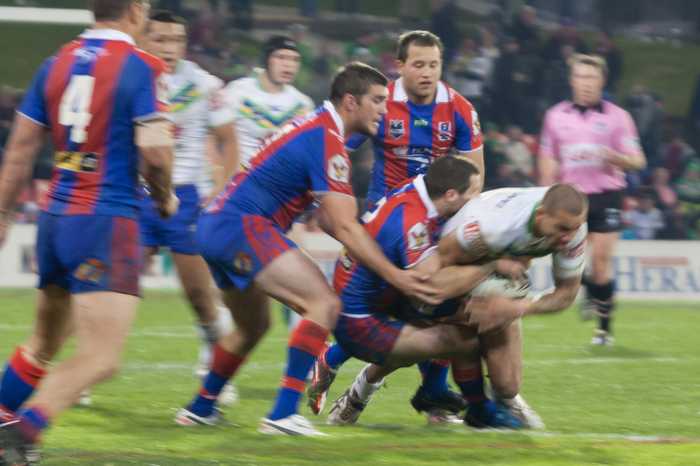
The casualty list is what gives this story its weight. Two of the ten injured are small children in the most serious categories: a five-year-old girl in critical condition — reported to be in an induced coma — and a two-year-old girl among the stable patients, alongside a second five-year-old girl. A 67-year-old man is the other critical patient. The age spread of the injured, from two to 67, tells its own story about the crowd: this was a family event, prams and grandparents alongside teenagers.
Newcastle Mayor Gavin Morris, who has children of his own at these events, captured the city's mood on ABC television: "It's just been a magical week of positivity and support, and we've all come together... So it was an absolute shock to hear the news this morning." He confirmed children were among those hurt.
Knights chief executive Peter Parr issued a statement on the club's website: "Our thoughts and prayers are first and foremost with everyone who has been injured, their families and loved ones, and everyone who witnessed what occurred this morning. What was meant to be a special morning for our community, thousands of Novocastrians coming together to farewell our team and show their support ahead of the Grand Final, has understandably turned into a distressing morning." Parr thanked supporters for the passion they showed, adding that "the scenes across Newcastle demonstrated once again what this football club means to our community."
The driver, the arrest, and what police have ruled out
The driver is an 18-year-old man on his P-plates. He was arrested at the scene and taken to hospital for mandatory testing — standard procedure in NSW after a serious crash. At a Saturday afternoon media conference, NSW Police Assistant Commissioner David Waddell said the teenager is expected to be charged later on Saturday. Charges had not been laid at the time of publication.
Two things police have said matter enormously for how this story is understood. First, initial inquiries indicate the incident is not believed to be terrorism-related, and Waddell said the crash is not believed to have been targeted — a deliberate attempt to calm the speculation that inevitably follows any vehicle-into-crowd incident. That assessment is preliminary; the investigation is ongoing. Second, investigators are examining whether the driver lost control of the vehicle in the moments before the collision. Mayor Morris, citing what he had been told, said it appeared the driver lost control and added: "It appears that he was revving the car in some form."
The distinction between a deliberate attack and a catastrophic loss of control is not academic — it determines everything from the charges to the public-safety response. But it is worth stating plainly: as of Saturday afternoon, police had described a young driver, an arrest, and expected charges — not a motive. Anything beyond that is speculation, and this publication will not engage in it.
How we got here: a city, a club, and a Grand Final week
To understand why a thousand people were standing by a roundabout at 9.30am on a Saturday, you have to understand what the Knights mean to Newcastle. The club, founded in 1988, is the Hunter region's flagship — a working-class team in a working-class city, winners of premierships in 1997 and 2001, and the emotional centre of a town that has ridden the club's fortunes for nearly four decades. The roadside farewell is one of rugby league's great folk traditions: the bus rolls out, the town lines the route, kids wave flags, and for an hour the boundary between team and community dissolves.
This week was the biggest of those occasions in a generation: the Knights' run to the NRL Grand Final, with a Sunday-night decider against the Sydney Roosters at Accor Stadium awaiting. All week, thousands had gathered to watch the team train. Saturday's send-off was meant to be the crescendo — the last collective moment before the bus disappeared down the highway to Sydney.
There is a darker historical backdrop too. Vehicle-into-crowd incidents occupy a grim spectrum. At one end are deliberate attacks — Nice in 2016 remains the reference point every police force in the world studies. At the other are terrible accidents: drivers suffering medical episodes, mechanical failures, or simple loss of control at exactly the wrong place and moment. Crowd-safety practice has evolved overwhelmingly around the deliberate end of that spectrum — bollards, barriers, hostile-vehicle mitigation at ticketed events. The vulnerability exposed at Wallsend is different: an open road, a spontaneous crowd, no perimeter, no tickets, no security cordon. It is the hardest kind of gathering to protect, and the kind Australians stage constantly — from Christmas pageants to funeral processions to football farewells.
Three questions this raises
1. Are roadside farewells safe enough — and who is responsible for them?
The send-off was a beloved tradition, but it was also a thousand people standing beside a live arterial road at a roundabout, with traffic still moving. Expect hard questions for the council and NSW Police about whether the route had a traffic-management plan, whether the road should have been closed, and whether barriers or a police escort were in place. None of that implies fault — spontaneous community gatherings are genuinely difficult to regulate — but the review will come, and other councils staging similar events will be watching it closely. The likely direction of travel is controlled send-offs: closed roads, designated viewing zones, club-organised rather than crowd-organised.
2. What does the driver's age tell us — and not tell us?
An 18-year-old P-plater behind the wheel will inevitably sharpen the perennial Australian debate about young-driver risk. NSW's graduated licensing scheme exists precisely because young drivers are over-represented in serious crashes, and P-plate restrictions — on speed, alcohol, demerit points and, for some, vehicle power — are among the strictest in the country. But a licence class is not a cause. Until police release the results of the mandatory testing and the forensic examination of the vehicle, the only honest statement is that a young driver lost control of a car near a crowd — or did something worse — and ten people are in hospital. The mayor's "revving" remark will be tested against the evidence, not the other way around.
3. What does this mean for Sunday's Grand Final?
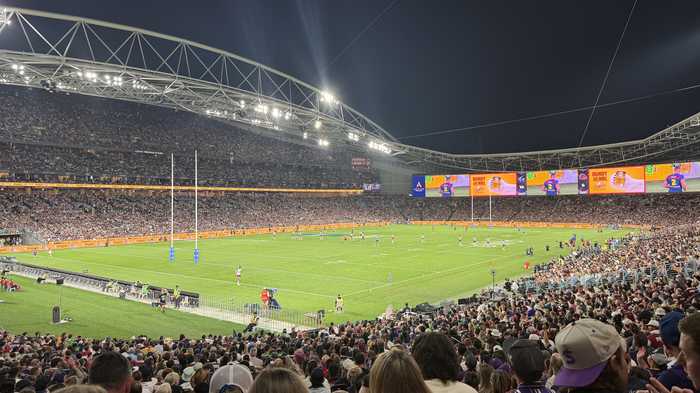
The game is scheduled to go ahead at Accor Stadium on Sunday night, and the NRL will now be weighing the security posture around it — not because police believe the crash was targeted, but because a mass-casualty event 24 hours before the code's showpiece demands visible reassurance. Expect heightened police presence at the stadium and at any Knights fan gatherings in Sydney. For the players, the challenge is psychological: a squad that left Newcastle to a city's love must now play its biggest game in decades carrying that city's grief. Sport has a long history of becoming the vessel for communal mourning — Sunday night may be one of those occasions.
What the numbers tell us
Put the figures in context and the scale sharpens. Roughly 1,000 people gathered along a single stretch of road — a crowd the size of a small town's main street, assembled in minutes, with no ticketing, no headcount, and no evacuation plan. Against that, the emergency response: 12 to 15 ambulances and multiple helicopters for ten patients. That ratio — more than one ambulance per patient, plus air assets — is the signature of a major-incident declaration, and it reflects how seriously NSW Ambulance treated the first reports. One patient airlifted, the rest road-transported to John Hunter Hospital, the Hunter's major trauma centre.
The injury profile matters too. Two critical, eight stable: a ratio that suggests most victims were struck glancingly or were able to get partially clear, while a small number took the full force. The ages — two, five, five, 24, 25, 31, 48, 57, 63, 67 — map exactly onto a family crowd, not a late-night entertainment district. And the setting matters: a roundabout on an arterial link road, the kind of high-speed environment where any loss of control becomes catastrophic in seconds. Roadside gatherings and fast roads are a combination Australia stages routinely; Wallsend is a reminder of the physics involved.
What happens next
The investigation. NSW Police will reconstruct the crash: the vehicle's speed and mechanical condition, the driver's toxicology results, witness accounts, and any available footage from the roundabout. Assistant Commissioner Waddell's statement that charges are expected on Saturday suggests investigators already have a working theory of the driving involved; the likely charges in NSW for this fact pattern sit in the dangerous-driving causing death or grievous bodily harm range, though police have not named any offence.
The safety review. Expect the City of Newcastle, NSW Police and the NRL to review how farewell events are managed — road closures, barriers, timing, and communication. The question will not be whether the tradition continues but under what controls. Other codes and councils will conduct their own quiet audits.
Sunday night. The Grand Final goes ahead as scheduled, barring any development police have not foreshadowed. The Knights will run out at Accor Stadium carrying the weight of the morning's news; the Roosters, to their credit, will be expected to acknowledge it. A minute's silence would surprise no one.
The longer healing. The hardest part is the least visible: a five-year-old in intensive care, a 67-year-old with life-altering injuries, and hundreds of witnesses — including children — who watched a celebration become a triage zone. Newcastle is a city that prides itself on looking after its own. It is about to need to.
Sources and reporting notes
- newy.com.au: Driver arrested after vehicle strikes crowd near Wallsend (October 3, 2026) — casualty figures, ages, hospital, road closure, police investigation
- Sky Sports: Newcastle Knights CEO extends support to victims after car drives into crowd of NRL fans leaving 10 injured (October 3, 2026) — Peter Parr statement, Grand Final details
- The Sporting Base: NRL — Multiple injured after car hits Knights fans at Grand Final farewell (October 3, 2026) — Assistant Commissioner David Waddell briefing, expected charges
- Sydney Morning Herald reporting (syndicated): Newcastle crash — multiple injured after car crashes into crowd of Knights fans (October 3, 2026) — Chris Clancy eyewitness account, Mayor Gavin Morris remarks, crowd details
- Reuters syndicated feed: Newcastle car crash — nine injured after vehicle hits Knights fans (October 3, 2026) — initial casualty reports, emergency response
- ABC News Australia, Top Stories podcast, October 3, 2026 — initial breaking coverage of the Wallsend incident
- Reuters news agency — syndicated reporting on the incident, including photographs by Kai Preston carried by The Sun
Casualty figures in this article reflect NSW Police updates through Saturday afternoon AEDT (ten injured, two critical). Early reports carried lower figures; where outlets differ on a single child's reported age, this article follows the ages released by NSW Police. Police have said initial inquiries do not suggest a terrorism link; that assessment is preliminary and the investigation continues.