Yemen hunger crisis
Yemen hunger crisisYemen record hunger 2026World Food Programme Yemen warningYemen food insecurityYemen households skipping mealsYemen war escalation food crisisYemen Red Sea fighting humanitarian crisisHouthi war Yemen displacementYemen WFP aid funding shortfallBab el-Mandeb shipping warYemen malnutrition children 2026
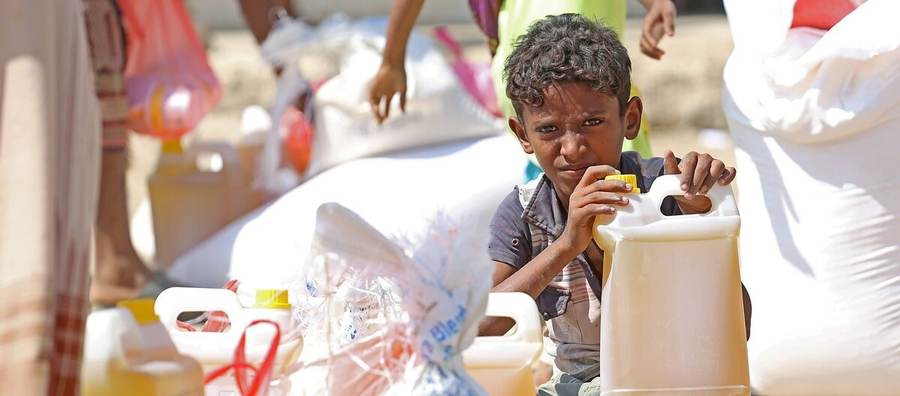
Yemen's hunger crisis has crossed a record threshold within weeks of renewed fighting, the World Food Programme warned Friday. In the roughly 10 million people living in government-held areas where WFP can operate, three in every four households are now skipping meals. Matthew Hollingworth, WFP assistant executive director for programme operations, told reporters in Geneva by video link from Rome that a record number of people there are no longer able to meet their food needs.
“The effect of this latest flare-up of insecurity on the food security situation threatens to be absolutely devastating,” Hollingworth said. The warning is not a forecast about some distant phase of the war. It describes a deterioration WFP says is already visible in household behavior: meals dropped, portions cut and purchasing power exhausted.
Why this matters: hunger is the war's second front
Battle maps show airstrikes, drones and closed roads. Hunger registers elsewhere: at a kitchen table where a family decides which meal to erase. “Three in four households skipping meals” means deprivation has moved beyond the poorest fringe and into the ordinary survival strategy of most households in the accessible south and east. It does not mean every family is in famine, and WFP did not declare famine. It does mean that a large majority lacks enough food or money to maintain a normal daily diet.
The word “record” carries unusual weight in Yemen. This is a country that entered the new escalation with more than 18 million people — roughly half the population — already facing acute food insecurity, according to WFP's September briefing. About 2.2 million children under five were already acutely malnourished. A record measured against that long emergency is not a return to crisis; it is deterioration from an already extreme baseline.
Before the latest flare-up, the 2022 UN-brokered truce had largely stopped cross-border attacks and reduced the intensity of major front lines, even though it never produced a comprehensive peace. Families remained poor, services remained weak and aid budgets were strained, but relative calm limited the speed at which those problems compounded. The new fighting removes that brake. Income disappears when roads close, food prices rise when transport is disrupted, and displacement forces families to start again without stores, work or local credit.
How Yemen got here: a truce without a settlement
The 2022 truce froze much of the Saudi-Houthi cross-border war without resolving Yemen's political division. The Iran-aligned Houthis retained control of Sana'a and much of the north and west, including stretches of the Red Sea coast. The internationally recognized government and allied forces held much of the south and east. That uneasy balance has now given way to the most serious escalation since the truce.
Taiz is again a central front. Six military sources told Reuters that fighting was widespread across the province and that 19 roads had been closed and designated military operational areas. Yemen's government said its air force carried out 20 strikes on Houthi targets in Taiz; our earlier report details the attributed claims and the limits of independent verification in the Yemen Taiz airstrikes.
The cross-border claims are disputed. Saudi Arabia said Thursday that the Houthis attacked a power distribution station in Medina supplying the Prophet's Mosque. The Houthis denied the claim through the Saba news agency. Two weeks earlier, Saudi Arabia said it intercepted a Houthi drone south of Mecca; the Houthis denied targeting Mecca or any holy site. With access limited and the parties at war, those competing accounts cannot all be independently verified in real time. Reporting them with attribution is essential; turning either side's statement into settled fact would not be.
Yemen record hunger 2026: what the numbers imply
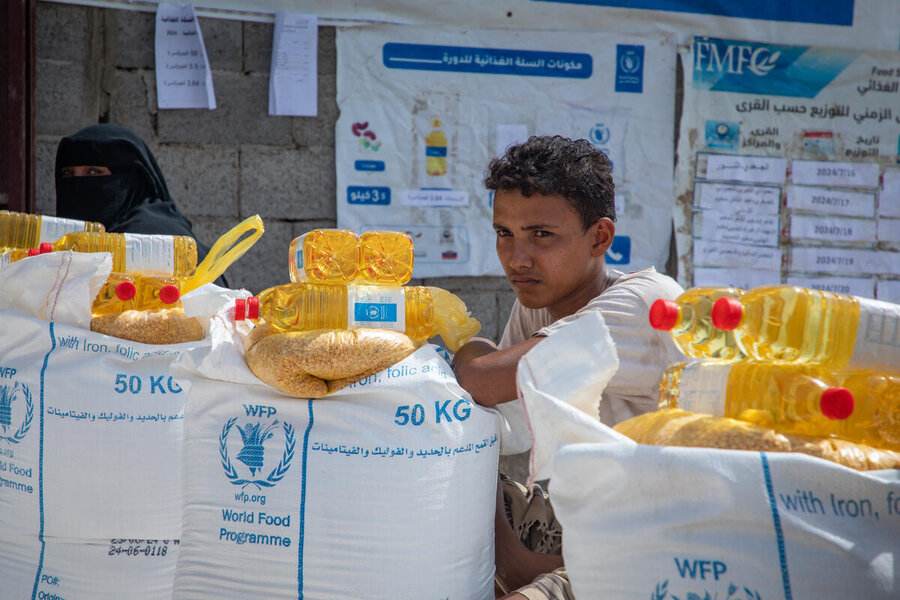
Yemen imports about 90% of its food. That dependence turns ports, airports, highways and the Red Sea into parts of the national food system. A disruption at a port is not merely a shipping problem; it can become a price shock at a market hundreds of miles away. A closed road can make an available sack of flour unaffordable after fuel, delay and risk are added to its cost.
The Bab el-Mandeb Strait is particularly important because it connects the Red Sea to the Gulf of Aden. Wider fighting around that corridor raises risks for commercial shipping, insurers and port operations. The immediate food effect depends on which routes are disrupted, for how long and whether importers can redirect cargo. Those variables remain uncertain. The structural exposure does not: a country importing nine-tenths of its food has little room to absorb prolonged transport shocks.
Displacement adds a second multiplier. UNHCR says more than 130,000 people have been displaced this month and projects another 100,000 could be uprooted within three months. If that projection materializes, the recent displacement total would approach 230,000 — a rise of roughly three-quarters from the current figure, not a literal doubling. Each movement increases demand in host communities while stripping displaced families of work, savings and familiar support networks. The scale and the uncertainty are examined in our UNHCR Yemen displacement warning.
Children absorb the damage fastest. Acute malnutrition is both too little food and too much disease: a child weakened by hunger is less able to survive diarrhea or infection, while illness makes it harder to retain nutrients. The national figure of 2.2 million acutely malnourished children under five is therefore a measure of medical vulnerability as well as food scarcity. See our background report on the Yemen child malnutrition surge.
Who gains, who loses — and why aid access is part of the conflict
No Yemeni faction gains durable legitimacy from mass hunger, but wartime actors can still seek short-term advantage from controlling roads, ports, taxes and relief access. A party that controls a checkpoint can shape movement; a party that controls a port can influence revenue and supply; a party that controls aid registration can reward allies or marginalize rivals. That is why humanitarian access is not a technical side issue. It sits inside the political economy of the war.
WFP says it cannot operate in Houthi-controlled areas after UN offices were occupied, assets confiscated and dozens of UN staff detained. That means its record warning is drawn from areas it can reach, not a complete national household survey conducted under identical conditions. Conditions in Houthi-held areas may be better in some places and worse in others; the access gap prevents a confident comparison. The absence of comparable data should not be mistaken for the absence of hunger.
The internationally recognized government and its backers may hope military pressure weakens Houthi capabilities and restores leverage. The Houthis may calculate that holding territory and threatening Saudi or Red Sea targets raises the cost of excluding them from a settlement. Civilians lose under either calculus when markets fragment, transport costs rise and public services fail. Traders face more risk, aid agencies face more restrictions, and families pay the final price.
The Yemen WFP aid funding shortfall
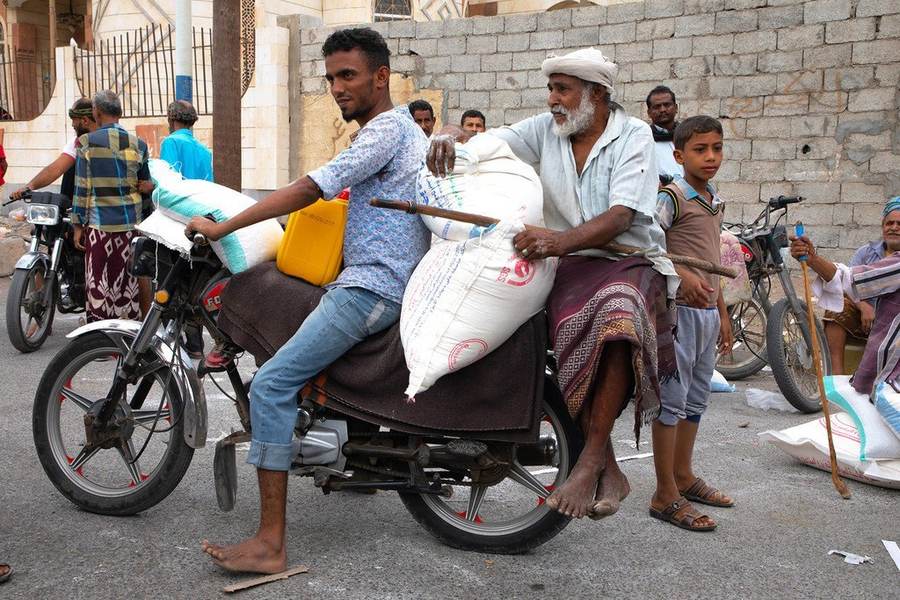
Funding is the quiet variable beneath the emergency. A food agency can have access but lack money to buy, transport and distribute enough assistance; it can also have money but lack safe access. Yemen now confronts both constraints. When budgets fall short, agencies narrow eligibility, reduce rations or stretch distribution cycles. Families then bridge the gap by borrowing, selling assets, withdrawing children from school or skipping meals — measures that protect survival today by weakening recovery tomorrow.
The three-in-four figure should therefore be read as a measure of household exhaustion. Skipping one meal once is different from repeatedly reducing food across most households in an area. WFP's warning suggests coping mechanisms are no longer isolated or temporary. The exact frequency and depth of meal reductions vary by household, and the accessible-area data should not be generalized mechanically to all of Yemen. But the direction is clear.
What happens next: de-escalation, wider war or a long squeeze
De-escalation would offer the fastest relief, even without a final political settlement. Reopening roads, keeping ports functioning and restoring predictable cross-border calm would reduce the risk premium embedded in food and fuel prices. It would also allow displaced families to consider returning and agencies to plan distribution rather than react to moving front lines.
A wider war would push in the opposite direction. More attacks on Saudi infrastructure, additional strikes in Yemen or disruption around Bab el-Mandeb could raise freight and insurance costs and interrupt imports. The worst case is not simply less food entering Yemen; it is food arriving at a price fewer households can afford.
A long squeeze may be the most plausible middle path: intermittent fighting, partial road closures, constrained aid and no decisive military outcome. Yemen's October-to-December harvest period can provide a limited local cushion in farming areas, but it cannot replace imports in a country dependent on foreign food for 90% of supply. Harvest gains can also be erased by displacement, fuel shortages or blocked transport.
Watch four indicators next: whether the 19 Taiz roads reopen; whether verified cross-border attacks continue; whether Red Sea and Bab el-Mandeb shipping faces new disruption; and whether donors close WFP's funding gap. Also watch for updated food-security measurements in Houthi-controlled areas. Without access, the national picture will remain incomplete — and policy made from an incomplete picture can miss the places deteriorating fastest.
Facts, claims and uncertainty
The household hunger figures, the 18 million national food-insecurity estimate, the 2.2 million child-malnutrition figure and the 90% import dependence are attributed to WFP reporting and briefings. The displacement figures are attributed to UNHCR. Statements about attacks near Medina and Mecca are claims by Saudi Arabia that the Houthis denied. The analysis of incentives, shipping exposure and possible scenarios is Signal Post News's interpretation of those verified facts, not a claim that any scenario is certain.
Sources
- Reuters, October 2, 2026: Record numbers going hungry in Yemen amid escalating conflict, WFP says.
- Reuters, October 2, 2026: Yemen carried out 20 strikes on Houthi targets in Taiz province, spokesperson says.
- World Food Programme: Yemen emergency overview.