Merz Kyiv visit October 2026
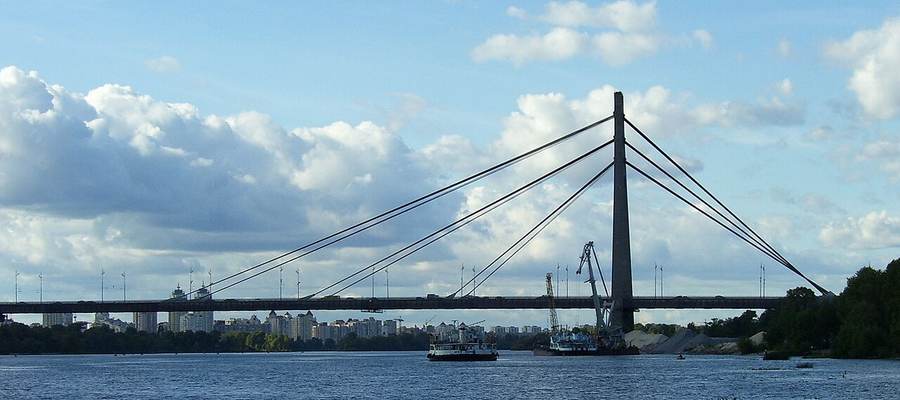
KYIV — The Merz Kyiv visit October 2026 began under air-raid warnings and turned almost immediately into a demonstration of the danger Germany says its new support package is meant to reduce. Chancellor Friedrich Merz arrived by train on Sunday, October 4, with Economy Minister Katherina Reiche and senior executives from Siemens Energy, Hensoldt, Diehl Defence and Quantum Systems. Shortly afterward, a Russian drone struck Kyiv's Pivnichnyi, or North, Bridge, damaging the roadway and a heating main while vehicles were still crossing. No casualties had been reported at publication time.
Reuters reported that Merz would release €1 billion in military assistance and €350 million for repairs to Ukraine's energy system, while the German and Ukrainian sides worked to finalize joint production of drones, missiles and related software. CNN reported that the North Bridge had been hit for the second day in a row and that Sunday's blast sent fire and black smoke above the crossing. The collision of diplomacy, weapons production and infrastructure attack was not symbolism arranged for the cameras; it was the strategic argument of the visit unfolding in real time.
Why this matters
A sitting G7 chancellor entering a capital during an active bridge-strike campaign carries a message in three directions. To Moscow, Berlin is saying that repeated attacks on civilian and logistical infrastructure will not automatically drive European leaders away or end industrial cooperation with Ukraine. To other European capitals, Merz is setting a standard measured not only in declarations but in factories, repair money and senior executives willing to travel. And to Washington, whose attention is divided by the U.S.-Iran crisis and the risk of a wider Middle East conflict, Germany is signaling that Europe must be capable of sustaining a major security commitment even when the United States is absorbed elsewhere.
Merz put the argument in blunt security terms. “I travelled to Kyiv today because Ukraine needs all our support in the coming weeks,” he said, according to Reuters, describing Russian attacks on towns, homes and heating plants. He added: “If Russia is not stopped, sooner or later its war machine will turn against us,” and said he would tell President Volodymyr Zelenskyy, “You can continue to count on our help.” On Saturday, CNN quoted Merz's X post: “Ukraine is facing decisive weeks ahead ... You can rely on us.”
The significance is not that a European leader visited Kyiv; several have. It is that this visit combines immediate money with an industrial proposition. The planned Germany drone deal Ukraine framework seeks to shorten the distance between Ukrainian battlefield feedback and German capital, components and manufacturing discipline. If it works, support becomes less a sequence of aid announcements and more a shared production system.
How we got here
Sunday's Kyiv North Bridge drone strike was part of a sequence, not an isolated impact. CNN reported that the North Bridge had already been hit on Saturday and that Russian attacks on crossings over the Dnipro had continued for four consecutive days. The Southern Bridge was struck on Friday and Saturday. Kyiv says the pattern is intended to interrupt the civilian and logistical connections between the city's eastern and western banks; bridge closures also push traffic onto fewer routes, lengthen emergency journeys and complicate the movement of workers and supplies.
Russia's Foreign Ministry sharpened the warning one day before Merz arrived, urging diplomats and foreign citizens to leave Kyiv and threatening further “massive reprisals.” Moscow says the strikes are retaliation for Ukrainian attacks inside Russian territory. Ukraine describes the campaign as an effort to break urban life and logistics. Those accounts are not mutually exclusive as statements of intent: retaliation is Russia's stated rationale, while disruption is the practical effect of repeated attacks on crossings, heating systems, rail and communications infrastructure.
The air campaign is also changing technically. Zelenskyy said Russia launched more than 1,900 attack drones in the preceding week, including over 800 fast jet-powered models designed to challenge existing defenses. Ukraine's Air Force said 135 drones were launched overnight on October 3–4 from Oryol, Kursk, Millerovo, Primorsko-Akhtarsk, occupied Donetsk and Crimea; 52 were described as jet-powered. Ukrainian authorities reported that 123 to 125 were shot down or suppressed, with impacts recorded at five locations. The range reflects differences in early official counts and should not be treated as greater precision than the reporting supports.
That is the arms race behind the Russian jet drones Kyiv bridges story. Large surface-to-air missiles are too scarce and too expensive to be the routine answer to mass drone waves. Ukraine needs interceptors that are cheap, fast, producible at scale and capable of catching jet-powered targets. Reuters reported that Quantum Systems has tested such an interceptor and that its joint venture with WIY Drones, Quantum WIY Industries, produces the Strila system. Zelenskyy said after a Wednesday phone call with Merz that the broader production agreement would soon be finalized.
Germany's role matters because it is Europe's largest backer of Ukraine by the measure used by German officials, with more than €10 billion in support since the full-scale war began. Sunday's package adds a more targeted layer: weapons for current pressure, repair funds for winter resilience and industrial cooperation intended to outlast a single delivery.
Who wins, who loses, what the critics say
Ukraine gains three things if the promises move quickly: cash for immediate procurement, money for Ukraine energy grid winter repairs, and access to German industrial partners for weapons it cannot afford to wait years to receive. The proposed Quantum anti-drone interceptors Ukraine effort is especially relevant because the threat has moved from slow propeller-driven drones toward faster jet models. Speed of production, however, matters more than the ceremony around the deal. A prototype that works is not yet a factory output large enough to protect a country.
German defense and energy companies gain an unusually direct development loop. Hensoldt, Diehl Defence and Quantum Systems can test technologies against a rapidly changing threat environment; Siemens Energy has a commercial and strategic role in restoring damaged infrastructure. The benefit to German industry is real, and Merz has described the relationship as serving Germany's own security. That also means the visit is not philanthropy alone: it is industrial policy tied to deterrence.
German taxpayers carry the near-term bill. Critics will ask whether another €1 billion in military aid can materially reduce an interceptor shortage when Russia can launch hundreds of drones in a night, and whether €350 million is enough against repeated damage to a national energy system. They will also ask what safeguards govern joint ventures and procurement. Those are legitimate questions, not evidence against the package. Merz is expected to press Kyiv on EU-requested reforms, including anti-corruption measures, precisely because durable support requires confidence that money and contracts can be audited.
Kyiv residents remain the clearest losers from the bridge campaign. Even when a strike causes no casualties, a ruptured heating main can cut hot water to a district, a damaged road deck can divert thousands of vehicles, and another closure can convert ordinary commutes into citywide bottlenecks. Russia says it is answering Ukrainian attacks on Russian territory. Ukraine says the targets and timing are designed to pressure civilian life. International humanitarian law turns on the nature of the target, the expected military advantage and proportionality — questions that cannot be settled from a fireball video alone.
What the numbers mean
The headline figure is €1.35 billion: €1 billion for military support and €350 million for energy repairs. Set against Germany's stated total of more than €10 billion since the war began, the new package is at least 13.5 percent of that earlier cumulative benchmark. But the comparison is imperfect: the €10 billion-plus figure aggregates different forms and periods of support, while Sunday's package divides money between defense and energy resilience.
The drone numbers show why the allocation is urgent. If Ukraine stopped 123 of 135 overnight aircraft, the minimum implied interception or suppression rate is about 91.1 percent. If the later count of 125 is used, the rate is about 92.6 percent. Both look strong until the denominator is considered: even a 7 to 9 percent leakage rate across repeated waves can produce several strikes per night. With more than 1,900 drones reported in a week, small changes in the percentage that gets through translate into many additional impacts.
The figure of more than 800 jet-powered drones — over two-fifths of the weekly total — is the more strategically important number. Faster targets compress warning and engagement time. They force defenders to use more capable interceptors and can saturate systems built for slower threats. This is why joint production of cheap anti-jet drones is potentially more consequential than the euro headline, provided output reaches operational scale.
Bridge economics are less dramatic but immediate. A Dnipro crossing is a fixed-capacity network node. Close one and the traffic does not disappear; it moves to the remaining bridges, where queues consume fuel, working hours and emergency-response time. Rupture a heating main on the same crossing and transport disruption becomes a utility outage. Repeated Kyiv bridge attacks October 2026 therefore impose costs even when engineers reopen a lane quickly.
The Friedrich Merz Zelenskyy meeting and the reform question
Merz and Zelenskyy laid tributes at the Maidan memorial to fallen defenders before their formal talks. The gesture connected the new package to the human cost of the war, but the meeting's harder work lies in contracts and conditions: which systems will be built, where production will occur, how intellectual property and software will be shared, and how output will be audited and allocated.
The composition of the German defense companies Ukraine delegation suggests a portfolio rather than a single drone contract. Siemens Energy points toward grid resilience; Hensoldt toward sensors; Diehl Defence toward missiles and air defense; Quantum Systems toward unmanned platforms and interceptors. Integrating those strands will be more difficult than announcing them. Sensors must detect the target, software must classify it, interceptors must be available near the threatened route, and production must survive attacks on factories and power infrastructure.
Anti-corruption reform is not a diplomatic footnote. Ukraine's EU partners have asked for stronger institutions as accession talks advance, and Germany's willingness to expand industrial cooperation raises the value of transparent procurement. The balanced test is whether oversight accelerates credible production rather than freezing it in paperwork. Wartime urgency and peacetime accountability are in tension, but neither can simply cancel the other.
What happens next
First, watch whether the drone agreement becomes a signed production schedule. The key milestones are factory locations, financing, monthly output and delivery dates for Strila or other anti-jet interceptors. “Finalized” matters only when contracts become production lines.
Second, watch the North Bridge. Kyiv's engineers and emergency services will determine whether the roadway can remain open and how quickly the heating main can be restored. Another strike, or a precautionary closure after structural inspection, would amplify congestion across the city's surviving crossings.
Third, watch the energy system as temperatures fall. The €350 million repair allocation can replace equipment and harden selected sites, but winter resilience will depend on spares, distributed generation, air defense and the tempo of future Russian attacks. Repair money buys capacity to recover; it does not guarantee that repaired assets will not be struck again.
Fourth, watch Moscow's signaling. The Russia warning foreigners leave Kyiv statement preceded an attack campaign that struck a bridge soon after a G7 leader arrived. There is no public evidence that Merz himself was targeted, and timing alone does not establish intent. But Russia's warning and the strike's proximity ensure the episode will be read in European capitals as coercive signaling, whether or not Moscow designed it for that purpose.
The visit's lasting measure will not be the photographs from Kyiv station or Maidan. It will be whether Germany's money arrives, whether Ukrainian and German factories turn designs into thousands of usable interceptors, whether Kyiv's bridges and heating network stay functional, and whether reforms keep pace with a rapidly growing defense relationship. The chancellor's arrival under attack made the stakes vivid. The harder task begins after the sirens.
Sources and reporting notes
- Reuters — Merz's arrival, aid package, delegation, drone deal, quotes and EU reform agenda
- CNN — North Bridge strike, fourth day of bridge attacks, Russian warning and drone-wave figures
- AFP via Le Pays De France — Merz visit, bridge damage, air-raid warnings and interceptor context
- Guardian live report — Maidan memorial, bridge impact and contemporaneous images
Verification note: Early Ukrainian reports differed on whether 123 or 125 of 135 drones were stopped. Both figures are preserved as a range. No casualties had been reported from the North Bridge strike at publication time. The bridge and official portraits are file images and do not depict Sunday's attack or meetings.