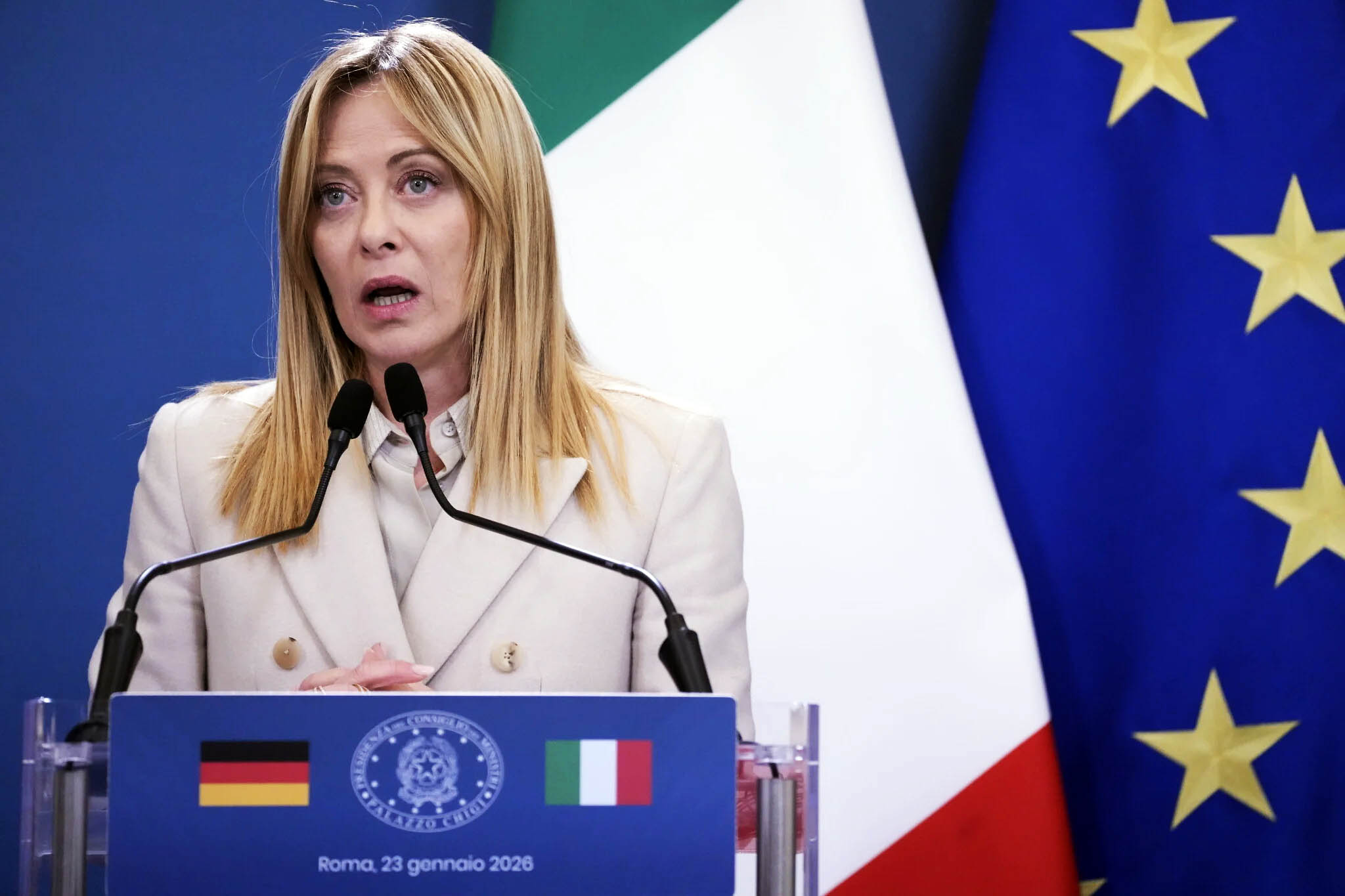
What Meloni announced
Speaking on September 20 at Fenix, the youth festival of her Brothers of Italy party, Meloni said a school-integration measure would go to Cabinet “soon.” She described three components: a ban on burqas and niqabs in schools, a legal cap on foreign pupils in each class and compulsory Italian lessons for parents of children judged to have serious difficulty integrating.
The proposed face-covering rule would not apply to the hijab. “You must go to school with your face uncovered,” Meloni said. On classroom composition, she argued that one child who does not speak Italian can integrate quickly, but that when such pupils form a majority, “it is no longer integration; it is neglect.” She gave no proposed numerical ceiling. The measure would need parliamentary approval within 60 days of Cabinet action to become law.
The context: numbers and law
Students who are not Italian citizens account for about 11.6% of national enrollment, according to ISMU, while ISTAT put the share at just under 12% for the 2023–24 school year. Those national figures are unevenly distributed: particular cities and neighborhoods carry much higher concentrations, which is where the proposed cap would have its greatest practical effect.
Italy has no national law expressly banning the burqa or niqab in all public places. A 1975 public-order law prohibits garments that prevent identification without justified reason, but its application to religious dress has been contested. Schools already work under a guideline that foreign students should generally not exceed 30% of a class; Meloni's proposal would turn some form of that guidance into binding law.
Citizenship further complicates the categories. Children born in Italy to foreign parents generally cannot apply for citizenship until age 18. A cap based on citizenship could therefore treat Italian-born, Italian-educated children as foreign even when Italy is the only home they have known.
Why this matters
Schools are where abstract immigration debates become immediate. Language proficiency affects instruction, parents' ability to navigate institutions and children's social ties. A policy can therefore be defended as classroom management while also carrying a broader message about who belongs.
Meloni has moved from nationalist outlier to an influential figure inside the European establishment, particularly on migration and defense. The school package shows how that institutional normalization can coexist with crowd-pleasing domestic policies ahead of next year's general election. It also moves Italy toward a European group that has legislated restrictions on Islamic dress, including France, Belgium, the Netherlands, Austria and Denmark.
The competing arguments
Supporters make three cases. The pedagogical case is that teachers need to see pupils' faces to communicate and assess participation. The integration case is that classrooms cannot function as a bridge into Italian society if too many students begin without the language. The women's-rights case treats the burqa and niqab as instruments of control rather than neutral expressions of faith.
Critics answer on proportionality, liberty and discrimination. The number of pupils wearing full-face veils is believed to be very small, making the ban heavily symbolic. Excluding a student from school may reduce rather than expand her freedom. And a citizenship-based cap risks stigmatizing children born and raised in Italy while moving them between schools to satisfy a legal ratio.
What remains uncertain
The headline is clearer than the policy. The government has not said what the foreign-student cap would be, whether it would be national or adjusted locally, or how schools already above the limit would comply. Nor has it defined “serious difficulty integrating,” identified who would assess parents or specified penalties when a pupil arrives wearing a prohibited face covering.
Parliamentary arithmetic and constitutional review are also unresolved. Any final law will be tested against protections for religious freedom and equal treatment, as well as the practical right to education. The wording that emerges from Cabinet will determine whether the plan is an enforceable reform or primarily an electoral signal.
Who gains, who loses
Meloni gains a policy that connects immigration, education and national identity — issues that mobilize her base — while presenting the intervention as practical rather than ideological. Schools with severe language bottlenecks could gain resources or a clearer framework if the law is accompanied by staffing and language support.
The risks fall on pupils and families who may be reassigned, singled out or required to satisfy tests that remain undefined. Municipalities could also bear the logistical cost of moving children between schools. Teachers may gain smaller concentrations of language need in one classroom while losing the stability that comes from keeping neighborhoods together.
What happens next
The first test is Cabinet, where the draft will reveal the numerical cap and the enforcement machinery. If approved, Parliament's 60-day window becomes the second test. The likely scenarios are passage close to Meloni's outline followed by litigation, a narrower bill after coalition negotiation, or delay that still allows the announcement to serve its electoral purpose.
The decisive evidence will be operational: whether the law adds language teachers and family support, or merely redistributes children and bans a garment worn by very few. That distinction will determine whether it functions as integration policy or identity politics.
Sources
Reuters, "Italy to ban veils in schools, limit foreign students per class, Meloni says," September 20, 2026: Read the report
Associated Press, "Meloni plans to ban burqas and niqabs in Italian schools, and cap foreign students in classrooms," September 20, 2026: Read the report
GKToday, "Italy Plans Burqa and Niqab Ban in Schools," September 20, 2026: Read the report