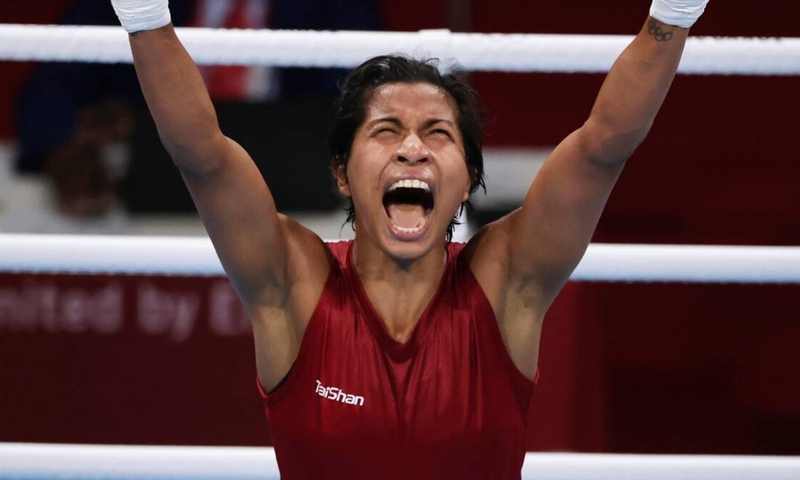
AICHI-NAGOYA, Japan — The Lovlina Borgohain Asian Games gold arrived on Friday with a flourish that sport rarely scripts so neatly. On her 29th birthday, the Indian boxer defeated China’s Bao Ziyi 5-0 by unanimous decision in the women’s 75kg boxing final, becoming only the second Indian woman to win an Asian Games boxing title and ending a 12-year wait since Mary Kom’s victory at Incheon in 2014.
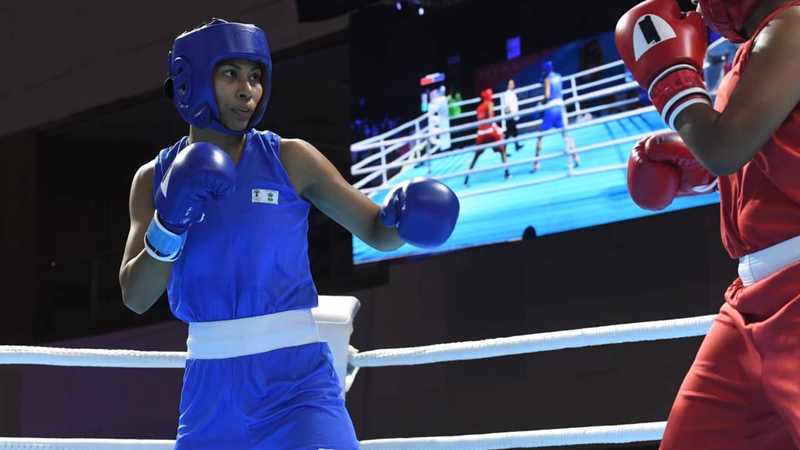
The final was less a brawl than a demonstration of judgment. Bao began aggressively, trying to compress the ring and force exchanges. Borgohain refused the invitation. She counter-punched, edged the first round 3-2 on the judges’ cards, widened her advantage to 4-1 in the second, then swept the third. The official 5-0 result made the finish look inevitable; the progression of the scores showed how deliberately she made it so.
“It’s very special. I think it’s the first time that I get a present for myself,” Borgohain said of the birthday victory, according to Reuters. She added: “This is my second Asian Games and I had silver at the last Asian Games. So I was fully confident that I could get the gold medal.”
Why the Lovlina Borgohain birthday gold medal matters
The birthday frame is irresistible because it reduces the achievement to one vivid human moment. But the structural story is larger. India produced Mary Kom, one of the defining boxers of her generation, and then waited 12 years for another woman to win this continental title. That is both a celebration of Borgohain and an indictment of the distance between India’s exceptional champions and the system beneath them.
One champion does not create a pipeline. Yet a second champion matters because she breaks the idea that Mary Kom’s 2014 Asian Games gold was a singular event that could not be repeated. Borgohain’s title extends Indian women’s boxing history from one towering name into a lineage. The Boxing Federation of India gains a credible proof point for investment; sponsors gain a champion whose story spans Olympic, world and continental stages; Assam’s sports programs gain evidence that athletes from outside India’s traditional metropolitan centers can become long-term international winners.
The hard question is whether institutions use that proof to widen the base. A federation can market a gold medal more easily than it can build coaches, sports-science support, domestic competition and athlete welfare across several weight classes. Borgohain’s win should be treated as leverage for that work, not a substitute for it.
Bao Ziyi vs Lovlina Borgohain: a final won in three acts
Patience under China’s opening pressure
In the first round, Bao’s aggression presented the most dangerous version of the contest: a short, noisy fight in which activity could be mistaken for control. Borgohain’s 3-2 edge was narrow enough to demand adjustment, but it also showed that her counters were being seen. She did not abandon the plan simply because it had produced a close score.
Control, then unanimity in the women’s 75kg boxing final
The second-round 4-1 card marked the turn. Borgohain was now dictating range, drawing Bao forward and answering with the cleaner work. By the third, all five judges were with the Indian. The final 5-0 decision therefore reflected competitive problem-solving rather than a mismatch: diagnose in round one, control in round two, close without ambiguity in round three.
That matters because her semifinal had been far less comfortable. A 3-2 split decision over Kazakhstan’s Natalya Bogdanova put Borgohain into a second consecutive Asian Games final after her silver at Hangzhou 2022. She became the first Indian woman boxer to reach back-to-back finals at the Games. Moving from that knife-edge semifinal to a unanimous final is the strongest performance clue of the week: she peaked when the medal changed color.
From Baromukhia to a world title: the Assam road
Borgohain was born on October 2, 1997, in Baromukhia in Assam’s Golaghat district. Inspired by her elder sisters, she first took up Muay Thai before moving toward boxing. At 14, in 2012, she began formal training at the Netaji Subhas Regional Centre in Guwahati and became a junior national champion that same year.
That origin matters because champions are often described backward, as if the medals prove the pathway was always obvious. It was not. The route from Baromukhia required talent to be recognized, moved into a regional training system and sustained over years. Assam benefits now not merely from reflected glory but from a living model for recruitment: a teenager from Golaghat can see a credible sequence from local combat sport to Guwahati, national selection and the biggest rings in the world.
The Mary Kom lineage — and stepping beyond its shadow
Mary Kom Asian Games gold 2014 became a symbol larger than its medal because she had already carried Indian women’s boxing into global consciousness. Every major Indian woman boxer after her has inherited both opportunity and an unfair comparison. Borgohain’s answer has been to accumulate a résumé that stands on its own.
The Lovlina Borgohain Tokyo Olympics bronze came at 69kg. She then moved into the 75kg class and won the 2022 Asian Championships, the 2023 world title in New Delhi, and silver at the 2026 Commonwealth Games in Glasgow before this Asian gold. The Arjuna Award in 2020 and Major Dhyan Chand Khel Ratna in 2021 recognized her rise; the later titles validated her adaptability.
That sequence — Olympic bronze, world gold, Asian gold — is not merely a list. It describes an athlete who learned to carry expectation, change divisions and convert close tournament survival into championship authority. Mary Kom opened a door. Borgohain has made the room look less like it belongs to one person.
India boxing gold in Aichi-Nagoya carries rivalry and risk
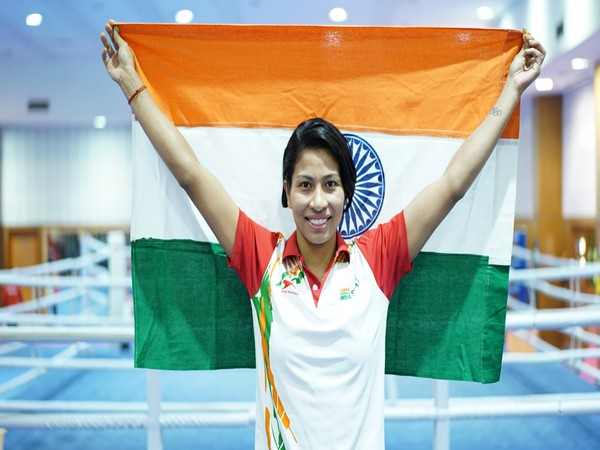
Beating a Chinese opponent in Japan will inevitably be read through the India-China sporting rivalry. That subtext has value: elite sport converts abstract national competition into a legible contest with rules, judges and a result. But it should not obscure the technical fact. Borgohain did not win because of symbolism; the symbolism acquired force because she solved Bao’s aggression round by round.
For the federation, the win offers leverage before the next Olympic cycle. For sponsors, it creates a rare combination of recognizable athlete, compelling biography and repeatable excellence. For younger boxers, it demonstrates longevity. The risk is that all three groups consume the story without investing in the conditions that produced it.
The realist’s counter is straightforward: one gold can mask fragility. A 12-year drought is 12 editions of annual planning, four Olympic cycles and countless youth tournaments compressed into a single uncomfortable number. India should celebrate the result while asking how many women can realistically contend across divisions, how many receive world-class sparring and recovery support, and how quickly the next prospect can survive the move from junior success to senior international boxing.
Asian Games 2026 boxing results inside India’s 70-medal picture
India’s reported Aichi-Nagoya total stood at 70 medals: 12 gold, 24 silver and 34 bronze. Borgohain’s title was therefore one of 12 golds — roughly one-sixth of the gold count belonged to the entire boxing final she controlled in nine minutes. That arithmetic helps separate medal-table breadth from championship conversion. Seventy medals show reach across sports; 12 golds show how scarce first place remains.
The Asian Games 2026 India medal tally also gives context to another Indian success readers may follow: India’s compound archery gold sweep at the Games. Together, the results suggest that targeted excellence can produce clusters of medals. The policy challenge is turning those clusters into durable systems rather than isolated peaks.
At Nishio Gymnasium boxing on the same day, Taiwan’s Lin Yu-ting defeated China’s Yang Chengyu 5-0 for the women’s 60kg gold. The victory came two years after the Paris Olympics gender-eligibility controversy; Lin had been cleared to compete earlier in 2026 following a World Boxing review. Her win and Borgohain’s shared a score line, but each carried a different burden of public narrative. Both ultimately reduced those narratives to five judges’ unanimous decisions.
What the gold sets up for the 2028 Olympic cycle
At 29, Borgohain is neither an athlete to be written into decline nor one whose runway can be treated as unlimited. The next two years should be managed around precision. The first scenario is continuity: remain healthy at 75kg, limit unnecessary mileage, and use selected international events to refine the patient counter-punching that beat Bao. That gives her the cleanest route toward the 2028 Olympics.
The second scenario is adaptation. Opponents will study the Aichi-Nagoya final and try to deny her preferred range, forcing her to lead rather than counter. Training must anticipate that tactical response. The third is institutional: Borgohain becomes both contender and mentor, using camps and her visibility to raise the standard of the women around her without allowing ambassadorial demands to consume preparation.
India has recent evidence that one transcendent performance can change how a sport is funded and imagined. It also has evidence that a medal can become a commemorative object rather than a foundation. The next two years will decide which path this title takes.
Conclusion: a gift to herself, a test for the system
The Lovlina Borgohain birthday gold medal is a clean ending to this tournament: a close semifinal, a decisive final, a national drought broken on the champion’s birthday. But the more useful reading begins after the celebration. Borgohain has supplied India with continuity from Mary Kom, a second female Asian Games champion, and a boxer whose arc now runs from Tokyo bronze to world gold to Asian gold.
What happens next belongs partly to her and partly to the institutions eager to stand beside her. If the federation, sponsors and Assam’s sports programs convert this moment into deeper coaching and a wider competitive base, the 12-year gap may look like the end of an era. If not, India will again be asking one extraordinary woman to disguise an ordinary system.