Dmitriev Washington Ukraine peace talks
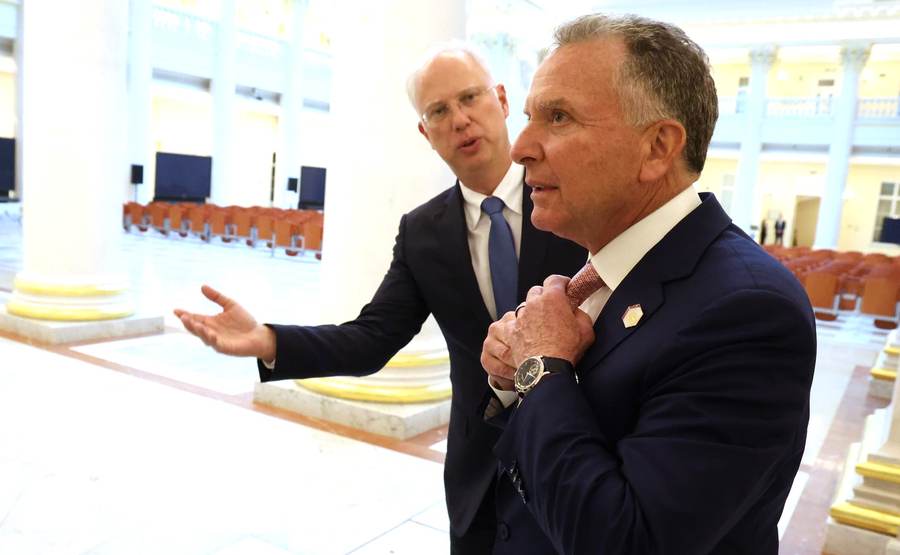
Dmitriev Washington Ukraine peace talks — Russian presidential envoy Kirill Dmitriev was in Washington, D.C., on Monday, September 28, holding what both sides described as “constructive” talks with U.S. officials on a peaceful resolution to the Russia-Ukraine war and on possible U.S.-Russia energy initiatives once the war ends. A U.S. official confirmed the meetings on Tuesday, September 29. According to Reuters, citing sources familiar with the preparations, Dmitriev met with representatives of the U.S. Treasury and Energy departments.
Dmitriev is no ordinary Kremlin emissary. He heads the Russian Direct Investment Fund (RDIF), Russia’s sovereign wealth fund; he was educated in the United States and worked at Goldman Sachs and McKinsey; and he is widely regarded inside Russia as its most U.S.-friendly negotiator. That profile matters, because this channel has already produced results once before: Dmitriev previously negotiated a U.S. sanctions waiver for seaborne Russian oil and several prisoner exchanges. When Moscow sends Dmitriev to Treasury and Energy — not the State Department — it is sending the man who talks money, sanctions, and deals.
The substance on the table, per the U.S. official and Reuters reporting, was twofold: first, a potential ceasefire on energy-related targets, the narrowest and most testable de-escalation step available; second, U.S.-Russia energy initiatives to be pursued after the war ends. That second item is the tell. Washington is now openly pricing a post-war economic track — one in which sanctions relief and energy commerce are part of the settlement architecture — even as the fighting continues at full intensity.

Why this matters
The significance of Monday’s meeting is not that a breakthrough was announced — none was — but that of the venue and the pairing. A Russian envoy sitting inside Treasury and Energy, discussing post-war energy cooperation while his country’s missiles are in the air, signals that Washington is now running two clocks at once: a military clock that keeps arming Ukraine, and an economic clock that is already sketching what “after” looks like. For a war that has been fought in part as an economic war — sanctions, seaborne oil, grain corridors — putting the economic settlement on the agenda before a ceasefire exists is a genuine shift in method, even if the outcome is still speculative.
And the energy-target ceasefire idea is the shrewdest possible first step, which is exactly why it keeps resurfacing. A halt on strikes against energy infrastructure is verifiable in near-real time — you can see whether the grid holds — it protects civilians on both sides from winter blackouts, and it gives each side something it wants without conceding territory. Ukraine gets its power grid and heating spared ahead of the cold months; Russia gets its own energy infrastructure left alone and a path toward the sanctions relief Dmitriev is there to discuss. It is a confidence-building measure that pays in megawatts rather than promises. That is precisely the logic Secretary of State Marco Rubio articulated after huddling with Russian Foreign Minister Sergey Lavrov at the U.N. last week: both sides, Rubio said, had expressed interest in a limited ceasefire involving grain and energy targets — though he added, pointedly, that getting there “won’t be easy.”
How we got here
September has been the busiest month of U.S.-Russia-Ukraine diplomacy in over a year, and Monday’s meeting is the third beat in a sequence. On September 5, Trump envoys Steve Witkoff and Jared Kushner traveled to Moscow to meet Vladimir Putin. On September 24, during U.N. General Assembly week, Dmitriev met Witkoff and Kushner in New York. Last week brought the Trump–Zelensky meeting in New York, after which Zelenskyy said the two leaders had discussed a potential ceasefire on energy-related targets, and Trump publicly urged just such an energy-infrastructure ceasefire. Rubio’s huddle with Lavrov at the U.N. added the grain dimension. Each round has narrowed the aperture a little further: from grand peace plans to grain and energy — the things you can verify and the things both sides need.
Two other threads are converging on the same point. The Atlantic has reported that Trump is interested in a deal in which Russia releases political prisoners in exchange for easing U.S. sanctions — a prisoners-for-waivers pattern that is exactly Dmitriev’s specialty, given his history on both fronts. And Trump has invited Putin to the December G20 summit in Miami, with Zelenskyy suggesting it could host a trilateral ceasefire meeting. Whether Miami becomes a summit or a talking point, the invitation reframes the timeline: the parties are now openly discussing December as a horizon. That is new, and it gives the energy-ceasefire idea a clock to beat: the first hard winter month, when the leverage of a grid truce is greatest.
Who gains, who loses
Russia gains the most obvious prize: a sanctions-relief pathway negotiated by its best Washington hand, and the implicit recognition that comes with being talked to about post-war commerce. The risk Moscow runs is the optics of the parallel track — talking peace in Washington while its ballistic missiles and jet-powered drones keep hitting Kyiv, as they did again overnight. Every strike during a diplomatic week feeds the argument that the talks are a screen, and that argument is already being made in Kyiv and European capitals.
Washington gains leverage and optionality: an economic track it controls, a narrative of deal-making progress, and potential energy access. Ukraine’s gain is concrete and immediate — a pause in grid strikes before winter, which would ease the pressure that has driven Kyiv to plead for air-defense systems, including the NASAMS system and missiles the U.S. and Norway just provided and the air-defense package pledged by France and Germany. But Kyiv also carries the sharpest fear: that an energy ceasefire becomes the thin end of a broader freeze that locks in Russia’s territorial gains, negotiated partly over Ukraine’s head. Zelenskyy’s government has lived this anxiety before, and its public line — no settlement without Ukraine at the table — is the constraint every envoy in this sequence has to price in.
Europe’s position is the most uncomfortable. Several European allies are wary of Washington normalizing economic relations with Moscow ahead of a political settlement; a U.S.-Russia energy track that runs ahead of European sanctions policy would strain the transatlantic front. The critics’ case, made by hawks in both parties and in Kyiv, is blunt: talks-as-cover. Russia has intensified strikes during previous diplomatic windows, and the combination of an army-expansion decree adding 15,500 troops toward a 1.55-million-strong active force with a fresh mobilization drive and more North Korean troops on Russian soil looks to them like a country preparing for a longer war, not a shorter one. The supporters’ case is equally blunt: even a narrow, verifiable deal that keeps the lights on this winter saves lives, and every channel that has ever ended a war started with talks that looked premature.
What the numbers say
The figures refuse to sit comfortably with the diplomacy, and that dissonance is the story. Moscow is expanding its active-duty army by 15,500 troops to 1.55 million — the arithmetic of a long war — at the same moment its envoy is discussing post-war energy commerce. Kyiv has endured more than 235 air-raid alerts totaling 261 hours since August 27; the National University of Kyiv is switching to remote learning; three F-16s are due from Belgium by year’s end to help defend a sky that keeps getting more dangerous. The two tracks — escalation and negotiation — are not contradictory so much as complementary in the cold logic of wartime bargaining: each side arms to strengthen its hand at the table. But there is a limit to how far the contradiction can stretch. If the energy strikes continue through October while the energy ceasefire is the headline topic, the diplomacy starts to look like weather — something people talk about while it rains.
One number deserves particular attention: the cost asymmetry behind the air war. Ukraine’s newly arrived Western interceptors, including the NASAMS missiles and the Franco-German package, are expensive and finite; Russia’s drones are cheap and scaling. An energy-target ceasefire would be, among other things, an economic circuit-breaker — it would let both sides stop burning money on the most destructive exchanges of the war. That is why the Treasury-and-Energy pairing is more than a venue detail: it is the recognition that this war will be settled, if it is settled, in the ledgers as much as on the map.
What happens next
Three scenarios now compete. First, the narrow deal: an energy-target ceasefire by early winter, sold as a humanitarian measure with heating-season leverage on both sides, possibly announced around the G20 horizon. This is the outcome the current sequence is designed to produce, and it would be genuinely significant — the first mutually observed restraint of the war. Second, the summit: the December G20 in Miami becomes a trilateral venue, with the energy truce as the down payment and prisoners and sanctions waivers as the currency of the next phase. This requires the narrow deal to hold first; it is the optimistic path. Third, the collapse: the talks stall on verification or on Ukraine’s red lines, the strikes intensify through the winter grid campaign, and the Washington meeting is remembered as diplomacy-as-cover — the scenario Kyiv’s hawks and European skeptics already expect.
What to watch, in order of how fast it would tell us which scenario we are in: any announcement on political prisoners, which would confirm the Atlantic’s reporting and Dmitriev’s track record is back in business; any Treasury licensing moves on Russian energy or oil, which would show the economic track is real; Zelenskyy’s next public statements on his X account, which will signal whether Kyiv believes the channel serves its interests or endangers them; and, most simply, whether the strikes on energy targets pause. Diplomats can meet for months. Grids either hold or they don’t — and winter is coming.
Sources
- Reuters: “Putin envoy, US officials discussed Ukraine war, energy initiatives, US official says” (September 29, 2026) — reuters.com
- New York Post: “Russian envoy in DC for talks with US officials on Ukraine war, energy cease-fire” (September 29, 2026) — nypost.com
- Associated Press, via reflector.com: “Russia’s ballistic missile and jet-propelled drone blitz keeps Kyiv on edge” (September 29, 2026) — reflector.com
- Associated Press, via AAP: “Russia has launched fresh mobilisation drive: Zelenskiy” — aapnews.aap.com.au