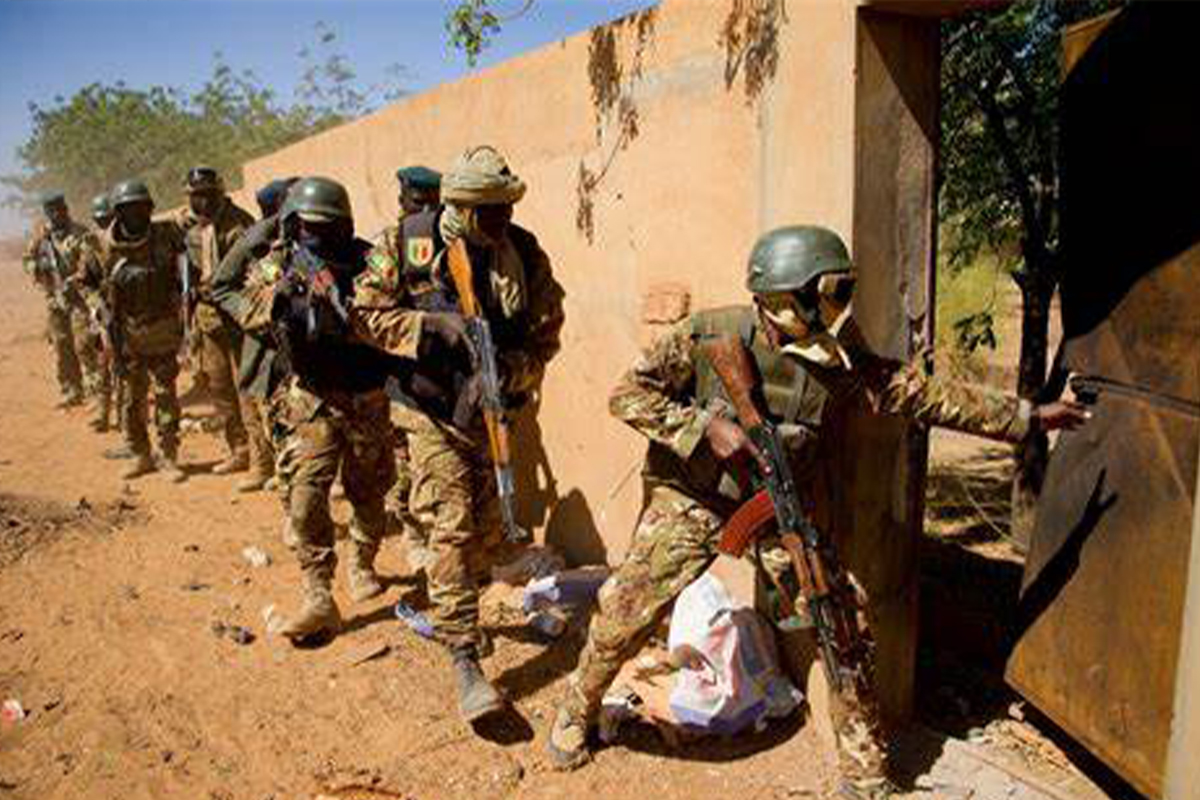
Jama’at Nusrat al-Islam wal-Muslimin, the al-Qaeda affiliate known as JNIM, claimed responsibility on Sunday, September 20, for attacks on a military base at Sévaré’s Mopti Ambodédjo Airport and on a barracks at Kona, also spelled Konna in Reuters reporting. The attacks place new pressure on two connected positions in central Mali only ten days after JNIM’s assault on the army camp at Dioura.
What can be reported with confidence is narrower than the group’s account. Reuters reported on September 21 that JNIM said it had struck air-defence systems at Sévaré airport. A local resident told Reuters that the airport had been under shelling for six consecutive nights as of Monday. The resident said they visited Sévaré hospital and saw about 40 wounded Malian soldiers and Russian fighters. Mali’s military did not respond to Reuters’ request for comment.
JNIM claimed that its attacks caused “great losses” to Mali’s air assets. It said mortar fire and self-propelled artillery destroyed four Bayraktar TB2 and Akıncı drones, several attack helicopters, the control tower of the drone network and the radar at the Sévaré airbase. It also claimed casualties and injuries among Malian forces and Russia’s Africa Corps, including what it described as a Russian captain. None of those equipment-damage or casualty claims has been independently verified. No imagery, official inventory, satellite assessment or other evidence cited in the available reporting establishes that the aircraft, control tower or radar were destroyed.
Reuters also reported JNIM’s claim that it killed 33 pro-government personnel in Sévaré and Konna. That figure is likewise a JNIM claim, not an independently verified death toll. The resident’s account of about 40 wounded people is a separate eyewitness observation; it does not prove who wounded them, when each injury occurred or how many people were killed. Keeping those categories apart is essential because a combatant group’s communiqué, a resident’s hospital observation and an official casualty list carry different evidentiary weight.
Why this matters: the junta’s airpower bet is now the target
Sévaré is not simply another remote garrison. The airport houses military aircraft and drones and functions as a central-Mali node for surveillance, strike operations, reinforcement and medical evacuation. Russia’s Africa Corps supports the Malian army in combat in the area. A sustained threat to the airport therefore reaches beyond one base perimeter: it tests the system Mali’s military rulers have built around Turkish unmanned aircraft and Russian battlefield support.
JNIM’s public claim is strategically useful to the group even before its details are verified. By asserting that it neutralized four advanced drones, helicopters, radar and command infrastructure, the group is presenting itself as capable of attacking the machinery that gives the state range and firepower. The claim tells potential recruits and local communities that the government’s technological advantage can be challenged. It also forces the junta either to reveal sensitive information about the condition of the base or leave an information vacuum that JNIM can fill.
The operational question is not whether every item in JNIM’s list was hit. It is whether repeated shelling can constrain sorties, divert personnel to force protection, disrupt maintenance or make crews and aircraft disperse. Airpower depends on runways, fuel, radar, control systems, technicians and secure operating rhythms. Six consecutive nights of reported shelling are therefore a measure of pressure continuity even without a confirmed damage assessment. A base does not need to be destroyed to become less efficient.
What JNIM says happened—and what remains unknown
JNIM described the strikes as retaliation for what it called thousands of victims killed by Turkish-drone missiles and Russian warplanes. That is the group’s characterization of the wider conflict, not an independently established account of responsibility or casualty totals. Its description serves a mobilizing purpose: it frames attacks on military facilities as revenge and attempts to turn civilian suffering into political legitimacy for the group’s campaign.
The group’s list of alleged targets is unusually specific. Bayraktar TB2 and Akıncı drones are high-value systems; attack helicopters, radar and a drone-control tower would represent distinct parts of an air-operation chain. Specificity, however, is not verification. Combatant groups routinely maximize claimed enemy losses, while governments may minimize their own. The evidentiary test is external corroboration: geolocated imagery, visible wreckage, serial-numbered equipment, satellite change detection, repair activity or a credible official inventory. None has been made public in the reporting used here.
Mali’s military silence leaves two unanswered sets of questions. The first is physical: Was the runway usable? Were radar and control systems operating? Were any aircraft damaged, moved or destroyed? The second is human: How many Malian and Africa Corps personnel were killed, wounded or missing, and were the hospital cases described by the resident linked to the September 20 attacks? Until those questions are answered, the most responsible formulation is that JNIM claimed extensive damage and casualties while Reuters confirmed the existence of the claim and reported eyewitness evidence of prolonged shelling and wounded personnel.
How central Mali reached this point
The double-attack claim follows the September 10 assault on Dioura, where two sources told Reuters that 100–150 Malian soldiers were killed; the specific estimates were about 120 and 130, while a security source said more than 100 soldiers were taken hostage. JNIM claimed that 150 troops were killed. Mali’s army acknowledged deaths and said a counter-operation caused significant losses to the attackers, but it did not publish its own casualty total. Those figures remain disputed.
Dioura and Sévaré are related but distinct developments. Dioura was an assault on an army camp. The new Sévaré and Kona claims concern pressure on an airport, air-defence systems and another barracks. Treating them as one event would blur both chronology and military function. Taken together, however, they suggest a campaign aimed at overloading the government’s central-Mali network: a fixed camp suffers heavy losses; an air hub comes under repeated fire; a nearby barracks faces a simultaneous threat.
The sequence also follows a broader escalation in 2026. In April, JNIM and the Tuareg-led Azawad Liberation Front, or FLA, carried out a coordinated offensive that Reuters reported killed Mali’s defence minister and reached Bamako’s main airport. JNIM and the FLA are separate organizations with different political goals, even when they cooperate tactically. The FLA’s narrative centers on Tuareg self-determination, while JNIM operates as an al-Qaeda-aligned coalition. Conflating them would obscure both the government’s adversaries and the constituencies each seeks to influence.
Mali’s current political order was forged through coups in 2020 and 2021. The junta broke with France, pushed out French and United Nations forces and made Russian support central to its security strategy. Africa Corps became the key foreign military backer. Turkish drones and Russian firepower offered the government tools to strike across difficult terrain, but Dioura and Sévaré expose the limits of a strategy centered on superior equipment when bases, roads and local intelligence remain vulnerable.
The numbers: pressure, not a settled ledger
The reported figures describe different things and should not be added together. JNIM claims 33 pro-government personnel killed in Sévaré and Konna. A resident told Reuters they saw about 40 wounded Malian and Russian fighters in a hospital. The Dioura estimates of roughly 120–130 killed come from Reuters’ security and diplomatic sources, while JNIM claims 150. One set is a militant death claim, one is a resident’s observation of wounded people, and the others are confidential-source estimates for an earlier battle.
Placed side by side, the numbers show why the new attack matters without pretending they form a verified total. Dioura’s reported deaths indicate the scale of a possible single-camp disaster. The roughly 40 wounded seen at Sévaré hospital indicate strain on treatment and evacuation capacity. The six nights of shelling indicate continuity: pressure lasted long enough to disrupt routines, consume ammunition and force defensive choices. JNIM’s disputed figure of 33 is useful only as a claim the group wants believed unless evidence supports it.
The regional scale is larger still. United Nations figures cited in the reporting brief recorded more than 9,000 people killed by Islamist violence across Mali, Burkina Faso and Niger in 2025. The Sahel was on course for another record year in 2026. That context should not reduce the people at Sévaré, Kona or Dioura to statistics. It shows instead that each base attack sits inside a regional conflict that has outlasted repeated changes of government, foreign partners and counterinsurgency doctrine.
Who benefits, who loses and what each side argues
JNIM benefits first in propaganda. The group can circulate a detailed inventory of alleged damage before an independent assessment exists, presenting itself as the force that can reach the junta’s prized air assets. If the claim draws recruits, induces defections or convinces communities that the state cannot protect them, the political effect may exceed the physical damage. The benefit is real even if individual claims later prove exaggerated.
The FLA can benefit indirectly in the political argument. A visible failure of the junta’s security model supports the broader separatist case that Bamako cannot govern or protect the north and center. That does not establish FLA participation in the September 20 attacks, and none should be implied without evidence.
Critics of the junta can point to repeated attacks as evidence that centralized military rule, Russian support and expanded drone operations have not delivered the promised security. Analysts who study militant communications caution that JNIM’s battlefield claims routinely need independent verification and may inflate damage. Junta supporters answer that JNIM statements are disinformation designed to manufacture a victory, and they may argue that disclosure about sensitive air assets would aid the enemy. Both positions can be tested only against observable outcomes: the airport’s operating status, verified equipment losses, casualty records and the frequency of follow-on attacks.
Mali’s army and Africa Corps face the clearest institutional losses. If the base was disrupted, the army loses operational tempo and Africa Corps loses prestige as a force multiplier. Even if the claimed equipment destruction is false, repeated shelling shows that high-value facilities require more protection. Morale suffers when casualty information is delayed and when troops believe reinforcement or evacuation can be contested.
Civilians in the Mopti region bear the greatest human risk. Shelling threatens homes and movement. Road insecurity can interrupt food deliveries, markets, schooling and health access. Any airport restriction can complicate civilian travel as well as military logistics. Government reprisals that fail to distinguish combatants from civilians would deepen mistrust and potentially aid recruitment; JNIM coercion, attacks and restrictions impose their own direct burden on communities.
What happens next
- The junta doubles down on airpower and Africa Corps. Bamako may answer with intensified drone and aircraft strikes, reinforced base defenses and expanded Russian support. That could restore freedom of operation, but reprisals would require transparent safeguards and investigation of any civilian-harm allegations.
- JNIM extends pressure along the Mopti–Bamako corridor. Further attacks on roads, camps or logistics sites could force the army to disperse protection while JNIM avoids a conventional battle. The key indicators would be convoy disruption, repeated shelling and whether nearby garrisons can be resupplied.
- Sévaré’s airport faces another closure or operational restriction. Any suspension would have effects beyond the military, including travel disruption, slower medical movement and reduced humanitarian access. A verified resumption of normal operations would limit JNIM’s strategic gain even if the attacks caused temporary disruption.
- An information contest hardens. JNIM will seek imagery or testimony supporting its damage claims; the junta may release selected footage or no detail at all. Independent satellite analysis, geolocated media and a credible casualty list would do more to resolve the facts than either side’s rhetoric.
The immediate conclusion is limited but important. JNIM claimed a coordinated attack on Sévaré’s air hub and the Kona barracks. Its claims that four drones, helicopters, radar and a control tower were destroyed—and that 33 pro-government personnel were killed—remain unverified. Reuters reported six consecutive nights of shelling and a resident’s account of about 40 wounded Malian and Russian fighters at the hospital. Those facts are enough to show sustained pressure on a strategic hub. They are not enough to declare Mali’s air fleet neutralized.
Earlier reporting: Dioura
- Dioura’s Reckoning: How 130 Dead Soldiers Exposed the Cracks in Mali’s Junta and Russia’s Africa Corps
- Dioura’s Missing Soldiers and Mali’s Unraveling Security Promise
Sources and reporting notes
- Reuters, September 21: Sévaré and Konna claims, six nights of shelling, the hospital eyewitness account, Africa Corps context and the Dioura estimates
- Demócrata: details from JNIM’s statement about alleged aircraft, radar and control-tower damage
- Small Wars Journal: background on the 2026 JNIM–FLA offensive and Mali’s counterinsurgency model
- Sahel Tribune: lead file-photo source
Reporting cutoff: September 22, 2026. JNIM’s damage and casualty statements are combatant claims and have not been independently verified. The resident’s hospital account is attributed to Reuters. Mali’s military did not respond to Reuters’ request for comment. This is a fixed reporting snapshot and does not update automatically.