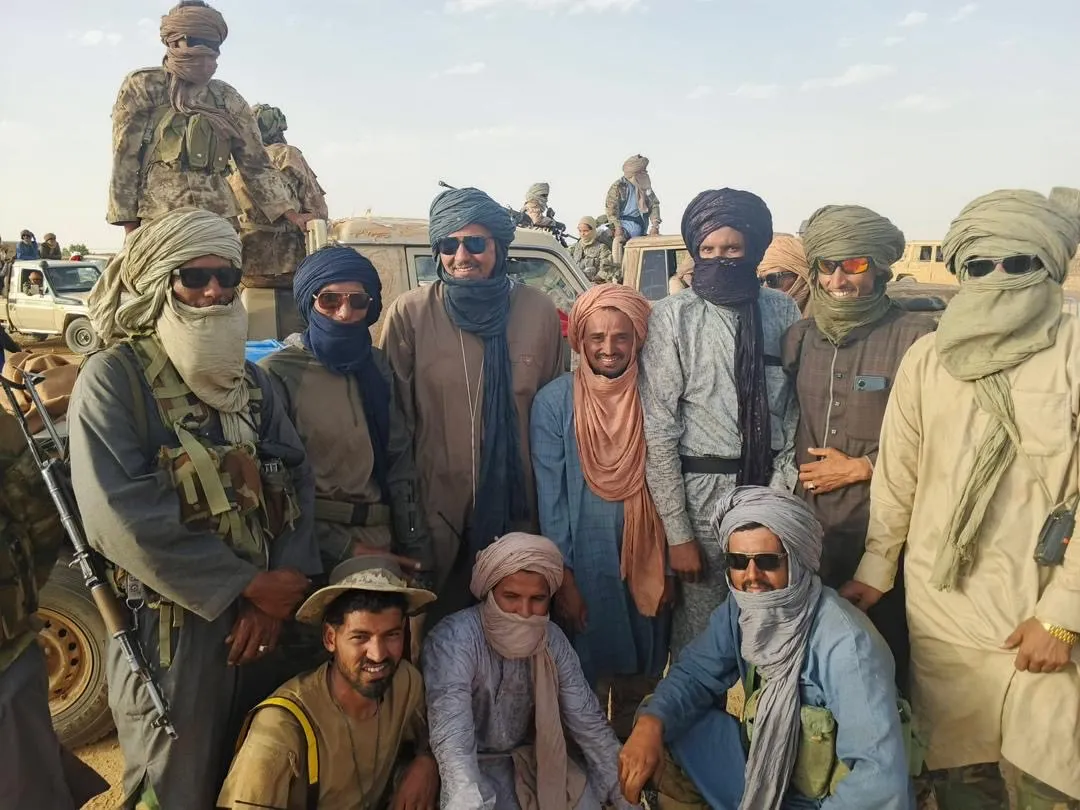
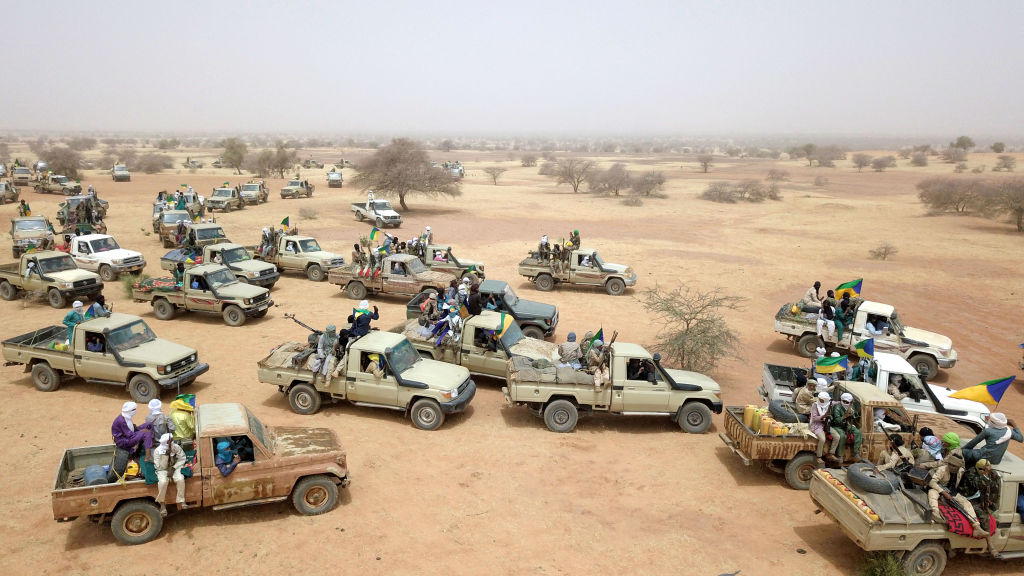
Fighters from Jama’at Nusrat al-Islam wal-Muslimin, the al-Qaeda-linked coalition known as JNIM, attacked the Malian army camp at Dioura in the central Mopti region on Thursday, September 10. Eleven days later, the country still has no official casualty total. A security source told Reuters that 130 soldiers were killed and more than 100 taken hostage; a diplomatic source put the deaths at about 120. Mali’s army acknowledged on Saturday, September 19 that soldiers had died and said a retaliatory operation lasting more than a week inflicted significant losses, but it did not say how many troops were dead, missing or captured.
JNIM claimed that it killed 150 soldiers. A separate report relaying the group’s statement said JNIM claimed to have captured 93 personnel, destroyed 15 military vehicles and more than 100 motorcycles, seized six vehicles and ten motorcycles, and taken weapons and ammunition. Those figures are claims by a combatant organization, not independently verified facts. They also do not neatly match the security source’s account of more than 100 hostages, which is one reason no single toll should be treated as settled.
The thesis is stark: Dioura matters not only because the reported death toll may exceed Mali’s worst army losses of 2019. It matters because JNIM appears able to strike a fixed camp, hold or remove large numbers of personnel, sustain pressure on nearby bases and threaten the air infrastructure on which Mali’s forces and their Russian partners depend. A government that took power promising stronger security now faces a test of whether it can still reinforce, evacuate and explain its own battlefield.
What is established—and what remains disputed
The common ground is narrower than the competing narratives suggest. The attack occurred at Dioura on September 10. Mali’s army has confirmed that some of its soldiers died. Reuters reported two independent-source estimates near 120 and 130 deaths. JNIM has issued a higher claim of 150. None of those casualty totals has been publicly supported by a named roll of the dead, hospital records, burial data or an independent site investigation.
The army’s September 19 statement is important because it ends any serious argument that there were no government losses. But its silence on scale leaves families without a public accounting and gives JNIM room to define the event through propaganda. The army’s assertion that its counter-operation caused significant militant losses is also unquantified in the cited reporting. It deserves the same caution applied to JNIM’s numbers.
An Africa Center for Strategic Studies media review, summarizing AFP reporting published September 15, gave an earlier and lower estimate: at least 50 Malian soldiers and five Africa Corps personnel killed, with several dozen soldiers captured. That snapshot may reflect incomplete information at an earlier stage; it does not prove the later Reuters estimates, and the later estimates do not retroactively make every claimed detail accurate. The responsible range is therefore not “50 to 150 confirmed dead.” It is that 50 was an early reported minimum, two later sources put the toll around 120–130, and JNIM claims 150.
Why this matters: the military arithmetic
Dioura exposes an imbalance between the tools Mali’s government possesses and the effects it can produce. The state has military aircraft and drones at Sévaré airport and receives battlefield support from Russia’s Africa Corps. JNIM, by contrast, is reported to move fighters by motorcycle, mass forces around isolated positions and exploit distance, surprise and weak reinforcement routes. Exact force sizes are not reliably available in the cited reporting, so head-count comparisons would create false precision. Operational indicators are more revealing.
First, the reported losses are not the result of a roadside bomb against a passing patrol; they follow an assault on an army camp. Second, the reported captures imply that JNIM retained enough freedom of movement to remove prisoners from the battlefield. Third, fighting did not end at Dioura. JNIM separately claimed that it struck air-defense systems at Sévaré airport and killed 33 pro-government personnel in Sévaré and Konna. Those claims remain unverified, but residents described continued shelling and apparent encirclement around Konna.
The arithmetic is therefore about functions, not just fighters. Mali’s side must defend camps, roads, airfields and towns simultaneously; evacuate wounded personnel; sustain aircraft; and reassure communities. JNIM can choose the time and place of attack, disperse, and use even disputed claims to impose political cost. The government can win individual firefights and still lose strategic confidence if its garrisons appear isolated.
Sévaré and Konna: pressure on airpower and reinforcement
Sévaré airport is a strategic hinge because it houses military aircraft and drones. Africa Corps supports Mali’s army in the area. A resident told Reuters that shelling continued for six consecutive nights through Monday, September 21, and said roughly 40 wounded Malian soldiers and Russian fighters were visible at Sévaré hospital. The resident also said Russian troops were no longer visible in the town on Monday. These are eyewitness observations from one resident, not an official deployment record.
About 55 kilometers away, two residents of Konna told Reuters that JNIM fighters on motorcycles appeared to have surrounded the camp. “Appeared” matters: residents can report what they saw, but they cannot necessarily establish a complete cordon or identify every armed group position. Even so, pressure at both Sévaré and Konna complicates the government’s response. An airport under threat cannot serve as an uncontested logistics hub, and a camp at risk of encirclement may require resupply or relief forces that expose themselves on the road.
This is why JNIM’s reported attack on air-defense systems carries significance even without a verified damage assessment. If the systems were disabled, the group would be trying to blunt the state’s technological advantage. If they were not, the claim still signals intent: JNIM understands that drones, aircraft and rapid reinforcement are central to the government’s ability to keep scattered positions from becoming separate emergencies.
From the coups to April 2026
Mali’s present rulers seized power in coups in 2020 and 2021. The first coup removed President Ibrahim Boubacar Keïta after protests and years of frustration with insecurity. In the second power grab, Assimi Goïta removed civilian leaders from the transition and installed himself as president. The junta then broke with France, pushed out French and United Nations forces, and turned toward Russian military support—first Wagner and later the state-linked Africa Corps.
The political bargain was straightforward even when it was not formally written: fewer democratic constraints would be justified by stronger sovereignty and better security. JNIM’s growth since the coups challenges that bargain. Reuters reported in August that the group and the Tuareg-led Azawad Liberation Front, or FLA, had mounted nationwide attacks on April 25 that hit Mali’s main airport and killed Defence Minister Sadio Camara. A later Reuters report said both groups also claimed attacks across multiple army positions on July 4.
Dioura is therefore not an isolated surprise. It follows a year in which armed opponents demonstrated coordination across distant locations and struck symbols of state power. The comparison also requires care: JNIM and the FLA are distinct organizations with different political projects, even when they cooperate tactically. Treating every anti-government fighter as one bloc may simplify a headline but obscures the alliances the army has to confront.
A historical comparison without false certainty
In November 2019, an attack on the Indelimane military post killed 53 soldiers and one civilian. Reuters described it at the time as one of the deadliest assaults on Mali’s army in recent memory. Coordinated attacks on two central Mali bases on September 30, 2019 killed 38 soldiers. The United Nations also condemned the 2019 attacks at Boulkessi and Mondoro, which left dozens dead and scores missing.
If the diplomatic and security-source estimates of 120–130 deaths at Dioura are confirmed, the single-camp loss would be more than twice the 53 military deaths reported at Indelimane. That would place Dioura among the gravest episodes of Mali’s long war and one of the deadliest blows suffered by a Sahel army. It would not justify the unqualified phrase “deadliest ever” while records remain incomplete and the final toll is disputed.
The before-and-after difference is political as much as numerical. In 2019, Mali still operated with extensive French and U.N. support. In 2026, the junta has recast the war around national sovereignty and a Russian partnership. A larger loss under the new model does not prove that every earlier arrangement worked, but it weakens the claim that strategic substitution alone delivered control.
Winners, losers and the arguments around the war
JNIM benefits if the attack recruits fighters, produces ransom or bargaining leverage through captives, and convinces communities that the state cannot protect isolated posts. Its casualty and equipment claims also serve propaganda whether or not every number is accurate. Publicizing large totals before the government publishes its own gives the group narrative initiative.
Mali’s junta loses credibility when it acknowledges deaths without offering a toll. Operational secrecy can protect a counterattack, but prolonged opacity imposes a different cost: it turns every unofficial figure into a plausible public substitute. Critics of the junta and its Russian partnership will cite Dioura as evidence that years of centralized military rule have not contained JNIM. Supporters can fairly answer that one catastrophic battle does not measure the entire campaign and that the army says it inflicted losses in response. The test is whether subsequent evidence shows restored control, rescued captives and functioning supply lines.
Africa Corps faces reputational and operational risk. The reported deaths of Russian personnel in the earlier AFP account and the resident’s sighting of wounded Russians in Sévaré connect the partner force directly to the battle’s cost. If Russian troops pulled back from public view, that could reflect redeployment, force protection or simple limits in what one resident observed; it should not be reported as a confirmed withdrawal without more evidence.
Soldiers, captives, families and civilians lose most. Soldiers face death or detention, families lack reliable information, and residents endure repeated shelling. Communities may also be squeezed by both sides for information, transport and allegiance. Any government response that relies on indiscriminate force would risk converting tactical pressure into JNIM recruitment; any militant coercion of communities would deepen the same insecurity the group claims to exploit.
What happens next: three scenarios
- The army stabilizes the corridor. Mali reinforces Konna, secures Sévaré airport and reopens road access while recovering prisoners or clarifying their status. This would limit JNIM’s operational gain, but the government would still owe families a credible casualty list and an account of how Dioura was overrun.
- A grinding central-front campaign. JNIM keeps shelling or probing camps around Mopti while avoiding a decisive battle with aircraft and Africa Corps. The state holds major towns but spends more resources escorting convoys and defending fixed positions. This is the most corrosive scenario because territory may look unchanged while military freedom narrows.
- Wider cascade and political shock. A fall of another camp, serious damage at Sévaré airport or evidence of mass executions could turn Dioura from a battlefield defeat into a national crisis. Pressure would rise inside the armed forces and among junta supporters who accepted authoritarian rule in exchange for security.
The next useful evidence is concrete: a government list of dead, missing and recovered personnel; names or proof of life for captives; satellite or geolocated imagery from Dioura, Sévaré and Konna; a verified damage assessment at the airport; and independent reporting on who controls the roads. Until that appears, the disciplined conclusion is narrower than either side’s propaganda. JNIM carried out a devastating attack. Mali’s army suffered significant losses. Credible sources say the dead number well above 100, but the final toll—and the strategic outcome—remain unresolved.
Sources and reporting notes
- Reuters, September 21: Dioura casualty estimates, Malian army statement, JNIM claims and resident accounts from Sévaré and Konna
- Africa Center for Strategic Studies media review: earlier AFP estimate for Malian and Africa Corps losses
- Zagazola Makama: detailed account of JNIM’s claimed casualties, captures and equipment seizures
- Reuters archive: the 2019 Indelimane attack and September 2019 base losses
- United Nations: Boulkessi and Mondoro attacks and the conflict’s 2012 origins
- Reuters, August 13: April 2026 JNIM–FLA attacks and conflict background
- Reuters archive: Assimi Goïta and Mali’s 2020–2021 coups
- Small Wars Journal: context-image source and analysis of the 2026 offensive
- Africa Defense Forum: context-image source
Reporting cutoff: September 21, 2026. Casualty and capture figures remain disputed; each is attributed to the army, JNIM, an eyewitness or a confidential source as reported. This is a fixed reporting snapshot and does not update automatically.