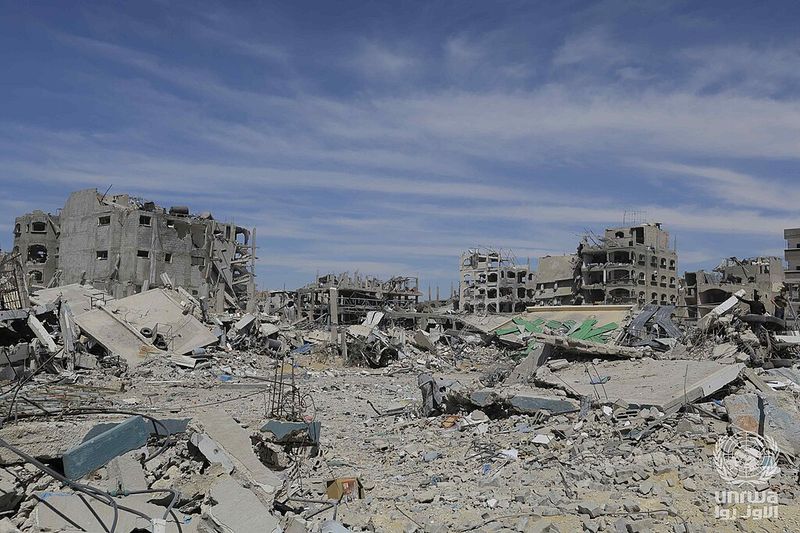
GAZA — An Israeli airstrike on Monday killed Adel Al-Helo, a worker with UNRWA, the United Nations agency for Palestinian refugees, near a water well in the Jabalia refugee camp in northern Gaza, and wounded three other people, Reuters reported. An UNRWA spokesperson told Reuters the strike hit a target on a street near the well, which was manned by UNRWA staff and a guard and was in regular use for water-well duties. The Israel Defense Forces told Reuters it was checking the request for comment; no Israeli account of the Jabalia strike had been published by the time of reporting. In a separate strike the same day, two Palestinians were killed when a vehicle was hit in western Gaza City, with others wounded — taking Monday’s toll to three dead, one of them a UN employee killed at his post.
Track it live: Israel war map — live tracker · Live wars tracker
What happened on Monday
The Jabalia water well
Jabalia, the largest of Gaza’s refugee camps, sits in the north of the Strip — an area that saw some of the war’s heaviest fighting and where water infrastructure, like almost everything else, was shattered long before the ceasefire. In a camp where piped supply cannot be assumed, a working well is not a convenience; it is a lifeline with a staff rota. According to UNRWA’s account to Reuters, that is what Al-Helo was doing on Monday: regular water-well duties, alongside colleagues and a guard, when the strike hit a target on the street near the well. He was killed and three others were wounded. UNRWA did not, in the Reuters account, identify the intended target of the strike, and neither did any other source available at publication. What is established is narrow: the location, the victim’s role and employer, the wounded, and the agency’s description of the scene. What is not established — who or what the strike was aimed at, and on what intelligence — is precisely the part the IDF said it was still checking.
The Gaza City vehicle strike
The second strike hit a vehicle in western Gaza City. Reuters reported that it killed two people and wounded others. The Palestinian news agency WAFA, carried by Jordan’s Petra news agency and reported via Fana News, put the vehicle strike’s toll at two killed and seven wounded, and gave the day’s combined total as three killed — Al-Helo in Jabalia and the two in Gaza City — including, as Fana’s headline noted, the UNRWA employee. Signal Post News keeps the two accounts attributed separately, as it does throughout this coverage: the Jabalia figures (one killed, three wounded) are UNRWA’s via Reuters; the Gaza City wounded figure of seven is WAFA’s via Petra and Fana. The totals agree on the number that matters most: three Palestinians killed in two strikes on a single Monday, fourteen months into a ceasefire.
Why this matters
A water well is a useful place to understand what the Gaza ceasefire has become. The October 2025 agreement, backed by the United States, genuinely halted the major fighting — the mass bombardments, the large ground operations, the war at full scale. Nobody serious disputes that it saved lives by the thousand. But it did not end Israeli strikes, and Monday’s are a study in the pattern that replaced the war: discrete, targeted attacks, in ones and twos, on streets and vehicles and — this time — beside a humanitarian water point, each individually explicable in the language of self-defence and each cumulatively corrosive of the word “ceasefire” itself. When the dead include a UN worker on duty at a well, the incident does double damage. It kills a man doing essential civilian work, and it raises the risk calculus for every other aid worker deciding whether a water run, a clinic shift or a distribution is safe to staff. Humanitarian operations run on exactly that calculus. Degrade it far enough and the wells go unmanned without a single further strike being fired.
It matters, too, because UNRWA is not a neutral bystander in the politics of this war, and pretending otherwise would not serve readers. Israel has accused the agency of infiltration by Hamas and moved to restrict its operations; UNRWA and the UN have rejected sweeping versions of those claims while acknowledging individual cases under investigation. Monday’s strike will be read through that fight by both sides. The verified core, however, does not depend on it: an identified UNRWA employee, named by his own agency, was killed at a water well his agency says he was manning. That fact stands whichever side of the UNRWA argument a reader starts from.
Context: a truce that froze the war, not the fire
The ceasefire that took effect in October 2025 ended the large-scale war that began with the Hamas-led attack on Israel on October 7, 2023, in which about 1,200 people were killed and more than 250 taken hostage — the atrocity Israel cites, including in its framing of current operations, as the foundation of its right to self-defence. The truce’s hardest problem was never the stopping; it was the sequencing. Hamas’s disarmament — the condition on which the agreement’s later phases depend — remains unsecured more than a year on, and the territorial picture has hardened rather than softened: Israeli troops now control around two-thirds of Gaza, Reuters reports, up from just over half when the ceasefire began. A line that was supposed to be a first step has become, in practice, a border that moves in one direction.
Inside that frame, the strikes have never really stopped — a rhythm Signal Post News has tracked through incidents such as Israeli drone strikes that killed two people in Gaza earlier this month and residents’ accounts of drones dropping explosive boxes on homes in Zeitoun and Bureij. Monday’s difference is the victim’s employer. Strikes during the truce have killed fighters and civilians, bystanders and, on the record of Gaza’s health authorities, children in large numbers. A UN staff member at a water well is a category the ceasefire’s guarantors cannot file under routine — or, if they do, that filing is itself the news.
The toll, in context
Reuters, drawing on the respective tallies, puts the since-ceasefire figures at at least 1,600 Palestinians and five Israeli soldiers killed since the October 2025 truce began. Set the two numbers side by side, as the agencies report them, and the asymmetry is the story and the dispute in one: Israel’s position is that its post-ceasefire operations are targeted responses within a self-defence framework against a Hamas that has not disarmed; the Palestinian and UN position is that a ceasefire under which 1,600 people have died on one side is a ceasefire in name more than in fact. Monday’s three deaths will not settle that argument. But each incident is a data point in it, and incidents involving UN personnel carry a particular weight in international law and diplomacy, because the protection of humanitarian workers is one of the few norms every party to this conflict has formally endorsed. The figure of five Israeli soldiers is a reminder that the truce’s violence is not one-directional even if it is one-sided in scale — soldiers have died in the same period, in a Gaza where armed groups remain armed. Both tallies are the respective authorities’ own, and both are reported here as such.
Multiple angles: what each side says, and what remains unsaid
UNRWA and the humanitarian agencies
UNRWA’s contribution to the record, via its spokesperson to Reuters, was factual and specific: a named employee, a defined duty, a described location, a wounded count. The agency has buried staff throughout this war at a rate without precedent in UN history, and each new death renews its argument that humanitarian space in Gaza exists on paper rather than in practice. Expect the agency and the UN secretariat to seek a formal Israeli accounting for the Jabalia strike; expect, on past form, that accounting to be slow, partial or classified.
Israel and the IDF
The IDF told Reuters it was checking the comment request — the standard first response, which establishes neither confirmation nor denial. Israel’s standing position is that its strikes target militants and military infrastructure, that Hamas operates within and beneath civilian areas, and that its operations since October 2023 are an exercise of self-defence. If a substantive Israeli account of the Jabalia strike emerges — identifying a target near the well — it will be added to this article’s record; the gap between the strike and any such account is itself part of how these incidents harden into opposing certainties before the facts arrive.
Palestinian officials and WAFA
WAFA’s account, carried by Petra, framed the day plainly: three Palestinians killed in Israeli airstrikes, including a UN employee. Palestinian officials have consistently characterised post-ceasefire strikes as violations of the agreement and have called on its guarantors — above all the United States — to enforce it. Monday gives that argument a UN badge to point to, and it will be pointed to.
What happens next
Scenario one: the incident is absorbed, like the others
The base case is the recent past, extended. The IDF’s check concludes without a public accounting, or with a statement that a militant target was struck; UNRWA protests; the guarantors note the incident and move on; the strikes resume their rhythm. More than 1,600 deaths have been absorbed by this ceasefire without breaking it, and the structural reasons — Hamas undisposed to disarm, Israel unwilling to withdraw further, Washington unwilling to spend leverage on enforcement — have not changed because of one terrible Monday.
Scenario two: the UN dimension forces a reckoning
A UN staff death is one of the few incident types with an institutional memory attached: it generates reports, briefings and, potentially, a Security Council conversation that a nameless strike does not. If UNRWA or the Secretary-General demands a formal investigation and sustains the demand, the Jabalia strike could become the test case for whether the ceasefire has any accountability mechanism at all — or whether it is, as its critics say, an agreement to stop counting.
Scenario three: accumulation breaks the frame
Ceasefires of this kind rarely die by a single blow. They die by accumulation — a strike with the wrong victim, at the wrong place, answered in kind, at the moment the other side’s restraint is already spent. A water well in Jabalia is not that moment, on the evidence of Monday. But every such incident spends a little of the truce’s remaining credit, and the direction of the territorial line — two-thirds and holding — means the credit is not being replenished. The next phase of the US-backed agreement, the part that was supposed to trade disarmament for withdrawal and reconstruction, remains exactly where it was in October 2025: unsigned by events.
For now, the verified record of Monday is narrow and should be kept narrow: Adel Al-Helo, an UNRWA worker, killed near a water well in Jabalia where his agency says he was on regular duty, three others wounded there; two more Palestinians killed in a strike on a vehicle in western Gaza City, seven wounded by WAFA’s count; an Israeli military that is checking; and a ceasefire in its fourteenth month that has now absorbed at least 1,600 Palestinian deaths and five Israeli soldiers by the respective tallies. A well is where a camp goes to live. On Monday it is where the ceasefire’s arithmetic added a UN name.
Read next: Israeli drone strikes kill two in Gaza as ceasefire toll passes 1,650 · Gaza residents say drones are dropping explosive boxes on homes
Sources
Sources: Reuters, “Israeli strike kills worker with UN Palestinian agency in Gaza, agency says,” November 23, 2026 (the Jabalia strike: Adel Al-Helo killed and three wounded near a water well manned by UNRWA staff and a guard on regular duties, per an UNRWA spokesperson; the IDF checking a request for comment; the second strike on a vehicle in western Gaza City killing two and wounding others; ceasefire context: the October 2025 US-backed agreement, Hamas disarmament unsecured, at least 1,600 Palestinians and five Israeli soldiers killed since the ceasefire per the respective tallies, and Israeli forces controlling around two-thirds of Gaza against just over half at the ceasefire’s start); WAFA via Jordan News Agency (Petra), reported by Fana News, “Israeli airstrikes kill three Palestinians in Gaza, including UNRWA employee,” November 23, 2026 (the Gaza City vehicle strike at two killed and seven wounded, and the day’s combined total of three killed including the UN staff member). Figures are kept attributed to their sources throughout: Jabalia casualties are UNRWA’s via Reuters; Gaza City wounded are WAFA’s via Petra/Fana; since-ceasefire totals are the respective authorities’ tallies as reported by Reuters. Israel’s self-defence framing references the October 7, 2023 Hamas-led attack, in which about 1,200 people were killed and more than 250 taken hostage. No Israeli account of the Jabalia strike had been published at the time of reporting; the IDF told Reuters it was checking.