ISRAEL-GAZA WAR
For about a week, residents along Gaza's Yellow Line say small quadcopter drones have been setting boxes packed with explosives on rooftops and beside houses, then detonating them remotely — a house-by-house demolition method that is hollowing out neighbourhoods the ceasefire was supposed to freeze in place.
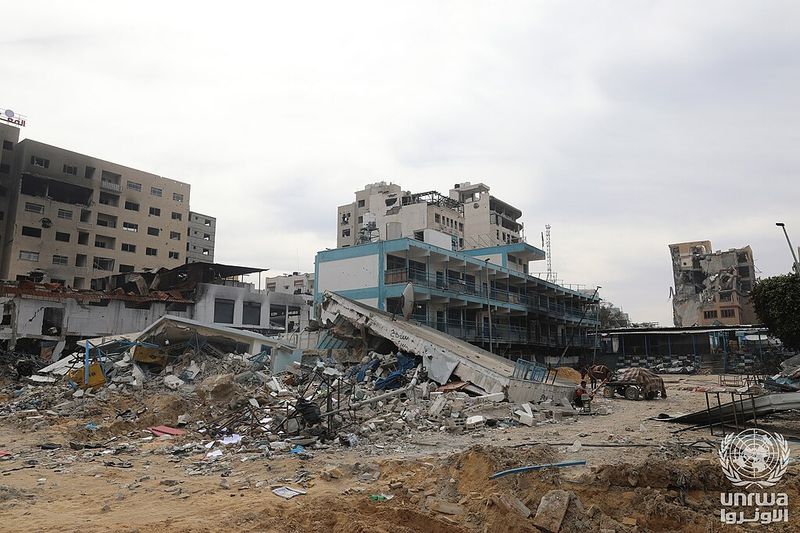
GAZA CITY — The sound comes first, residents say: the thin buzz of a small drone settling over a rooftop. Then the machine descends, sets down a box, and climbs away. Minutes later the box explodes, and another house in Gaza — already damaged, already emptied once — folds in on itself.
That sequence, described by residents and witnesses to Anadolu Agency and documented by Palestinian monitoring groups, has repeated across eastern Gaza for about a week, according to reporting published on Tuesday. The devices are quadcopter drones of the kind both sides have used throughout the war for surveillance and small munitions. The boxes, local sources told Anadolu, contain several kilograms of explosives and are detonated remotely once the drone is clear.
Track the war live: Israel war map · Live war trackers
Where the boxes have fallen
The reports cluster in the districts that back onto the "Yellow Line", the boundary of the zone Israel's military still controls inside Gaza under the ceasefire that took effect on October 10, 2025. Anadolu's reporting placed the drops east of Gaza City's Zeitoun and Tuffah neighbourhoods, in eastern Deir al-Balah, and around Bureij refugee camp in central Gaza. On November 10, local sources said, two already-evacuated houses east of Maghazi camp were demolished this way; four similar demolitions were reported around Dar al-Salam Hospital in northeastern Khan Younis.
On Friday, November 13, dozens of Palestinians fled Zeitoun fearing their homes would be targeted next, Anadolu reported. On Monday, the tempo rose: boxes were dropped near the Wadi Gaza bridge on Salah al-Din Street — the strip's main north-south artery — and north of Bureij and Nuseirat camps, with at least seven such operations reported that day, causing powerful explosions and extensive destruction, according to local sources cited by the agency.
Video footage cited in the reporting reportedly showed drones lowering boxes onto rooftops. Signal Post News has not independently verified footage of a drop, and no verified still image of one has been cleared for publication; the photographs with this article are file photographs.
What the monitors say
The International Commission to Support Palestinian Rights (ICSPR), a Palestinian rights organisation, issued a statement on Monday condemning what it described as "the use by occupation forces of drones to drop boxes rigged with explosives onto the rooftops of destroyed homes and the remaining residential buildings in populated areas, before detonating them in successive waves, as occurred in the Al-Zaytoun neighbourhood east of Gaza City." The group said the boxes were dropped and detonated repeatedly there, destroying homes and tents and displacing dozens of families who fled without their belongings.
ICSPR's legal characterisations of the practice are its own stated position; they are not adjudicated findings, and no court has ruled on the tactic. The group also documented 24 Palestinians killed across Gaza between November 11 and 15 — an overall figure for those days, not a toll attributed to the explosive boxes. No casualty figure has been attributed to the box operations themselves in the verified reporting.

Corroboration — and one claim that stands alone
The tactic's existence is corroborated from several directions. The Palestinian Information Center reported on November 13 a new wave of displacement in eastern Zeitoun after drones dropped explosive-laden boxes on homes near the Yellow Line and detonated some of them. Qatar News Agency reported on November 15 that Israeli drones dropped three explosive-laden boxes near the Abu Odeh olive press north of Bureij camp. Gaza Civil Defense's media head, Ali Hawas, urged residents never to approach or touch suspicious objects, and Government Media Office director Ismail al-Thawabta warned of the pattern near the Yellow Line, according to the Gaza Herald's field reporting.
Israeli-side reporting on November 13 described IDF drones placing explosives on buildings in Zeitoun in preparation for demolition. One Israeli outlet characterised the buildings as used for terror activity, but cited no IDF statement for that characterisation, and it stands unattributed and unevidenced in the reporting. The Israel Defense Forces has made no comment on this tactic in any of the reporting reviewed for this article, and Signal Post News does not state an Israeli purpose or target-selection rationale for the drops as fact, because none has been put on the record.
Demolition inside a ceasefire
The demolitions are unfolding inside a ceasefire that has now held, formally, for more than a year — and inside a landscape of destruction that was already near-total. Gaza's Health Ministry put the Palestinian toll since the ceasefire at 1,650 killed and 5,975 wounded as of Monday, according to Anadolu; the Government Media Office, in its own November 16 statement, put the figures at 1,649 killed in what it called 6,233 violations, and said 79,585 of 240,600 stipulated aid trucks — 33 percent — had entered. Those are the authorities' figures, carried here as attributed claims, not independently verified totals.
The demolitions reported this week sit in Israeli-controlled areas along the Yellow Line, where Israel has continued to raze structures since the ceasefire began. What is new is the delivery method — and what it implies. Earlier phases of demolition relied on airstrikes, on charges planted by ground forces, on armoured vehicles packed with explosives, and on bulldozers: methods that are either indiscriminate at scale or that put soldiers and heavy equipment on the street. A quadcopter carrying a few kilograms of explosive is cheap, precise about which roof it visits, and risks no crew. It can also work one house at a time, street by street, below the threshold of what ceasefire monitors typically record as a "strike".
That grey zone is the heart of the matter. Ceasefire verification tends to count airstrikes, shelling and gunfire. A drone-delivered demolition inside the controlling power's own zone may be logged, if it is logged at all, as engineering work. Residents experience it differently: as the removal, one rooftop at a time, of the homes they were told the truce would let them return to. The United Nations has estimated reconstruction needs at about $71.4 billion, with roughly 90 percent of Gaza's infrastructure destroyed; every house dropped this week is one more subtracted from the stock that figure assumes might be repaired. There is also a narrower, lethal hazard: a box that fails to detonate, or is left in place, becomes unexploded ordnance on a roof or in a lane where children walk — the danger behind Civil Defense's warning not to touch anything.
What happens next
Three things will show whether this is a localised clearing operation or a widening method. The first is geography: whether drops remain confined to the Yellow Line districts or appear deeper in central Gaza, around Deir al-Balah and the camps, in greater numbers. The second is monitoring: whether the ceasefire's guarantors treat drone-delivered demolition as a violation to be logged and protested, or as a permitted activity inside the controlled zone — a distinction that will shape what the truce means on the ground this winter. The third is shelter: some two million displaced Palestinians are entering the cold months in tents and damaged buildings, and each demolished house narrows the options for families camped in its street.
For now, the pattern residents describe is consistent and independently echoed by monitors, relief officials and Israeli-side reporting alike: the buzz, the box, the climb away — and then the explosion. Signal Post News will update this article if the IDF comments on the tactic or if monitors publish verified documentation of individual drops.
Related coverage: our reporting on Tuesday's deadly strikes across Gaza and on the winter floods that hit Gaza's displaced families.
Sources
Anadolu Agency via Daily Meezan — “Israel drops explosives packaged in boxes in Gaza”. ICSPR press release, November 16 — “24 Palestinians killed in three days as killing, destruction and forced displacement continue in Gaza”. Gaza Herald, November 17 — “Death traps over Gaza: Israeli drones turn Palestinian homes into explosive hazards”. Palestinian Information Center via Shafaqna, November 13 — “Gaza: New wave of displacement in Zeitoun neighborhood”. Israeli-channel reports summary, November 13 — “IDF drones drop explosives on Gaza City’s Zeitoun buildings before demolition”. Government Media Office figures via ABNA, November 17 — “Gaza GMO: 1,649 Palestinians killed in 6,233 Israeli ceasefire violations”.