Israeli settlers attack Jalud
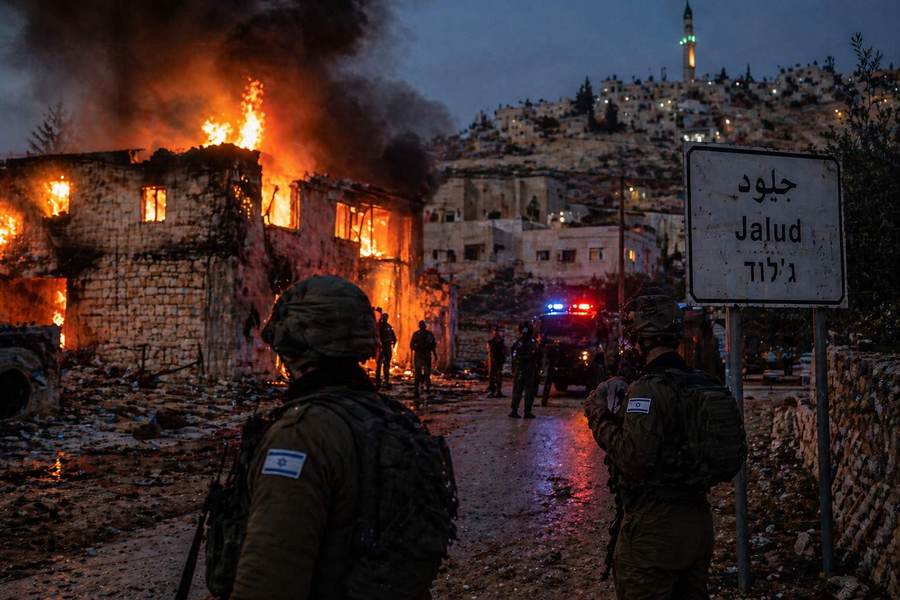
JALUD, West Bank — More than 100 Israeli settlers attacked the Palestinian village of Jalud overnight, setting fire to two homes belonging to the al-Tubasi family and forcing the family out only minutes after Israeli soldiers and police had escorted them back, according to witnesses, the family and the Israeli military.
The return was supposed to enforce a court-backed outcome after nearly two months of displacement. Instead, it became a stark demonstration of how quickly organized settler violence can overwhelm an operation protected by the state itself. Reuters reported that about 10 minutes after the family arrived, the crowd descended on the houses, blocked access roads and threw rocks at Israeli officers. Three officers were injured, the Israel Defense Forces said.
"Due to the violence, the mission to return the family to their homes was not completed," the military said. Witnesses told Reuters that troops moved the Palestinians to the roof as settlers broke in, then evacuated them when the confrontation intensified. CNN reported that members of the crowd attacked the family and police inside before setting fire to the building and the family car.
A return operation collapses in minutes
The al-Tubasi homes had been under pressure since early summer. CNN reported that settlers first besieged the property, on the edge of Jalud, before the family was forced out toward the end of July. The family pursued legal remedies and was eventually told by the body coordinating between Israeli authorities and Palestinian security officials that it could return.
Israeli police and military personnel escorted the family back early Tuesday. On the approach, the family passed settlers camped in a tent outside the property, CNN reported. Inside, the house was already in disarray. Video filmed by a son of the family showed debris on the floors, smashed doors and appliances, and jagged holes opened in walls.
Wael Tubasi told Reuters the homes were "damaged beyond description." He said doors and windows had been smashed, tiles and stairs removed, and bathrooms wrecked. The destruction meant the return operation was never simply about crossing a threshold; it was also about whether the houses remained habitable and whether Israeli forces could secure the site long enough for repairs and normal life to resume.
The answer, that night, was no. The attack pushed the family out again and left the homes burned. When Reuters journalists visited Tuesday afternoon, they found walls blackened by tar and tyre residue, about half a dozen soldiers patrolling, and the family absent.
Why the Jalud village settler attack matters
This incident stands out because every formal instrument that was supposed to protect the family's return was present: legal action, coordination with Israeli authorities, an armed police and military escort, and personnel on the scene. The operation still failed. That makes the attack more than another episode of property destruction. It tests whether court decisions and military orders can be enforced when a large settler crowd mobilizes against them.
The injured Israeli officers make the confrontation politically explosive inside Israel. Settler attacks overwhelmingly fall on Palestinians and their property, but the Jalud crowd also threw rocks at state security personnel carrying out an authorized mission. That forces the government to confront two issues at once: protection of Palestinian residents under Israeli control and the state's ability to maintain command when Israeli civilians defy soldiers and police.
The military said two settlers were arrested and an investigation was opened. Prime Minister Benjamin Netanyahu strongly condemned the violence and called on law-enforcement authorities to prosecute those responsible. Those steps matter, but the measure of the response will be what follows: whether investigators identify more participants, whether prosecutors bring charges supported by the available video and testimony, and whether courts impose penalties that deter another organized attack.
Israeli and Palestinian rights groups have long argued that settlers accused of violence are rarely punished. That record is why two arrests, by themselves, will not settle the larger question. The case will be read as a test of enforcement, not simply a test of condemnation.
The competing accounts and the state's responsibility
Reporting from the scene separates several claims that should not be collapsed into one. Reuters and CNN reported that Israeli forces escorted the family back and that settlers attacked both the family and the officers. The military says its personnel tried to carry out the return and were injured in the process. Other reports, including accounts carried by Al Jazeera and Anadolu, accused Israeli forces of protecting settlers and compelling the family to leave at gunpoint. Those accounts describe the evacuation differently.
What is undisputed across the reporting is the outcome: the family did not remain in its homes, the houses suffered extensive fire damage, and the security operation failed. Determining individual conduct during the clash belongs to the investigation. The broader responsibility is already clear. Israeli authorities approved and escorted the return; they therefore carried the duty to plan for resistance, keep access routes open and protect the family after arrival.
The scale of the crowd raises operational questions. If roughly 100 people could gather within minutes, investigators will need to establish how the mobilization occurred, whether there was advance warning, and why the force assigned to the mission could not secure the approach. Those questions are not accusations; they are the minimum required to understand a public-security failure acknowledged by the military itself.
West Bank settler violence in the 2026 data
The Jalud arson attack sits inside a sharp rise in settler-related violence. UN records cited in reporting on the incident documented more than 1,330 settler-related attacks on Palestinians from January through late July 2026 — roughly six a day and the highest rate in about two decades. The category includes attacks on people and damage to homes, vehicles, livestock and agricultural land.
That average can make the crisis sound routine. It is not. Six incidents a day means residents must calculate risk around ordinary acts: driving between villages, tending olive trees, sleeping in an isolated home or returning to property after a court decision. Repetition changes behavior even where no one is physically injured. It pushes families away from land, raises the cost of farming, and can turn temporary displacement into permanent loss.
The same day as the Jalud attack, settlers burned cars in Al Mughayyir and spray-painted "revenge" on an apartment building, Reuters reported. Resident Moussa Mohammed Hamdan described the pressure in practical terms: "Wherever they see cars, livestock or olive trees, they destroy them — anything that can hurt us. But God willing, we will remain patient." The proximity in time matters because it suggests a risk of spread and retaliation rather than an isolated dispute around one house.
Jalud's history makes the warning harder to dismiss
Jalud lies roughly 30 kilometers south of Nablus and is encircled by settlements and outposts near Shilo and Shvut Rachel. The village has repeatedly been a flashpoint. On March 22, 2026, settlers beat residents and torched cars and buildings. In April 2022, Haaretz described a settler firebomb attack there as a "pogrom." In October 2013, settlers attacked the village school and set olive groves on fire, according to reporting by Haaretz journalist Amira Hass.
That history gives the September attack a cumulative meaning. For residents, each new fire is not a stand-alone event but another reason to doubt that rebuilding will last. For Israeli authorities, repeated attacks in the same location weaken any claim that the risk was unforeseeable. For nearby settler communities, the violence creates its own danger by inviting collective suspicion toward people who did not participate and by increasing the chance of clashes with Palestinians and the army.
The Israeli election turns enforcement into a national argument
The attack is becoming an issue in Israel's coming general election. Gadi Eisenkot, Netanyahu's main challenger, blamed what happened on a "dangerous [government] policy," CNN reported. His argument is likely to be that permissive politics toward unauthorized outposts and extremist activists have eroded state authority. Netanyahu's condemnation points in the opposite direction: that the government rejects the violence and expects police and prosecutors to act.
The political stakes go beyond a contest of statements. Parties aligned with the settlement movement are central to Israel's governing coalition, while security officials must implement court orders and protect public order. Jalud compresses that tension into one scene: a Palestinian family, an Israeli escort, a settler crowd and officers struck by stones. Voters will judge not only the government's sympathies but its capacity to make its own decisions stick.
Internationally, the incident will reinforce scrutiny of settlement expansion, land seizures and the protection of Palestinian civilians. Governments that distinguish between Israel's security needs and unlawful violence by civilians will focus on whether the arrests produce credible prosecutions. The diplomatic cost rises when an escorted, court-authorized return ends in arson in front of the forces assigned to protect it.
What happens next
The immediate questions are concrete. Can the al-Tubasi family return safely? Who will secure the site while the homes are repaired? Will evidence identify organizers as well as people caught at the scene? And will the military change the size, timing or rules of future escort operations in areas where settlers can mobilize quickly?
The investigation and two arrests are the first test. A wider prosecution would signal that attacking Palestinian property and Israeli officers carries consequences even when the perpetrators come from politically influential communities. A case that stalls would reinforce the impunity argument advanced by rights groups and leave future court orders vulnerable to the same tactic: mass mobilization faster than the state can respond.
The second test is escalation. The "revenge" graffiti and vehicle fires in Al Mughayyir point to a broader cycle in which one incident becomes justification for the next. The approaching olive-harvest season is especially sensitive because Palestinian families must reach agricultural land, sometimes near settlements and outposts, while attacks on trees can destroy years of income in a single night. Security plans that protect a house but not the road to it, or an orchard but not the farmers working it, will not be enough.
Jalud's lesson is stark: a right recognized on paper is fragile if it cannot survive the first ten minutes on the ground. The credibility of Israel's courts, military and political leadership now turns on whether the al-Tubasi family's next return ends differently.
Sources
- Reuters — attack chronology, military statement, arrests, injuries and reporting from Jalud, September 29, 2026.
- CNN — the family's displacement, video from inside the home and Israeli election reaction, September 29, 2026.
- TBS News — court-ordered return and damage to the two homes, September 29, 2026.
- The Wall Street Journal — court order, security deployment and the rise in settler violence.