Gaza strikes kill two
Gaza strikes kill twoNuseirat refugee camp strikeGaza City rooftop strikeGaza ceasefire violationsGaza death toll since ceasefireMiliband stain on the conscience of the worldHamas disarm GazaIsrael Hamas ceasefire October 2025Gaza reconstruction stalledIsraeli strikes Gaza September 2026
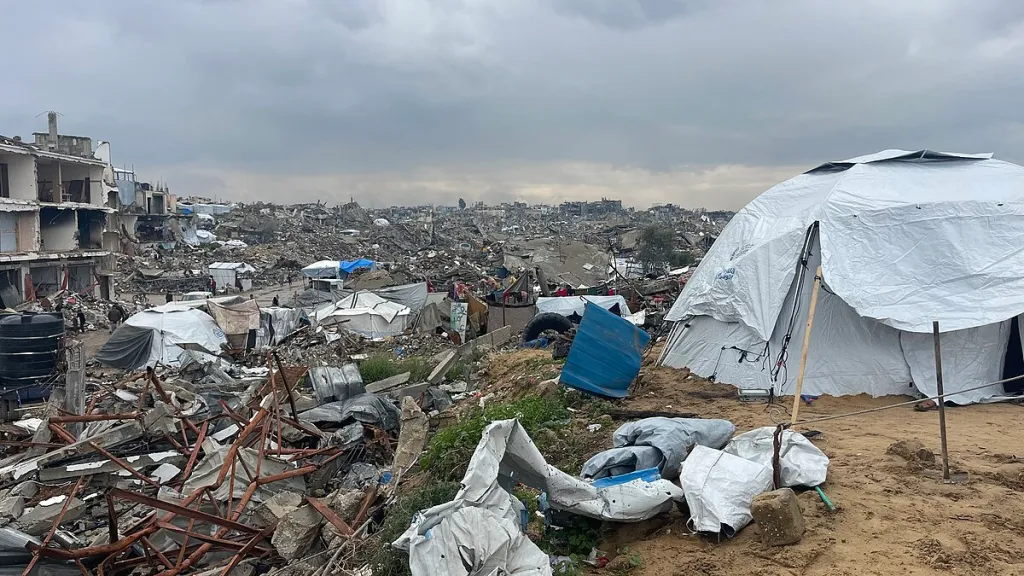
GAZA CITY — Gaza strikes kill two Palestinians in separate attacks on Monday, according to Palestinian officials and reporting by Reuters. A woman was killed and her husband and several other people were wounded when a strike hit the rooftop of their building in Gaza City. In central Gaza, another strike killed a woman and wounded others in Nuseirat refugee camp.
The Israeli military said it struck a militant in Nuseirat and gave no further details. It did not immediately comment on the Gaza City strike. Those statements leave a familiar evidentiary gap: Palestinian officials describe civilian deaths and damage, while the military describes a militant target without publicly providing information that would allow the claim to be independently tested.
Two attacks, two women killed
Nuseirat refugee camp strike
The Nuseirat refugee camp strike killed one woman and wounded several other people, Palestinian officials said. Israel's military acknowledged a strike in Nuseirat, saying it targeted a militant, but did not identify the person or explain the operational circumstances. The two accounts are not mutually exclusive, but neither resolves whether the civilian harm was anticipated, avoidable or proportionate.
Gaza City rooftop strike
In the Gaza City rooftop strike, officials said a woman was killed when the roof of her building was hit; her husband and others were wounded. The Israeli military did not immediately comment on that incident. With access and independent on-site verification constrained, the most responsible account is to attribute each claim and avoid assigning motive beyond what the parties have said.
Why this matters
Each strike lands on a ceasefire that increasingly exists on paper more than in civilian experience. Palestinian authorities say at least 1,400 people have been killed since the U.S.-brokered truce took effect; WAFA's Monday update put the number above 1,420. Spread across roughly a year, 1,400 deaths work out to close to four killings a day. That is not the tempo of the war's most intense phases, but it is far too high to function as peace.
A steady daily rate keeps Gaza's war economy of grief running: funerals, emergency care, displacement, damaged homes and the uncertainty of whether a strike will be treated as an isolated exception or a breach requiring retaliation. It also poisons reconstruction bargaining. Donors cannot price projects, contractors cannot protect crews and families cannot decide where to return when violence remains routine enough to destroy new work.
The Gaza death toll since ceasefire
Palestinian health authorities say more than 73,000 people have been killed in Gaza since October 7, 2023; WAFA's Monday update put the total above 74,000. The difference reflects separately timed updates and should not be blended into a false single figure. The post-ceasefire toll of at least 1,400 represents roughly 2% of the broader reported war total.
That percentage can sound small only because the denominator is catastrophic. In human and political terms, more than 1,400 deaths after a truce are enough to make the word “ceasefire” lose credibility. Israel's military says four Israeli soldiers have been killed since the agreement took effect. Every casualty total is attributed because the parties collect data under wartime conditions and independent verification remains difficult.
How the Israel-Hamas ceasefire of October 2025 stalled
The Israel-Hamas ceasefire October 2025 was structured as a bridge from a halt in major combat toward a broader political and security arrangement, with eventual reconstruction tied to later stages. Its central bargain never fully closed: Israel wants Hamas disarmed and security threats removed; Hamas has resisted giving up its weapons without firm guarantees over Israeli withdrawal and the future governance of Gaza.
That sequencing problem has become the agreement's trap. Israel argues that withdrawing before disarmament could allow Hamas to rebuild. Hamas argues that disarming before a verified withdrawal would surrender its remaining leverage. With neither side willing to move first, low-level strikes, raids and accusations of violations have filled the space where implementation should have been.
Hamas disarm Gaza versus Israeli withdrawal
The demand that Hamas disarm Gaza is more than a technical weapons question. It reaches command authority, policing, border security and the identity of any postwar government. Israeli withdrawal is equally complex because it requires agreed lines, monitoring and consequences for breaches. Without a trusted sequence or outside guarantor, each step creates a vulnerability the other side may exploit.
Who gains from continued low-level strikes — and who loses
Hard-liners on both sides can benefit politically from a ceasefire that never becomes a settlement. Continued Israeli operations allow the government to say it is still acting against militants rather than accepting an unresolved threat. Hamas can point to continuing strikes as evidence that disarmament would not protect Palestinians. Each narrative reinforces the other's.
Civilians lose first. They face the physical danger and the collapse of confidence needed to rebuild homes, schools and businesses. Hostage-deal leverage also erodes: renewed violence makes every exchange or remains-transfer negotiation more vulnerable to suspension. The United States loses diplomatic capital because an agreement it brokered is judged by what happens after the signatures, not by the ceremony that produced them.
Rights groups and foreign critics focus on civilian protection and accountability. The Israeli military says its operations target militants. Both propositions require evidence at the level of each strike: who was targeted, what precautions were taken, who was harmed and whether the force used met international-law obligations.
Miliband: “stain on the conscience of the world”
UK Foreign Secretary Ed Miliband told Labour's annual conference on Monday that Israeli actions in Gaza and the occupied West Bank were “a stain on the conscience of the world,” one of his government's sharpest criticisms of Prime Minister Benjamin Netanyahu's government. Miliband said Labour under Andy Burnham had changed its approach to challenge abuses.
The Miliband “stain on the conscience of the world” line matters because it moves criticism from operational conduct to moral and political responsibility. Supporters of Israel will argue that such language can understate the continuing threat from Hamas and the problem of armed groups operating among civilians. Critics answer that a ceasefire cannot be meaningful if civilian deaths continue at a daily rate and accountability remains remote.
Why Gaza reconstruction remains stalled
Gaza reconstruction stalled because security, governance and money are inseparable. Gulf and Western donors may finance housing, utilities and hospitals, but they want assurance that projects will not be destroyed in renewed fighting. Israel wants materials and funds monitored so they cannot strengthen Hamas. Palestinians need rapid rebuilding without a system so restrictive that every shipment becomes a political negotiation.
The result is a circular failure: reconstruction needs calm, but calm depends partly on people seeing a credible future beyond camps and ruins. Delays deepen displacement and resentment; renewed strikes make donors more cautious; caution slows rebuilding and leaves armed actors with fewer incentives to compromise.
What happens next
Three tracks will determine whether the truce hardens or unravels. The first is a disarmament formula: staged weapons handovers, third-party monitoring or a new Palestinian security structure could narrow the gap, but only if paired with a credible Israeli withdrawal schedule. The second is reconstruction finance, including who holds funds, who approves projects and what happens if fighting resumes.
The third is U.S. pressure. Washington could press Israel to tighten targeting and publish fuller strike reviews while pushing regional partners to offer reconstruction money and security guarantees. It could also condition diplomatic cover or assistance on measurable compliance by both sides. Without enforcement, appeals for restraint are likely to produce the same pattern: brief quiet, disputed incidents, retaliation and another round of blame.
The near-term test is simple. If investigations of the Gaza City and Nuseirat attacks remain opaque and the casualty count continues climbing, the ceasefire will become less a path out of war than a label placed over a lower-intensity phase of it.
Sources and reporting notes
- Reuters, September 28, 2026: two fatal strikes, the Israeli military's Nuseirat statement and ceasefire context.
- Arab News report via WE News English, September 28, 2026: Gaza City and Nuseirat casualty details.
- WAFA report via Demócrata, September 28, 2026: updated Palestinian casualty totals and the Gaza City strike.
Reporting cutoff: September 28, 2026 at 1:50 p.m. PDT. Casualty figures and battlefield claims are attributed to the authorities and organizations that reported them; Signal Post News could not independently verify the incidents.