Sports · Formula 1 · Mexico City Grand Prix
Sports / Mexico City — The Hamilton first Ferrari pole arrived 1,197 days after his last one, by nine thousandths of a second, at 41 years old — and it has set up the most loaded grid of the Formula 1 season. Lewis Hamilton starts first in Sunday’s Mexico City Grand Prix, George Russell second and Charles Leclerc third, and Kimi Antonelli — the 20-year-old who replaced Hamilton at Mercedes — starts fourth, needing only a ninth-place finish to become the youngest world champion in the sport’s history and Italy’s first since Alberto Ascari in 1953.
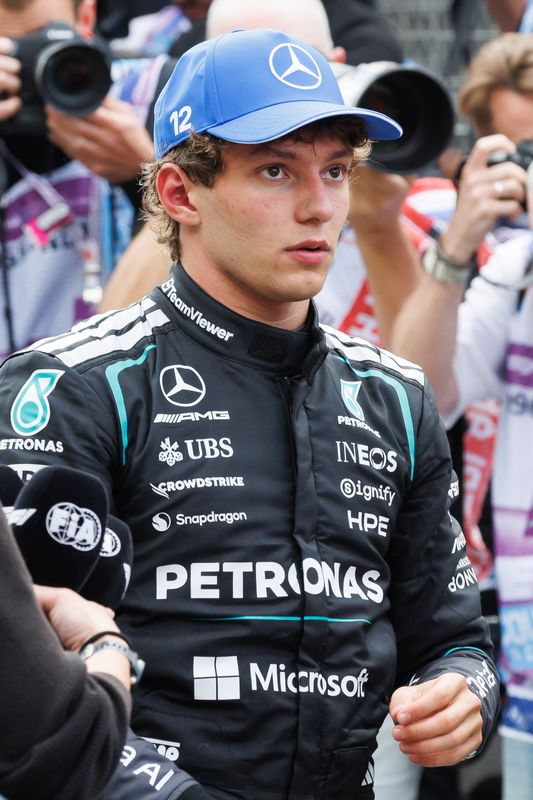
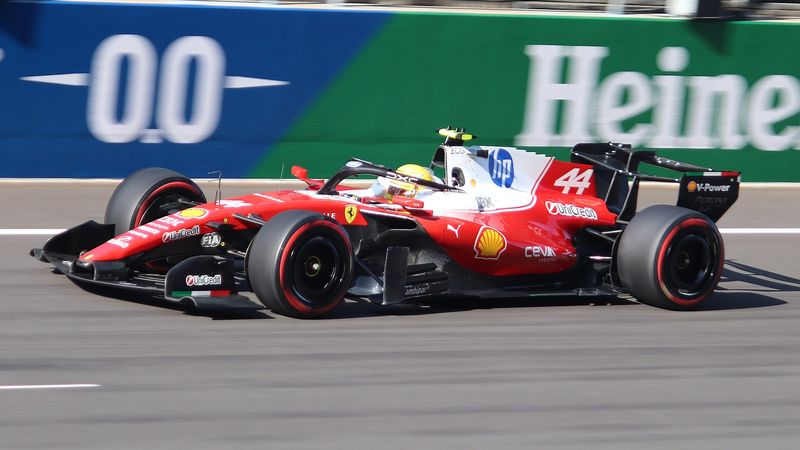
MEXICO CITY, October 31, 2026 — Lewis Hamilton took pole position for the Mexico City Grand Prix on Saturday, and every layer of the result carries its own history. The lap — 1:16.514 around the Autódromo Hermanos Rodríguez — was the 105th pole of Hamilton’s career, his first for Ferrari, and his first at a Grand Prix since Hungary in 2023. Reuters put the wait at 1,197 days. At 41, Hamilton is the oldest driver to take a Formula 1 pole since Mario Andretti in 1982, according to AFP, and the lap was also Ferrari’s first pole position of the entire 2026 season — delivered, in the end, by the driver the team signed to end exactly this kind of drought.
The margin tells its own story about how fine the line was. George Russell’s Mercedes stopped the clock at 1:16.523 — 0.009 seconds slower, a gap that at racing speed is measured in centimetres rather than car lengths. Charles Leclerc made it two Ferraris in the top three with a 1:16.633, and the first five cars in the Mexico City Grand Prix qualifying results were covered by less than two-tenths of a second: Max Verstappen was fourth fastest in 1:16.692 and Kimi Antonelli fifth in 1:16.707. Hamilton, informed of the numbers afterwards, was characteristically brief about what they meant to him. “I think this is my first pole with Ferrari, and 105, I like that number,” he said, in comments published by Formula1.com. “Where there’s a will, there’s a way.” Ferrari team principal Fred Vasseur called it “a fantastic job” — an understatement, perhaps, for a team that had waited until the season’s final stretch for its first Saturday headline.
Mexico City Grand Prix qualifying results: a front five covered by 0.193 seconds
The full qualifying order at the front reshuffles once a penalty is applied, and the reshuffle matters enormously for Sunday. Verstappen’s 1:16.692 was the fourth-fastest time of the session, but the Red Bull driver carries a one-place grid penalty for a clash with Liam Lawson during Friday practice, which drops him to fifth on the grid. Antonelli, fifth fastest, therefore moves up to fourth — the outside of the second row, and the cleanest possible launch position for the long run down to Turn 1. Lando Norris qualified sixth for McLaren. The day’s biggest casualty was Oscar Piastri, eliminated in Q2 and left 13th on the grid, according to Fox Sports Australia — a result that removes the second McLaren from the front-group fight entirely and leaves Norris to carry the team’s race alone.
The FIA’s account of the session described a thrilling qualifying hour, and the numbers support the adjective. Five drivers from four teams — Ferrari, Mercedes, Red Bull and Mercedes again — inside 0.193 seconds, at a circuit 2,240 metres above sea level where the thin air strips cars of downforce and engines of power, and where small errors are amplified rather than absorbed. Hamilton’s pole lap was not a blowout delivered by a dominant car; it was a lap extracted at the limit of a session in which the top of the field was effectively tied. That is what makes the 0.009 seconds to Russell the defining statistic of the day: the Hamilton Russell qualifying Mexico duel was decided by less than the blink of an eye, between the two men who — along with Antonelli — still hold live mathematical claims on the world championship.
The title mathematics: ninth place, and Antonelli is champion
Antonelli arrives at Sunday’s race — start time 14:00 local in Mexico City — leading the championship with 365 points. Russell is second on 242, which is 123 points behind; Hamilton is third on 241, 124 behind. After this weekend, exactly 100 points will remain on the table across the season’s final races. That single comparison — gaps of 123 and 124 against a maximum remaining haul of 100 — is why Sunday is a coronation waiting for a signature rather than a contest still in balance, and why the Antonelli title Mexico scenarios can be stated so plainly.
The simple version: ninth place seals it
If Antonelli finishes ninth, he scores two points, reaches 367, and cannot be caught: neither Russell nor Hamilton could close a gap of 125 or more with only 100 points left to win. Ninth place is the whole requirement — the Antonelli needs ninth place title equation that has followed him since his win in Austin last weekend, where he took his ninth victory of the season but saw Russell and Hamilton finish high enough to keep the championship technically alive for one more week. A driver who has won nine races this year needs to finish ninth in one more. The asymmetry is the story of the season’s endgame.
The scoreless route: champion even with zero points
The mathematics are even more forgiving than the headline scenario. If neither Russell nor Hamilton wins the race on Sunday, Antonelli is world champion even if he scores nothing at all — a retirement, a first-lap incident, a pointless afternoon would all still end with the title in his hands, because a non-win caps either rival’s maximum final total below his current 365. In other words, the championship leader does not strictly need to beat anyone on Sunday. He needs only for one specific thing not to happen: a victory by one of the two men chasing him.
What Russell and Hamilton must do: win, or wait for Brazil
For the title to survive Mexico, Russell or Hamilton must win the race — nothing less keeps either man inside the 100-point window with a mathematical path remaining. Second place is not enough; a one-two finish for the two chasers is not enough. That condition is what makes Hamilton’s pole so pointed: of the two drivers who must win, the one starting first is the 41-year-old, and the one starting second is Russell. Both men control their own side of the condition. And both know that even a win only delays the outcome to São Paulo — it does not reverse it, because Antonelli would carry a lead of at least 98 points into a run-in worth 100, needing almost nothing more. Reuters’ framing of the weekend has been consistent: this is a coronation that one result can postpone, not prevent.
A hard week to be the favourite: illness, noise and a borrowed fourth place
What the mathematics cannot capture is the condition in which Antonelli has arrived at his coronation weekend. He is still recovering from the illness that struck him on Thursday — a high fever and stomach problems that kept him away from the circuit on media day entirely. “I still haven’t recovered completely,” he told reporters, describing low energy and poor sleep across the weekend, in comments reported by Reuters. The physical problem has run in parallel with a psychological one that he described with unusual candour: “Definitely, I’ve been a bit more tense than usual, especially when you keep hearing, wherever you go, any time of the day, the same thing... People telling that it’s already done. Knowing myself, I’ve been trying to block as much as possible this noise, but it hasn’t been easy.”
Qualifying reflected the strain. Antonelli was fifth fastest — his lowest Saturday return in weeks — and he did not dress it up, saying he had struggled for tyre feeling through Q3 and that “it hasn’t been my finest drive.” Verstappen’s penalty then handed him a grid place he had not earned on the stopwatch, lifting him to fourth, and his focus in the same interviews was already on the start: “Turn One is always very tricky... if we get a good start, we have a good chance to move forward.” His family has arrived in Mexico City for the weekend, and his plan for Saturday night was deliberately unglamorous — disconnect, and sleep; TSN and AP reported his joke that he would “bombard myself with melatonin.” There is also a team prize riding on Sunday: Mercedes can clinch the constructors’ championship in Mexico for the first time since 2021, according to AP — meaning Antonelli’s employers could leave the Autódromo with both titles settled in a single afternoon.
Why this matters
The man he replaced starts directly ahead of him
Every championship has a moment that condenses its story into a single image, and Mexico City has produced one before a wheel has turned in anger. Antonelli holds the Mercedes seat that Hamilton vacated. The succession was the sport’s biggest story of the last two years: the seven-time champion leaving for Ferrari, the teenager promoted in his place, and an open question — asked in good faith — about whether Mercedes had traded certainty for potential. Sunday’s grid answers the question in the most cinematic way available. The 20-year-old can take the title. The 41-year-old he replaced starts the race at the front of it, in the red car, holding the only lever that can delay him. Neither man arranged this; the stopwatch did — by 0.009 seconds over the team-mate Antonelli shares a garage with. If Hamilton wins on Sunday, the coronation moves to Brazil and the delay will be remembered as the old champion’s last word in a title race he could not win himself. If he does not, the succession is complete in a single frame: the replacement crowned, the replaced man the first to be beaten by the arithmetic.
Italy’s 73-year wait, and a record that has stood since Vettel
The Kimi Antonelli youngest world champion storyline carries a second, older weight. Italy has not produced a Formula 1 world champion since Alberto Ascari won his second title in 1953 — a 73-year drought for the country that gave the sport Ferrari, its founding teams and some of its defining drivers. Ferrari itself, for all its history, has spent those decades fielding champions from elsewhere. That an Italian driver is now one ninth-place finish from ending the wait — at 20 years old, in his second season, driving for a German team while an Englishman in an Italian car tries to delay him — is the kind of cross-current that makes this more than a statistics weekend. The youngest-champion record, meanwhile, has been one of the sport’s most durable marks of precocity; Antonelli would not edge it but reset it, as the first driver to take the title at 20 in a season he has led for most of the year.
Hamilton’s long road to a pole in red
It is worth pausing on what Saturday ended for Hamilton himself. The move to Ferrari was sold — by him, carefully — as a final challenge rather than a farewell tour, but the first pole position for the team took until the closing weeks of his second season in red to arrive, and his last pole of any kind dated back 1,197 days to Hungary 2023, in a different car, a different era of his career. Reuters’ account of the Mexico session led with the drought’s end for a reason: at 41, as the oldest polesitter since Andretti in 1982, Hamilton has now given Ferrari its first pole of 2026 and himself a 105th — a number, as he noted, that he likes. Whatever Sunday brings, the Saturday of this weekend belongs to him outright, and it arrived not as a nostalgia act but as the fastest lap of the day, won against his successor’s team-mate by nine thousandths.
The risks: Turn 1, thin air and a five-time winner in the mirrors
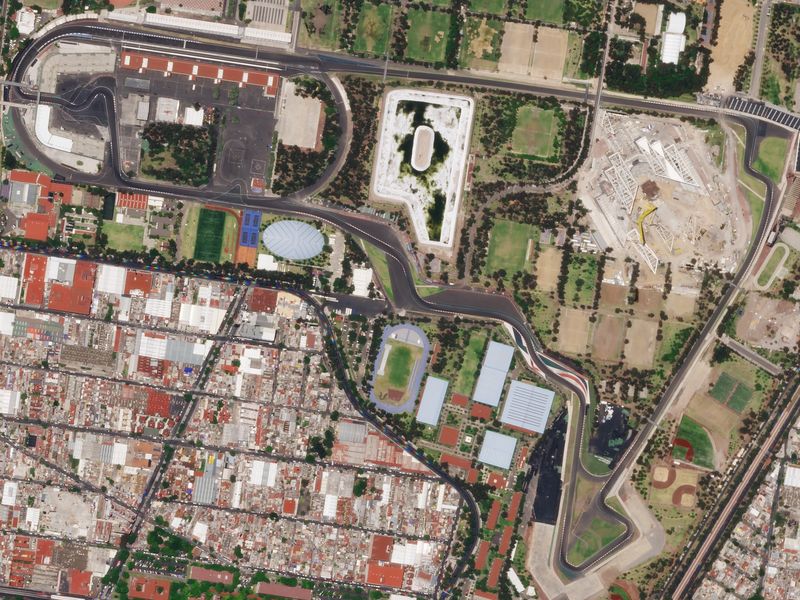
None of this makes Sunday a procession, and the reasons are specific to this circuit. The run from the grid to Turn 1 at the Autódromo Hermanos Rodríguez is one of the longest in Formula 1 — long enough for slipstreams to reorder a grid before the braking zone, and the first corner complex here has a long history of contact deciding races in its opening seconds. Antonelli starts fourth, on the outside; a poor getaway or a squeezed line could cost him the handful of places that separate comfort from a long afternoon spent fighting through the midfield with a championship’s worth of caution in every move. The altitude cuts the other way for everyone: at roughly 2,240 metres, the thin air reduces downforce and cooling alike, punishes engines and brakes over a full race distance, and makes tyre behaviour harder to predict — a particular concern for a driver who said on Saturday that tyre feeling was exactly what he could not find in Q3.
Then there is the man directly behind him. Verstappen starts fifth, one place back, and he is a five-time winner of this Grand Prix — the most successful driver at this circuit in the field, with a record of turning Mexico City Sundays into processions of his own. A Verstappen launch past Antonelli into Turn 1 is the single most predictable disruption on the grid. Layered over all of it is the human factor Antonelli himself named: he is ill, short on sleep, admittedly more tense than usual, and being told hourly that the title is already his. The scenarios say ninth place is enough. The circuit, the altitude, the five-time winner behind him and his own condition all say that ninth place still has to be survived, corner by corner, for 71 laps. Compare the run-in with the chaos of the Sepang weekend earlier this month, where the race unravelled through failures no one planned: Mexico does not need chaos to complicate a coronation — its first corner has been doing that job for years.
What happens next
Sunday’s race starts at 14:00 local time, and its outcomes sort into three clean branches. First, the coronation: Antonelli finishes ninth or better, or neither Russell nor Hamilton wins — in which case Formula 1 has its youngest champion, Italy has its first since Ascari, and Mercedes, if the constructors’ mathematics also lands, leaves Mexico with the sport’s present entirely in its hands. Second, the delay: Russell or Hamilton wins, Antonelli’s lead shrinks to the high nineties, and the title travels to São Paulo with the formalities unfinished — a scenario that would extend the season’s story by a fortnight, hand the winner a famous victory in its own right, and change nothing about the direction of travel. Third, the mess: a first-lap incident or mechanical failure scrambles the order, and the title is settled by other people’s results in the stewards’ room arithmetic rather than on the road — the one outcome nobody in the paddock wants attached to a record-breaking championship.
Beyond the drivers’ title, the undercard has its own stakes. Russell and Hamilton are separated by a single point in the fight for second in the championship — 242 to 241 — and Sunday pays 25 to its winner; whoever of the two takes the race almost certainly takes control of that contest too. Ferrari, with both cars in the top three on the grid and its first pole of the year finally banked, has a genuine chance of a first win of the season’s run-in and the momentum that would carry into 2027. And the wider calendar keeps expanding beneath all of it: Formula 1’s global map is still being redrawn, as Signal Post News reported in its coverage of the ten-year deal to take the sport back to Africa with a Grand Prix in Rwanda — the championship Antonelli is about to inherit will be contested on more continents, in more time zones, than any before it. But all of that is next season’s story. This season’s is a 41-year-old on pole for the first time in red, a 20-year-old four places back with a fever and a two-point target, and 0.009 seconds that decided which of them gets to set the terms of Sunday.
Reporting based on coverage by Reuters, the FIA, Formula1.com, AFP, Sky Sports and Autosport; see the sources below.
Sources
- Reuters, October 31, 2026 — Hamilton ends his pole drought in Mexico City qualifying: the 1:16.514 lap, the 105th pole of his career, the 1,197-day wait since Hungary 2023, and the title context — Antonelli as Italy’s prospective first champion since Alberto Ascari in 1953.
- Reuters, October 31, 2026 — Antonelli on the title pressure: his incomplete recovery from Thursday’s fever and stomach illness, the missed media day, his admitted tension at being told the title is “already done”, and his struggle for tyre feeling in Q3.
- FIA, October 31, 2026 — The federation’s official account of Mexico City qualifying: Hamilton’s first Ferrari pole position and the session classification, including Verstappen’s one-place grid penalty.
- Formula1.com, October 31, 2026 — Hamilton clinches his first pole with Ferrari in Mexico City qualifying: his reaction (“I like that number... Where there’s a will, there’s a way”) and Ferrari team principal Fred Vasseur’s verdict of “a fantastic job”.