Updated October 1, 2026 at 11:55 a.m. PDT
Gaza journalists killed
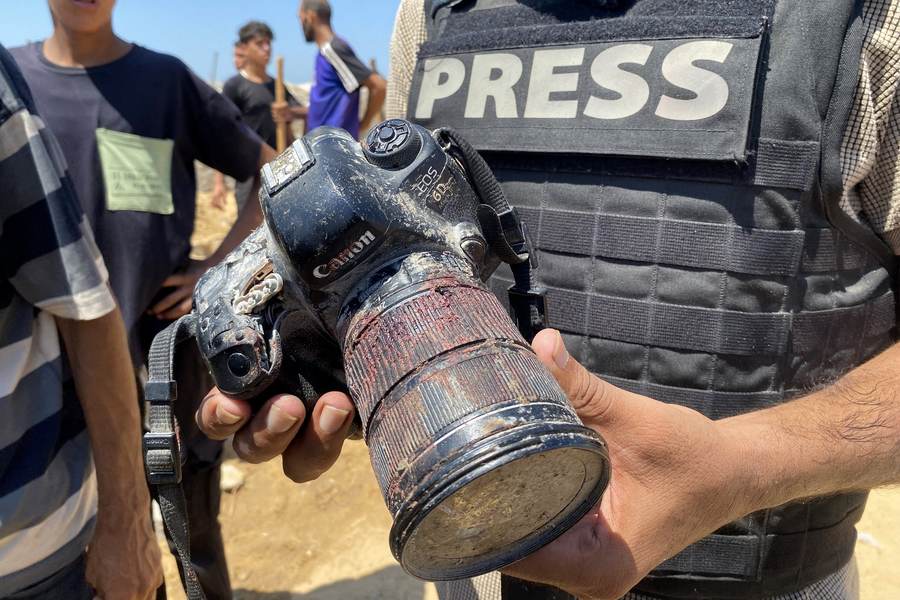
The phrase "Gaza journalists killed" has been among the most repeated — and most weaponized — statistics of the Israel-Hamas war. This week it cracked open. On October 1, 2026, the Israel Defense Forces published a database of 170 Gazans whose deaths were reported around the world as the killing of journalists, identifying each one as a member of the military wings of Hamas, Palestinian Islamic Jihad, or smaller armed groups. The release landed days after the Committee to Protect Journalists stripped 19 names from its own casualty tally after finding combat involvement, and days after a Telegraph investigation found 53 of the "journalists" on a BBC Arabic list had ties to Hamas or other terror groups. Three institutions, three revisions, one uncomfortable question: who was actually holding the camera — and who was holding the rifle?
What happened: 170 files in a single day
According to the IDF, each of the 170 files names the individual, their media affiliation where applicable, their armed organization, and their military position — frequently accompanied by photographs and military identification material. An analysis by Jewish Onliner of the 170 records found 118 Hamas members, 50 Palestinian Islamic Jihad operatives, and two others from the Popular Resistance Committees and a group identified as the Lords of the Desert. Forty-four held command positions. Seventeen took part in the October 7, 2023 infiltration of Israel that started the war. The listed military roles stretch well beyond media work: snipers, intelligence personnel, engineering operatives, operations officers, military trainers, commanders — and sixteen who served in military propaganda units. The release dramatically expanded an IDF project that had initially gone online with just ten names. Among the first ten: Mohammed Mahmoud Abdel Aziz Abu Sharia, who worked for the Shams News Agency while the IDF says he served as a PIJ sniper in the Gaza Brigade — his name had been engraved at the Reporters Without Borders memorial site in France; and Amro Nahid Abdel Rahman Abu Odeh, a photographer for Reuters whom the IDF identifies as a Hamas squad commander in the military wing's photography unit. Other files name Hassan Abdel Fattah Mohammed Aslih — who worked for AP, CNN and Alam24 while allegedly serving as a Hamas operative in the Southern Khan Yunis Battalion and infiltrating Israel on October 7 — as well as journalists tied to AFP, the BBC, Le Monde, Radio France, Anadolu Agency, and Al Jazeera, including six Al Jazeera staffers the IDF identifies as Hamas or PIJ operatives.
The independent corroboration: CPJ's audit and the Telegraph's 53
The IDF's claims do not stand alone. On September 24, the Committee to Protect Journalists — the most-cited independent tracker of journalist deaths — announced a comprehensive review of its Israel-Gaza database covering 229 deaths. It removed 22 people: 19 after its investigation established they had engaged in combat, and three because their work as journalists could not be verified. It reinstated six cases, including two Israeli journalists killed in the October 7 attack, and reclassified 12. Its revised tally: 191 Palestinian journalists and media workers killed. CPJ said the review was triggered in part by obituaries published by Hamas and Palestinian Islamic Jihad themselves identifying supposed journalists as members of their armed wings — the militant groups supplied the disproof. CEO Jodie Ginsberg said the group bases its determinations solely on whether individuals meet its definitions of a journalist, "not an individual's affiliation or views, nor in response to pressure or intimidation from any government or interest group." The overlap with the IDF files is striking: 18 of the 19 people CPJ removed for combat involvement match names in the IDF's 170, and 26 of the 27 people CPJ has ever removed for combat involvement appear in the IDF database. Separately, a Telegraph investigation reported September 28-29 found that 53 of the more than 180 "journalists" on a BBC Arabic running tally had ties to Hamas or other terror groups; the BBC said the list, last updated in August 2025, was based on information available at the time and is now under review. Ten of the 53 appeared on both the BBC Arabic and English-language BBC lists. CPJ has already removed 12 of those names. One case cited: Abdullah Darwish, described by BBC Arabic as an Al-Aqsa TV cameraman, photographed in a uniform associated with Hamas's Al-Qassam Brigades with indications he took part in October 7. A caveat that matters: reporting on the 53 notes the evidence differs significantly between individuals and does not establish all of them were combatants. And a 2025 study by the Meir Amit Intelligence and Terrorism Information Center, examining 266 Gaza residents classified as journalists or media workers killed through November 2025, found roughly 60 percent were members of or affiliated with terrorist organizations.
Why this matters
The journalist death toll has not been a footnote in this war — it has been ammunition. The figure, most recently 263 per Gaza's Hamas-run health ministry, has anchored United Nations condemnations, a complaint before the International Criminal Court (one of the IDF's ten named men, Asem Adli Ahmed Al-Barsh, had his death included in an ICC filing), and the broader case that Israel systematically targets the press. If a large share of the counted dead were combatants, the evidentiary foundation of that case shifts under it. There is a second, quieter casualty: the press vest itself. Under international humanitarian law, journalists are civilians — unless they take a direct part in hostilities. The blue vest is supposed to be a shield. Every documented case of dual-hatting — camera in one hand, rifle in the other, sometimes literally in the same week — corrodes the protective power of that emblem for everyone still working in Gaza, including the genuine reporters whose deaths are not in dispute. And there is a third lesson, about numbers as weapons: casualty statistics in this war are political instruments wielded by all sides, and this week demonstrated that the instruments themselves need calibration before anyone cites them.
How we got here: the making of a death toll
To understand how 170 alleged militants ended up on journalists' memorials, start with Gaza's media ecosystem. Outlets like Al-Aqsa TV, Al-Quds Al-Youm, Shams News Agency and BarQ Gaza are simultaneously broadcasters and organs of Hamas-aligned movements; in Gaza, the line between "media worker" and "operative" was blurry by design, not accident — sixteen of the IDF's 170 served in military propaganda units, a category that exists precisely on that blurred line. The international tallies were then built on names supplied locally and rarely independently verified, because Israel has barred foreign journalists from entering Gaza for most of the war — satellite imagery remains, as Bellingcat noted this week, one of the only ways to assess what is happening on the ground. So the Reporters Without Borders memorial in France engraved Abu Sharia's name, the UN condemned Abu Armana's killing, and the numbers compounded — until Hamas and Islamic Jihad's own martyr obituaries began contradicting the press lists, handing CPJ the evidence for its purge. This is not the first round: in October 2024 the IDF published what it said were captured Hamas documents identifying six Al Jazeera journalists as Hamas or PIJ members. And none of this erases the undisputed cases: AP visual journalist Mariam Dagga was killed with 21 others, including rescue workers and journalists, in Israel's August 2025 double strike on a Gaza hospital — a strike nobody claims involved combatants with cameras.
What the numbers actually imply
Put the figures side by side and read them carefully. The IDF's 170 represents about 65 percent of the 263 journalist deaths claimed by Gaza's health ministry — strikingly close to the Meir Amit study's independently derived 60 percent, though both methodologies lean partly on the militant groups' own martyr materials and neither is an adjudication. The strongest number in the whole affair is not 170 but 26 of 27: the near-total overlap between the people CPJ itself removed for combat involvement and the names in the IDF files — an independent watchdog converging on the same names as the Israeli military. Forty-four command positions and seventeen October 7 infiltrators suggest this was not a handful of marginal cases. But three cautions are mandatory. First, the IDF's files are claims, not court findings; some employers have rejected IDF evidence in past cases. Second, "affiliation" is not the same as "direct participation in hostilities" — the legal threshold under humanitarian law — and membership lists alone do not settle whether any particular strike was lawful. Third, even CPJ's corrected tally of 191 makes this, in CPJ's words, "by far" the deadliest conflict for journalists and media workers worldwide since 2023. The revision changes the composition of the toll far more than its historic scale.
Who gains, who loses, and what the critics say
The winners are legible. Israel's diplomatic position gains an evidentiary counterweight to the "Israel targets journalists" charge just as Gaza's toll faces renewed scrutiny — the IDF's Gaza Division commander said this week his forces control 63 percent of the Strip and that Hamas is "in very serious condition," and narrative control matters as much as terrain. CPJ gains credibility the hard way, by publishing its own errors. And the recently launched Gaza GenoLIE campaign, endorsed by more than 100 civil society organizations, gains its central exhibit. The losers are legible too: Hamas's information strategy, which relied on Western press-freedom institutions laundering its casualty claims; the authority of UN and NGO statistics built on unverified local sourcing; and the wire services — Reuters, AP, AFP, the BBC — each of which now has names from its own Gaza stringer networks on a militant roster, raising questions about vetting that will not go away. The most exposed losers of all are working Gazan journalists: suspicion now attaches to the press vest itself, and the next reporter in a blue vest will be read through this week's files. The critics' answer deserves equal weight. Press-freedom advocates note that none of this retroactively legalizes any individual strike, that the IDF has cried "militant journalist" before with evidence employers rejected, and that the timing — amid a fragile ceasefire, ongoing Israeli strikes, and 105 bodies recovered from Gaza City rubble buried this week — looks like narrative management. Their core point stands untouched by the revisions: even at 191, Israel has killed more journalists in this war than any army in any recent conflict, and affiliation lists do not answer the lawfulness question case by case.
What happens next
Three things are now near-certain. First, newsroom vetting will tighten: expect more names challenged, more stringers dropped, and more friction between editors who need Gaza coverage and the reality that some of their fixers appear in militant rosters. Second, the legal fight will absorb this: the ICC complaint naming Al-Barsh is now complicated, and international lawyers will spend months litigating the line between "member of an armed group" and "direct participant in hostilities" — a distinction the IDF's database blurs and the law does not. Third, the toll will keep moving. Watch whether Reporters Without Borders revises its memorial, whether the UN updates its condemnations, and whether Gaza's health ministry — which has not distinguished combatants from civilians in any of its tolls — adjusts the 263 figure. The durable lesson of this week is procedural, not partisan: in a war where every number is a weapon, the only honest casualty figure is a provisional one.
Sources
- Associated Press via KCAU: CPJ database audit, September 24, 2026
- Jewish Onliner: analysis of the IDF's 170 records, October 1, 2026
- The Jewish Edition: the IDF's first 10 names, October 1, 2026
- Christian Post via The Telegraph: BBC review of 53 names, September 28, 2026
- Drop Site News: Gaza death-toll context, October 1, 2026
- Bellingcat: satellite imagery and Gaza access constraints, October 1, 2026
Reporting note: The IDF database consists of military claims rather than court findings. CPJ's independently revised totals and the BBC review are identified separately, and this article preserves the distinction between affiliation and direct participation in hostilities.