World / Middle East — An Islamic University Gaza strike killed three university staff and wounded students in Gaza City on Sunday, in the second attack on the same campus within a few hours, hospital officials, university sources and an Al Jazeera correspondent at the scene reported. Four more people were killed in separate attacks across the territory the same day — two in Khan Younis, one in Deir al-Balah and one in the north — bringing Sunday’s reported toll to seven, in a territory where a ceasefire has officially been in place for more than a year.
Track it live: Israel–Gaza live war map · Live Global Wars Tracker
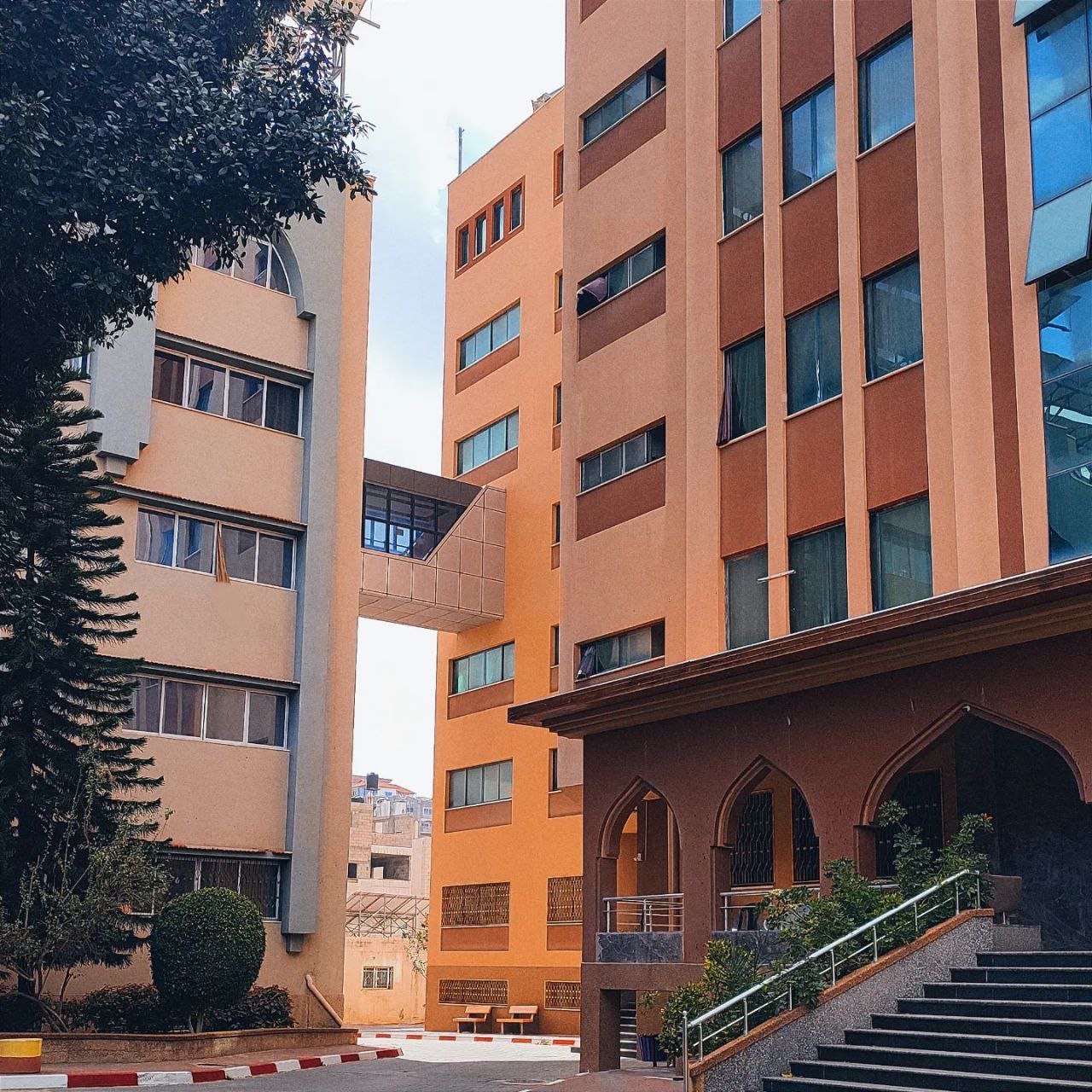
Al-Shifa Hospital in Gaza City said it received three bodies and treated eight wounded people after a drone strike on the Islamic University campus on Sunday, according to reporting by Agence France-Presse (AFP) carried internationally on Sunday. Two sources at the university told AFP the people killed were administrative staff, and the wounded were students who had been present for classes. Gaza’s Civil Defence spokesman Mahmoud Bassal said four other people were killed elsewhere in the territory on Sunday: two in an airstrike in the southern city of Khan Younis, one in central Deir al-Balah, and one in the north of the Strip.
Al Jazeera, reporting independently from the scene, gave the same overall shape and the same total — seven killed — with its own on-the-ground detail. Its correspondent Hani Mahmoud said the three people killed at the university were security guards, killed in an air strike that was the second attack on the institution in the space of a few hours. In the earlier drone strike on the campus, seven female students were injured by flying shrapnel, one of them seriously, Mahmoud reported, adding that the Al Jazeera team had been filming on site shortly before the second strike and had spoken to the guards. Separately, Al Jazeera reported — citing the Nasser Medical Complex — that two people were killed by shelling in al-Mawasi, in Khan Younis, with several others wounded including a child; that one person was killed in a drone strike east of Deir el-Balah; and that one person was killed and several wounded in an attack on al-Rashid Street, near Hamad Hospital in the northern Gaza Strip, citing the Palestinian WAFA news agency.
The two chains — AFP’s hospital-and-university reporting and Al Jazeera’s on-scene reporting — converge on the central facts: a university campus hit twice in hours, three staff dead there, students among the wounded, and four more deaths spread across the south, centre and north of the territory on the same day. Where the chains differ, this article keeps both versions visible rather than choosing one: administrative staff in AFP’s account, security guards in Al Jazeera’s; eight wounded treated at Al-Shifa in AFP’s account, seven female students injured in the earlier strike in Al Jazeera’s. Those wounded figures are reported separately above and are not added together, because the reporting does not establish whether they overlap.
What Israel says — and what has not been established
Reached by AFP, the Israeli military initially said it was looking into the reports of the university strike. A subsequent report in The Times of Israel, citing the military, said the strike had targeted what the military described as terrorist operatives, and that further details would follow. That account is an Israeli military claim reported second-hand in the initial coverage; it has not been independently verified, and the initial reporting did not establish whether the campus was being used for any military purpose at the time of the strikes. Israeli officials have previously accused Hamas of operating in civilian areas and using public infrastructure for military purposes. Hamas has rejected such accusations. No evidence bearing on either claim, specific to Sunday’s university strikes, was published in the reporting available at the time of writing.
Gaza’s education ministry condemned the strike in a statement, saying students had been present for classes and warning that silence over attacks on students and universities encouraged their continuation. The ministry said about 95 percent of the buildings belonging to higher-education institutions in Gaza have been damaged during the war — a figure consistent with UNESCO’s documented assessment that nearly 95 percent of Gaza’s higher-education campuses have been destroyed or damaged since October 2023 — and said ten students and educators had been killed by Israeli fire in the six days before its statement. The university announced the suspension of administrative and academic work at its Gaza City campus on Sunday because of the bombardment, Al Jazeera reported. Hamas urged the mediators of the ceasefire to intervene and press Israel to stop the attacks.

Why this matters
A strike on a university would be significant in any phase of this war. It matters differently now, for three reasons that go beyond Sunday’s casualty count.
First, the setting is a ceasefire, not a battle. The truce that took effect in October 2025 was supposed to be the mechanism that made places like a reopened university campus predictably safe. Sunday’s deaths did not occur during a ground offensive or a declared operation; they occurred, on the reporting, while students were attending classes, in a campus that had resumed teaching. Every such incident tests the same question the ceasefire was built to answer — whether “calm” in Gaza means an absence of lethal fire, or merely a lower rate of it. The Gaza health ministry’s running figures, attributed here to that ministry, put the toll since the ceasefire began at at least 1,551 people killed and 5,573 injured; wire reporting carrying the Israeli side of the ledger notes four Israeli soldiers killed in Gaza over the same period. Those two figures are not symmetrical measures of the same thing, and neither is independently audited in this reporting — but together they describe a truce under which lethal attacks have never actually stopped.
Second, the target is the territory’s future capacity, not only its present safety. With roughly 95 percent of higher-education buildings already damaged or destroyed, Gaza’s universities are attempting something close to reconstruction under fire: reopening partially standing buildings, resuming classes for a generation whose schooling has been interrupted for three years. Al Jazeera’s correspondent noted that most of the Islamic University’s buildings were already destroyed before Sunday, with only a couple partially standing. A strike that kills staff and wounds students in one of the few functioning teaching spaces does damage that outlasts the day’s toll: it tells every student and every lecturer weighing a return to campus that the risk calculation has not changed. That is why education officials frame such attacks as a pattern rather than an incident, and why the casualty figures for students and educators over the preceding six days were included in the ministry’s statement.
Third, the accountability gap is widening in plain sight. On Sunday, the sequence was the familiar one: local hospitals and civil defence reported deaths; the Israeli military first said it was examining the reports, and was later reported to have described the target as terrorist operatives, with details promised. No details, evidence, or independent assessment had been published by the time the day’s reporting closed. That pattern — claim, counter-claim, and no shared factual record — is the same one that has followed hundreds of individual strikes during the ceasefire period. Whether mediators treat a university strike as a ceasefire issue requiring a response, or as background noise within an accepted level of fire, will signal how much of the truce’s enforcement machinery is still real.
Context: a ceasefire that never fully stopped the fire
The war began with the Hamas-led attack on southern Israel on October 7, 2023, in which about 1,200 people were killed and 251 hostages taken, and Israel’s subsequent assault on Gaza, which the Gaza health ministry says has killed 74,544 people in total since October 2023 — figures this article attributes to that ministry, as the wire reporting does. The ceasefire brokered by the United States, Egypt and Qatar took effect in October 2025. It halted the large-scale campaign, but strikes, shelling and gunfire have continued throughout, with each side accusing the other of violations: Israel says Hamas has been rearming and launching attacks in violation of the deal; Hamas denies trying to carry out attacks or rebuild its arsenal and accuses Israel of undermining the agreement. Little progress has been made toward the deal’s later stages, which were to include Hamas disarming and Israeli forces withdrawing.
The Islamic University has been part of this war’s argument as well as its geography. One of Gaza’s most prominent higher-education institutions, its campus in Gaza City was heavily damaged earlier in the war, and Israel has previously accused Hamas of using the university for weapons development and military intelligence — an allegation for which, as reference works summarising the record note, little hard evidence has been made public, and which the university’s defenders reject. That contested history is context for Sunday, not a verdict on it: the reporting on Sunday’s strikes does not establish what, if anything, was targeted inside the campus beyond the military’s reported description, and it does establish — through a hospital that received the bodies — who was killed there, on the accounts of the university’s own staff.
Sunday’s other deaths underline that the university strike was not an isolated event but the largest single incident in a territory-wide day of fire: shelling in al-Mawasi, a designated area in the south where displaced people have concentrated; a drone strike east of Deir el-Balah in the centre; and an attack on the coastal al-Rashid Street in the north, near Hamad Hospital. Spread across three regions, the pattern matches what residents and monitors have described for weeks — continuing lethal strikes at a pace well below the war’s peak, but persistent, and falling on the places where civilian life has been attempting to resume.
What the numbers actually say
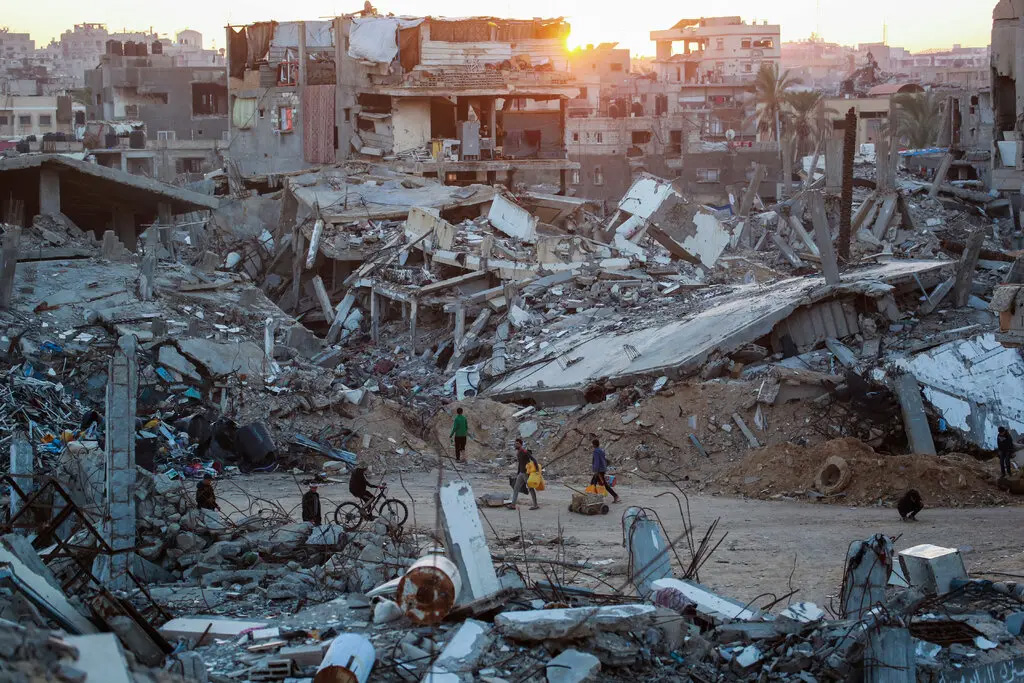
Seven deaths in a day is, by the standards of this war’s worst months, a small figure — and that is precisely the analytical trap. Measured against the ceasefire’s own baseline, Sunday was not exceptional: a ministry tally of 1,551 killed over the roughly twelve and a half months since the truce began works out to an average of about four deaths a day, every day, under an agreement whose purpose was to end the killing. Sunday’s seven therefore sits above the ceasefire’s daily average without breaking its pattern. The honest comparison is not with October 2023 but with the promise of October 2025: a ceasefire that produces a steady single-digit daily death toll, punctuated by incidents like a twice-hit university, is functioning as a reduction in violence, not as its end — and both sides’ publics are being asked, in different ways, to treat that reduction as either success or betrayal.
The education figures carry a similar double reading. A 95 percent damage rate for higher-education buildings means the system Sunday’s strike hit was already almost entirely destroyed; the marginal physical damage of two more strikes is, in that sense, small. The human and institutional damage is not: the remaining 5 percent is where teaching actually happens, staffed by the small number of academics and administrators who have kept the institutions alive. Losing three of them in a day, and wounding the students they were teaching, strikes at the scarcest resource in Gaza’s education system — not buildings, but the people willing to work and study inside the ones still standing.
What happens next
The immediate questions are factual, and they are addressed to the Israeli military, which has said — on the Times of Israel’s reporting — that details will follow: what was the stated target at the Islamic University, what evidence supports the description of those targeted as operatives, and how does that account sit with the hospital’s and the university’s identification of the dead as staff and the wounded as students? Until those details are published and can be assessed, the two accounts remain unreconciled, and this article leaves them that way.
Beyond that, watch three things. First, whether the ceasefire’s mediators — the United States, Egypt and Qatar — treat Sunday as a violation requiring a response, as Hamas has demanded, or absorb it into the existing level of tolerated fire, as has happened after previous deadly days under the truce. Second, whether the university, and Gaza’s other partially reopened institutions, suspend teaching again, and for how long; the speed of any return to classes has become one of the most concrete measures of whether civilian normalcy in Gaza is advancing or retreating. Third, whether Sunday proves to be a single day’s escalation or the start of a higher daily tempo — the distinction that has mattered after every previous spike under this ceasefire, most of which subsided back to the same grim average rather than collapsing the truce outright. The truce has survived worse days than Sunday. What it has not yet produced is a day on which a student in Gaza City could attend a lecture with the question of a strike genuinely off the table.
Related coverage: Israeli fire kills four in Gaza under the ceasefire · UNICEF: 340 children killed in Gaza since the ceasefire · UN envoy warns of risk of a new Gaza war
Sources
- Agence France-Presse (AFP), Oct 25, 2026 — strike on the Islamic University in Gaza City killed three, staff and Al-Shifa Hospital said; Civil Defence spokesman Mahmoud Bassal reported four more killed across the territory; Israeli military said it was looking into the reports. Via The Good Morning (AFP) and Sweden Herald / TT (AFP).
- Al Jazeera, Oct 25, 2026 — seven killed in Gaza as Israel targets the university campus and other sites; correspondent Hani Mahmoud reporting from the scene (second strike killed three security guards; earlier strike injured seven female students); Nasser Medical Complex (al-Mawasi) and WAFA (al-Rashid Street) via Al Jazeera. Via Al Jazeera reporting (mirror).
- The Times of Israel, citing the Israeli military, via Oct 25 synthesis reporting — the military said the university strike targeted alleged terrorist operatives and that further details would follow (attributed, unverified). Via Terror Monitor synthesis of AFP and other international reporting and Globe TV / Dawn summary.
- Gaza Ministry of Education statement, Oct 25, 2026 (via AFP) — students present for classes; about 95 percent of higher-education buildings damaged; ten students and educators killed in the preceding six days (ministry figures, attributed).
- UNESCO, via Al Jazeera, Oct 25, 2026 — nearly 95 percent of Gaza’s higher-education campuses destroyed or damaged since October 2023.
- Gaza health ministry figures, via AFP / Al Jazeera, Oct 25, 2026 — at least 1,551 killed and 5,573 injured since the October 2025 ceasefire began; 74,544 killed in total since October 2023 (ministry figures, attributed).