France student riots
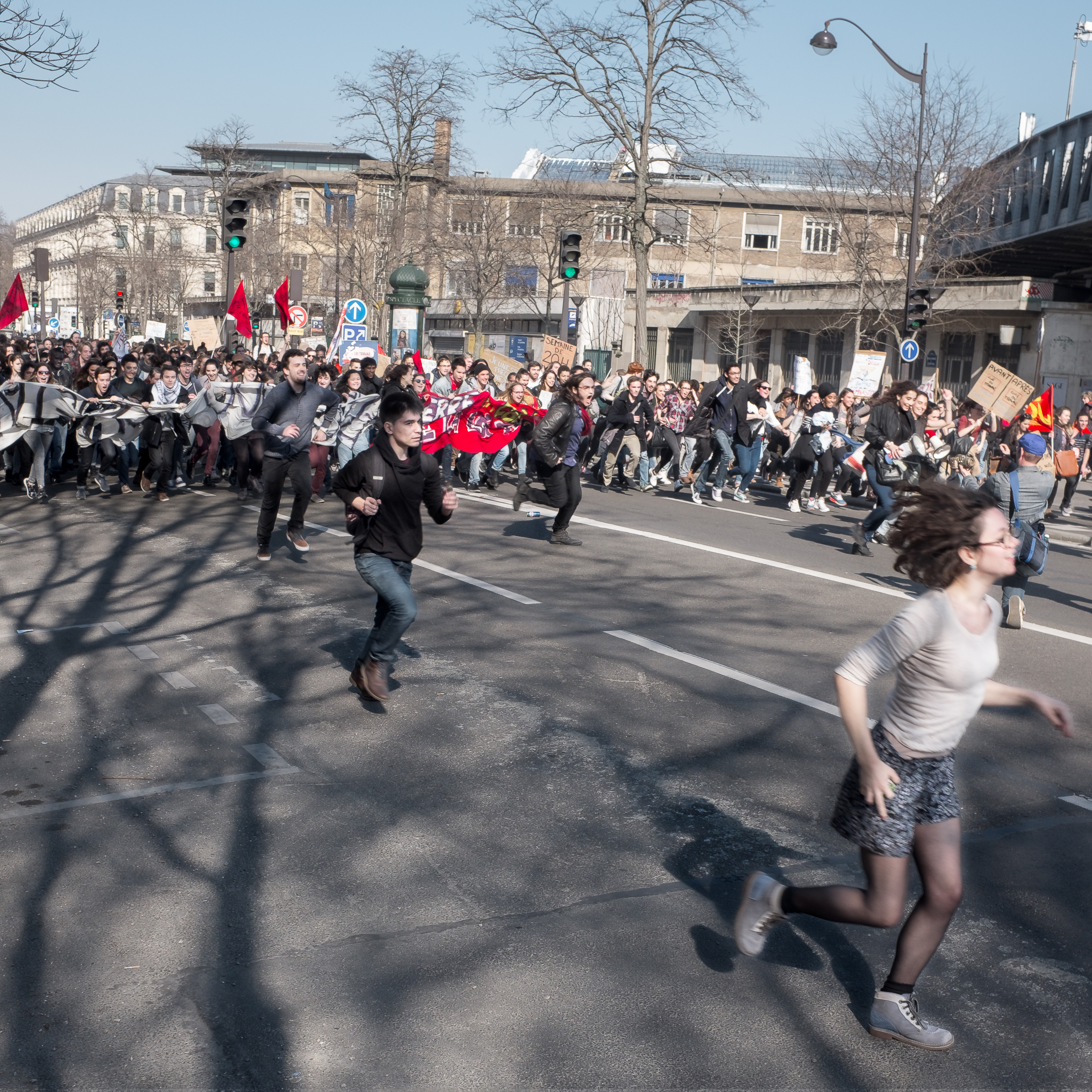
MARSEILLE, France — France has endured street fury before, but this episode now carries the most dangerous signature of a protest wave losing the ability to police its own boundaries. A 15-year-old is accused of turning an aerosol can and lighter into a crude flame weapon and directing it at a woman’s face. Hours later and hundreds of miles away, fire gutted part of a school in Metz. The demands may still concern teaching posts, class sizes and repairs; the dominant public image is now arson and assault.
That distinction matters. A government can be wrong about education funding and right that a person spraying fire at a bystander must be arrested. Protesters can have legitimate complaints and still lose their movement to people who care more about confrontation than classrooms. Any analysis that chooses only one of those truths is not analysis at all; it is recruitment material for one side.
The Marseille flamethrower attack: what happened to the social worker
The Marseille flamethrower attack happened at a bus stop on Friday, October 2. Video showed a teenager spraying a burst of flame from what investigators described as a makeshift device: an aerosol can held to a lighter. Police arrested a 15-year-old boy. Le Parisien reported that the woman struck in the face suffered first-degree burns and was treated at the scene.
The victim was not a rival protester or an officer advancing behind a shield. She was a social worker who told BFM TV that she intervened because youths were vandalizing the bus stop. That fact strips away the comforting fiction that all violence in a riot is a direct contest between demonstrators and the state. Here, a civilian tried to protect shared public property and became the target.
First-degree burns may sound clinically limited beside the images that circulated, but the moral significance is not measured only in depth of tissue injury. A flame directed at someone’s face can blind, disfigure or kill. The outcome could easily have been worse. Calling the device improvised does not make it childish mischief; it describes how ordinary objects were converted into a weapon in seconds.
The state will use the episode to justify tougher crowd control. It will also use it to collapse the distinction between pupils making demands and masked youths seeking disorder. Student organizers therefore face a test as serious as the government’s: condemn the assault without qualification, isolate violent actors and show that a movement about schools can still exercise discipline outside them.
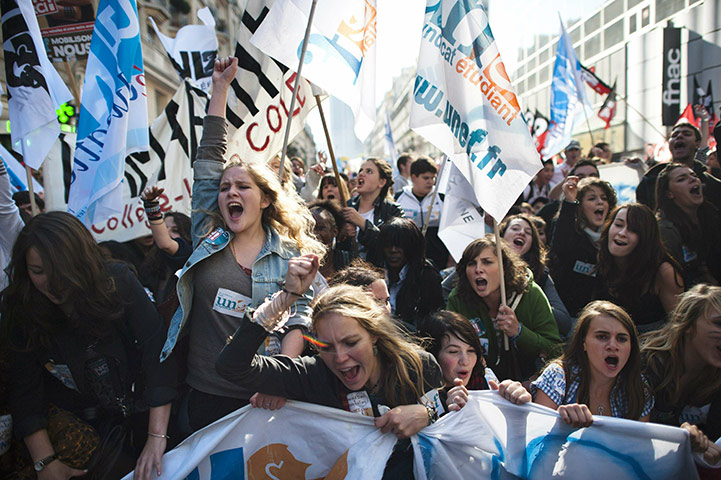
A school burns in Metz
Overnight in Metz, Collège François Rabelais became another scene of destruction. Fire consumed the school’s toilet block and cars were destroyed. The Metz school fire was not merely damage beside a demonstration. It was an attack on the institution students say they are trying to improve.
That contradiction is the political gift every government wants from a protest movement. The original case was straightforward: pupils said classrooms lacked teachers, groups were too large and neglected buildings required repairs. Burning a school reverses the symbolism. Instead of the state failing to maintain public education, the public sees rioters physically dismantling it.
The practical cost will outlast the nightly footage. Closed rooms must be secured and rebuilt; investigators need access; timetables move online or into already crowded facilities. Families reorganize work. Teachers lose teaching time. The pupils with the least space, equipment or adult support at home pay the largest price. In other words, the people most dependent on a functioning public school system are the first losers when that system is set alight.
The fire also broadens the geography of the emergency. Marseille can be explained as a volatile southern city with its own history of inequality and fraught policing. Metz, in northeastern France, makes that explanation inadequate. The unrest is national, mobile and capable of reproducing its tactics far from the dispute that began it.
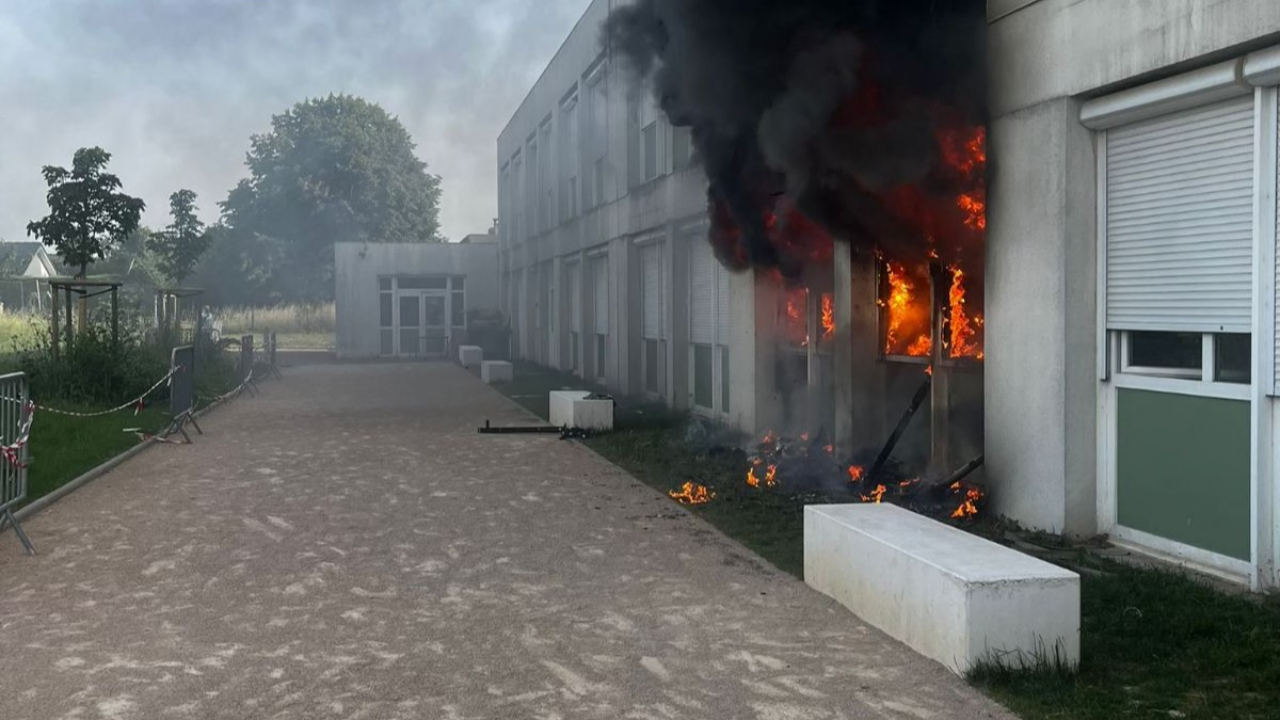
The numbers behind the unrest: 5,000 arrests, 600 police injured France
Interior Minister Laurent Nunez told TF1 that more than 5,000 people had been arrested since the protests began, with high-school minors making up the majority. National Police spokesperson Agathe Foucault said more than 600 police officers and gendarmes were injured. Euronews reported more than 65 school staff hurt and roughly 400 schools shuttered. Paris police chief Patrice Faure described the unrest as beyond effective control.
Those four numbers describe four different failures. The arrest total shows extraordinary police contact with adolescents on a national scale. The officer-injury count shows that this is not a theatrical exchange of slogans and tear gas but sustained physical confrontation. Injuries to school staff show that violence has entered the workplace at the center of the grievance. The closures show the state retreating from normal service because it cannot guarantee safety.
What 5,000 arrests actually imply
Five thousand arrests do not equal 5,000 convictions, nor do they prove that every detained teenager committed violence. Mass public-order operations routinely sweep in people later released without charge. But the figure is too large to dismiss as a few agitators. It means police, prosecutors, juvenile courts and families are being pulled into the crisis at the same time.
The prevalence of minors changes the political calculus. Every detention can become evidence for opposite narratives: government supporters see parents who have lost control and police confronting real danger; critics see teenagers absorbed into a security system before the state has answered why their classes lack teachers. The government must process allegations individually. Collective suspicion is administratively tempting and democratically corrosive.
What 600 injured officers and 400 closed schools say about scale
The phrase 600 police injured France is not a normal statistic for an education protest. It suggests repeated close-range encounters, projectiles, fires and attempts to breach police lines across many cities. Even if injuries vary widely in severity, the cumulative number tells commanders that fatigue and fear are becoming operational factors. Tired units make mistakes; frightened crowds react to those mistakes; escalation feeds itself.
Roughly 400 shuttered schools are equally revealing. Closures are a public-order tool, but they also hand violent groups a veto over education. Shut enough buildings and the state may reduce immediate confrontations while proving that disruption works. Keep them open without sufficient protection and officials risk more injured staff and pupils. There is no cost-free option once violence reaches this scale.
Why France education protests violence matters beyond the streets
The deeper significance is institutional trust. France asks young people to believe in the republican school as the place where origin matters less than citizenship and effort. Students now describe a system where vacancies remain unfilled, classes swell and deteriorating buildings tell them precisely how much priority they have. When the answer arrives mainly in the form of riot police, that promise becomes harder to sell.
But violence destroys trust in the other direction too. Teachers cannot be expected to defend a movement that leaves colleagues injured. Residents cannot be asked to excuse burned vehicles or an attack on a woman at a bus stop because class sizes are too large. Public sympathy is a finite political resource, and each act of cruelty spends it faster than any minister could.
This is why the crisis is more than a contest between order and rebellion. It is a struggle over whether ordinary democratic pressure can still deliver visible results before radicals demonstrate that destruction gets faster attention. If the government offers only force, it strengthens the radicals’ diagnosis. If it offers money only after violence, it strengthens their method.
How we got here: Créteil, France lycée blockades and an old national reflex
The protests began in late September over unfilled teaching posts at a high school in Créteil, east of Paris. The demands spread because they were recognizable: more teachers, smaller classes and repairs to buildings pupils use every day. What began as a local staffing complaint found a national audience among students who believed their own schools told the same story.
The first wave of France lycée blockades showed how quickly a school gate can become a political stage. Blockades are highly visible, relatively easy to copy and perfectly suited to social media. They also create friction with pupils and staff who want to enter, giving determined outsiders an opening to turn persuasion into coercion.
The budget argument supplied accelerant. Prime Minister Sébastien Lecornu’s government is already under pressure over its €54 billion fiscal squeeze. A promise to repair schools competes with demands to contain debt; a refusal risks making students the visible face of austerity. That is the trap in which the new government now finds itself.
From May 1968 to the 2023 Nahel riots
France has a long memory of protest waves that begin in one constituency and become judgments on the state. May 1968 started in universities before merging with a general strike and a challenge to authority itself. The 2005 banlieue unrest followed the deaths of two teenagers hiding from police and spread through marginalized suburbs, exposing the depth of exclusion around housing, work and policing.
The yellow-vest movement began in 2018 with fuel taxes and living costs, then developed into a broader revolt against distance — geographic, economic and cultural — between Parisian power and provincial life. The 2023 riots after the police killing of Nahel Merzouk again fused a specific event with accumulated anger over policing and opportunity.
The student protests France October 2026 are not identical to any of those episodes. The participants are younger, the institutional setting is school and the initial demands are unusually concrete. Yet the pattern is familiar: a narrow grievance becomes a vessel for wider mistrust; decentralized action outruns formal leadership; a spectacular act of violence redefines the entire movement; and the government responds through the language of order because order is the one thing it can deliver quickly.
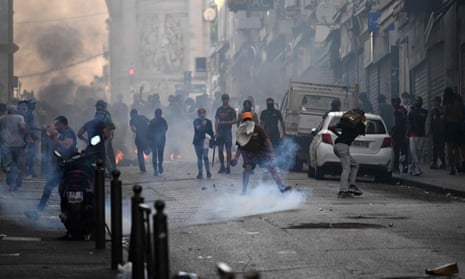
Multiple angles: who benefits, who loses and what critics say
Education Minister Edourd Geffray has argued that the movement began from legitimate concerns but was later captured by ultra-left groups. A Reuters-cited intelligence memo, as reported by Human Events, reportedly assessed that France Unbowed, known by its French initials LFI, and far-left proxies helped organize the movement. That is a reported intelligence claim, not an established fact. No public evidence supplied with the account proves that a political party directed the arson or the assault in Marseille.
LFI can benefit from being identified with anger that the political center has failed to absorb. It gains attention, a younger constituency and a way to connect school conditions to austerity. But the association is combustible. If the public accepts the government’s framing, LFI becomes accountable not only for demands it supports but for violence it says it does not control. A backlash could harden voters against the party and split peaceful organizers from political actors eager to speak for them.
The government can benefit in the short term because images of fire move debate from spending to security. President Emmanuel Macron, speaking in Madrid, urged calm, a presidential posture intended to sit above the street battle. Lecornu can present police deployment as protection for teachers, pupils and public property. Yet the same government loses if the public concludes that it ignored credible school grievances until they became a security emergency.
Students lose class time and moral ownership of their campaign. Teachers lose safe workplaces and may be asked to deliver remote lessons with the same staffing shortages that started the dispute. Families lose predictability. Municipalities inherit repair bills. Police lose personnel to injury and credibility whenever crowd-control tactics catch peaceful pupils. The person least likely to benefit is the student who wanted a mathematics teacher and now finds a locked school gate.
What critics say about the crackdown
Critics of the government argue that mass arrests and school closures treat symptoms while avoiding the policy failure underneath. They warn that broad deployment around lycées can turn normal adolescents into adversaries of the state and that aggressive crowd control supplies the images radicals need for recruitment.
Critics of the movement answer that no democratic grievance licenses attacks on civilians, school staff or police. They argue that organizers who cannot keep weapons and arson away from their demonstrations should suspend blockades rather than demand that the public distinguish endlessly between a legitimate cause and illegitimate conduct occurring under its banner.
Both criticisms contain an uncomfortable truth. Policing cannot fill a teaching vacancy, and a teacher shortage cannot absolve a flamethrower attack. France needs an answer capable of holding those propositions at the same time.
What happens next: crackdown, closures and political fallout
Scenario one — a harder crackdown. The government deploys more mobile gendarmes, tightens exclusion zones around schools and accelerates juvenile prosecutions. This may suppress open disorder, especially if parents keep children home. It may also disperse confrontations into smaller, less predictable sites and create new disputes over proportionality.
Scenario two — extended school closures. Authorities keep damaged or blockaded establishments shut and expand remote learning. Immediate safety improves; educational inequality widens. Pupils with stable homes and good internet cope. Those who relied most heavily on school fall further behind, deepening the grievance that began the crisis.
Scenario three — concessions split the movement. Lecornu announces emergency teaching hires, smaller classes in selected districts and a repair fund. Unions and mainstream student groups claim progress and withdraw. Violent networks are isolated. The political danger is obvious: opponents say the government rewarded disorder, while budget hawks ask where the money comes from.
Scenario four — the crisis becomes a verdict on Lecornu. If unrest survives the weekend and returns with teachers or university students, the new government faces a legitimacy test rather than a school-management problem. Failure to restore order damages Lecornu’s authority; restoring it through force alone damages Macron’s promise of republican cohesion. The opposition will make sure every closed school is counted against them.
Scenario five — backlash against LFI. Further evidence of party coordination, if produced and verified, could trigger parliamentary and public demands for investigations. Without evidence, repeated accusations may look like an attempt to criminalize opposition. LFI’s own conduct will matter: an unambiguous separation from arson would protect it; equivocation would make the government’s case for it.
The indicators are now concrete. Watch whether arrests convert into charges, whether schools reopen, whether injuries continue to rise, whether government funding promises move beyond rhetoric and whether recognized student organizations regain control of demonstrations. The next decisive act may not be another blaze. It may be a credible negotiation that gives peaceful pupils a reason to leave the streets — or the failure to produce one.
France has reached the point where every side must refuse its easiest excuse. Ministers cannot say violence proves the schools were fine. Protest leaders cannot say broken schools make violence someone else’s responsibility. The way out begins when both stop using the worst conduct of the other as permission to avoid their own obligations.
Sources
- The Telegraph: French school protester arrested after flamethrower attack
- New York Post: 15-year-old arrested after woman burned during France student riots
- TMZ: Video and report from the Marseille attack
- The Sun: Schools burn as riot police clash with students
- Human Events: Arrest, unrest and the reported intelligence assessment
Reporting note: arrest, injury and closure totals were attributed in the reporting to French officials and Euronews. The claim about LFI and far-left proxies is presented as a reported intelligence assessment, not as a finding independently established by Signal Post News.