World · France · Europe · Protests
A third straight weekend of protest over living costs and education brought 320,000 people onto France’s streets on Saturday — fewer than on the two Saturdays before it, but more than enough for the day to end the way the government feared: in bottles, fireworks and tear gas at dusk in eastern Paris.
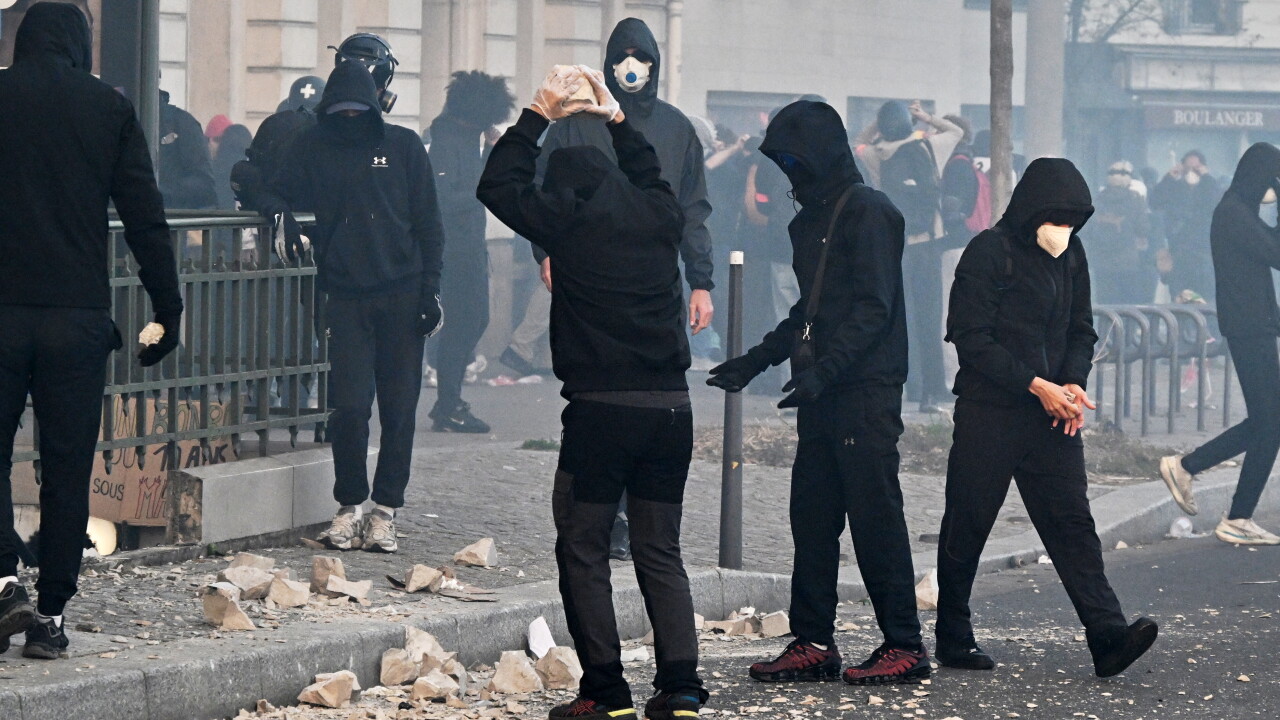
France protests today drew an estimated 320,000 people nationwide, including about 70,000 in Paris, in a third consecutive weekend of demonstrations over living costs and education, according to France’s Interior Ministry. The day held two stories in one: a long, largely peaceful and at times festive march through the eastern edge of the capital, and then, as it ended at dusk near Porte de Charenton, the now-familiar rupture — protesters hurling glass bottles and fireworks, police answering with stun grenades and tear gas. By evening, about 300 people had been arrested across the country, the Associated Press reported, and clashes had also been reported in Marseille, Lyon and Toulouse.
The turnout confirms a pattern that now cuts in two directions at once. On the Interior Ministry’s own count, the movement is shrinking: 550,000 people marched on October 17, 410,000 on October 24, and 320,000 on Saturday. But 320,000 people is still an enormous mobilisation for a third consecutive weekend, and the ministry’s figures are only half of a disputed ledger. Organisers claimed 800,000 marchers on each of the two previous weekends — more than double the official count on October 24 — and the two sets of numbers have never been reconciled. Readers should treat both as claims: the government counts low, the movement counts high, and the truth, as on every French protest Saturday, is argued over before the tear gas has cleared. France 24’s reporting on the third weekend likewise led with the ministry’s 320,000 figure while noting the organisers’ far larger estimates.
The state, for its part, did not wait to see which version of the day it would get. About 70,000 police and gendarmes were deployed nationwide, the deployment Reuters detailed on October 30 ahead of the marches, and Interior Minister Laurent Nuñez had warned of a “very high risk” of disorder, especially after dark on Halloween. Signal Post News set out the scale of that operation before the first marcher set off, in its report on how France deployed 70,000 police and pushed the Paris march to the city’s edge. Saturday tested whether that show of force would merely contain the day — or define it.
A march exiled to the ring road
The Paris march never reached the streets where Parisian protest is supposed to happen. After a last-minute court battle over the route, the authorised procession was rerouted away from the centre and ran instead from Porte de Bagnolet, at the city’s eastern gate, along the Boulevards des Maréchaux — the broad ring of avenues that traces the old city wall — to Porte de Charenton in the south-east. It is a long, wide corridor, easily watched and easily sealed, and about as far from the symbolic heart of the capital as a march can be while remaining, technically, in Paris.
The restrictions tightened as the day darkened. Police barred entry to Place de la République and the Les Halles district from 11 p.m. until 6 a.m. — both were scenes of the worst disorder on October 17 — and around the Champs-Élysées, unaccompanied minors faced a 9 p.m. curfew. The measures were aimed squarely at the night rather than the march: at the hours after the organised crowds go home, when Halloween costumes, darkness and anonymity have historically done the work that placards cannot.
For hours, a festival with a helicopter
What the rerouted march actually looked like, for most of its length, confounded the morning’s warnings. For hours the Paris procession was largely peaceful and, by the standards of this angry autumn, almost joyful. Students led it hand in hand. Stewards from the CGT union watched over the front of the march. Techno music played. Some marchers came in Halloween costumes; some went trick-or-treating along the route. Overhead, unhurried and ever-present, a police helicopter circled — the one discordant note in a scene that otherwise resembled a street party with a grievance.
The grievance itself is worth hearing in a marcher’s own words, because it explains why students remain the movement’s engine even as the crowds thin. Corentin Cabreux, 21, described life in his state-run student residence to reporters: damp stains spreading across the walls, paint peeling, and, in his words, “cockroaches everywhere, rats.” It is a small, squalid inventory, and it travels well because so many of the young people marching behind him recognise it. A movement that began over school buildings has never really stopped being about the physical conditions in which France houses and teaches its young — and about a generation’s suspicion that those conditions are not an accident but a choice.
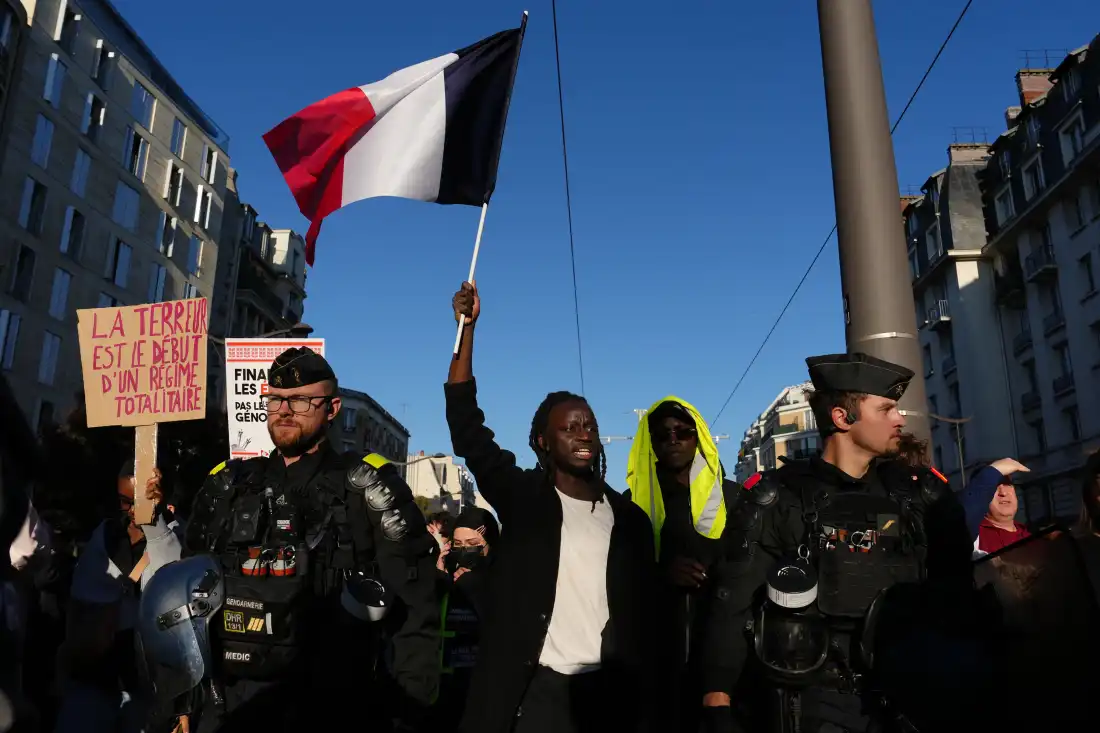
Dusk at Porte de Charenton
The turn came where the route ended. As the march reached Porte de Charenton and began to disperse at dusk, clashes broke out: protesters hurled glass bottles and fireworks at police lines, and officers replied with stun grenades and tear gas, according to AP reporting. Peaceful marchers scattered — some of them into the Bois de Vincennes, the great wooded park that begins at the city’s south-eastern edge. The geography mattered. A confrontation on the central boulevards becomes a siege of shops and symbols; a confrontation at Charenton dissolves into park paths and ring-road junctions, harder to photograph, easier to contain, and over sooner.
Paris was not alone. Clashes were also reported in Marseille, Lyon and Toulouse, the country’s second, third and fourth cities — a reminder that while the capital absorbs the cameras, the movement’s map is national, and its angriest fringes are not all within the périphérique. Even so, by the measure the government cares most about, Saturday was not October 17. There was no repeat, on the reporting available by evening, of the looting that disfigured the first weekend.
France protest arrests: the slowest fuse of the three weekends
The arrest figures tell the day’s real story, and they reward a plain comparison. By 2 p.m. local time, police had made just 27 arrests nationwide — against 217 at the same point on October 24. By the evening, arrests had risen to about 300 across the country, down from about 800 at the same point in last week’s protests, the AP reported; some counts put the evening figure just under 300, and it is best stated as about 300. Read the three numbers together and the shape of the day emerges: a movement that started later, clashed less and dispersed faster than on either previous weekend, policed by a state that had positioned itself, in overwhelming numbers, exactly where trouble was most likely to start. Whether that is deterrence working or a movement tiring is the argument the next section takes up — but the fuse, this Saturday, burned slower than it has all month.
How France got here: a school in Créteil, a budget with no room
The movement began last month in the least theatrical place imaginable: a school in Créteil, in the suburbs south-east of Paris, where high-school students walked out over neglected school buildings, teacher shortages and a university admissions system widely seen as unfair to disadvantaged students. Signal Post News traced that tinderbox in its explainer on the France schools crisis and why students are striking. What turned a schools revolt into a national condition was the arrival of everyone else: the trade unions, with their stewards and strike funds; veterans of the Yellow Vest protests, carrying the older grievance of 2018; and cost-of-living campaigners for whom school buildings were simply the most visible symptom of a state that feels permanently short of money for the things ordinary people use.
The government they are marching against is in no position to buy peace. President Emmanuel Macron’s minority government is deep in talks on the 2027 budget with public debt approaching 120 percent of GDP — a ratio that narrows every concession to a negotiation with the bond markets as much as with the street. The first weekend showed what that impasse can produce: on October 17, the protests deteriorated into some of France’s worst rioting in years, a night Signal Post News documented in its account of how 550,000 marched nationwide and town halls burned. October 24 was larger in arrests but calmer in temper. October 31 was smaller, later to ignite, and quicker to end. The trend is real. So is the crowd.
Why this matters
Analysis: start with the arithmetic, because both camps are spinning it and the numbers, stated plainly, support each side’s favourite sentence. Turnout fell by 90,000 on the Interior Ministry’s count week on week — from 410,000 to 320,000, a drop of about 22 percent. Against October 17, the fall is 230,000, or about 42 percent. A government spokesman can say, truthfully, that the movement has lost more than two-fifths of its official numbers in a fortnight. An organiser can reply, also truthfully, that a third consecutive weekend still put 320,000 people on the street on a cold Halloween Saturday, that the organisers’ own counts are far higher, and that no French protest movement in recent memory has been required to prove itself three weekends running. Both are describing the same curve: shrinking, but nowhere near gone.
Who benefits from a long, contained, slowly deflating crisis? Start with Marine Le Pen. Reuters’ pre-event reporting noted that Le Pen is leading polls ahead of April’s presidential election, and a movement she does not have to lead, fund or even endorse is doing her campaign’s work for it: every weekend of disorder is evidence for her standing argument that the republic’s managers have lost control of the streets, the schools and the budget at once. The government’s defenders make the mirror-image claim — that Saturday’s low early arrests and contained clashes show a state learning, weekend by weekend, how to protect both the right to march and the streets being marched on. Critics of the government answer that a playbook built on rerouting, curfews and 70,000 officers is not a policy but a posture, and that it concedes the very thing it claims to defend: the centre of Paris now belongs, on protest Saturdays, to the police.
Who loses is easier to list. The students lose if the curve keeps falling before the schools money arrives, because a movement’s leverage is its next crowd, and each smaller Saturday discounts it. Paris loses a centre it must seal to protect. The government loses either way the argument lands: if the protests fade, it will be said that force and exhaustion, not persuasion, ended them; if they endure, it will be said that a minority government with debt near 120 percent of GDP simply cannot afford the country it is governing. And the moderate majority of the march — the hand-in-hand students, the CGT stewards, the costumed trick-or-treaters — loses most quietly of all, because the images that survive Saturday are not theirs. They are the stones at Charenton.
The containment playbook: order kept, centre conceded
The state’s method now deserves a name, because it was applied whole on Saturday and it worked on its own terms. Reroute the march to the ring boulevards, where there is little to loot and room to manoeuvre. Seal the symbolic squares overnight, from 11 p.m. to 6 a.m., so the after-hours crowd has nowhere historic to gather. Curfew the minors around the Champs-Élysées from 9 p.m. Deploy officers in numbers — 70,000 — so large that most confrontations are overmatched before they begin. The result was a day in which the worst clashes came at the route’s end, at dusk, in a place chosen by the state, and in which arrests by mid-afternoon were barely an eighth of the previous weekend’s. As crowd control, it is hard to fault.
But containment has a price that does not appear in the arrest count. A government that must exile a lawful march from the centre of its capital, close its most famous square and avenue to the young, and field a small army to do it has not restored normality; it has rationed it. Each repetition normalises the exception a little further, and hands the movement’s radicals their most persuasive leaflet: proof, printed by the state itself, that Paris is frightened. The playbook limits damage. It also, weekend by weekend, advertises the emergency it is managing.
What happens next
The first test comes within hours, not weeks. Halloween night, after the organised marches disperse, is when disorder has historically flared in France — leaderless, costumed and scattered — which is precisely why the République and Les Halles closures run until 6 a.m. and why Nuñez’s “very high risk” warning was aimed at the dark rather than the demonstration. A quiet night would let the government claim its fullest victory of the autumn. A bad one would erase the day’s good numbers by breakfast.
The second test is whether there is a fourth weekend, and what size it is. A call to march again next Saturday is the movement’s way of saying the curve is a pause, not a verdict; a crowd that holds anywhere near 300,000 would signal a floor — a durable constituency that budget talks will have to reckon with through the winter. A crowd that halves again would tell a different story: of a schools revolt that shook the republic for a month and then, like so many French autumns before it, went home to wait for the spring and the election. Between those two futures sits the budget itself, where any serious money for school buildings, teachers and student housing must survive a parliament the government does not control and a debt ratio it cannot wish away.
Hovering over everything is April. Every additional weekend of protest is a campaign broadcast for the opposition that leads the polls, and every weekend of competent containment is the government’s counter-argument that the republic still functions. Saturday suggested both campaigns may have to run a while longer: the movement is smaller than it was, the state is better at this than it was, and neither fact has yet been enough to end the argument.
Conclusion
Three weekends in, France’s autumn of protest has found its rhythm: a huge, young, mostly peaceful mobilisation by day; a rerouted march on the city’s edge; a fringe that waits for dusk; a state that answers with numbers, curfews and tear gas; and a turnout figure that falls by a fifth, then argues about what the falling means. On Saturday the numbers said 320,000, the arrests said about 300, and the clashes at Porte de Charenton said the anger underneath both numbers is intact. A movement losing two-fifths of its crowd in a fortnight is dying, or consolidating, or merely resting — and France, which has buried protest movements before only to meet their children in the street, would be unwise to decide which before the fourth Saturday answers.
Sources
- Associated Press, via NPR — “Europe roiled by more youth-led protests” (October 31, 2026): the third weekend of demonstrations in Paris and across France, the festive character of the march, the student residence account and the dusk clashes.
- Associated Press, via Scripps News (Tampa Bay 28) — “French protesters defy heavy police presence in new demonstrations” (October 31, 2026): the Interior Ministry’s turnout estimates, the Paris route and closures, the clashes at Porte de Charenton and in Marseille, Lyon and Toulouse, and the arrest figures through the day.
- France 24 reporting (October 31, 2026) on the third weekend of protests: the nationwide turnout of 320,000 on the Interior Ministry’s count and the movement’s disputed counter-estimates.
- Reuters (October 30, 2026): the deployment of about 70,000 police and gendarmes, Interior Minister Laurent Nuñez’s warning of a “very high risk” of disorder, and the pre-election polling context.
This article is based on Associated Press reporting of October 31, 2026, as carried by NPR and Scripps News, France 24 reporting on the third weekend turnout, and Reuters reporting of October 30, 2026. Turnout figures are the Interior Ministry’s estimates; organisers’ estimates are higher and are identified as disputed in the text. Arrest figures are given as about 300 because counts reported by the evening ranged just below and at that level. The quotation from Corentin Cabreux is as reported by AP. Analysis is by Signal Post News.