World · Europe · France
France’s unions and students staged their biggest coordinated day of action in years on Thursday: hundreds of thousands marched for higher wages, fairer taxes and funded public services, most of them peacefully — while in Lyon riot police fired tear gas at black-clad protesters, Paris students barricaded their schools with rubbish bins, and the Eiffel Tower closed its doors.
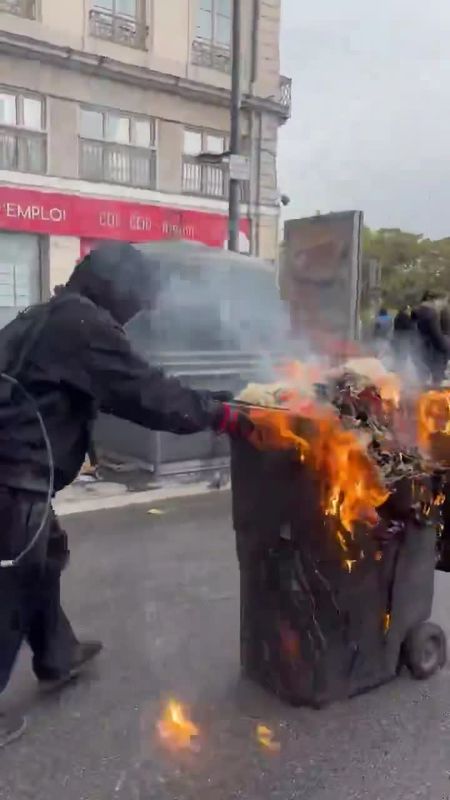
By the time the main Paris march stepped off from Place de la République in the afternoon, Thursday had already become the day France’s autumn of unrest grew up. What began in September as student protests over education funding has, in two months, drawn in the country’s biggest union confederations, shut schools and landmarks, and produced the most serious sustained challenge to President Emmanuel Macron in the final stretch of his presidency. The call for Thursday’s action came from the CGT, CFDT and Force Ouvrière union confederations, backed by student organisations, under demands that fit on a single banner: higher wages, tax justice, better public services and more money for education.
Reuters, which followed marches across the country, stressed the point the government also made: the demonstrations were largely peaceful. But they were not only peaceful. In Lyon, police fired tear gas and charged groups of black-clad, face-covered protesters who hurled projectiles and set pallets alight. In Paris, students piled rubbish bins across streets, a student and a teacher were reported injured, and near Toulouse a fire forced the evacuation of a high school. No deaths were reported anywhere in the country. The day’s real significance sits in the tension between those two facts — a mass movement that stayed mostly orderly, and a fringe of confrontation that keeps pulling the cameras, the police and the politics toward it.
The numbers: a country counted in marchers and police
France argues about crowd sizes the way other countries argue about election results, so read Thursday’s figures with their sources attached. The Interior Ministry said 270,000 people had marched outside Paris by its early counts. The intelligence services, briefing ahead of the day, had expected between 500,000 and 700,000 outside the capital. The unions had planned roughly 250 to 260 rallies nationwide. Against the crowds, the state fielded about 70,000 police and gendarmes, according to Interior Minister Laurent Nuñez, supported by armoured vehicles, drones and helicopters — a deployment on the scale France usually reserves for nights it expects to lose control of.
Even the lowest of those numbers describes one of the largest coordinated protest days in recent French history, and the spread matters as much as the size. This was not a Parisian event with provincial echoes: marches ran through Lyon, Marseille, Nantes, Bordeaux, Lille and dozens of smaller towns, each with its own local grievances folded into the national demands. A movement that can put a quarter of a million people on the street outside the capital on a working Thursday, in November rain, is not a mood. It is an organisation — and organisations can do it again next month.
Paris: bins for barricades, and a landmark goes dark
The capital’s morning belonged to the students. Teenagers dragged rubbish bins into the street on the Rue de Rivoli and outside the Lycée Hélène Boucher, turning the city’s own waste containers into the barricade of choice for a generation that has made school blockades its signature tactic since September — the same tactic that forced hundreds of schools to close earlier in the autumn, as Signal Post News reported when France shut 500 schools as the student protests escalated. Europe 1 reported that 81 high schools were blocked by 10 a.m.; student unions claimed far more, and as with the crowd counts, both figures should be carried with their claimants. Le Monde reported that a student and a teacher were injured in the morning’s scuffles.
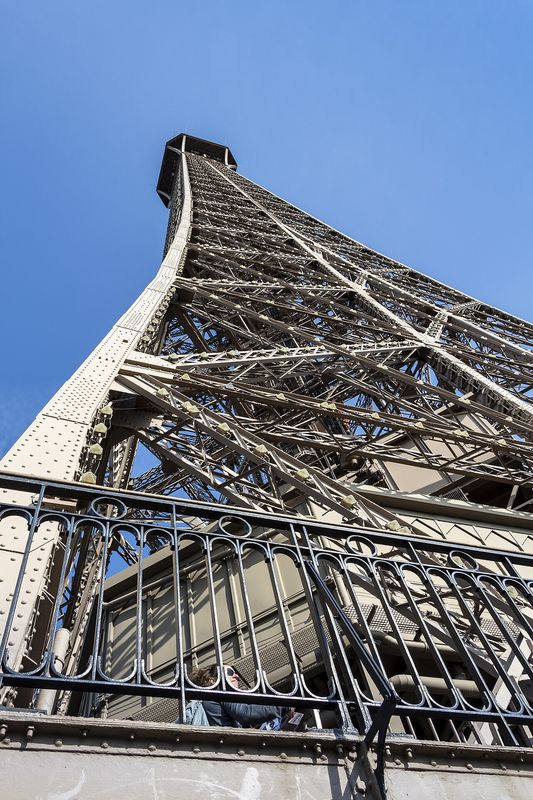
The afternoon belonged to the unions. The main Paris march moved from République to Nation, the historic east-side route of the French left, in a column that mixed union banners with student contingents and the now-familiar black-clad fringe at its edges. And above it all, the day produced its most economical image: the Eiffel Tower, shut by the strike. A closed national monument is not an economic fact, but it is a political one — the photograph that tells the world, in a single frame, that France’s machinery has stopped. Tourism sites, transport and public services across the country reported disruption through the day as strikers in sector after sector downed tools.
Lyon: where the day turned
If Paris supplied the scale, Lyon supplied the confrontation. Organisers said more than 25,000 people marched in France’s third city. Within the march, groups of black-clad, face-covered protesters — the black bloc that has attached itself to French protest movements for a decade — threw projectiles at police, dragged burning bins and pallets into the streets and set a car alight. Riot police answered with tear gas and charges. Six people were arrested, according to the authorities, and metro lines were shut as the clashes moved through the city centre.
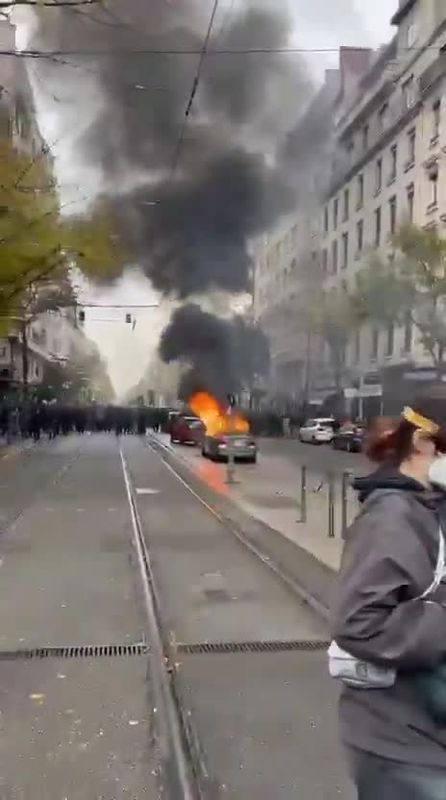
The Lyon sequence matters because it is the government’s strongest argument and the movement’s biggest liability, in the same few streets. Nuñez had vowed a firm response to violence before the marches began, and the interior ministry’s line through the day blamed masked rioters for the clashes — a framing the images from Lyon genuinely support. Union stewards, for their part, spent the day trying to keep the march’s discipline, and the overwhelming majority of Lyon’s 25,000 marched and went home without incident. Both things are true, and the politics of the coming weeks will be fought over which of them the public remembers.
The day’s most alarming single incident happened away from the cameras. Near Toulouse, in the suburb of Tournefeuille, a fire broke out at a high school on Thursday morning after fireworks and intruders were reported on the site; the school was evacuated. No account of the fire has been officially tied to the strike, and it should not be folded into the protest story without evidence — but in a week when schools have become the movement’s front line, an evacuated lycée is the kind of event that hardens every side’s narrative.
What the movement wants, and what the government answers
Strip the day to its demands and it is a cost-of-living movement wearing several uniforms. The unions’ core asks are higher wages that keep pace with prices, a tax system they describe as rigged toward the wealthy, and proper funding for the public services — hospitals, schools, transport — whose slow decay is the daily texture of the squeeze. The students add education funding and conditions in overcrowded classrooms. What unites a CGT rail worker, a CFDT nurse and a blockading lycéen is not an ideology; it is the shared arithmetic of pay packets and public services that feel thinner every year.
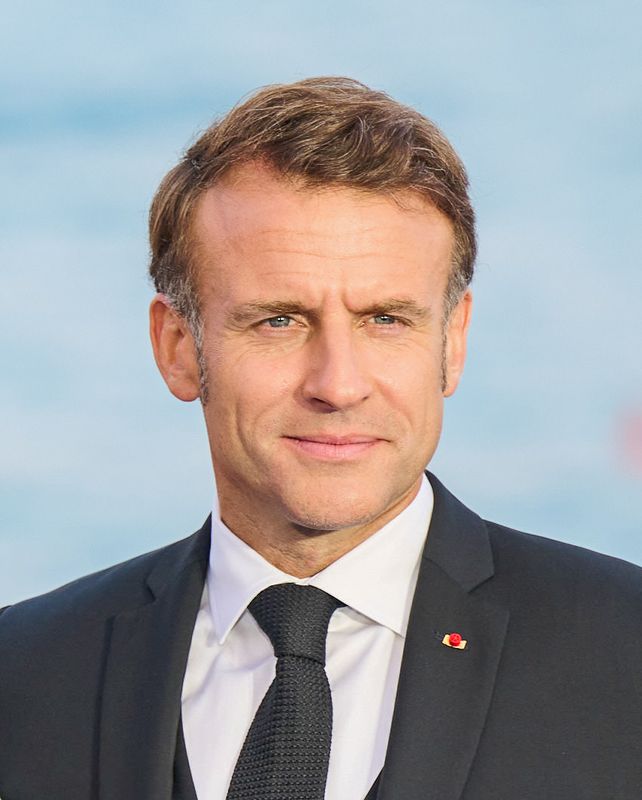
The government’s answer runs on two tracks. On the street, it is Nuñez’s: order, firmly kept, with the violence assigned to masked minorities who, ministers argue, exploit legitimate marches. In the longer term, it is the argument that France cannot spend what it does not have — an argument made harder by the state of the public finances, and made easier, ministers hope, by the distance between the largely peaceful majority and the burning bins on the evening news. Macron himself is in the constitutionally strange position of a president in his final months: he cannot run again, his parliamentary position is weak, and every concession he makes will be read as the act of a man spending authority he no longer needs — which is precisely why the unions believe pressure can work, and precisely why his camp fears it.
How France got here: September classrooms, October fires
Thursday was a culmination, not a beginning. The movement started in September in the schools, when students began blockading lycées over funding and conditions. Through October it widened and darkened. On October 17, riots and looting in several cities caught the authorities visibly off guard, with shops damaged and looted; the weekend unrest that followed forced curfews and a rolling security mobilisation that Signal Post News followed as curfews spread during the October riots. By the third weekend of the protests, marches were drawing hundreds of thousands — 320,000 marched on the third weekend alone — and on October 31, in a single night of Halloween unrest, 779 people were arrested nationwide.
That arc explains Thursday’s two defining features: the unions’ arrival, and the police numbers. A student movement became a labour movement, which in France is the difference between a disruption and a national event. And a state that had been caught off guard in October was determined not to be caught again — hence 70,000 officers, the armour, the drones, and an interior minister who spent the day performing firmness for the cameras. Each side, in other words, spent Thursday answering the last battle. The question the coming weeks will settle is whether either of them is preparing for the next one.
Why this matters
France is the eurozone’s second economy and its most protest-prone democracy, and the two facts are connected: this is a country where the street has been a working branch of government since before there was a republic, and where every president since the 1990s has had at least one reform broken on it. What is new this autumn is the coalition. Students supplied the spark and the tactics; unions supplied the numbers and the staying power; and the black bloc supplied the images that dominate coverage while representing almost nobody. That triangle — sympathetic demands, mass participation, violent garnish — is the hardest configuration for a government to beat, because repression photographs badly, concessions invite repetition, and waiting only works if the movement tires before the state does.
The timing sharpens everything. A presidential election is about five months away, and the strike movement is, among other things, an audition: every candidate is being measured against the question of who can end this. For the unions, a lame-duck president and an approaching election are leverage — concessions extracted now cannot easily be taken back by a successor who campaigned on calm. For Macron, the calculation is inverted: give ground and he validates the street as the way to govern France in his final months; refuse, and he hands the election a winter of burning bins. There is no version of the next five months in which this movement is not a central fact of French politics. The only question is whether it peaks as a negotiation or as a habit.
What happens next
Expect, first, another day like this one. French union movements run on rhythm: a strike day, a pause to count, a bigger strike day. The confederations will compare Thursday’s turnout with their targets, and if the count holds anywhere near the ministry’s 270,000 outside Paris, a further national day before Christmas is the base case, with transport and public services the sectors to watch. Expect, second, a fight over the images: the government will prosecute the Lyon arrests visibly and keep the black bloc at the centre of its story, while unions work to keep their stewards, their numbers and their demands in frame instead.
And expect, third, the election to swallow the strike. Candidates will begin pricing the movement’s demands into their platforms — wage floors, tax changes, education money — and the street will learn, as French streets always do, that its leverage is greatest before anyone has won anything. The movement that began with teenagers and rubbish bins in September has already achieved the first thing movements want: it cannot be ignored. Whether it achieves the second — being answered — is what the winter is for.
Reporting based on Reuters coverage of the November 5, 2026 strike day; the Guardian’s reporting of the Paris and Lyon marches; Le Monde on the Paris school blockades and injuries; Europe 1 on the count of blocked high schools; and Interior Ministry figures via Interior Minister Laurent Nuñez. Crowd, arrest and deployment figures are attributed to the sources cited in the text; union and organiser counts are identified as such where they differ from official figures. The Tournefeuille school fire has not been officially linked to the strike.