A doctor at Alamata General Hospital told the BBC the dead included children as young as three days old; heavy artillery struck homes, the city's market, and sites near a Catholic mission and a mosque.

What happened
The Ethiopia Tigray Alamata fighting turned the southern Tigray town of Alamata into the deadliest flashpoint of the renewed war this week. According to the BBC, at least 52 civilians were killed in three days of heavy fighting — Saturday, September 26 through Monday, September 28 — after Ethiopian government forces retook the town from TPLF-led rebels and pressed their advance north toward the regional capital, Mekelle.
A doctor at Alamata General Hospital told the BBC that heavy artillery and high-powered explosives struck homes across the city, and that 12 people died in a single attack on the city's market. Strikes were reported near the Catholic mission, near the bridge at the town's Waja entrance, and near a mosque. The victims, the doctor said, included children as young as three days old, mothers, and cattle herders.
Crucially, residents who spoke to the BBC could not say which side was responsible for the strikes — a reminder of how little independent verification is possible in a conflict fought under a near-total information blackout. What is not disputed is the outcome on the ground: government troops now control Alamata, footage circulating on social media shows army tanks on the town's streets, and federal forces are pushing toward Mekelle.
Why this matters
Alamata is not just another dot on the map of a spreading war. It is the gateway town of southern Tigray — the first major population center on the road from federal-held territory into the Tigrayan heartland. Its capture gives Addis Ababa something it has not held in this conflict: momentum, and a staging ground within striking distance of Mekelle itself.
The civilian toll is what makes this a turning point rather than a footnote. Fifty-two dead in three days is the single deadliest reported incident of the renewed Tigray war, and it lands barely a week after fighting resumed on September 23. If the 2020–2022 war taught the world anything, it is that civilian casualty counts in Tigray are almost always revised upward once the fog lifts — the earlier conflict's estimated 600,000 dead emerged only after years of painstaking documentation. The Alamata figure, sourced to a hospital doctor and residents speaking to the BBC, is the floor, not the ceiling.
From Pretoria to September 23: how the truce broke
To understand Alamata, rewind to November 2022. After two years of war that killed an estimated 600,000 people, Ethiopia's federal government and the Tigray People's Liberation Front signed the Pretoria cessation-of-hostilities agreement — a deal that stopped the shooting but never resolved the underlying disputes over territory, particularly the contested lands of western Tigray, or the TPLF's fractured relationship with both Addis Ababa and its own splintered leadership.
That fragile peace held, barely, for nearly four years. Then on September 23, 2026, a TPLF-led alliance of seven armed groups launched a coordinated offensive — seizing Mekelle's airport and other positions — in what the TPLF described as a defensive war. Addis Ababa called it an unprovoked rebellion. Each side blames the other for firing first, and with Tigray cut off from the internet and independent journalists locked out, there is no neutral arbiter to settle the question.
What followed was swift: federal forces counterattacked, and within days the front line had shifted from the TPLF's opening gains to a government advance — culminating in the battle for Alamata and now the push toward Mekelle on the fourth day of fighting.
Stranded in Lalibela: the war reaches the tourists
The fighting is no longer confined to Tigray's borders. In Lalibela, the Amhara-region town whose 12th-century rock-hewn churches are a UNESCO World Heritage site, about 33 foreign tourists have been stranded since last week as the conflict spread. Fourteen Israelis were airlifted out by military helicopter on Monday; those still waiting include Americans, Britons, South Koreans and South Africans.
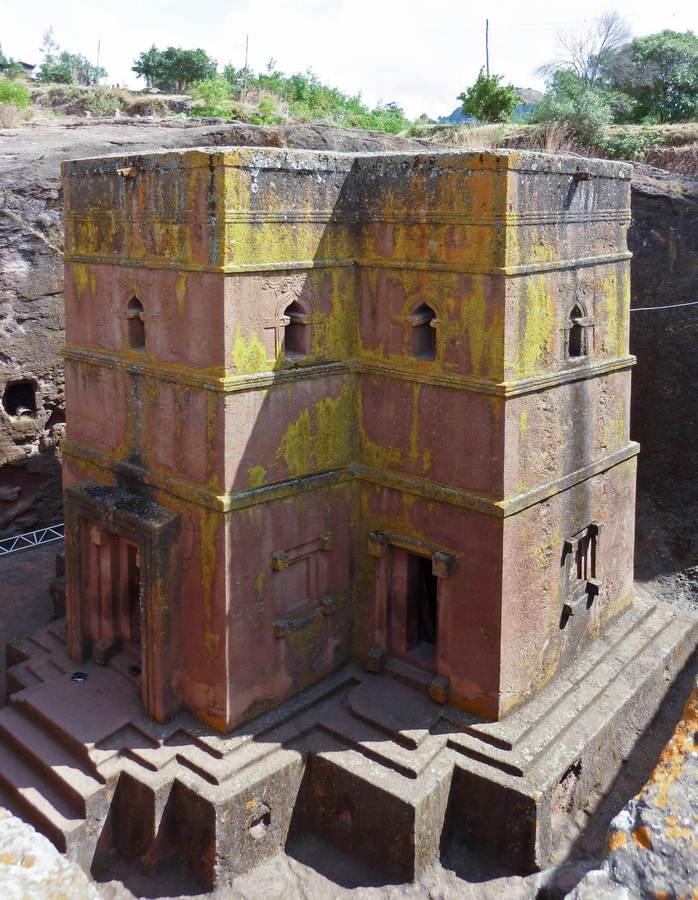
Lalibela's predicament is a small story next to Alamata's dead — but it is a telling one. The town sits far south of the Tigrayan front lines, and its entanglement signals how quickly a localized offensive is metastasizing into a regional crisis. For Ethiopia's tourism sector, already battered by years of conflict advisories, the images of helicopter evacuations from a World Heritage site will be devastating.
Who benefits, who loses
Addis Ababa benefits — for now. Prime Minister Abiy Ahmed's government has retaken the initiative after the TPLF alliance's opening gains, and Alamata's capture is the kind of visible victory that plays well domestically. But the history of this war counsels caution: the federal government "won" the 2020–2022 war on the battlefield too, then watched the political settlement rot from within.
The TPLF loses ground but not necessarily leverage. Losing Alamata and facing a drive on Mekelle is a military setback. Yet the TPLF's core asset was never territory — it was the ability to make Tigray ungovernable for anyone else. If the group reverts to that strategy, Addis Ababa could find its Alamata victory as hollow as its 2021 capture of Mekelle proved to be.
Eritrea, Sudan and Egypt are the accused bystanders. Ethiopia's army chief, Marshal Birhanu Jula, has accused all three of backing the rebels — a charge each government denies. The accusation matters less for its truth (unverifiable from outside) than for what it signals: Addis Ababa is framing this as a foreign-backed war, which is how regional conflicts in the Horn of Africa metastasize.
The Afar corridor is the economic tripwire. Fighting has already displaced a reported 150,000 people in Afar, and the region carries Ethiopia's most important trade artery — the road and rail corridor to Djibouti's port, through which the landlocked country moves the vast majority of its imports and exports. A war that chokes that corridor becomes an economic crisis, not just a military one.
Civilians lose, again. UN humanitarian coordinator for Ethiopia Ozonnia Ojielo has expressed deep concern over the fighting, warned of growing protection risks for civilians, and said the UN is monitoring the situation closely. In a region with an internet blackout, a banking freeze, and hospitals filling with war-wounded, his warning is about as strong as UN language gets.
What the numbers say
Put the Alamata toll in context. Fifty-two civilians dead in three days is a fraction of the estimated 600,000 killed in the 2020–2022 Tigray war — roughly 0.009 percent of that toll. But that comparison cuts both ways: the earlier war's staggering total accumulated at an average of about 800 deaths a day over two years. Alamata's ~17 civilian deaths a day, in a single town, is not an anomaly against that baseline — it is the baseline reasserting itself.
The medical data is more alarming still. MSF teams reported treating more than 420 war-wounded at Korem and Alamata hospitals between September 22 and 25 alone, with 300 more arriving at Suhul hospital in Shire. Those are hospital admissions, not estimates — hard numbers from an organization with staff on the ground. A health system absorbing 700+ war-wounded in four days is a health system approaching its breaking point, and it is doing so with Tigray's banks closed and its internet dark.
What happens next
Three scenarios, in descending order of likelihood.
First, the Mekelle drive. Federal forces are already pushing north from Alamata toward the regional capital. If Mekelle falls — or is besieged — the war enters a new phase: urban warfare in a city of half a million, with the TPLF's leadership cornered. Addis Ababa will present it as the end of the rebellion; history suggests it would be the beginning of an insurgency.
Second, the corridor crisis. If fighting spreads further into Afar and disrupts the Djibouti trade corridor, Ethiopia faces fuel shortages, import price spikes, and a currency under pressure — pain that lands in Addis Ababa's markets, not just Tigray's battlefields. Economic warfare by geography, with no shots fired at the capital.
Third, regional spillover. Army chief Jula's accusations against Eritrea, Sudan and Egypt are the rhetorical kindling of a wider Horn of Africa conflict — one that would edge dangerously close to the Red Sea crisis already unfolding off Yemen's coast. All three deny involvement, but denial is cheap and the region's borders are porous. A single cross-border incident could turn a civil war into a regional one.
The least likely scenario, for now, is a ceasefire. The Pretoria agreement is broken, trust is at zero, and both sides currently believe they can win. Wars in Tigray do not end when one side captures a town — as Alamata's own history, traded back and forth since 2020, should remind everyone.
Related coverage
Sources
- Democrata (citing BBC) — more than 50 civilians die in clashes between the Ethiopian army and the TPLF in the north of the country (September 30, 2026).
- Ethiopia Observer — more than 50 civilians reportedly killed in and around Alamata (September 30, 2026).
- ReliefWeb / MSF — renewed fighting in northern Ethiopia: MSF teams scale up medical response amid increase in war-wounded (September 28–29, 2026).
- The Media Line — Horn of Africa fault lines edge closer to Yemen's Red Sea crisis.