Dodgers Brewers NLCS rematch 2026
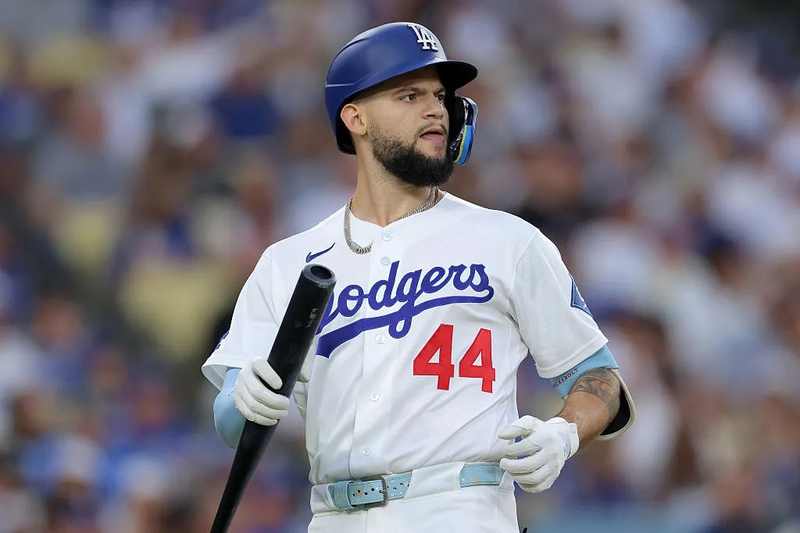
ATLANTA — Two seventh-inning swings, made hundreds of miles apart, completed the 2026 National League bracket. Andy Pages punched a two-run single off Robert Suarez to break a pitchers' duel at Truist Park. In San Diego, Jackson Chourio's fifth-inning single put Milwaukee ahead for good. By night's end, the Dodgers and Brewers had each won Game 4 and their series 3-1.
The Dodgers Braves Game 4 score — Los Angeles 4, Atlanta 1 — sent the Dodgers to a third consecutive NLCS, extended their run to eight straight postseason series victories and kept alive a bid to become the first National League club to win three straight World Series. The Brewers Padres Game 4 score — Milwaukee 3, San Diego 1 — returned the Brewers to the NLCS for a second straight year and ended an MLB-record-tying 12-game postseason road losing streak that dated to 2018.
How Los Angeles finally solved the biggest at-bat
Andy Pages' two-run single changed a series built on stranded runners
Los Angeles entered the seventh inning 0-for-14 with runners in scoring position in the series. Teoscar Hernández singled, rookie Josue De Paula drew a pinch-hit walk and Tommy Edman replaced him on the bases. Pages then lined Suarez's offering through the infield, scoring both runners and producing the Dodgers' first hit with a runner in scoring position all series.
Pages finished with two of the club's five hits and two of its three RBIs. The moment mattered because the Dodgers had not overwhelmed Atlanta; they had survived it. Tyler Mahle allowed only three hits in 6 1/3 innings, with two runs — one earned — four strikeouts and one walk. His reward was a hard-luck loss.
Tyler Glasnow was uneven rather than dominant: 4 1/3 innings, one run, one hit, five walks and five strikeouts. Dave Roberts removed him at 78 pitches in the fifth. Alex Vesia, Edgardo Henriquez, Tanner Scott and Edwin Díaz responded with 4 1/3 scoreless innings. Henriquez earned his first career postseason victory, Díaz collected his second save of the series, and the bullpen retired Atlanta's final seven hitters in order.
Max Muncy supplied the last punctuation mark with a 389-foot solo homer in the ninth. It was his third home run of the series and 19th of his postseason career, breaking the Dodgers franchise record. Atlanta, meanwhile, finished the series 1-for-23 with runners in scoring position; Michael Harris II collected two of its three hits in the finale.
Milwaukee's road breakthrough came with a catch at the wall
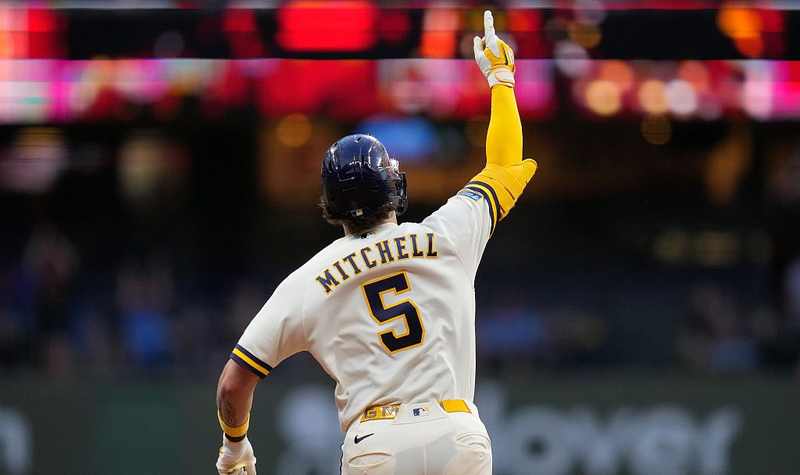
Garrett Mitchell robs Machado's home run — and ends the road curse
Mitchell's box score was already full before the play that defined Milwaukee's night. He tripled and scored the go-ahead run in the fifth, went 2-for-4 with an RBI and a run, then tracked Manny Machado's 406-foot drive to the wall in the eighth. The catch denied what would have been a tying homer.
Chourio had delivered the tiebreaking single one inning after Fernando Tatis Jr.'s third-inning solo homer tied the game. Sal Frelick added a sixth-inning sacrifice fly. William Contreras had two hits, while Jake Bauers reached four times — a single and three walks — and scored.
Aaron Ashby gave Milwaukee the calm the game demanded: three hitless, scoreless relief innings on 38 pitches, with three strikeouts and two walks. San Diego managed only three hits. Jackson Merrill and Machado singled in the first, when the Padres left the bases loaded, and Tatis homered in the third. After that, the Brewers' pitching and defense closed the door.
Machado called Milwaukee “the best team in baseball, and one of the best pitching staffs in all of baseball.” That description is not courtesy alone. The Brewers won 103 games, the majors' best regular-season record, and earned the right to host the opening games of the NLCS.
Why the rematch is bigger than revenge
Last year's sweep meets this year's evidence
The Dodgers swept Milwaukee 4-0 in last year's NLCS and held the Brewers to four runs in the entire series. That is the psychological backdrop, but it is not a forecast. Milwaukee won four of seven regular-season meetings with Los Angeles this year and arrives with a deeper claim than underdog energy: 103 wins and home-field advantage.
Pat Murphy's public posture reflected that shift. “We're going in to beat them,” the Brewers manager said. “We earned it in the regular season to get home-field advantage.” The challenge is converting that regular-season edge into October offense against a staff that just showed it can survive a starter issuing five walks.
Roberts framed the Dodgers' position differently: “Eight more wins,” he said, adding, “We're smarter, we're better and we're tougher.” Los Angeles is making a 14th consecutive postseason appearance. A third straight championship would separate this roster from every previous National League dynasty in the divisional era.
Small-market precision against superteam depth
This series will also be read as a referendum on baseball's economic divide. Los Angeles can absorb injuries and imperfect starts with expensive depth. Milwaukee's model depends more heavily on development, role clarity, pitching design and squeezing value from the middle of the roster. Pages and Mitchell, rather than the sport's most marketable stars, supplied Wednesday's decisive plays — a reminder that October can flatten payroll differences for a night.
Yet the payroll argument will not disappear, especially with labor negotiations, a possible work stoppage and renewed salary-cap debate looming over the sport. A Dodgers win will be cited by critics of spending concentration; a Brewers win will become evidence for clubs that insist smart development can still beat financial scale. Neither conclusion would be complete, but both will shape the offseason argument.
NLCS schedule 2026: what comes next
NLCS Game 1 is October 11 in Milwaukee
The best-of-seven series begins Sunday, October 11, in Milwaukee. At publication time, the clubs had not formally announced every rotation assignment, so any precise matchup remains conditional. Home field gives Murphy more control over bullpen deployment and pinch-hitting sequence in the first two games; the Dodgers' advantage is the number of plausible ways they can build a staff plan.
Two health questions bear watching. Shohei Ohtani's workload and physical condition will shape how aggressively Los Angeles can deploy him, while both clubs must decide how much recent Division Series usage should influence Game 1. Tarik Skubal is not part of this NLCS; his “factor” applies only to a possible World Series matchup if his American League club advances. That distinction matters when projecting the Dodgers' broader three-peat path.
The cleanest Milwaukee scenario is to turn Games 1 and 2 into low-scoring contests, force the Dodgers to hit with runners in scoring position and protect late leads with the same precision shown in San Diego. The cleanest Los Angeles scenario is to score early, neutralize Milwaukee's crowd and make the Brewers chase last year's sweep. The most likely reality sits between them: a longer, tighter series in which one defensive play — the kind Mitchell made at the wall — matters as much as a star's swing.