For one hour in Burbank, California's two would-be governors finally shared a stage: Xavier Becerra, the veteran Democrat sitting on a 25-point poll lead, and Steve Hilton, the Republican betting that anger over prices can break a 20-year blue streak.
What happened
On Wednesday evening, September 30, Democrat Xavier Becerra and Republican Steve Hilton met in the only scheduled debate of California's 2026 governor's race: a one-hour, nationally televised matchup on CNN, broadcast from the network's Los Angeles studios at 6 p.m. PDT and moderated by anchors Jake Tapper and Dana Bash. It was the first time the two had shared a debate stage since advancing from a crowded June primary — and, unless plans change, the last time voters will see them go head-to-head before the November 3 general election.
The timing was no accident. The debate landed just days before mail ballots were expected to begin arriving at California homes, with early voting and ballot drop-off locations opening statewide on October 5, according to Secretary of State Shirley Weber. To earn a podium, each candidate had to meet requirements set by the California secretary of state, raise, contribute, or loan at least $1 million for the campaign, and reach at least 15% support among registered or likely voters in two qualifying polls.
Why this matters
California will elect its first new governor since 2019 — Gavin Newsom is barred by term limits from seeking another term — and the job is arguably the most consequential statehouse in America. The governor of the nation's most populous state, and the world's fifth-largest economy, shapes national policy on climate, technology, housing, and immigration whether Washington likes it or not.
What makes this race analytically interesting is the rare consensus at its center: both candidates are running on bringing costs down. Gasoline, utility bills, housing, homelessness — the affordability crisis is the defining issue of California politics, and neither candidate disputes the diagnosis. The debate was therefore never going to be about whether prices are too high; it was about credibility and method. Who do voters trust to actually fix it — the career government hand or the outsider promising to blow up the bureaucracy?
The national stakes are real, too. California has been the Democratic Party's counterweight to Donald Trump's Washington, and Hilton — who carries Trump's endorsement — would be a Trump-aligned governor in a state that voted against the president by more than 20 points in 2024. A Hilton win would scramble the national map; a Becerra win would preserve the status quo and hand Democrats a fresh statewide mandate weeks before the midterms.
The two candidates at the podium
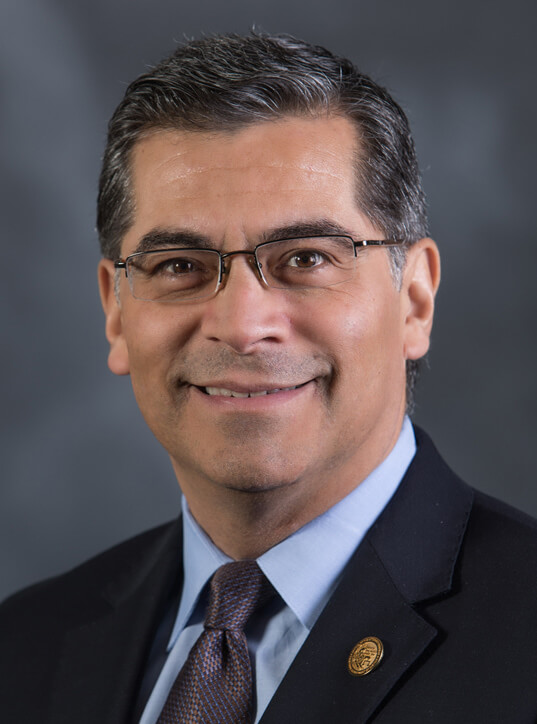
Xavier Becerra, Democrat. The résumé candidate: former U.S. secretary of health and human services under Joe Biden, former California attorney general, and a former congressman representing the Los Angeles area. Becerra's pitch is experience — that only someone who has managed crises at the cabinet level can fix California's problems — paired with a promise to bring down household costs and a pledge to push back against Trump's agenda. His vulnerability is energy: since the June primary he has kept a relatively low profile, and even sympathetic coverage notes he has struggled to generate the kind of campaign enthusiasm his opponent has.
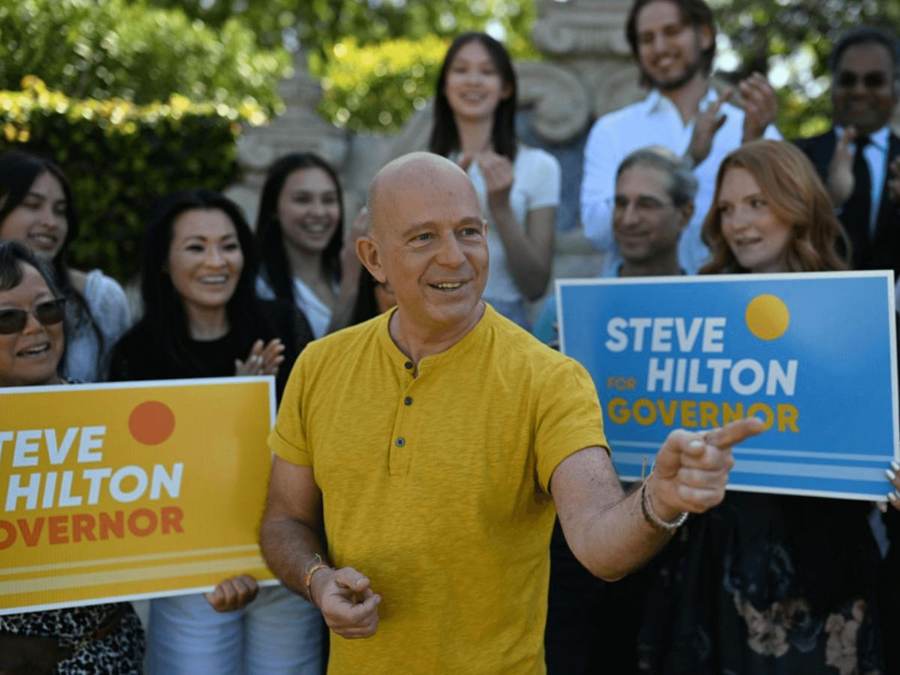
Steve Hilton, Republican. The insurgent: a former Fox News host and a former adviser to British Prime Minister David Cameron, campaigning as the man who will make California affordable again. His promises are vivid and specific — bring gasoline down to $3 a gallon, roughly half the current price; cut residents' utility bills, among the nation's highest, in half; eliminate state income taxes on the first $150,000 in earnings. He has campaigned exhaustively, with crowded, boisterous town halls built around the cost of living, homelessness, crime, and gas prices — and he carries the endorsement of President Trump.
The numbers, and what they actually mean
Start with the headline number: the September UC Berkeley Institute of Governmental Studies poll found Becerra leading Hilton 58% to 33%, a 25-point advantage. Then look beneath it. The same polling ecosystem finds both candidates lukewarm with voters: the Politico-Citrin poll put Hilton's unfavorable rating at 55% and Becerra's at 44%, while a Berkeley poll found just 48% of likely voters viewing Becerra favorably against 40% unfavorable. Fifty-three percent disapprove of the job Newsom is doing. Sixty-eight percent disapprove of Trump's performance.
Read together, the numbers tell a story of structural advantage rather than personal appeal. Becerra's lead is built on Democratic registration dominance and anti-Trump sentiment, not enthusiasm — the classic profile of a candidate winning by default in a blue state. That is why the race still matters despite the margin: California has not elected a Republican governor since Schwarzenegger's 2006 re-election, and no Republican has won any statewide office since. The partisan math is a wall. But 53% disapproval of the incumbent party's governor is a genuine opening — and the election's central tension is the collision of two discontents: voters unhappy with Democratic Sacramento and voters unhappy with Trump, with Hilton and Becerra each embodying one side of it.
The primary that produced this matchup was chaotic enough to explain the odd pairing. Former Democratic Rep. Eric Swalwell exited the race — then announced he would leave Congress — after allegations that he sexually assaulted a woman twice, including while she worked for him. Billionaire Tom Steyer ran what was described as the most expensive political advertising campaign in the country in a losing bid for the Democratic nomination. What survived the wreckage is the starkest possible contrast: the ultimate insider versus the ultimate outsider.
What to watch
For Hilton, the Associated Press framed the stakes plainly: the debate was "perhaps his best chance of gaining ground." Trailing by 25 points with a month to go, he needed a breakout — a moment crisp enough to travel beyond the hour and land with voters opening their mail ballots next week. The question was whether his vivid promises could survive contact with follow-up questions: $3 gasoline and halved utility bills are easy to chant and hard to engineer, and Becerra's best line of attack was always going to be the gap between the slogan and the mechanism.
For Becerra, the task was the opposite: avoid the mistake, show some energy, and connect a cost-of-living message to a record that — as the state's former top lawyer and a former cabinet secretary — is long on titles and short on kitchen-table wins. The Trump factor cuts both ways and both candidates knew it: Hilton's endorsement from the president fires up the Republican base but, in a state where 68% disapprove of Trump, it is also the easiest weapon Becerra owns.
The honest analytical note: one-hour debates rarely move 25-point races. What they can do is set the narrative for the final month — and with mail ballots landing within days, the debate's real audience was never the studio: it was the voters filling out ballots at their kitchen tables next week.
What happens next
Three scenarios are worth watching. The most likely: Becerra holds his lead and the race stays out of reach — the debate generates a news cycle or two, but California's partisan math is the heavy favorite and has been for two decades. The final month becomes a turnout exercise, with Becerra banking early mail votes while Hilton tries to squeeze persuasion out of affordability anger. The upset path: a genuine Hilton breakout narrows the margin into the teens, national money floods in, and California briefly becomes the most-watched race in America — though even then, the Democrat starts every simulation ahead. The wildcard: a gaffe or a viral exchange moves a few points at exactly the moment low-information voters are marking ballots, turning a coronation into a contest. That last scenario is the one Hilton's campaign is praying for. The first is the one the numbers suggest.
Related coverage
Sources
- Associated Press (Sophie Austin and Michael R. Blood) — "Rivals for California governor to meet in only scheduled debate as mail ballots go to voters" (September 30, 2026)
- CNN — "CNN to host California gubernatorial debate ahead of November election" (September 8, 2026)
- Desert Sun — "Becerra, Hilton to face off in California governor debate. What to know" (September 29, 2026)
- KFI AM 640 / City News Service — "Debate Set For Hilton Becerra In Governor's Race" (September 8, 2026)
- Washington Examiner — "Becerra leads in California governor's race, but voters remain lukewarm" (September 25, 2026)