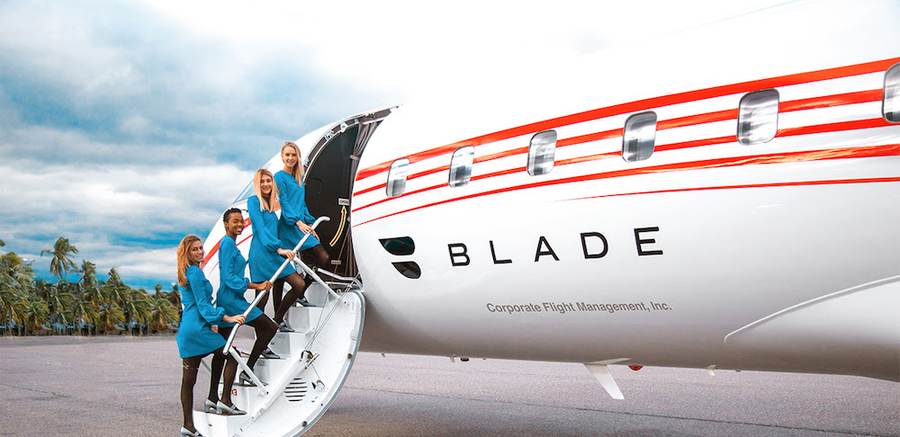
BladeOne New York Florida flights return November 19, reopening a high-end middle ground between a scheduled first-class ticket and chartering an entire aircraft. The seasonal service will connect Westchester County Airport (HPN) with Miami-Opa Locka Executive Airport (OPF) and President Donald J. Trump International Airport (DJT), the renamed Palm Beach airport formerly identified as PBI. Flights are scheduled through May 2, 2027 and will be operated for Blade by USAC Airways 695, an Aero subsidiary.
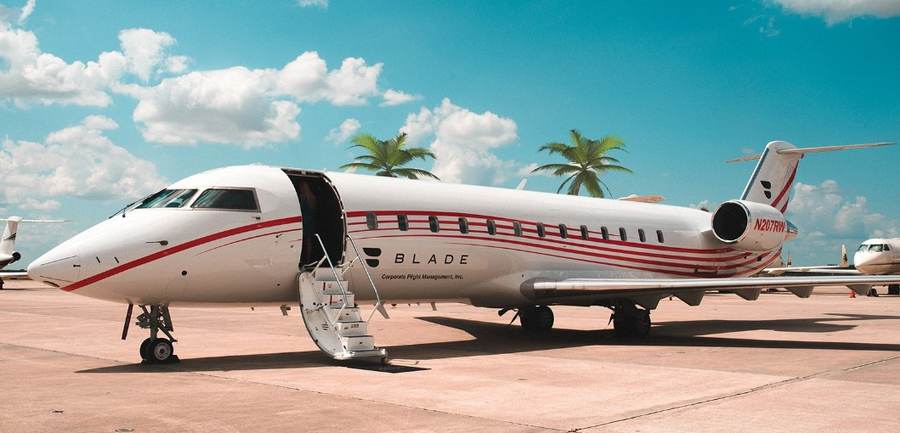
The aircraft is an Embraer regional jet refitted with only 16 single seats in eight 1-1 rows. Every passenger gets both a window and aisle. Blade says the cabin will include Starlink Wi-Fi, amenity kits, dining and bar service, with cabin service by the SKYfx team. The more important differentiator is on the ground: passengers use private-terminal facilities rather than the main commercial concourse. That removes much of the queuing that makes a short flight consume a day.
Why the Blade semi-private jet Florida relaunch matters
Blade first launched the BladeOne concept in 2015 and discontinued the earlier version in May 2024. Its return is a bet that migration, second-home travel and business links between the New York region and South Florida have created enough concentrated demand for a premium shuttle. Blade founder and CEO Rob Wiesenthal described the target as the “white space” between a roughly $1,000 first-class seat and a $25,000 charter. Published fares start at $2,450 each way, confirming that the product is much closer to luxury commercial travel than to a cheap private jet.
The service also tests Joby Aviation’s strategy after its $125 million acquisition of Blade’s passenger business. Joby’s long-term narrative centers on electric air taxis, but existing helicopter and jet operations can build customer relationships, terminal access and booking habits before electric aircraft scale. BladeOne is therefore both a seasonal airline product and a bridge in a wider premium-mobility network.
For travelers, the central value is time certainty. A passenger who avoids a crowded terminal, long security line and distant gate may save an hour or more, though road travel to Westchester can erase some of that advantage. The product makes most sense when the traveler’s origin, destination and schedule align with the private terminals. It is not automatically faster for someone living near JFK and heading to South Beach at rush hour.
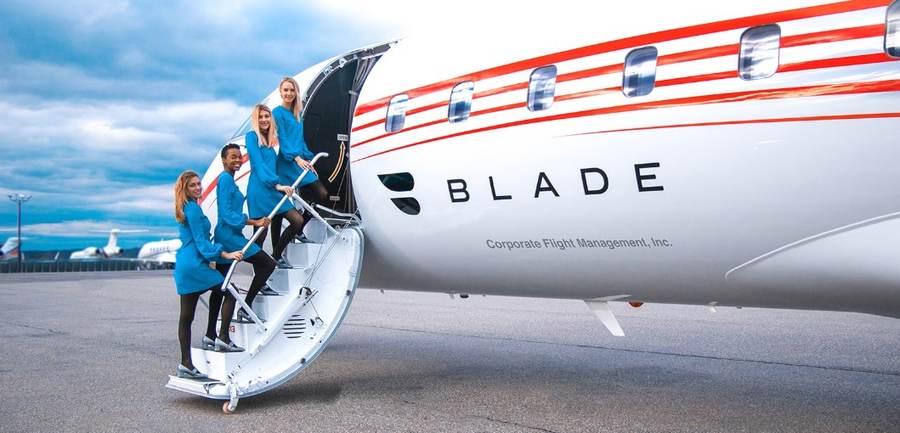
What semi-private means — and what it does not
“Semi-private” is a marketing description for scheduled public charter or by-the-seat travel. Customers purchase an individual seat on a published flight rather than hire the whole aircraft. They share the cabin with other passengers and follow the operator’s schedule. The experience uses a private aviation terminal, often called an FBO, and a low-density cabin, but it is not a private charter that departs whenever the customer chooses.
The distinction matters for expectations and consumer protection. Aero’s operating entity, not the Blade app alone, is responsible for the flight. Weather, crew duty limits, maintenance and air-traffic restrictions can still delay or cancel service. A small schedule has fewer recovery options than a major airline operating multiple flights a day. Travelers should read the contract of carriage, cancellation terms and rebooking policy before buying, especially for cruises, weddings or international connections.
The usual private-terminal advantage is a short arrival window. Industry coverage says comparable services can accept passengers roughly 20 to 45 minutes before departure; for planning, BladeOne travelers should use the time printed in their confirmation and allow 30 to 45 minutes unless instructed otherwise. Arriving late can be more consequential than at a large airport because a 16-seat flight may not have a same-day substitute.
Aero BladeOne schedule and frequency
The seasonal pattern is built around long weekends. Private Jet Card Comparisons reported southbound flights on Thursdays and Fridays, with northbound service Sundays and Mondays. That schedule suits second-home owners, leisure travelers and executives splitting time between the regions. It does not suit a traveler needing daily flexibility. Exact departure times, operating dates and the choice between OPF and Palm Beach should be confirmed in the booking system before ground transport is arranged.
The published season runs from Thursday, November 19, 2026 through Sunday, May 2, 2027. That window captures Thanksgiving, winter holidays, school breaks and the South Florida high season. It also avoids summer, when demand reverses, heat and hurricane risk make the market less attractive, and many seasonal residents leave Florida.
A 16-seat aircraft limits inventory by design. Popular holiday flights can sell out quickly, and low frequency means flexibility has value. Travelers comparing fares should examine change penalties and refundable options, not just the first displayed price. A less expensive fare that cannot move may be a poor fit for an uncertain schedule.
Pricing: from $2,450 one way, plus the real trip cost
Published coverage lists fares from $2,450 each way. A round trip therefore begins near $4,900 before add-ons, ground transfers or higher peak pricing. The company also plans to sell trip books, which may appeal to frequent travelers if the effective per-flight price, blackout dates and expiration terms are favorable. Blade allows Bilt Cash redemptions, but it does not currently offer the airline-mile earning partnership that JSX has with United MileagePlus.
The correct comparison is door-to-door cost. Add the ride from Manhattan to HPN, or price an integrated Blade helicopter transfer. In Florida, add a car from OPF or Palm Beach to the final address. Compare that total with a commercial first-class fare from JFK, LaGuardia or Newark, including lounge value, checked-bag fees, airport transfer and the cost of time. For two travelers, BladeOne’s starting round trip approaches $9,800; at that level, flexibility and service must carry significant value.
The $25,000 charter comparison is directionally useful but route- and aircraft-dependent. A charter price covers the aircraft, not one seat, so a group can divide it. Eight people paying $2,450 each spend $19,600 one way before extras, narrowing the gap with some charter quotes. BladeOne is strongest for individuals and couples who want private-terminal convenience without organizing a group.
Luggage rules and pets: verify before packing
Blade’s announcement and initial independent coverage emphasized cabin configuration and service but did not publish a complete baggage allowance in the material reviewed for this report. Travelers should not assume commercial-airline limits or private-charter flexibility. Regional jets have constrained baggage volume, and weight-and-balance requirements can be strict. Confirm the number, size and weight of included bags on the exact fare before purchase; oversized golf equipment, strollers and mobility devices should be disclosed in advance.
Pet access is more explicit in current reporting. Up to five dogs under 20 pounds may be accepted at $500 per flight, and a $3,500 pet program was reported to offer frequent-travel privileges with a guaranteed spot, subject to the published terms. Confirm carrier, documentation and behavior requirements directly with the operator. Limited pet capacity means approval should be secured before nonrefundable lodging is booked.
Medication, valuables and one change of clothes should remain in a personal item when possible. A small operator can provide high-touch handling, but bags still face loading limits and operational disruptions. Travelers connecting onward internationally should leave generous time and verify whether baggage can be through-checked; in most semi-private models, it cannot.
Getting to Westchester County Airport
HPN sits in White Plains, north of New York City. It can be convenient for Westchester and parts of Connecticut, but Manhattan travel times vary sharply with traffic. A car service is the straightforward option; build a buffer for the Hutchinson River Parkway and local roads. The private-terminal address in the confirmation matters because arriving at the main terminal may create unnecessary delay.
Blade plans integrated helicopter bookings between Manhattan and HPN for Florida passengers. That can turn an unpredictable road segment into a short flight, but weather, baggage and additional cost affect the equation. Travelers should examine the transfer’s cancellation handling: if the helicopter cannot operate, ask whether Blade provides a car and how much buffer remains before the jet departure.
Public transportation can reduce cost but undermines some convenience. Metro-North reaches White Plains, followed by a taxi or rideshare to the airport. This may work for a light-packing solo traveler, but the transfer needs contingency time. The semi-private experience begins at the FBO; it does not eliminate the geography between home and HPN.
Getting from OPF and Palm Beach
Miami-Opa Locka Executive Airport is northwest of central Miami and can be well positioned for Miami Beach, Bal Harbour, Aventura and northern Miami-Dade, depending on traffic. It avoids Miami International’s main terminal but not South Florida congestion. Reserve a car service or rideshare with the exact FBO pickup point, and compare drive times for the final address rather than assuming “Miami” means downtown proximity.
The Palm Beach destination uses the airport renamed President Donald J. Trump International Airport and the code DJT in the service announcement. Travelers should verify how navigation and airline systems display the new name and code during the transition from PBI. For Palm Beach, West Palm Beach and nearby communities, it may offer a shorter final drive than OPF. For Fort Lauderdale or Boca Raton, compare both endpoints.
Rental-car availability at an FBO may differ from a commercial terminal counter. Arrange delivery or confirm shuttle procedures. If friends are collecting passengers, send the operator and terminal name, not only the airport code. Private airports and commercial fields often have multiple entrances separated by several minutes of driving.
JSX vs BladeOne
JSX already flies from HPN to the same South Florida markets, making it the direct benchmark. The Points Guy reported that JSX uses Embraer E135 and E145 aircraft with 30 seats: 2-1 seating on some E135s and 1-1 on E145s. Aero’s BladeOne E135 carries 16 passengers in eight rows of 1-1 seating. Blade therefore offers more space and exclusivity on the same basic regional-jet platform.
JSX has network scale and a United MileagePlus earning relationship. Blade counters with lower cabin density, integrated Manhattan helicopter transfers, Starlink and a hospitality-led package. Price, schedule and disruption recovery may matter more than seat count. A traveler should compare the exact date because a competitor’s broader schedule can be more valuable than a more spacious cabin that flies only certain days.
Competition is good for the corridor if it produces schedule choice and service discipline. It can also expose the limits of a niche market: two operators dividing a finite premium audience may struggle outside peak periods. Blade’s seasonal dates and weekend-oriented frequency reduce that risk by matching capacity to demand.
Who this is for — and who should book commercial first class
BladeOne fits a traveler whose time is expensive, whose trip begins north of Manhattan or can use the helicopter connection, and whose Florida destination is close to OPF or Palm Beach. It also suits passengers who value a quiet 16-seat cabin, dislike main-terminal friction or travel repeatedly between homes and offices. The service is especially compelling when a commercial first-class fare is already elevated during a holiday weekend.
Commercial first class remains better for travelers needing daily departures, airline lounges, protected connections, large baggage allowances, broad rebooking networks or loyalty benefits. Families multiplying a $2,450 fare across several seats may find the premium difficult to justify. Travelers with a fixed international connection should prefer an itinerary whose airline can protect the whole journey.
Economy and premium economy remain dramatically cheaper. “Cheap semi-private flights Florida” is a popular search phrase, but BladeOne is not a budget product. Its proposition is avoiding friction, not democratizing private aviation. Customers should be skeptical of any comparison that ignores the cheapest commercial alternatives.
Winners, losers and wider aviation effects
Westchester and the South Florida FBO ecosystem gain high-spending travelers. Aero gains aircraft utilization and brand exposure on a proven seasonal corridor. Blade reconnects its helicopter network to a longer jet leg. Passengers gain another choice, and JSX faces pressure to defend service and pricing.
Commercial airlines may lose some premium passengers, though 16 seats per flight are small relative to the New York–Florida market. Environmental critics will question the emissions per passenger of a lightly configured regional jet. BladeOne uses an E135 that might otherwise carry 30 passengers; spreading fuel burn across 16 seats increases per-passenger impact unless operational factors offset part of the difference. Convenience should be weighed against that footprint.
Local residents around smaller airports may see more traffic and noise. HPN already faces community debates over capacity and quality of life. Premium aviation’s growth can concentrate benefits among travelers while distributing noise to neighbors. A balanced assessment recognizes both the time savings and the external costs.
What happens next
The first test is booking conversion: do customers pay the published premium beyond Thanksgiving and Christmas? The second is operational reliability during Northeast winter weather. A polished cabin cannot compensate for repeated cancellations without strong recovery options. The third is whether Blade and Aero add frequency, extend the season or replicate the model on another corridor.
If demand holds, semi-private flying could capture more routes where premium traffic is dense and secondary airports sit near affluent communities. The model is harder where ground access is poor, demand is spread across the week or commercial airlines offer abundant nonstop service. New York–South Florida is close to an ideal laboratory because migration, second homes and business ties create repeat travel.
The practical verdict is simple: BladeOne offers a genuinely different journey, not merely a larger first-class seat. But the advantage is conditional. Price the entire door-to-door trip, verify luggage and pet rules, examine the limited-day schedule, and have a disruption plan. The best semi-private flight is the one whose airports align with where you are actually going.
For related travel and transport analysis, see Signal Post News on the global diesel supply squeeze, aviation safety after the Catalina crash, and the business archive.
Booking checklist before paying
Start with the exact operating date and direction, because the Thursday-Friday southbound and Sunday-Monday northbound pattern may not cover every week identically. Confirm whether the arrival airport is OPF or Palm Beach and save the FBO address. Read the fare’s refund and change rules, identify the operating carrier and note the check-in cutoff. Add every traveler and pet before payment so the price reflects the real party.
Next, obtain written confirmation of baggage allowance, including dimensions and weight. Ask specifically about golf clubs, skis, strollers, wheelchairs and medical equipment. Price Manhattan ground transport and the optional helicopter separately. In Florida, reserve a car to the correct terminal and compare both destination airports by road time. If the trip connects to a cruise or international flight, build an overnight buffer rather than relying on a separate-ticket same-day connection.
Finally, compare the full itinerary with at least two commercial options and JSX on the same date. Include loyalty value, bags, cancellation flexibility and airport transfer. The lowest sticker price is not always the lowest trip cost, and the most luxurious cabin is not always the fastest door to door. A spreadsheet with four columns — fare, ground, time and recovery — will usually make the decision clearer than marketing language.
What reliability will mean for a 16-seat network
Small scheduled operations live or die by recovery. A major airline can move passengers to another flight or route them through a hub; a four-day weekly semi-private pattern may have no immediate substitute. Blade and Aero can offset that disadvantage through proactive communication, ground support and reaccommodation agreements, but customers should not assume those protections. Winter operations at HPN add snow, deicing and low-visibility risk, while South Florida adds convective weather and air-traffic congestion.
Reliability statistics after launch will be more informative than launch amenities. Track completion rate, average delay, handling of diversions and how quickly refunds arrive. Premium customers pay partly to remove friction; a disruption that requires hours of self-service searching damages the value proposition more than a missing amenity kit. The operator’s service recovery will determine whether occasional customers become trip-book buyers.
Could semi-private become mainstream?
The model can grow, but “mainstream” is relative. Sixteen seats create intimacy and speed while limiting revenue per departure. High fares, strong load factors and efficient aircraft utilization are essential. Routes need concentrated premium demand at both ends and airports that offer meaningful ground advantages. New York–South Florida fits those conditions better than most U.S. city pairs.
Technology may change the economics over time. Joby’s electric-air-taxi ambitions could make airport transfers quieter and potentially cheaper, but certification, infrastructure and weather remain constraints. For now, the business rests on conventional helicopters and regional jets. BladeOne’s return is evidence that customers value the network concept before electric aircraft arrive. It is not proof that the economics will work on a national scale.