Business · Economy
The government gave protesting garment workers the wage board they asked for on Sunday — and urged them back to their machines. The workers, demanding Tk30,000 a month against a current minimum of Tk12,500, stayed on the streets, with 529 factories shut and nearly a million workers idle.
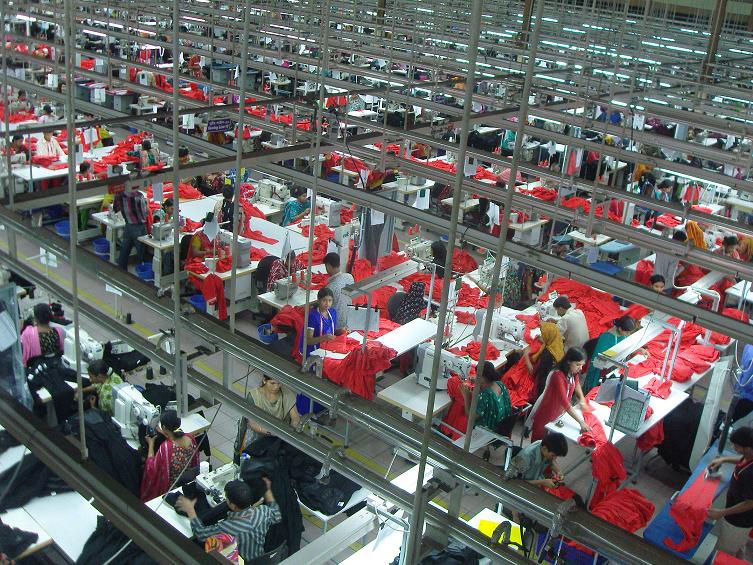
Bangladesh formed a six-member Minimum Wage Board on Sunday, November 1, to review garment workers’ pay, and the government urged workers to return to their factories — but the Bangladesh garment workers protest continued across Dhaka, Gazipur and Ashulia regardless, in the largest labour unrest the industry has faced since the last wage round three years ago. The workers’ demand is specific: a minimum monthly wage of Tk30,000, about $245, more than double the current Tk12,500, about $101. Workers and their federations say the present floor no longer covers the basic costs it is meant to cover — food, housing, transport and healthcare — after three years of rising prices.
The scale of the shutdown is what turned a pay dispute into a national story. The Bangladesh Garment Manufacturers and Exporters Association (BGMEA) said the unrest had forced 529 factories to shut, leaving 987,190 workers out of work across the country’s main industrial hubs. The sector behind those numbers is the backbone of the economy: roughly 4,000 registered factories employing more than four million people, about 65 percent of them women, generating over 80 percent of export earnings and shipping $38.7 billion worth of clothing in 2025-26. Bangladesh is the world’s second-largest apparel exporter, behind only China — which is why a wage fight in Gazipur is also a story about the price of a T-shirt in Berlin, London and New York.
Labour Minister Ariful Haque Choudhury, announcing the board, said the workers’ own central demand — a wage board — had now been met, and he urged them to leave the streets and return to work. He also alleged that the protests were being politically instigated — an allegation worker leaders have not accepted, presented here as the minister’s claim, not an established fact. Worker representatives said they hoped the board’s work would begin soon. But the protests continued through Sunday — a reminder of the distinction at the heart of this dispute: a wage board is a process, not a pay rise, and nobody’s wages changed on Sunday.
What happened on Sunday
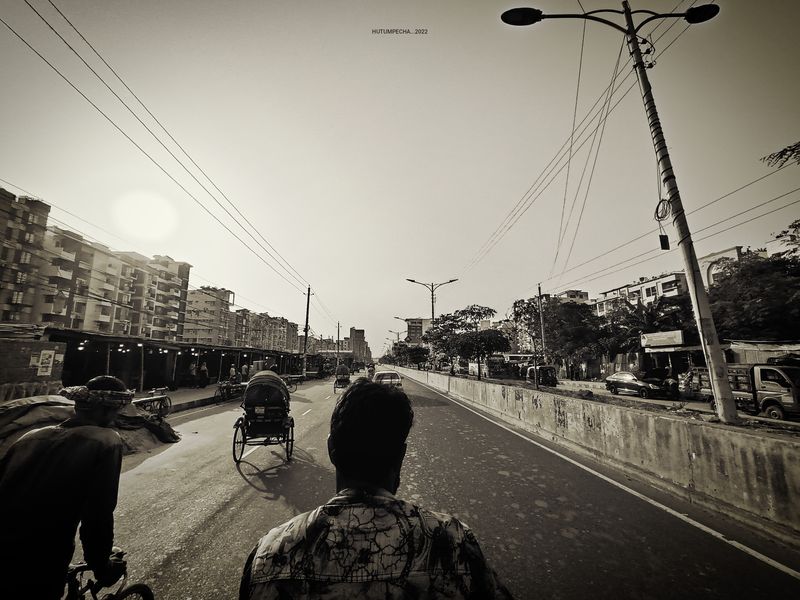
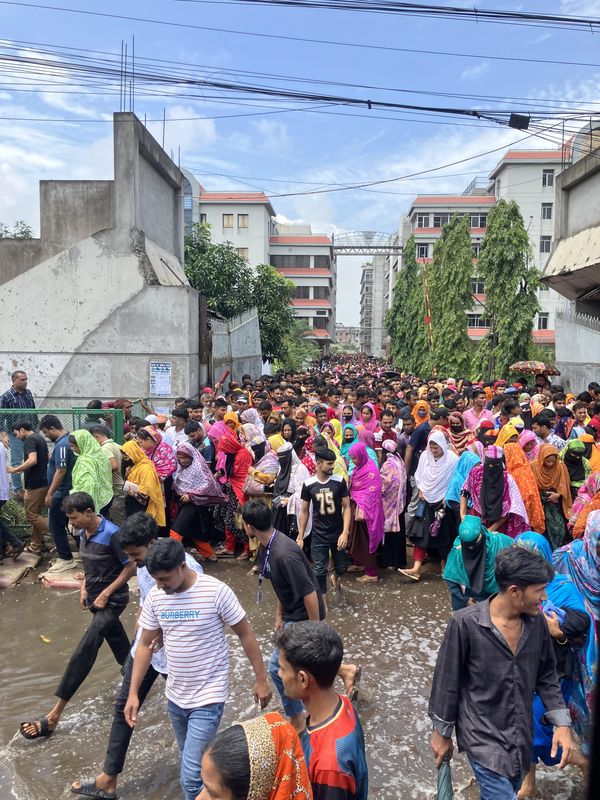
The day’s Dhaka garment workers protest centred on Mirpur, in the north of the capital, where workers blocked the Mirpur 10 intersection from the morning, bringing traffic to a standstill at one of the city’s busiest roundabouts; the gates of the Mirpur 10 metro station were closed as the blockade took hold. In Gazipur, the industrial district on Dhaka’s northern edge where much of the industry is concentrated, the Gazipur garment factory protest shut the Dhaka-Tangail highway, one of the country’s main freight arteries.
Parts of the day turned violent. In Konabari, in Gazipur, a police box was set on fire; in a separate incident, a police vehicle was also set on fire. Police responded with tear gas, water cannon and sound grenades, and Border Guard Bangladesh personnel were deployed in Gazipur alongside police. The unrest was not a one-day eruption: protests over the wage demand began in August 2026 and escalated sharply in late October, and on Saturday, October 31, about 30 factories in Ashulia declared holidays in the face of the demonstrations. Sunday’s tally of 529 closed factories — the BGMEA’s count of the Bangladesh factory closures the protests have caused — marks the escalation from disruption to something close to a sector-wide stoppage in the main hubs.
The wage board: who sits on it, and what it can do
The Bangladesh garment workers wage board announced on Sunday has six members, drawn from the judiciary, academia, employers and workers. It is chaired by Senior District and Sessions Judge Sheikh Ashfaqur Rahman. The neutral member is Professor Mosleh Uddin Ahmed of Dhaka University. Employers are represented by Asif Ayub of the Bangladesh Employers’ Federation and ABM Shamsuddin of the BGMEA; workers by Anwar Hossain of the Bangladesh Jatiyatabadi Sramik Dal and Babul Akhter of the Bangladesh Garments and Industrial Workers Federation. The board was formed under Section 138 of the Bangladesh Labour Act 2006, as amended in 2026 — an amendment that shortened the wage review cycle from five years to three, itself a reflection of how quickly a fixed minimum loses value when prices rise.
A wage board of this kind hears the stakeholders, weighs the cost of living against the industry’s stated capacity to pay, and recommends a revised minimum wage, which the government then adopts and gazettes. It does not set pay by itself on the day it is formed. The timetable matters: the current Tk12,500 minimum took effect on December 1, 2023, raised from Tk8,000 after the 2023 protests, in which workers had demanded Tk23,000. Under the new three-year cycle, the next review falls due this December — so the board is working against a deadline weeks away if the revised Bangladesh minimum wage for garment workers is to arrive on schedule.
When will Bangladesh garment workers get a pay rise?
On the evidence of Sunday: not yet, and no date has been announced. The minister urged the board’s members to take up their work promptly, and worker representatives said they hoped it would begin soon — the first meeting, the consultations and the recommendation all still lie ahead. Workers judging the announcement against 2023, when a review ended well below their demand, chose to keep protesting rather than treat the board’s formation as the end of the argument. Whether the board can move fast enough to change that calculation is the immediate question in Dhaka this week.
Why this matters
The Bangladesh clothing exports wage dispute matters far beyond Bangladesh because of where the clothes go. As the world’s second-largest apparel exporter, Bangladesh sews for many of the leading Western high-street and online brands, and garments generate over 80 percent of the country’s export earnings — no other industry could absorb a prolonged stoppage. Every day of closure is a day of missed production against shipping deadlines set months ago. Orders that miss their vessel either fly at far higher cost, arrive late into a short selling season, or are cancelled — and buyers who get burned once quietly dual-source the next order to a competing country.
The second reason this matters is trust in the process itself. In 2023, garment workers demanded Tk23,000 and, after protests much like these, received Tk12,500 — a raise of more than half on the old Tk8,000 floor, but barely more than half of what was asked. That history is the credibility gap hanging over Sunday’s announcement: the government presents the wage board as the demand met; many workers hear the start of a process that last time delivered roughly half their claim, before inflation took its share. Which reading proves right depends on the number the board eventually recommends — and how much of the gap between Tk12,500 and Tk30,000 it closes.
Background: safety moved faster than pay
Why are Bangladesh garment workers protesting?
The short answer is arithmetic. The minimum wage has been Tk12,500 since December 1, 2023. In the three years since, workers say, the prices of the things wages are spent on — food first, then housing, transport and healthcare — have risen faster than the floor beneath their pay, so a wage that was already contested in 2023 buys materially less in 2026. The demand that garment workers demand 30,000 taka a month is framed by the federations as a living-cost calculation: the figure they say a worker’s household needs to cover those basics. Owners counter that the prices global buyers pay per piece cannot absorb a 140 percent rise in the wage floor at once. That unresolved argument is why the protests began in August and why they have grown.
The longer background is the industry’s uneven reform story. After the Rana Plaza factory collapse in 2013, which killed more than 1,100 workers, international safety accords and buyer pressure drove a decade of factory remediation — fire exits, structural inspections, boiler safety — that genuinely changed physical conditions inside much of the industry. Pay reform never moved at the same pace: there is an accord tradition for safety, but no equivalent mechanism tying what brands pay to what workers earn. Reviews came at long intervals — five years under the old cycle, now three — and each was preceded by street protests, in 2023 and again now. The pattern across a decade is that Bangladesh’s wage floor tends to move when workers stop work.
Who benefits, who loses
Workers stand to gain most if the board moves quickly and lands well above the current floor — and they are also paying the most immediate price, in wages lost for every idle day. Factory owners are squeezed from both directions: buyers who resist paying more per garment on one side, and a wage bill that will rise by an amount they do not control on the other. Owners gain if a credible board process restores order quickly; they lose doubly if closures drag on, first in cancelled and delayed orders, then in buyers who shift future seasons elsewhere.
Brands occupy the uncomfortable middle. A fast, credible settlement protects their supply and their public commitments on worker welfare; a prolonged dispute, or a settlement widely seen as inadequate, exposes them to the charge that rock-bottom prices and living wages cannot both be had. Rival exporting countries — Vietnam, India, Cambodia and others competing for the same orders — are the clearest potential gainers from any long disruption, since orders moved in a crisis do not always move back. And the government owns both halves of the outcome: it formed the board, and it will be judged on whether the streets clear and the December review lands on time.
What the numbers mean
Start with the wage itself. Tk12,500 a month is about $101 — roughly $3.40 a day. The demand, Tk30,000, is about $245 a month, roughly $8.20 a day. The gap is Tk17,500 a month, an increase of 140 percent — which is why owners describe the demand as unabsorbable and workers describe the current floor as unliveable: both are describing the same ratio from opposite ends. Next, the stoppage: 987,190 workers out of work is just under a quarter — about 24.7 percent — of the sector’s four-million-plus workforce, and 529 closed factories are roughly 13 percent of the approximately 4,000 registered factories. A dispute that idles a quarter of the workforce of the country’s dominant export industry in a single weekend is a macroeconomic event, not only an industrial one.
Finally, the settlement arithmetic — illustrative only, not a forecast. Suppose, purely for illustration, that the board recommended a midpoint of Tk20,000: a 60 percent rise, or Tk7,500 more per worker per month. Applied to all four million workers, that would add about Tk30 billion — roughly $245 million — a month to the industry’s wage bill, about $2.9 billion a year, against garment exports of $38.7 billion. At the full Tk30,000 demand, the same illustrative maths gives roughly Tk70 billion a month, about $6.9 billion a year. These are upper-bound illustrations — not every worker sits on the minimum grade — but they show the shape of the negotiation: every Tk1,000 on the floor is a material sum at national scale, which is why the recommendation will be fought over taka by taka.
What happens next
Three scenarios cover most of the plausible paths. In the first, the board moves fast — an early first meeting, a signalled direction — and workers return while the process runs, with a recommendation landing before the December review point. In the second, talks drag and closures spread into the peak shipping season: each additional week converts temporary delay into cancelled orders and permanent buyer defections, and pressure on the government compounds from both the streets and the exporters. In the third, the dispute settles on paper but not in the factories — a recommendation seen as too low triggers a fresh round of protest, the 2023 pattern repeating at shorter interval. What to watch this week is concrete: the date of the board’s first meeting, the BGMEA’s daily closure count, whether the Dhaka-Tangail highway and Mirpur stay open, and the first public word from any major Western buyer. The board exists. Everything else — above all, when will Bangladesh garment workers get a pay rise, and how large it will be — is still to be decided.
Related coverage
South Korea Exports October 2026 Jump 93.7% to $115.28 Billion as AI Chips Rewrite the Record Book
Bangladesh Dengue Death Toll Hits 418 After the Deadliest Month of the Year
More business and economy coverage: Signal Post News — Business
Sources
Reuters, “Bangladesh to form wage board after garment protests shut factories,” November 1, 2026 — reuters.com · The Business Standard, “Wage board formed to set garment workers’ salaries amid protests,” November 1, 2026 — tbsnews.net · The Business Standard, “Violent protests close 529 RMG factories,” November 1, 2026 — tbsnews.net · Dhaka Tribune, reporting on the Konabari police box fire and the Gazipur blockades, November 1, 2026 · Prothom Alo, reporting on the Mirpur 10 blockade and the wage board’s membership, November 1, 2026 · Al Jazeera, “Bangladesh forms wage board as garment workers protest,” November 1, 2026