Putin abandons rules of war
The claim arrived against a separately documented pattern of strikes affecting schools, homes, hospitals, telecommunications and energy facilities. Those outcomes demand scrutiny, but they do not by themselves prove the existence or wording of a Kremlin directive.
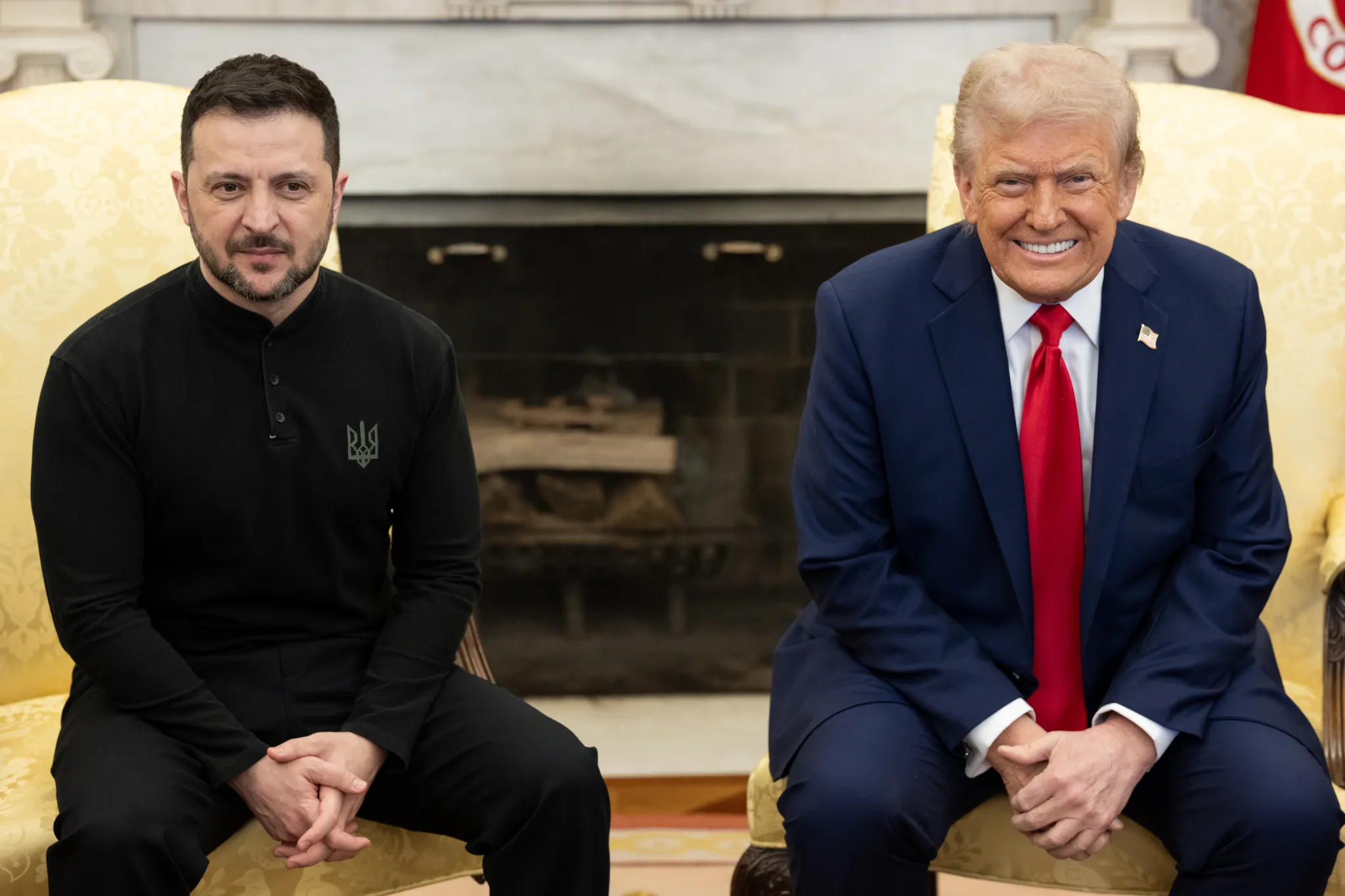
Putin abandons rules of war is how a specific new claim from Kyiv is being summarized. In an interview with the Financial Times, conducted by the newspaper's Chris Miller at the site of a Russian jet-drone attack on a school in Kyiv, Zelenskyy said Ukrainian intelligence had intercepted an order from Russia's president to military leaders: “there are no more rules now.” The FT News Briefing described the allegation as Putin asking his generals to “go after civilian targets,” particularly schools, hospitals, telecommunications networks and data centers.
The words matter because an explicit decision to make civilians or civilian objects the object of attack would violate a foundational rule of international humanitarian law: parties must distinguish between military objectives and civilian people and property. But the evidentiary standard matters just as much. What the public has is Zelenskyy's account of intelligence, reported by the FT and repeated by LaPresse. The underlying intercepts, their context, the chain of custody and any independent intelligence assessment have not been published.
That leaves two propositions that must be kept separate. First, the Putin no rules order is a claim by Ukraine's president about classified Ukrainian intelligence. Second, Russian attacks have repeatedly damaged civilian infrastructure and killed or injured civilians; this is documented across official casualty records, photographs, local authorities and independent reporting. The second proposition can strengthen questions about intent and policy, but it does not automatically prove the first.
Why this matters: a claim about policy, not only battlefield conduct
Most arguments over civilian harm in war begin with an individual strike. Was the object a military target? Was expected civilian harm excessive in relation to the anticipated military advantage? Were feasible precautions taken? Zelenskyy's allegation moves the argument upward. He is not merely saying that one Russian unit made an unlawful decision. He is saying the Russian commander in chief authorized a broader abandonment of restraint.
If authentic and accurately interpreted, such an order could become evidence about command responsibility and the purpose of a campaign. A written or recorded directive is not required to establish a policy, but proof that senior leaders instructed forces to target civilians would be qualitatively different from proof that civilian objects were hit. It could affect future war-crimes investigations, allied intelligence sharing and governments' calculations about air-defense support.
If the claim is incomplete, mistranslated or based on an ambiguous interception, the risks run in the other direction. Intelligence is collected for decision-makers, not written for public consumption. Short phrases can lose operational context. Wartime governments also have incentives to release information that supports diplomatic and military objectives while withholding the material that would allow outsiders to test it. Skepticism here is not indifference to civilian casualties; it is part of the standard needed when attributing a criminal policy to a head of state.
That is why the responsible headline contains an attribution. Zelenskyy says Putin abandoned the rules of war. Russia has not publicly acknowledged such an order. Moscow has long maintained that its forces strike military targets and infrastructure connected to Ukraine's war effort, while Ukrainian officials and international monitors document repeated damage to homes and civilian services. The legal and factual dispute cannot be resolved by rhetoric alone.
The Zelenskyy FT interview and what was actually reported
The setting of the interview was part of the message. Miller met Zelenskyy at a school in Kyiv struck by what the FT described as a Russian jet-powered drone. According to the FT News Briefing, Zelenskyy said new Ukraine intelligence intercepts indicated that Putin had instructed the military to remove previous limits and intensify attacks on civilian infrastructure. Miller summarized the claimed target categories as schools, hospitals, telecoms and data centers.
LaPresse's October 2 account reported the same core quotation: Putin had ordered the military leadership to abandon the rules of war, and “there are no more rules now.” A news-aggregation listing carried the FT headline and deck, but the direct FT article address was not available in the public search results reviewed for this report. The FT podcast therefore provides the clearest publicly accessible account of Miller's interview.
The available reporting does not disclose when the alleged order was given, which Russian commands received it, whether it was written or spoken, who intercepted it, or whether another government independently authenticated it. It also does not establish whether the phrase referred to international humanitarian law, operational restrictions previously imposed by Moscow, geographic limits on strikes, or the political language of escalation. Those missing details are not minor. They determine what the intercepted words would mean in practice.
Nor has a public Russian response to the specific FT allegation been identified in the material reviewed for this article. That absence should not be treated as confirmation. It means the claim currently rests on the Ukrainian account and the FT's reporting of it. A fuller assessment would require the intercept itself, corroborating intelligence, an official Russian response, or a pattern of operational orders and target selection that can be independently reconstructed.
How the air campaign escalated: mass waves and jet-powered drones
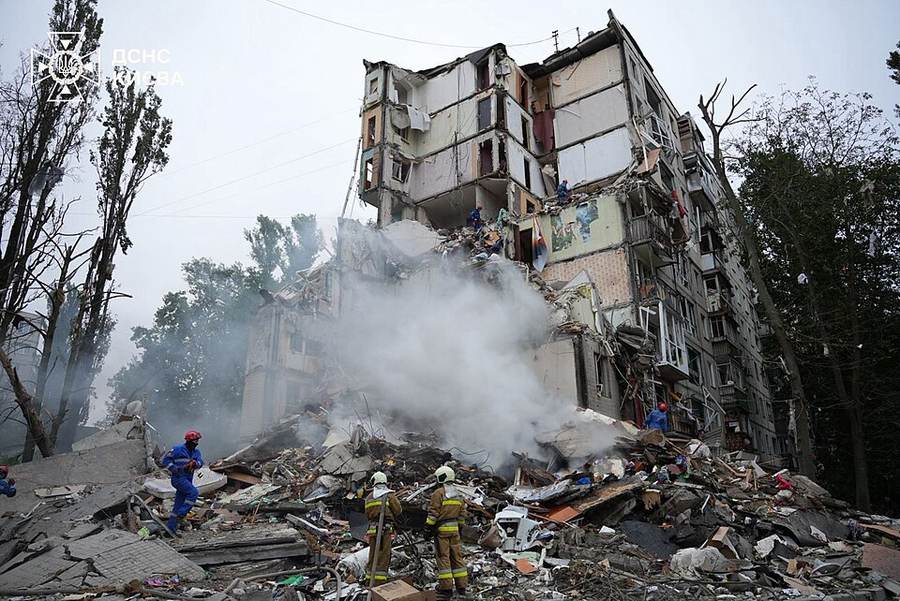
The claim emerged after a visible change in the air war. Russia has expanded the volume, variety and sequencing of its long-range attacks. Propeller-driven one-way attack drones remain central, but Ukrainian officials and analysts have also reported faster jet-powered drones. Their speed compresses detection and interception time, raising the cost of defending a large city even when the warhead is not larger.
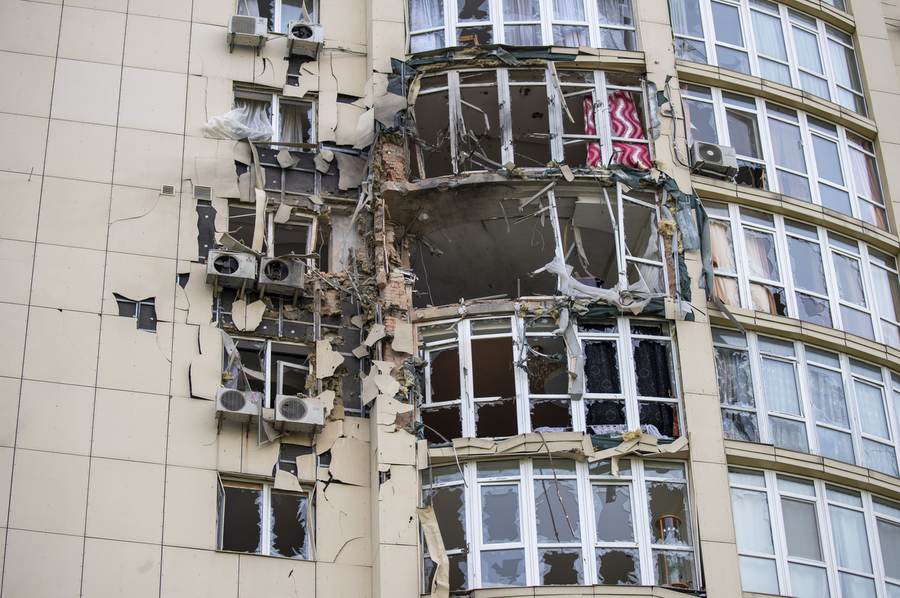
The October 2 overnight barrage illustrates the pressure. In Signal Post News's account of the Kyiv, Izmail and Volgograd strikes, Ukraine's Air Force said Russia launched 108 attack drones, including 47 jet-powered Shaheds. Ukraine reported that 88 were shot down or suppressed by 8 a.m., yet impacts were recorded at 11 locations. A drone hit a 25-story residential building in Kyiv's Darnytskyi district, killing one person and injuring two, according to local authorities cited in that report.
Those numbers show why an interception percentage cannot tell the whole story. An 81 percent neutralization rate sounds high. If the surviving aircraft or falling debris reach apartments, bridges, substations or port facilities, a minority of the wave can still create casualties and wide disruption. Defenders must protect many possible targets; attackers need only find a few gaps. Faster drones, mixed routes and repeated waves intensify that asymmetry.
The October campaign also widened the operational map. Kyiv authorities closed the Southern and Paton bridges and partially restricted the Metro Bridge after the overnight attack. Izmail's port area was struck, and Ukrainian drones targeted the Volgograd refinery in Russia. These are not equivalent target claims, and each strike must be assessed separately. Together, however, they show a war in which both sides increasingly use long-range systems against infrastructure that supports national endurance.
That background is central to evaluating the Zelenskyy claim. A rising operational tempo creates more civilian risk even without a new top-down order. More launches mean more opportunities for targeting error, malfunction, interception debris and strikes on objects that one side labels military-relevant and the other calls civilian. To infer a deliberate policy change, investigators need more than an increase in damage; they need evidence of selection, repetition, intent and command direction.
Russia civilian infrastructure strikes: what is independently documented
The pattern of Russia civilian infrastructure strikes is broader than the alleged intercept. The Atlantic Council cited strikes affecting the National Academy of Sciences in Kyiv, hospitals, schools, supermarkets, fuel stations, internet data hubs and business centers. It also pointed to repeated attacks on a busy Dnipro bridge. Those examples describe real damage to civilian life and services, even where Russia may argue that a target had military or dual-use value.
The United Nations casualty data cited in that analysis showed civilian deaths in July running 70 percent higher than a year earlier. That comparison does not assign responsibility for every death, and it is not a count of infrastructure strikes. It does show that the human cost was moving in the wrong direction as the air campaign intensified. Civilian casualty figures in an active war are often revised as incidents are verified, so percentage changes should be read as indicators of trend rather than a final ledger.
Schools are especially sensitive because their legal status depends on use, not symbolism. A school is a civilian object unless and for such time as it is used for military purposes. On October 1, a Russian drone struck a Kyiv school while 160 students and staff sheltered below, according to Signal Post News's report on the school attack. The warhead reportedly failed to detonate and no casualties were reported. The absence of deaths does not settle whether the strike was lawful; the relevant questions include the intended target, the information available to the attacker and precautions taken.
Bridges and telecommunications networks can present harder legal questions. A bridge normally used by civilians can become a military objective if it effectively contributes to military action and its destruction offers a definite military advantage at the time. Data centers and telecoms may support both civilian life and military communications. But “dual use” is not a blanket exemption from the rules. Distinction, proportionality and feasible precautions continue to apply, and civilian status cannot be erased merely by describing an entire system as strategic.
The same caution applies to hospitals. They receive special protection under international humanitarian law, though that protection can be lost under tightly defined circumstances if a facility is used to commit harmful acts outside its humanitarian function and warnings go unheeded. Public claims of military use require evidence. A pattern in which protected sites are repeatedly damaged deserves investigation; it is not self-proving evidence about each attack or about an alleged presidential order.
Ukraine intelligence intercepts: the evidentiary limits
Intercepted communications can be powerful evidence. They can reveal wording, hierarchy and timing in a way that satellite imagery or strike debris cannot. They can also be deceptively incomplete. An intercepted sentence may be genuine yet stripped of the conversation around it. A speaker may be relaying a rumor, using shorthand, exaggerating for subordinates or referring to a narrower operational rule. Translation adds another layer, especially when a phrase such as “no more rules” could be idiomatic rather than legal language.
Authentication involves several steps the public cannot perform from the FT summary. Analysts would want to know how the speaker was identified, whether the voice or device was verified, whether the transmission was continuous, whether timestamps match known meetings or operations, and whether later Russian behavior corresponded with the order. They would also test alternative explanations, including deception. Intelligence services sometimes transmit false information on channels they believe are monitored.
The source's incentives also matter without automatically discrediting it. Ukraine has an evident interest in persuading partners that its air-defense shortage is urgent and that Russian conduct is becoming more dangerous. Russia has an evident interest in denying unlawful intent and framing infrastructure strikes as military necessity. Both incentives are relevant; neither decides the truth. The evidence must do that work.
The strongest public case would combine multiple forms of proof: authenticated communications, target lists, operational orders, testimony from participants, repeated strike patterns, weapons analysis and evidence that commanders continued attacks after learning of disproportionate civilian harm. Until such material is public, the Putin no rules order should remain attributed in every retelling. Removing “Zelenskyy says” would convert a reported intelligence claim into an asserted fact.
What the laws of war require
“Rules of war” is a broad phrase. The relevant legal framework includes distinction between civilians and combatants, distinction between civilian objects and military objectives, proportionality in attack, and feasible precautions to reduce civilian harm. The law does not prohibit every attack that damages a civilian object or kills civilians. It prohibits directing attacks at civilians or civilian objects, indiscriminate attacks, and attacks expected to cause excessive civilian harm compared with the concrete and direct military advantage anticipated.
Intent therefore cannot be read from the result alone. A hospital hit by a weapon may reflect deliberate targeting, mistaken intelligence, weapon malfunction, interception debris, a nearby military objective or an unlawful disproportionate attack. Investigators reconstruct the decision from targeting records, available intelligence, weapon choice, timing, warnings and commanders' knowledge. Repetition can support an inference, but each incident still requires evidence.
An order explicitly removing legal constraints would not make subordinate actions lawful. Soldiers and commanders remain bound by international humanitarian law, and manifestly unlawful orders do not erase individual responsibility. At the same time, the existence of broad political language does not prove that every subsequent strike was unlawful. Legal analysis turns on conduct as well as command.
This distinction is important for public debate. “Civilian infrastructure” can describe the social function of an object, but the legal category may depend on its use at the time. Conversely, calling a power station, bridge or server facility “dual use” does not automatically make any level of civilian harm proportionate. The discipline is to ask precise questions rather than let either side's label settle the case.
Who benefits, who loses, and what critics say
Russia could benefit militarily if a broader infrastructure campaign forces Ukraine to spread scarce air defenses across more cities and systems. It could benefit politically if blackouts, transport disruption and damaged communications weaken public confidence or increase pressure for negotiations. The strategy also carries costs: attacks seen as indiscriminate can strengthen Ukraine's case for more interceptors, deepen sanctions support and create evidence for future prosecutions.
Ukraine benefits diplomatically from making the alleged order public because it turns requests for air defense into an argument about protecting civilian society, not only the front line. The interview setting reinforces that case. But Kyiv also accepts a credibility risk. If later evidence does not support the claim, partners may become more cautious about intelligence-based public allegations. That is another reason to preserve the attribution now.
Civilians lose under every scenario. They bear the physical danger, displacement and uncertainty created by air-raid alerts and damaged services. They also bear the informational burden of competing claims: Russia says infrastructure can serve military purposes; Ukraine says civilian systems are being selected to terrorize and exhaust the population. The people deciding whether to sleep in a corridor, commute across a bridge or keep a business running cannot wait for a legal judgment years later.
Critics of Zelenskyy's disclosure may argue that the language is designed to unlock Western weapons and collapse distinctions between lawful and unlawful Russian strikes. Critics of Moscow argue that the accumulation of school, hospital, apartment, energy and communications damage is too systematic to dismiss as isolated error. Both arguments identify real incentives and patterns; neither substitutes for the missing intercept or an incident-by-incident investigation.
There is also a strategic criticism of the alleged Russian approach. Infrastructure coercion has a mixed historical record. It can impose high repair costs and reduce economic output, but it can also harden public resistance and draw allies closer. The effect depends on scale, duration, defensive capacity and whether political leaders can maintain basic services. A campaign that produces civilian harm without changing decisions may be unlawful in execution and strategically inefficient at the same time.
What the numbers imply about Kyiv drone attacks in October 2026
The 108-drone October 2 wave is one night, not a trend line by itself. But it shows the arithmetic of saturation. If 88 were neutralized, 20 were not counted as intercepted or suppressed at the reporting cutoff. Ukraine said hits occurred at 11 locations. The relationship between those numbers is not one drone per site: several weapons can hit one location, debris can cause damage, and assessments can change. Still, the gap between launches and successful defenses explains how a high interception rate can coexist with fatal consequences.
Earlier reporting cited about 2,200 Russian drones launched in a single week. Even if the precise composition and results of every launch vary, that scale changes the economics of defense. An interceptor that costs far more than the target drone may be justified to protect a crowded building or critical substation, but a country cannot place its most capable systems everywhere. Electronic warfare and cheaper interceptors matter because volume is itself the weapon.
The UN's reported 70 percent year-on-year increase in July civilian deaths adds a human measure, but it should not be merged mechanically with the drone figures. Civilian casualties come from multiple weapons and fronts. The statistic does not prove that jet-powered drones caused the increase or that a single policy order explains it. It does support the conclusion that protection was deteriorating during a period of intensified attacks.
The bridge closures reveal a second-order effect not captured in casualty totals. An attack can disrupt transport, emergency response and daily commerce even when structural damage is limited. Repeated inspections and closures consume personnel and time. The Southern Bridge strike showed how a single incident can force authorities to treat a major crossing as both infrastructure and an active security problem.
Numbers therefore point to capacity as much as intent: Russian production and launch capacity, Ukrainian detection and interception capacity, and civilian repair capacity. The FT allegation concerns the commander's purpose. The statistics show the environment in which that purpose would be carried out. Conflating the two weakens analysis; examining them together, with their different evidentiary weights, makes it stronger.
What happens next: four scenarios
First, the intercept is corroborated. Another intelligence service, a defector or captured records could confirm the wording and distribution of the alleged order. That would intensify demands for air defense and accountability, while making target-selection evidence central to any legal case. Corroboration would still not predetermine the legality of every strike, but it would materially change the assessment of policy and command intent.
Second, the campaign intensifies without public proof of an order. This may be the most likely near-term path. Russia can increase attacks on energy, transport and communications while continuing to describe them as military or dual-use targets. Ukraine can document the effects while being unable to publish sensitive intercepts. The factual record of damage would grow even as the disputed claim remained unresolved.
Third, tactical adaptation reduces the impact. Ukraine may deploy cheaper counter-drone systems, disperse infrastructure functions, harden data centers and substations, and improve rapid repair. Western partners could supply more Patriot interceptors and other defenses, though high-end stocks are finite. Russia would then have to change routes, timing, payloads or target sets to preserve pressure.
Fourth, reciprocal infrastructure strikes widen. Ukraine's attacks on Russian refineries and logistics sites give Moscow a basis for claiming it is responding in kind, while Kyiv distinguishes between war-supporting assets and civilian targets. As both sides expand long-range operations, disputes over dual-use infrastructure will multiply. The risk is not only escalation in volume but erosion of the shared vocabulary needed to evaluate restraint.
Watch for three kinds of evidence. The first is documentary: authenticated intercepts, orders or corroborating intelligence. The second is operational: a sustained change in target categories, weapon allocation or strike timing. The third is institutional: statements from Russian officials, international monitors and investigators that directly address the alleged policy. None should be replaced by a viral quotation detached from its attribution.
Zelenskyy's warning may prove to be an early description of a deliberate shift, a compressed account of more limited orders, or a claim that remains impossible for the public to verify. The documented destruction already warrants attention without overstating what is known. The central task for journalists, governments and investigators is to keep evidence in the foreground: name the allegation, test it, document the strikes, and resist turning uncertainty into either dismissal or certainty.
Related coverage
- Russia Ukraine Drone Strikes October 2026: One Killed, Kyiv Bridges Closed
- Russian Drone Strikes Kyiv School During School Day as 160 Shelter Below
- Kyiv Southern Bridge Drone Strike: Russia Hits Bridge in First Since 2022
Sources and reporting notes
- Financial Times interview with Volodymyr Zelenskyy by Chris Miller, October 2, 2026. The direct FT article URL was not available in the public search results reviewed for this report; the headline and deck are indexed in this Financial Times listing.
- FT News Briefing, October 2, 2026: Chris Miller describes the interview setting and Zelenskyy's intelligence-based allegation.
- LaPresse: “Ukraine, Zelensky: ‘Putin has ordered the army to no longer follow the rules of war’”, October 2, 2026.
- Atlantic Council UkraineAlert: reporting and analysis of strikes on civilian infrastructure and UN casualty data.
- Al Jazeera report republished by Europe Says: Putin's October 1 position on long-range attacks and the reciprocal energy-strike campaign.
Reporting note: The alleged Putin order is not independently verified in this article. Strike and interception figures attributed to Ukrainian authorities may be revised. References to the laws of war describe general principles; final legal findings require incident-specific evidence and competent judicial review.
Signal Post News will update this report if the alleged intercepts are released, independently corroborated or specifically answered by Russian authorities.
Back to all stories