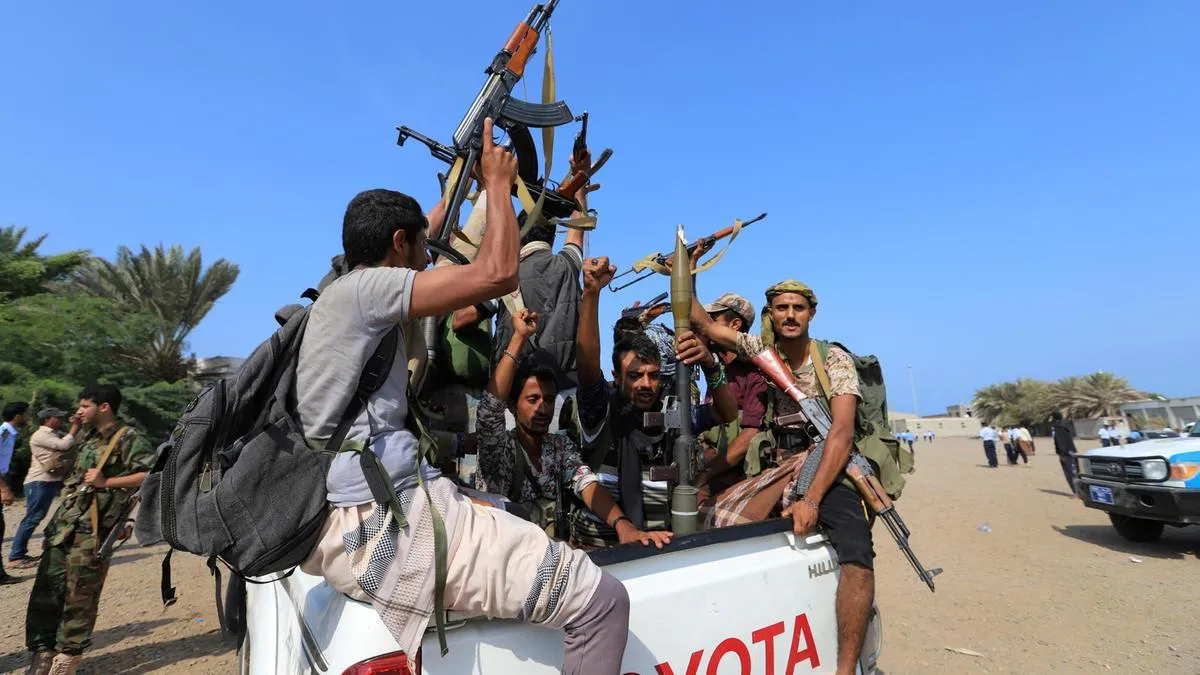
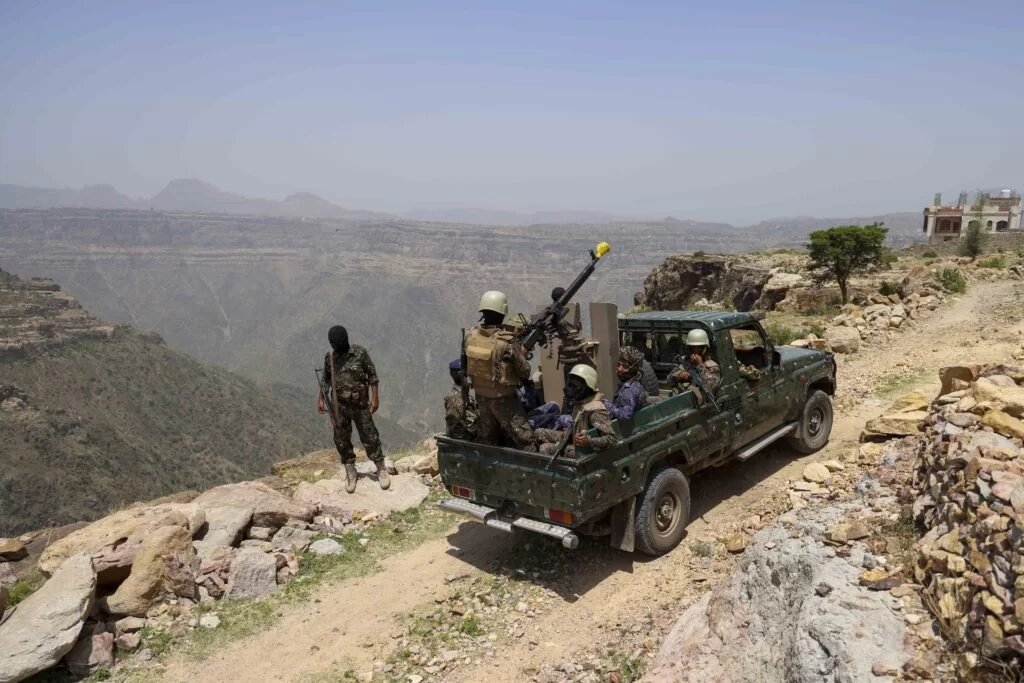
Fighting on September 21 centered near Al-Wazi’iyah district and Ras al-Ara, according to five Yemeni military sources who spoke to Reuters. The sources said the Houthi aim was to take the Kahboub Mountains, strengthening positions around Bab al-Mandab, the coastal town of Dhubab and Perim Island while creating options for attacks from the highlands. Reuters reported that Saudi-backed forces had withdrawn rapidly from some positions. The Houthis, through their media, said Saudi Arabia had carried out hundreds of strikes; that total was a Houthi claim, not an independently verified count.
The immediate news is a contest for terrain. The larger story is the possible joining of two crises: a renewed Yemeni ground war around the southern entrance to the Red Sea and disruption around the Strait of Hormuz. One affects a route between Asia and Europe; the other affects the principal oil-export passage from the Gulf. Control of mountains does not itself close a waterway, but it can change the range, protection and sustainability of forces positioned near it.
Why this matters
The Kahboub range sits inland from the coast where the Houthis made their largest gains in years. High ground can support observation, supply routes and defensive depth. Yemeni analyst Mohammed Al-Qadhi told Reuters that the mountains could determine whether the Houthis consolidate those gains or government-aligned forces retain positions from which to mount a counteroffensive. That is an assessment, not a forecast: the front is fluid, and public reporting does not establish full control of the range.
The strategic question is whether a coastal advance becomes a durable military system. Positions at Dhubab and Perim Island can create pressure close to Bab al-Mandab, but isolated coastal holdings are vulnerable if opponents dominate the roads and elevations behind them. A successful highlands push could make those positions harder to dislodge. A successful Saudi-backed counterattack could instead separate the coast from inland support and preserve a route back toward the strait.
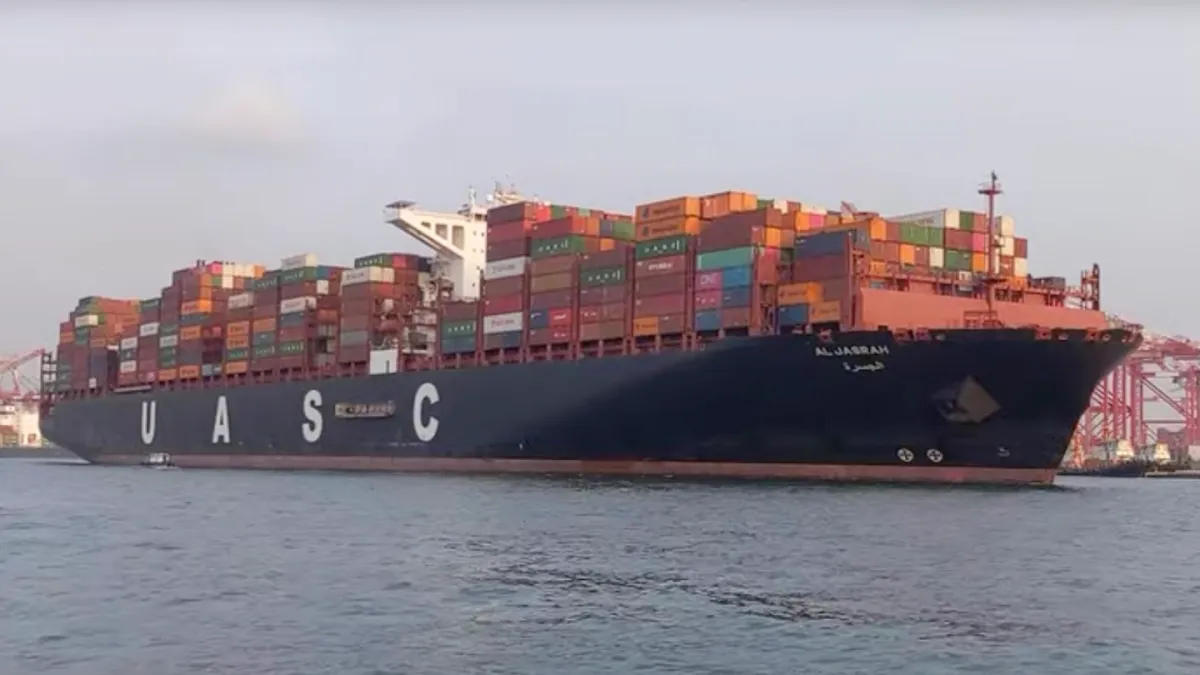
About 12% of world trade normally passes through Bab al-Mandab, according to Associated Press reporting. The figure does not mean 12% would disappear if risk rose: vessels can reroute around Africa, cargo can be delayed, and insurers can reprice exposure. But those workarounds add time and cost. With Hormuz also under pressure, the same shipping system has fewer easy substitutes.
Background
Yemen’s civil war began after the Houthis seized Sanaa and much of northern and central Yemen in 2014. Saudi Arabia intervened on the government’s side in 2015. The Associated Press says the war has killed more than 150,000 people over roughly 12 years. A truce reached in 2022 sharply reduced large-scale fighting and largely held until hostilities resumed in July 2026.
The current sequence has unfolded in stages. Houthi forces advanced along the Red Sea coast and seized Mokha on September 10, according to Houthi and Yemeni officials cited by the AP. Officials then said the group took Perim, also known as Mayun, inside the Bab al-Mandab Strait. Signal Post News’s September 19 “second front” report examined how those moves linked Yemen more closely to the wider U.S.–Iran conflict. Its September 20 Riyadh report covered Houthi strike claims and the Saudi defensive response. The September 21 push toward the Kahboub Mountains is the next step in that sequence: coast, islands, strikes on Saudi territory and now contested high ground.
Several elements remain disputed. Saudi-backed withdrawals were described by military sources rather than documented in a public operational map. Houthi claims of hundreds of Saudi strikes have not been independently verified. The New York Times reported that President Donald Trump called off prepared U.S. strikes against the Houthis at the last minute while bombs were being loaded. Reuters said it could not verify that account, and U.S. Central Command did not provide confirming comment. The report may affect how regional actors judge U.S. intentions, but it should not be treated as confirmed operational fact.
The humanitarian costs are less abstract. United Nations figures cited by Reuters put deaths in the current escalation at nearly 700, with thousands injured, more than 120,000 people internally displaced and thousands more fleeing by boat. Those totals describe human consequences across the wider fighting, not a casualty count for the Kahboub operation alone. In a country already weakened by years of war, displacement quickly becomes a food, shelter, health and protection emergency.
Who benefits, who loses, what critics say
The Houthis benefit if the mountains give their coastal positions depth and improve their bargaining power. Saudi Arabia and Yemen’s internationally recognized government lose room to maneuver if forces aligned with them cannot hold the approaches. Iran could gain indirect leverage if an allied movement increases pressure on Saudi Arabia and on shipping without Iranian forces operating there directly. That does not make every Houthi decision an Iranian order; the movement has its own Yemeni objectives and has said its actions respond to Saudi restrictions and years of war.
Saudi-backed forces benefit if the terrain forces Houthi units into exposed supply lines or if a counteroffensive retakes the roads linking the interior to Bab al-Mandab. Riyadh also retains major air and financial advantages. The costs of a sustained campaign, however, include civilian risk, pressure on Saudi defenses and a renewed commitment to a war the 2022 truce had contained.
Commercial crews and Yemeni civilians are the clearest losers from escalation. Human Rights Watch said several recent Houthi attacks on commercial vessels likely amounted to war crimes and stressed that civilian ships and crews are protected under international humanitarian law. The organization also noted uncertainty around claimed military cargoes in some incidents. That legal standard applies across the conflict: parties must distinguish military objectives from civilians and take feasible precautions, while allegations require evidence rather than inference.
Critics of a primarily military response argue that airstrikes may slow advances without producing a political settlement and can deepen civilian harm. Critics of restraint argue that leaving new positions uncontested could normalize attacks on ships and Saudi territory. Both arguments depend on facts that remain incomplete: who controls each road and ridge, how fighters and weapons are supplied, what was struck, and whether diplomacy can change behavior. The responsible conclusion is therefore conditional, not categorical.
What the numbers imply
Energy data shows why the two maritime theaters cannot be considered separately. Reuters reported that Saudi crude exports through Hormuz rose from about 700,000 barrels per day in August to roughly 2.9 million barrels per day recently, while loadings at the Red Sea port of Yanbu halted. The shift reverses the logic of using Yanbu as a bypass when Hormuz is dangerous: pressure near Bab al-Mandab and the Red Sea can push more barrels back toward Hormuz just as that route is also insecure.
Brent crude moved from nearly $110 a barrel to approximately $100. That decline indicates some reduction in the market’s immediate worst-case pricing; it does not show that supply routes are safe. U.S. retail diesel rose from about $3.75 a gallon before the war that began in February to above $6.51 on September 21, Reuters reported. Diesel reflects crude costs, refining capacity, inventories and distribution, so the increase cannot be assigned to a single battle. It does show how a regional security shock can reach freight, farming and household budgets.
The United Kingdom Maritime Trade Operations agency said a Hormuz-bound vessel was struck by a projectile, causing minor injuries to crew members. That incident occurred in the Hormuz theater, not at Bab al-Mandab, but it illustrates the compound risk: damage, injury or even credible threats at both ends of the regional shipping network can raise insurance and routing costs before either passage is fully blocked.
The humanitarian numbers carry a different warning. Nearly 700 reported deaths, thousands of injuries and more than 120,000 internal displacements mean the escalation is already larger than a contest over a single ridge. Thousands fleeing by boat also transfer risk to the Gulf of Aden and neighboring states. These figures do not predict the next military move; they measure how little margin Yemeni communities have left for another prolonged campaign.
What happens next
- Houthi consolidation. If Houthi forces secure the Kahboub Mountains and the approaches around Al-Wazi’iyah and Ras al-Ara, they could make coastal holdings near Dhubab and Perim harder to isolate. The strategic effect would depend on actual control of roads, launch sites and logistics—not the announcement of a gain.
- A Saudi-backed counteroffensive. Government-aligned forces may try to hold or retake high ground before the front hardens. Air power could support that effort, but the outcome would still depend on ground-force coordination, which AP reporting identified as a weakness during the rapid coastal advance.
- A U.S. decision during U.N. General Assembly week. The unverified account that prepared U.S. strikes were halted leaves allies and opponents watching for a clearer policy. Iranian President Masoud Pezeshkian was due in New York on September 22 for the General Assembly. Any U.S. military decision would interact with diplomacy taking place in the same week.
- Simultaneous disruption at Hormuz and Bab al-Mandab. Sustained attacks, port interruptions or threat-driven rerouting across both passages would be more consequential than an isolated incident at either one. Shipping volumes, insurer notices, port loadings and verified damage reports will matter more than declarations.
- Diplomacy. Reuters reported that China privately asked Iran to help restrain Houthi attacks after a Saudi appeal, citing three Iranian sources. Beijing publicly called for restraint, but the private approach and Tehran’s response were not independently disclosed in detail. U.S.–Iran diplomacy has been stalled since the June interim agreement collapsed. A reopening of talks, a Saudi–Houthi channel or pressure from China could slow escalation, but none currently amounts to a settlement.
The next reliable indicators are concrete: independently verified control of the Kahboub heights, changes in Saudi-backed deployments, documented strike locations, shipping advisories, Yanbu loading data and any formal U.S. or regional diplomatic announcement. Until those arrive, the evidence supports a narrower judgment. The Houthi push has made Yemen’s highlands central to the security of the Red Sea coast; it has not yet determined who will hold the terrain or whether either shipping chokepoint will be closed.
- Reuters: Kahboub Mountains fighting, military-source accounts, humanitarian figures, energy data and the unverified U.S. strike report
- Reuters: China’s reported private appeal to Iran and the dual-chokepoint risk
- Associated Press via Military.com: Mokha, trade-route context and the renewed civil-war risk
- Associated Press via WUTC: Perim Island, Saudi export exposure and displacement
- Associated Press via BusinessMirror: the coastal advance and eastern-front context
- AFP-sourced report via SOFX: Mokha and Bab al-Mandab context
- Human Rights Watch: commercial-vessel attacks and international humanitarian law
Reporting cutoff: September 21, 2026. Battlefield claims are attributed to the parties or sources that made them; this article does not independently verify control of the Kahboub Mountains, the claimed number of Saudi strikes or the reported U.S. strike preparations. It is a fixed reporting snapshot and does not update automatically.