Trump Xi meet again November China
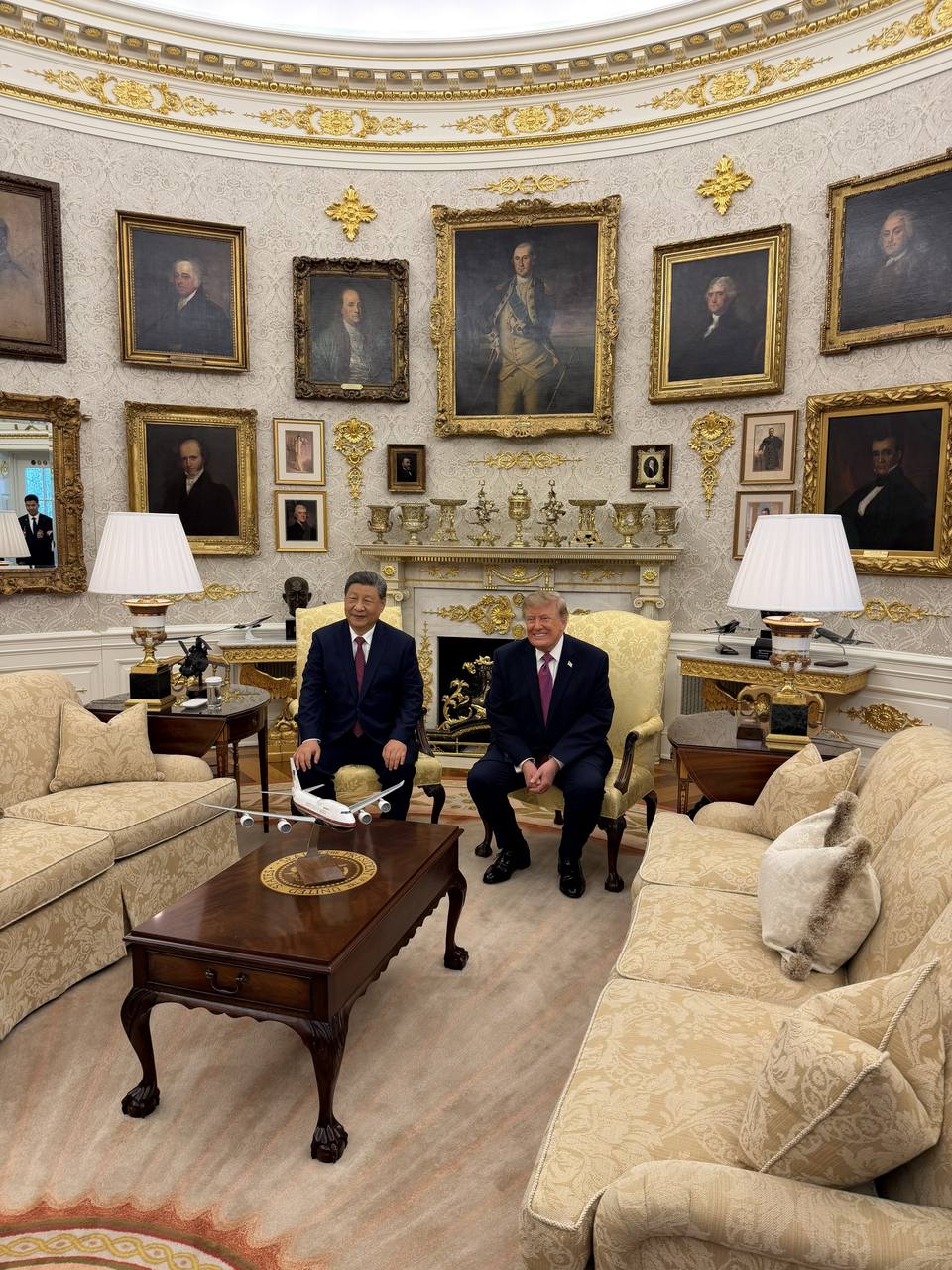
The state visit was barely over — Xi Jinping's plane had only just left Washington — when Donald Trump set the next dates. "We will be meeting again in November, in China, and then at the G20 in December, in Miami, Florida," Trump wrote on Truth Social on Friday, September 25, 2026, describing his summit with the Chinese president as one of "Friendship, Strength, and Success, for both China and the U.S.A." The Trump Xi meet again November China announcement means the two leaders will have sat down five times in barely fourteen months — a diplomatic tempo with no modern precedent — and it lands while the fragile U.S.-China trade truce is ticking toward a hard deadline in January.
What Trump announced
The post that set the calendar
"President Xi and Madam Peng have just left D.C., heading for China," Trump's Friday post read in full. "The meeting was one of Friendship, Strength, and Success, for both China and the U.S.A. We will be meeting again in November, in China, and then at the G20 in December, in Miami, Florida. Much has been, and will be, accomplished. I look forward to our next meeting!" The announcement came without a formal joint statement from either government — a signature of this relationship, where the personal channel between the two leaders increasingly is the channel. Earlier, Xi had invited the Trumps to the Asia-Pacific Economic Cooperation summit in Shenzhen, China, in November, and floated the possibility of meeting again at the G20 summit in Florida, according to Aju Press. Trump's confirmation on Friday solidified the schedule.
Greer promises trade news Monday
The substance trailing the ceremony is trade. U.S. Trade Representative Jamieson Greer said Friday that the United States would announce agreements with China on trade in non-sensitive goods as soon as Monday, September 28, covering transactions overseen by a newly created Board of Trade — potentially including American agricultural and medical device shipments to China and Chinese exports of consumer products. "We're in a managed trade situation," Greer said on CNBC. "Yes, we've had progress and I think we will release on Monday a lot more details about what we've accomplished over the past few weeks in negotiating with the Chinese." The framework, Greer added, would ring-fence certain goods so that if tariff disputes flare again, "we just leave those things to the side." Since the leaders' May summit in Beijing, markets have anticipated tariff cuts covering roughly $30 billion in two-way trade. Monday will test whether that anticipation was priced correctly.
Why this matters
The calendar is the policy
Diplomatic schedules are usually ephemera — the furniture of statecraft, not the substance. This one is different. By locking in November (APEC in Shenzhen) and December (G20 in Miami), Trump has built a ratchet into the U.S.-China relationship: each meeting creates a deliverable deadline, and each deadline forces the working-level negotiators to produce something the leaders can announce. That is how the trade truce got extended through January 10, 2027 in the first place — summits manufacture momentum. The risk is the mirror image: a calendar full of meetings is also a calendar full of moments when talks can visibly fail. Trump is betting that the pageantry — the Andrews tarmac greeting, the Rose Garden military review, Thursday night's state dinner — does the political work that communiqués cannot, making concessions feel like friendship rather than surrender.
Five meetings, fourteen months
Count them: Busan last October, Beijing last May, Washington this week, Shenzhen in November, Miami in December. No pair of American and Chinese leaders has ever met this often, this fast. The tempo itself is the message — to markets, to allies, to Beijing's own system. For investors, it converts the U.S.-China relationship from a tail risk into a managed process: Greer's phrase, "a managed trade situation," is doing deliberate rhetorical work, telling capital that the world's two largest economies are on "a stable footing," in Bloomberg's words. For allies — Tokyo, Brussels, Taipei — the tempo is more ambivalent. Taiwan's foreign ministry on Friday denounced Xi's summit remarks on "reunification" as a "distortion of the facts," a reminder that every warm handshake in Washington is watched nervously in Taipei. Frequent leader contact can steady a rivalry, but it can also let one great power negotiate over the heads of the smaller ones.
The pageantry premium
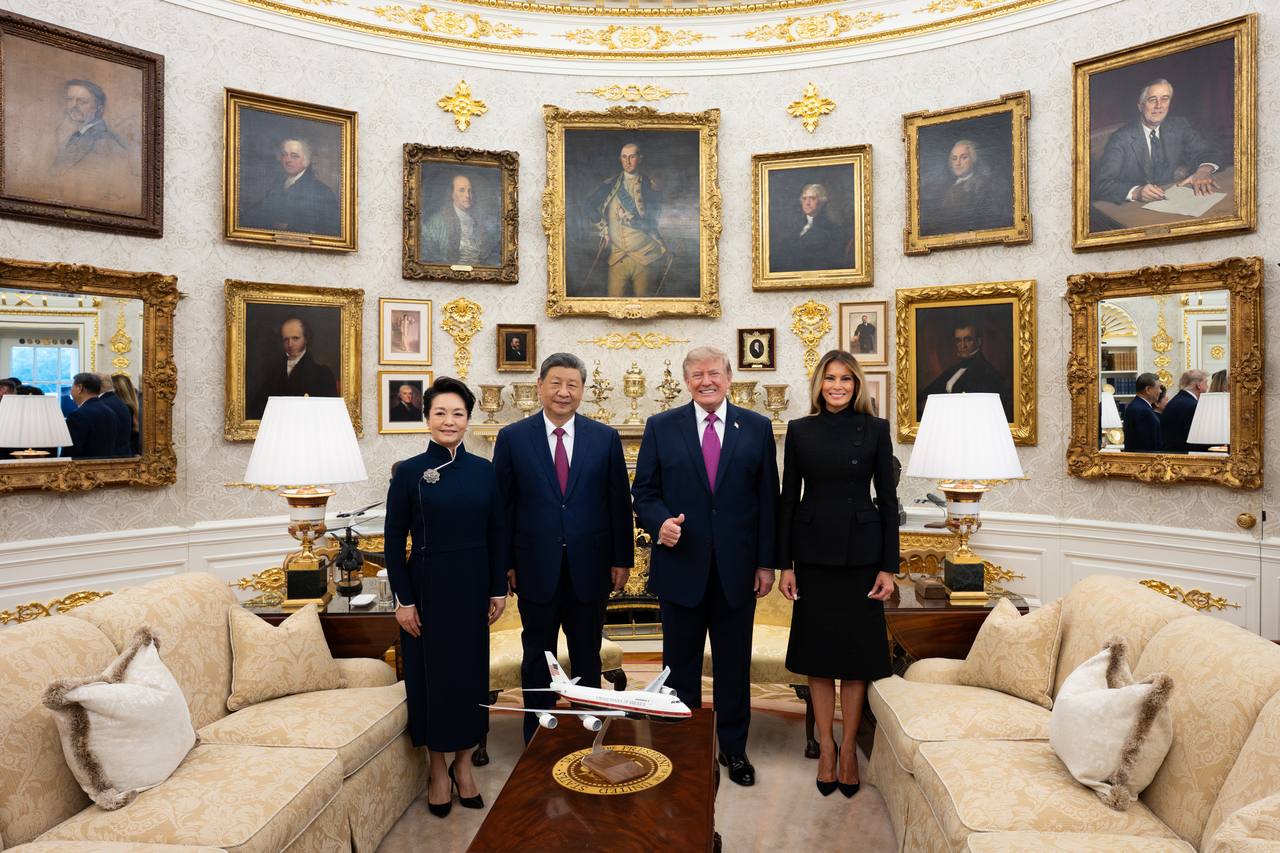
It is worth stating plainly what the September visit was: long on ceremony, short on deliverables. No new agreement emerged on tariffs, artificial intelligence, Taiwan, or broader strategic competition — a point even sympathetic coverage concedes. What emerged was choreography: Trump personally greeting Xi at Joint Base Andrews, the Silent Drill Platoon review, the National Archives tour showing the Chinese president the Declaration of Independence and the Constitution, the first ladies' Smithsonian outing. This is not nothing. In a relationship where trust is scarce and verification is hard, ritual is a technology — it signals commitment publicly, making it costlier for either side to defect. But ritual has a half-life. If November in Shenzhen and December in Miami produce another round of warm photos and another extension of the truce, the pageantry premium will start to look like a pageantry tax.
Background: how we got to five meetings
From Busan to Washington
The current cycle began when Trump started his second term. The two leaders met in Busan last October, then in Beijing in May — where Trump, according to later reporting, discussed Iran with Xi directly — and now in Washington for Xi's first state visit to the U.S. in more than a decade, and the first time any Chinese leader has made two formal state visits to the United States since the two countries established diplomatic ties in 1979. Each meeting has layered onto the last: Busan reopened the channel, Beijing set the trade-truce machinery in motion, Washington extended the truce and added the AI conversation — including Trump's campaign to rename artificial intelligence "Super Intelligence," which Xi, per Trump's Friday post, "seemed to like."
The truce and its January cliff
The through-line of all five meetings is the trade truce, currently extended through January 10, 2027. The structure Greer described Friday — carving non-sensitive goods out of future tariff fights via the Board of Trade — is an attempt to make the truce durable by shrinking the surface area of conflict. American farmers are the most visible constituency: Trump said Friday the talks were "great for the farmers," and agricultural shipments to China are expected to feature in Monday's announcement. The January deadline is the forcing function. If the November and December meetings do not convert the pause into something more permanent, tariffs and critical-mineral restrictions can snap back — and the same calendar that manufactured momentum becomes a countdown.
The Taiwan shadow
No U.S.-China summit happens outside Taiwan's shadow, and this one cast a long one. During the Washington visit, Xi told Trump that China's position on "reunification" was clear and hoped the U.S. would oppose Taiwan independence; on Friday, Taiwan's foreign ministry called that "the consistent Chinese approach of distorting facts," insisting Taiwan's future "can only be determined by the Taiwanese people through democratic means." The rebuke matters because it sets the terms of what the November and December meetings cannot paper over: the structural issue — Beijing's claim, Taipei's democracy, Washington's arms sales — is untouched by summitry. Every meeting that ends without addressing it leaves the hardest question for the next meeting.
The numbers, honestly
Five in fourteen months, ~$30 billion, one January deadline
Put the figures together and the scale of the gamble is clear. Five leader-level meetings in about fourteen months is historically unprecedented for the U.S.-China relationship. Roughly $30 billion in two-way tariff cuts has been anticipated since the May Beijing summit — the market's down payment on diplomacy, still awaiting confirmation on Monday. The truce runs to January 10, 2027, which means the November APEC and December G20 meetings are effectively the last two chances to replace a temporary pause with a durable framework before the cliff. And the trade is not symmetrical: the U.S. wants agricultural and medical-device access plus curbs on practices it calls unfair; China wants tariff relief, technology access, and an end to what it sees as containment. Greer's "non-sensitive goods" carve-out is the compromise mechanism — protect the easy trade, keep fighting over the hard stuff.
What "managed" really means
Greer's phrase deserves scrutiny, because "managed trade situation" is doing a lot of quiet work. It means: the tariffs stay as leverage, the exemptions grow as relief, and the whole apparatus is negotiated leader-to-leader rather than through the WTO or standing institutions. That is faster than multilateralism and more fragile than law. It works as long as the two men keep meeting — which is precisely why Friday's calendar announcement matters more than it looks. The management system IS the meetings. Stop the meetings, and there is no system.
Who gains, who loses, what the critics say
The winners, for now
American farmers and exporters are the most immediate winners if Monday's announcement delivers — agricultural shipments to China have been the hostage of every trade fight for a decade, and a carve-out would be genuine relief. Markets are winners too, to the extent that a visible calendar of summits damps the volatility premium on U.S.-China headlines. And both leaders win politically at home: Trump gets to show the dealmaker at work weeks before the November midterm elections; Xi gets the imagery of equal-footing summits — Andrews, the Rose Garden, the state dinner — that plays powerfully in Beijing's telling of China's restored centrality.
The skeptics' case
The critics' argument is straightforward and not easily dismissed: three meetings in, and the concrete deliverables are a truce extension, a promise of Monday announcements, and a renamed technology. Taiwan, AI governance, semiconductors, rare earths — the hard files — remain where they were. "Light on concrete policy outcomes" is Bloomberg's polite summary of the Washington summit, and it applies to the cycle so far. There is also the institutional critique: personal diplomacy between two strongmen produces deals that last exactly as long as the personal relationship, with no treaty, no enforcement mechanism, and no buy-in from the bureaucracies that must implement them. The counter — that institutions had a decade to solve U.S.-China trade and produced the current mess — is fair. But it is not an answer.
The Taiwan test
The sharpest version of the critique comes from Taipei. Taiwan's Friday statement was not just diplomatic throat-clearing; it was a warning that summitry-as-usual is being read on the island as a slow erosion of its position. If the November and December meetings produce trade wins while saying nothing new on Taiwan — and if Trump's paused arms sale to Taiwan stays paused as a "bargaining chip," as he described it in May — Taipei's anxiety will harden into a political fact that outlasts the summits. The test of whether this diplomacy is stabilizing or merely cosmetic will not be answered in Shenzhen or Miami. It will be answered in the Taiwan Strait.
What happens next
November: Shenzhen and the APEC sidelines
The November meeting will likely happen on the sidelines of the APEC Economic Leaders' Meeting and CEO summit, which China is hosting in Shenzhen — Xi's home turf, and a deliberate piece of stagecraft in its own right. Expect the agenda to be dominated by whether the truce can be converted into the durable framework Greer described: the Board of Trade mechanism, the non-sensitive-goods carve-out, and the tariff-cut package markets have been waiting for since May. The risk in Shenzhen is asymmetry of expectations — Beijing will want the January deadline lifted as proof of goodwill; Washington will want concessions first. If the two sides arrive with different definitions of what November is for, the pageantry will have to cover another gap.
December: Miami and the home-field summit
Then the G20 in Miami — Trump's home field, in every sense. Hosting the G20 in Florida lets Trump stage-manage the finale of the year's diplomacy on American soil, weeks after the midterm elections, with the full apparatus of a U.S.-hosted summit. A December deliverable would be the political capstone of the five-meeting cycle: the moment the truce either becomes a deal or gets its next extension. Watch for whether the G20 setting multilateralizes the bilateral — other leaders in the room change the dynamics, and Xi will be performing for them too, not just for Trump.
The January cliff, and the scenarios
Three scenarios from here. The optimistic one: Monday's announcement is substantive, Shenzhen converts the truce into a framework, Miami seals it, and January 10, 2027 passes as a non-event. The base case: another extension — the truce rolls forward, the hard files (Taiwan, semiconductors, AI governance) stay parked, and the meetings continue into 2027 as the management system. The pessimistic one: Monday underwhelms, Shenzhen exposes the expectation gap, and the January deadline arrives with tariffs snapping back and critical-mineral restrictions tightening — at which point the five-meeting tempo looks less like diplomacy and more like the world's most photographed countdown. Friday's announcement bought time and set dates. What it did not do — what no announcement can do — is resolve the underlying contest. That work happens in November and December, or it doesn't happen at all.
Trump set the calendar on Friday; the substance has to fill it. Five meetings in fourteen months is either the most sustained great-power diplomacy in modern history or the most elaborate way ever devised to postpone the hard decisions. Shenzhen and Miami will tell us which.
Related coverage from Signal Post News
Sources
- Donald Trump, Truth Social post, September 25, 2026 — "President Xi and Madam Peng have just left D.C.... We will be meeting again in November, in China, and then at the G20 in December, in Miami, Florida..." (quoted verbatim via Washington Examiner and ANI) — Washington Examiner
- Bloomberg, September 25, 2026 — "Trump Says He'll Meet Xi Twice More This Year as Summit Wraps" (Greer Monday announcement; "managed trade situation"; Board of Trade framework; ~$30B tariff-cut anticipation) — Bloomberg
- Washington Examiner, September 25, 2026 — "Trump confirms two more meetings with Xi this year" (APEC Shenzhen November; three-day state visit details) — Washington Examiner
- Aju Press, September 26, 2026 (KST) — "Trump Announces Two Upcoming Meetings with Xi Jinping" (Xi's APEC invitation; G20 Florida) — Aju Press
- ANI via APNA MA TV, September 26, 2026 — "Chinese President concludes US visit, Trump says Xi visit marked 'friendship, strength, and success'" (full Truth Social quote) — APNA MA TV
- The HinduBusinessLine (Bloomberg), September 26, 2026 — "Trump to meet Xi again in November as US-China trade agreements loom" (Taiwan, AI, semiconductors, rare earths differences remain) — The HinduBusinessLine
- Roic.ai, September 25, 2026 — "Trump Sets November APEC and December G20 Meetings with Xi as Trade Truce Faces January Deadline" (truce extended through January 10, 2027) — Roic.ai