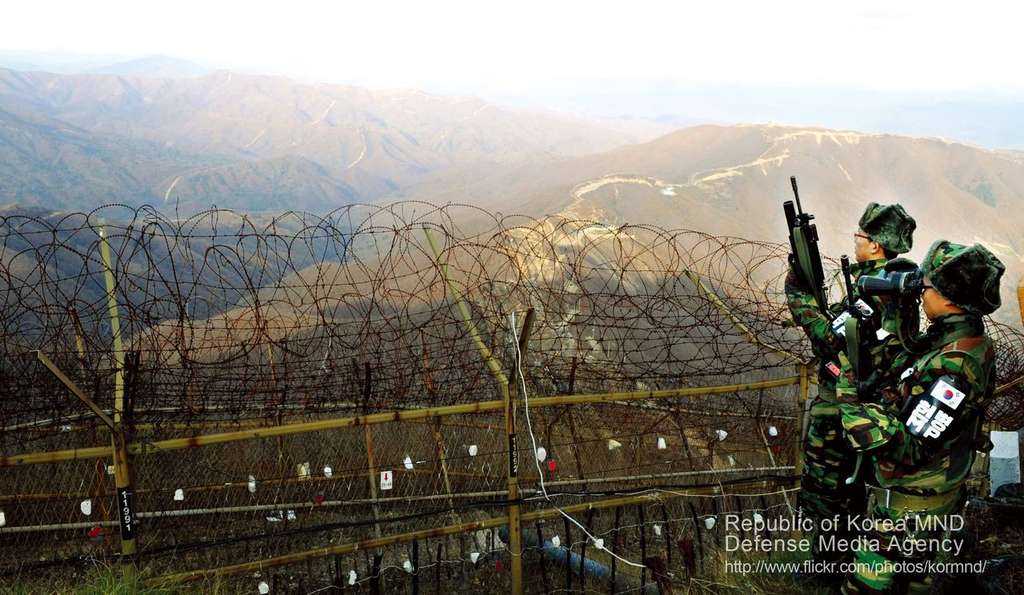
SEOUL — South Korea's military and the United Nations Command have launched a DMZ landmine explosion investigation after a blast inside the Demilitarized Zone injured three South Korean soldiers on September 21. Seoul's Joint Chiefs of Staff said on Sunday that a joint team of about 40 officials has begun sweeping the area around the blast site with mine detectors, and promised that the findings — including where the mine came from — will be made public.
The explosion struck on Monday, September 21, as the soldiers were clearing a patrol route in the western sector of the DMZ, the buffer that has divided the Korean Peninsula since the 1953 armistice. Two of the three injured are officers, and their injuries are described as serious, according to South Korea's Yonhap News Agency. President Lee Jae Myung said the blast was caused by a landmine.
The politically charged core of the inquiry is the mine's origin. Opposition lawmakers are demanding full transparency amid suspicions the device may have been planted by North Korea, Reuters reported. Forensic analysts are examining fragments recovered from the blast site to determine whether the mine was of South or North Korean origin. A presidential official, speaking to reporters in Mexico City where he was accompanying Lee on an official visit, promised "a fair, rapid, and in-depth investigation" conducted in coordination with the UN Command — necessary, he noted, because the blast occurred on a newly established reconnaissance route south of the Military Demarcation Line.
Why this matters
A landmine south of the Military Demarcation Line that turns out to be North Korean would be more than an accident — it would be a hostile act inside South Korean-controlled territory, the kind of provocation that has repeatedly pushed the peninsula to the brink. Seoul's decision to bring in the United Nations Command, the U.S.-led body that polices the 1953 armistice, is the tell: this is being treated not as a training mishap but as a potential armistice violation, which internationalizes whatever the forensics conclude and makes the result far harder for Pyongyang to wave away.
There is a second, quieter significance. The demand for transparency is itself the story of South Korean democracy at work: an opposition that does not trust the government's handling of North Korea, and a government that cannot afford to be seen covering up a Northern provocation — or inventing one. The 40-person team, the public disclosure promise, the forensic protocol: these are the instruments of a state trying to make its conclusion unassailable, because it knows the conclusion will be contested whatever it is.
Background: the most heavily mined border on earth
The Demilitarized Zone runs roughly 250 kilometers across the peninsula and 4 kilometers wide, established by the 1953 Korean Armistice Agreement. An estimated one to two million landmines lie in and around it — the legacy of the war and of seven decades of fortification since. Mine explosions are, as Reuters notes, a recurring hazard that periodically injures military personnel on both sides.
The precedent everyone in Seoul is thinking about dates to August 2015, when two South Korean soldiers were maimed by wooden-box mines in the DMZ. Seoul blamed the North; the crisis escalated through resumed loudspeaker propaganda broadcasts to an artillery exchange before a joint statement defused it on August 25. That episode is the template: a mine, an attribution, and a peninsula holding its breath.
There was once a counter-trend. Under the September 2018 inter-Korean military agreement, both sides demilitarized the Joint Security Area and jointly cleared mines at Arrow Head Hill. That agreement has since unraveled, and North Korea has resumed border fortification — mine-laying and fence construction — with South Korean media reporting the work resumed in March. The September 21 blast detonated in that new, harder reality.
Who gains, who loses — and what the skeptics say
If the mine proves to be North Korean, Lee Jae Myung's government gains justification for a harder line but loses whatever room for engagement it still held; the opposition gains proof that dovishness toward Pyongyang fails; Washington gains leverage for pressure; and Pyongyang gains a deterrence signal at the cost of deeper isolation — assuming it planted the device, which remains unproven.
If it is a legacy South Korean mine, the politics invert: relief in place of crisis, but embarrassment for the military and hard questions about how a patrol route was cleared over live ordnance.
The skeptics urge caution about attribution itself. Floods move mines; decades-old ordnance shifts in the soil; a fragment's metallurgy is not a fingerprint with a flag attached. The opposition's transparency demand is also a political instrument — a way to keep the government off balance no matter what the forensics find. And Pyongyang, which had not publicly addressed the incident in available reporting, will deny a Northern origin whatever the evidence shows, making "inconclusive" the most politically explosive outcome of all.
What the numbers actually mean
Forty investigators is not a routine safety review — that is a commission-sized team, sized for a contested conclusion. The six days between the blast and the search reflect both the danger of the site, a newly established reconnaissance route, and the care being taken — but every day of waiting also feeds suspicion. Three injured, two of them officers seriously hurt on a route-clearing patrol, raises the stakes beyond an ordinary mishap. And against a background of up to two million mines, no patrol route is ever truly clear: the base rate makes "tragic accident" plausible and "deliberate provocation" unprovable without forensics. The fragment analysis is, quite literally, the entire case.
What happens next: three scenarios
One: forensics point north. Seoul lodges a formal protest through the UN Command, possibly resumes loudspeaker broadcasts or announces new exercises; Washington is briefed and the finding enters the U.S.–North Korea file; Pyongyang denies everything. Escalation risk: moderate, 2015-style.
Two: forensics inconclusive. The most likely outcome — and the most corrosive. The opposition cries cover-up; the government insists on the science; the mine's origin becomes a permanent Rorschach test for inter-Korean politics.
Three: a legacy Southern mine. The temperature drops; the military orders a review of route-clearance procedures; the political class moves on. The DMZ keeps its mines, and the next patrol walks the same ground.
The DMZ has a way of turning small explosions into large questions. A mine is a mine until forensics give it a nationality — and in Korea, nationality is everything. The investigators sweeping that hillside with their detectors are not just looking for fragments. They are looking for an answer the whole peninsula can believe, in a place where belief has been in short supply for seventy years.
Related coverage
- North Korea's September missile tests and what they signal
- Lee Jae Myung at the Mexico summit: Seoul's diplomatic balancing act
- North Korean POWs in Ukraine: Seoul's intelligence windfall
Sources
- Reuters, "South Korean military, UN command launch investigation into DMZ explosion," September 27, 2026 (reporting by Heejin Kim and Hyunyoung Yi). Full report
- Yonhap News Agency (via Daily Kiran), "South Korea Launches Joint Investigation into Suspected Landmine Blast in DMZ, Three Soldiers Injured," September 27, 2026. Full report