Russia strikes Palau-flagged vessel Odesa

Russia strikes Palau-flagged vessel Odesa — that stark phrase sums up the most alarming development in a night of nationwide attacks on Ukraine. In the early hours of Monday, September 28, a civilian cargo ship sailing under the flag of Palau was struck twice as it departed the port of Odesa, Ukrainian officials said. The vessel, loaded with 2,800 tonnes of corn, caught fire. Seven crew members and the harbor pilot were rescued; two sailors remain missing, Ukraine’s recovery minister Mykola Kalashnik said on Telegram. By morning, President Volodymyr Zelenskyy reported that the wider wave of strikes had killed two people in the Kyiv region and wounded 28 — including nine children — in Kharkiv.
The ship attack was not an isolated incident. It was the second consecutive night of Russian strikes on Odesa’s port infrastructure, and it landed amid a sweeping barrage — 99 drones and a ballistic missile, by Ukraine’s count — that hit homes in Sumy, Rivne, Kharkiv and Odesa and infrastructure in Vinnytsia, Dnipro, Khmelnytskyi and Zaporizhzhia. Russia, for its part, said it had hit energy, data and logistics centres and the Vasylkiv military airfield, and claimed the vessel it struck was carrying military goods — a claim that, like much of what both sides say about the shadow war at sea, could not be independently verified.
A ship hit twice, two sailors missing
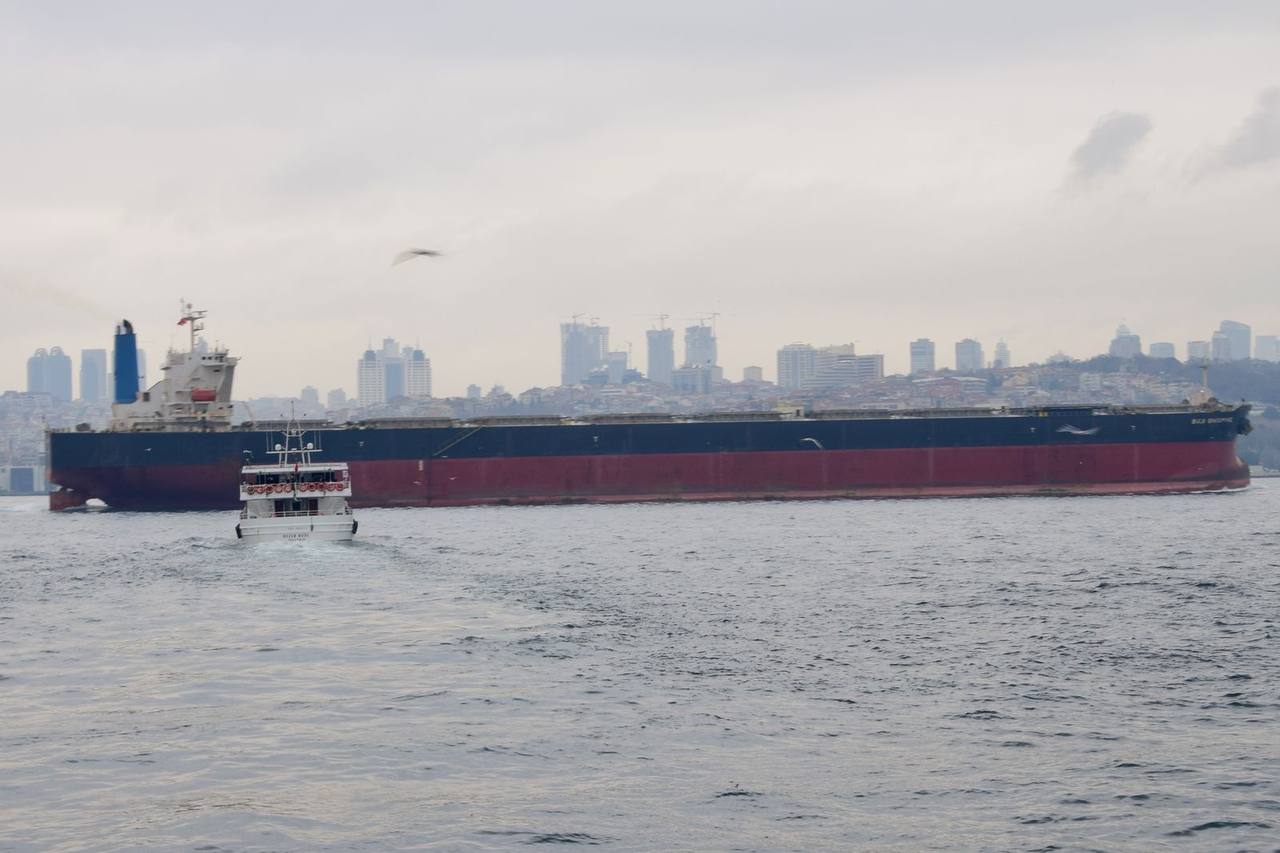
The Palau-flagged vessel was outbound from Odesa when it was hit — twice — in the overnight hours between September 27 and 28. A fire broke out aboard the corn-laden carrier. Seven crew members and the harbor pilot were brought to safety; two sailors are unaccounted for, according to Kalashnik’s Telegram statement. The minister did not name the vessel.
It was the second night running that Odesa’s ports came under fire. The Slovak barge Majestic was also reported damaged in the strikes, according to maritime press accounts — a reminder that the port campaign does not distinguish neatly between deep-sea bulkers and river barges.
Moscow offered a different story. Russian officials claimed the strike hit a cargo ship carrying military goods bound for Odesa. No evidence was provided, and the claim could not be independently verified — a pattern that has repeated through months of competing claims over the Black Sea.
Monday’s toll, city by city
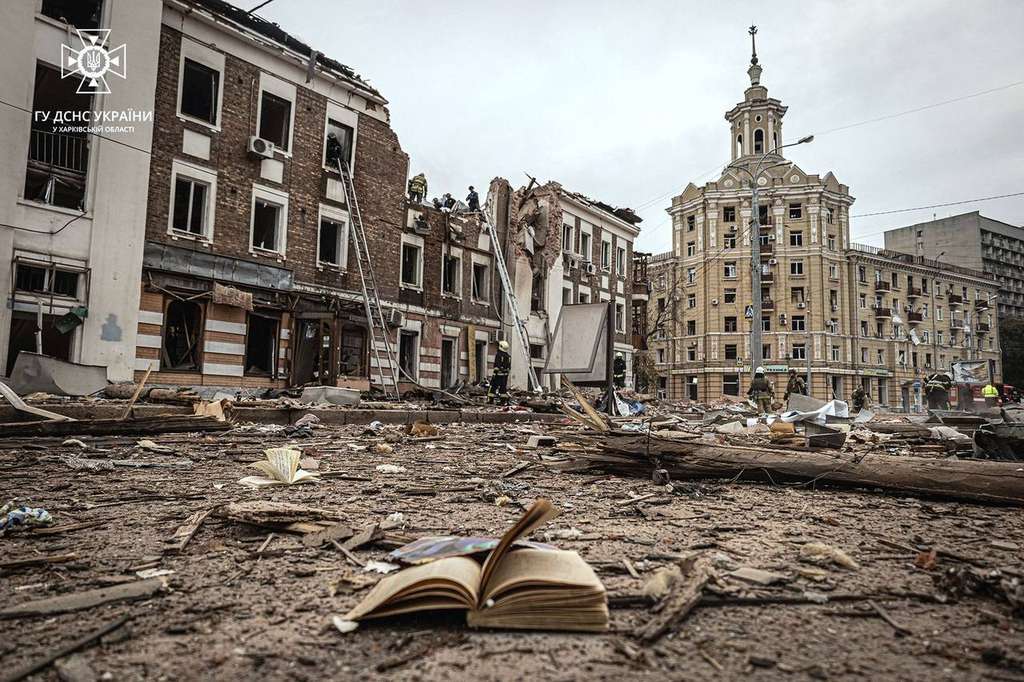
In his Monday statement, Zelenskyy said two people were killed in the Kyiv region, one of them a citizen of Azerbaijan, and that the number of wounded in Kharkiv had risen to 28, including nine children. The Kharkiv figure is an updated toll from the guided-bomb strike on an apartment building in the Saltivka district — an attack this site covered earlier with 22 wounded, a figure Reuters also reported citing the city’s mayor. As rescue work continued, the number climbed.
The Kyiv-region deaths require context. On the previous evening, a strike on the Stolichny market area in Sofiyivska Borshchahivka, outside Kyiv, was reported to have killed two people. That incident belongs to Sunday night’s toll, not Monday’s — but it illustrates how the casualty count in this war is a rolling ledger, compiled district by district as the rubble is cleared.
Elsewhere, the night’s damage was scattered and civilian. In Zhytomyr, an ice cream factory was damaged — the kind of target that underscores how little of this war’s destruction falls on military objectives, whatever the official statements say. Residential buildings were hit in Sumy, Rivne, Kharkiv and Odesa; infrastructure took damage in Vinnytsia, Dnipro, Khmelnytskyi and Zaporizhzhia.
Ukraine’s air force said Russia launched 99 drones and one ballistic missile overnight, of which 73 were downed or jammed. That is a Ukrainian claim, and like all battlefield claims, it is best read as one side’s accounting rather than settled fact.
Why this matters
There is a difference between striking a port and striking a ship — and that difference is why Monday’s attack matters beyond its immediate casualties. Ports can be repaired; berths rebuilt; cranes replaced. A vessel hit while underway, under a third country’s flag, sends a different message: that the act of sailing itself, not just the infrastructure ashore, is now the target.
Consider what that means for the grain trade. Ukraine’s seaborne exports are the country’s economic lifeline and a meaningful share of the world’s traded corn and wheat. Every sailing depends on a chain of fragile confidence — the shipowner willing to send a hull, the insurer willing to underwrite it, the crew willing to board. Each attack on a merchant vessel tightens that chain. War-risk premiums for the Black Sea have already been repriced repeatedly through this war; incidents like this one push them higher still, and the cost lands on freight rates, then on food prices, then on the import-dependent countries — many in the Middle East and Africa — that buy Ukrainian grain.
Then there is the flag. Palau is a small Pacific island nation whose registry, like those of Panama and Liberia, is a flag of convenience — the vessel’s owners are unlikely to be Palauan. But the flag is still the vessel’s nationality at sea, and an attack on a Palau-flagged civilian ship widens the diplomatic blast radius: it is no longer only Ukraine’s war, but an incident involving a third state, however symbolically. That is how the October 2024 strike on the Palau-flagged Optima became a diplomatic event as well as a military one — and why this second Palau-flagged incident will be watched in capitals far from Odesa.
Finally, there is the question of intent versus effect. Russia says it targets military cargo; Ukraine says the cargo was corn. Whether or not any given vessel carries dual-use goods — and in a war economy, the line between civilian and military logistics is genuinely blurry — the effect is the same: fewer ships sail, insurance costs more, and Ukraine’s export revenues bleed. If the strategic goal is to throttle Ukraine’s economy without declaring a formal blockade, the ambiguity is the point.
Background: the grinding campaign against Ukraine’s ports
Monday’s strike did not come from nowhere. Ukraine says Russia has carried out around 60 attacks on its port infrastructure in the last three months, damaging some 300 facilities and hitting 22 civilian vessels. Those are Ukrainian figures, offered without independent verification — but the direction of travel is not seriously disputed: Odesa, Chornomorsk and the Danube ports have been under sustained pressure for months.
The precedent hanging over this incident is the Optima. In October 2024, a Palau-flagged vessel of that name was struck at Odesa, killing crew members and drawing international condemnation. Same flag registry, same port, same competing claims. The parallels are uncomfortable — and they suggest that whatever deterrent effect the outrage over the Optima was supposed to have, it has not held.
The deeper background is the grain corridor itself. The UN- and Türkiye-brokered Black Sea Grain Initiative ran from July 2022 to July 2023, moving millions of tonnes of grain under a fragile inspection regime. When Russia withdrew, Ukraine built its own unilateral corridor hugging the western Black Sea coast — and it worked, remarkably well, restoring export volumes close to pre-war levels. Russia’s port campaign is best understood as the slow, grinding answer to that corridor: not a single dramatic interdiction, but a steady accumulation of risk designed to make the corridor commercially unviable.
Two accounts of one ship
It is worth laying the two accounts side by side, because the gap between them is the story of information warfare at sea.
Ukraine’s account: a civilian vessel, flagged to Palau, loaded with 2,800 tonnes of corn, departing Odesa in normal commercial service — struck twice, set ablaze, crew mostly rescued, two sailors missing. The account is specific, attributed to a named minister, and consistent with the vessel’s observed behavior.
Russia’s account: the strike hit a cargo ship carrying military goods destined for Odesa; separately, the defense ministry said Monday’s strikes hit energy, data and logistics centres and the Vasylkiv military airfield. The claims are general, unattributed to verifiable evidence, and — as Reuters has repeatedly noted in similar cases — could not be independently verified.
What would settle the question? The cargo manifest. A flag-state investigation. An independent inspection of the vessel or its cargo. None has been offered. Until one is, readers should treat both accounts as claims — one detailed and attributed, the other vague and unverified — and resist the temptation to fill the gap with certainty.
The numbers, in context
2,800 tonnes of corn. It sounds like a lot until set against the scale of the trade: a large Handysize bulker carries ten times that. At roughly $230 a tonne, the cargo was worth on the order of $640,000 — a rounding error in global grain markets, a season’s work for the farmers and traders behind it. But the cargo’s value was never the point. The point is the two missing sailors, and the risk premium now priced into every future sailing.
99 drones and one ballistic missile, 73 intercepted. If Ukraine’s accounting is right, roughly three-quarters of the incoming weapons were stopped — a rate consistent with recent Ukrainian claims. It is also cold comfort: the quarter that got through hit apartment buildings, a factory, ports and infrastructure across eight regions.
22 to 28 in Kharkiv. Casualty tolls in this war almost always rise in the hours after a strike, as rescue crews work through rubble. Nine of the 28 wounded are children — nearly a third. That single statistic does more to convey the character of the Saltivka strike than any official statement.
What happens next
The commercial consequences will arrive first. Shipping operator OLSIDZ has suspended its Odesa operations — the kind of decision that speaks louder than any press release. Insurers will reprice Black Sea war risk again; some owners will simply decline Odesa voyages; freight rates for Ukrainian grain will climb. None of this requires another missile to fall. The risk premium is the weapon.
Ukraine’s options are constrained but real: more air defense around Odesa, continued use of naval drones to push Russian launch platforms back, and diplomacy — at the International Maritime Organization, with flag states, and with Türkiye, the corridor’s indispensable broker.
Europe, meanwhile, is watching a wider shadow war. EU foreign policy chief Kaja Kallas has warned that Russia is planning more sabotage operations in Europe — a reminder that the conflict’s edges are not confined to Ukraine’s borders, and that ports, cables and infrastructure across the continent are part of the same strategic picture.
Russia’s pattern points toward a winter campaign against energy and logistics — the ports fit that template as surely as power plants do. And Ukraine is applying reciprocal pressure: overnight, Ukrainian drones set fire to the Pavlovskaya/Edelweiss-95 oil depot in Russia’s Krasnodar Krai. The infrastructure war now runs in both directions.
Three scenarios suggest themselves. First, the corridor holds but gets more expensive — Ukraine’s exports continue, with higher freight and insurance baked in. Second, the accumulation of risk effectively throttles Odesa sailings, achieving by commercial pressure what no blockade has formally declared. Third, diplomatic intervention — through Türkiye, the UN or the IMO — establishes clearer protections for merchant shipping. Which future arrives depends less on any single strike than on whether shipowners, insurers and crews decide the Black Sea is still a place to do business.
Sources
- Reuters, via Devdiscourse: Russia hit Palau-flagged vessel in Ukraine’s Odesa region, Zelenskiy says
- AnewZ: Russian strike injures 15 in Kharkiv (live updates)
- Assafina Online: Palau-flagged vessel attacked off Odesa, two missing
- Infomarine: Vessels damaged as Russia intensifies attacks on Ukraine’s ports
- ANI, via Indian Economic Observer: Zelenskyy says Russian strikes killed at least 2 in Kyiv region, injured 28 including 9 children in Kharkiv
- Anadolu Agency, via EuropeSays: Russia–Ukraine war report
- Reuters: Russian bomb attack injures 22 in Ukraine’s Kharkiv, mayor says