Russia Kaliningrad nuclear threat
LONDON — Russia has issued one of its most explicit public nuclear warnings in months, with its embassy in London declaring Tuesday that any British or NATO military action against Kaliningrad — including a blockade or strike on the Baltic exclave — would be met with “all means at Russia's disposal, including nuclear weapons.”
The warning appeared on the embassy's official X and Telegram accounts in response to British media discussion of hypothetical NATO action around Kaliningrad and a Sky docu-drama in which fictional British leaders order a strike on the territory. NATO later condemned the “threat of force, including any irresponsible nuclear rhetoric,” while stressing that the alliance is defensive and prepared to protect allied territory.
What happened
“Those advocating plans to blockade or strike Kaliningrad should have no illusions about the consequences,” the Russian Embassy in London said. “Any British or NATO military action against Russian territory would be met with a response using all means at Russia's disposal, including nuclear weapons.”
The embassy cited an article in The i Paper that described Kaliningrad as “a tiny outpost in Europe” and “Putin's greatest weakness,” while discussing a blockade or “de-recognizing Russian sovereignty.” It also pointed to Sky's mini-series The Wargame, whose fictional prime minister, played by former British minister Michael Gove, orders retaliatory attacks on Murmansk and Kaliningrad.
The statement also said Russia “does not seek confrontation with NATO and Europe nor intends to attack them,” but warned that anyone initiating such a conflict should expect a response. A week earlier, the Russian Embassy in Paris told Anadolu Agency that Russia would use all means available to defend its territory and described retaliation against such plans as “inevitable and overwhelming.” The published reports reviewed by Signal Post News describe newspaper analysis and fictional scenarios; they do not identify a British or NATO government proposal to blockade Kaliningrad.
(a) Why this matters
Embassy statements are not operational orders, but their wording is calibrated diplomatic signaling. By attaching an explicit nuclear consequence to blockade, strike and sovereignty scenarios, Moscow is trying to turn discussion of Kaliningrad from a conventional military question into a deterrence question before any government adopts such a policy.
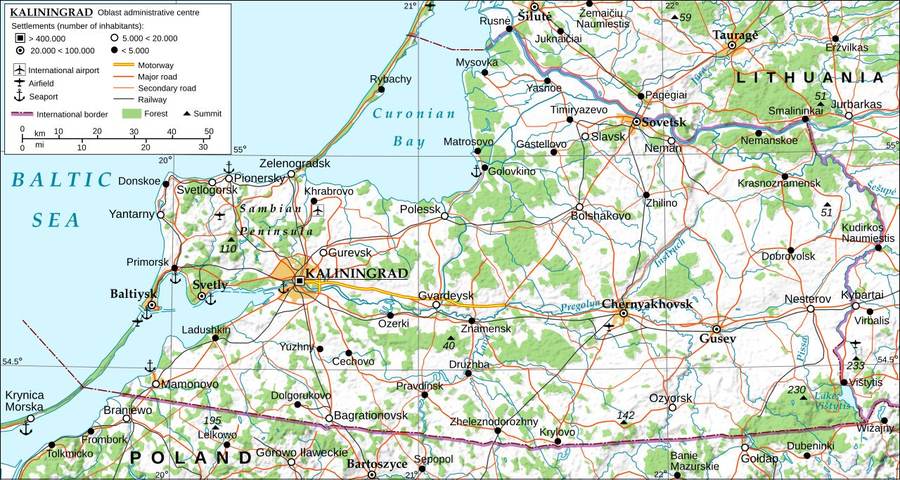
The geography makes that signal especially sensitive. Kaliningrad sits between NATO members Poland and Lithuania, while the nearby Suwałki corridor is the Baltic states' overland connection to the rest of the alliance. Any military incident around either location would immediately raise questions about NATO's collective-defense commitment. Nuclear language narrows the political space for crisis management by making every exercise, transit dispute or media scenario easier to portray as a step toward a red line.
There is also a ratchet effect. A threat intended to deter can become the new baseline for the next exchange, encouraging allied officials to answer with reassurance and Moscow to answer that reassurance with sharper language. NATO's response tried to separate those tracks: it rejected the nuclear rhetoric while insisting its own exercises and activities pose no threat to Russian territory.
(b) Context and background
Kaliningrad was the German city of Königsberg before the Soviet Union took the territory at the end of World War II and renamed it in 1946. The collapse of the Soviet Union left the region physically separated from the Russian mainland. Today it hosts the headquarters of Russia's Baltic Fleet, as well as Iskander tactical missiles and air-defense systems.
The last major transit confrontation came in June 2022, when Lithuania stopped rail shipments of steel and other EU-sanctioned goods. Moscow called the measure a blockade; Vilnius said it was enforcing European Union sanctions. The standoff eased after the European Commission allowed sanctioned civilian goods, excluding weapons, to keep moving by rail. That episode matters because it established the exact vocabulary now being reused: a transport restriction described by Moscow as a blockade and treated as a security threat.
What is new is the venue and trigger. The latest warning came from an embassy responding not to a government decision but to an opinion article and a television drama. That lowers the threshold for official nuclear messaging and turns speculative discussion into a diplomatic event.
(c) Who benefits, who loses, what critics say
Moscow benefits if the warning chills Western discussion of Kaliningrad as leverage. It also projects domestic resolve: the exclave is portrayed as unquestionably Russian territory whose defense is inseparable from the defense of the state. The cost is credibility. Repeated nuclear warnings over hypothetical scenarios can produce a “boy who cried wolf” effect, making future signals harder to distinguish from routine intimidation.
NATO faces a reassurance dilemma. Saying nothing could leave eastern members feeling exposed; answering too dramatically can validate Moscow's portrayal of a confrontation already in motion. The alliance chose a defensive formula — condemn the rhetoric, deny hostile intent and restate its ability to protect allied territory.
Ukraine has mixed incentives. Strong NATO deterrence helps limit Russian coercion, but any crisis that shifts allied attention and military planning toward the Baltic region competes with the immediate demands of Ukraine's war.
(d) The numbers in context
SIPRI's 2026 estimate put Russia's total nuclear inventory at about 5,420 warheads, including 1,796 deployed on missiles and at bomber bases. Those estimates explain why the embassy's phrase “including nuclear weapons” cannot be dismissed as an empty category, even though a public threat does not reveal any change in alert status or deployment.
The Suwałki corridor is roughly 65 kilometers long. Its scale is small enough to make it a vivid planning problem, but its political significance is much larger: it links the Baltic allies to Poland by land while separating Kaliningrad from Belarus. Kaliningrad also contains Russia's Baltic Fleet headquarters and missile systems, making it both a platform for Russian power and an exposed exclave.
The most important number in the immediate story is zero: none of the reporting reviewed identifies a NATO government decision to blockade Kaliningrad. The triggers cited by the London embassy are a newspaper argument and a fictional television scenario.
(e) What happens next — scenarios
1. The rhetoric fades — the most likely near-term outcome. The statement serves its deterrent and domestic purposes, NATO records its objection, and no operational change follows.
2. A coordinated embassy campaign expands. The London and Paris statements may become a template used before winter exercises or diplomatic meetings, with Moscow repeatedly attaching nuclear consequences to any language about isolating the exclave.
3. Transit friction returns through Lithuania. A sanctions or rail dispute could bring the word “blockade” back into an actual policy argument. That would be more dangerous than today's media-triggered exchange because it would attach the nuclear warning to a live movement-of-goods dispute.
Sources
- Russian Embassy in the United Kingdom, official X and Telegram accounts — statement published September 29, 2026.
- Europe Says / Daily Sabah — embassy quotation, UK media triggers and Paris embassy warning.
- Europe Says / Anadolu — London and Paris embassy statements.
- Dangerous Minds — the Sky docu-drama and The i Paper passages cited by the embassy.
- Europe Says — NATO response, Kaliningrad military background and the 2022 transit dispute.
- Europe Says — SIPRI 2026 estimate of Russia's nuclear inventory.