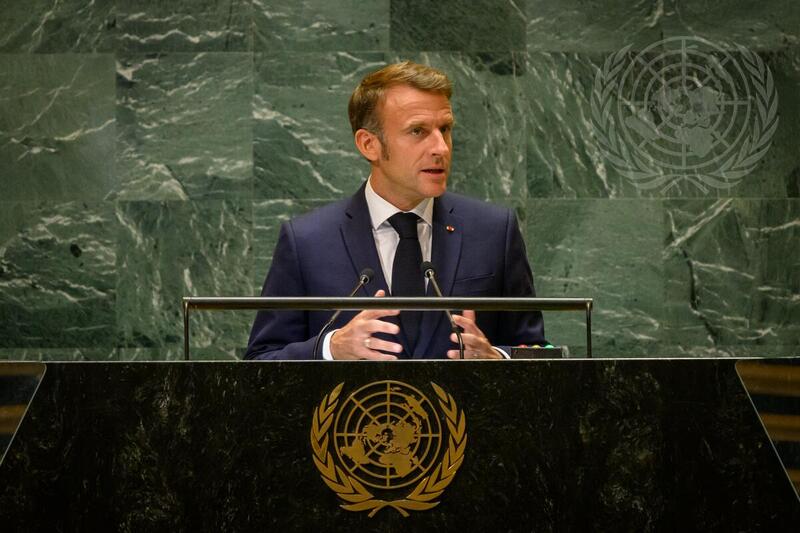
UNITED NATIONS, New York — Emmanuel Macron used his final address to the United Nations General Assembly on Tuesday, September 22, to mount an unusually direct challenge to President Donald Trump’s account of peace in Gaza. Hours after Trump stood at the same rostrum and said, “we ended the war in Gaza, saving untold thousands of lives,” the French president argued that the diplomatic headline had not produced the humanitarian access by which a peace agreement must be judged.
“Some boast of a supposed peace. But that peace has not reopened humanitarian access for a single second,” Macron said, according to Reuters. “Are we simply to stand by and watch this spectacle that should shame us all?” He banged his fist on the podium and ended with the declaration, “LONG LIVE THE UNITED NATIONS.”
The importance of the exchange lies less in its theatre than in the standard Macron set. Trump points to the end of open war, the return of hostages, unanimous Security Council approval of a 20-point plan and creation of a Board of Peace. Macron points to a claimed absence of reopened humanitarian corridors. One side measures diplomatic architecture and the cessation of war; the other asks whether civilians can receive aid. Both claims can be politically consequential, but they are not interchangeable.
What happened at the UN
Trump’s speech presented Gaza as one of his administration’s defining diplomatic successes. He said that when he addressed the General Assembly a year earlier, the war between Israel and Hamas was still raging and hostages remained in Gaza. “A few weeks later, we ended the war in Gaza,” he said, crediting the agreement with saving lives and returning the hostages.
After Macron’s speech, the U.S. State Department quoted Trump on X celebrating the Security Council’s unanimous approval of the administration’s 20-point Gaza peace plan and its authorization of a Board of Peace, calling the development “fantastic.” That response emphasized formal endorsement: the plan had passed through the Council and acquired an international mechanism intended to oversee implementation.
The White House then answered Macron more directly through spokeswoman Anna Kelly. “President Trump ended the war between Israel and Hamas, freed all living hostages, returned the bodies of the deceased to their loved ones, and is now leading the implementation of the 20-Point Plan for Peace in Gaza,” she said in a statement provided in response to Reuters. “While others talk, this President took this complex problem head on. No one has done more for peace and stability in the region.”
That is the administration’s case in its strongest form: an agreement ended the war, resolved the hostage issue and created a framework for the next phase. Macron did not answer by denying every claimed achievement. He attacked the gap between the framework and the condition he said civilians still faced—no restored humanitarian access.
Why this matters: a major ally removes the diplomatic cushioning
Macron’s intervention was one of the bluntest public rebukes of Trump’s foreign-policy narrative from the leader of a major U.S. ally. It came in the same hall, only hours later, and in a speech with unusual finality: Macron is due to leave office in May 2027 and was making his last UN address as president. That reduced the immediate electoral cost of confrontation and gave the moment the character of a legacy statement.
A private disagreement could have been managed as an implementation dispute. Macron instead used the General Assembly to say that an alleged humanitarian failure should shame the international community. By doing so, he forced governments supporting Trump’s plan to address two different questions: whether the agreement exists and whether it works.
For Trump, the political value of the Gaza plan rests on a simple promise—that decisive U.S. leadership succeeded where established diplomacy had failed. Macron’s attack complicates that story because France is not rejecting diplomacy from outside the Western alliance. It is challenging the results from inside it. If other European governments adopt the same standard, the Board of Peace could face coordinated pressure for benchmarks on aid access, settlement policy and Palestinian governance.
A year after France recognized Palestine
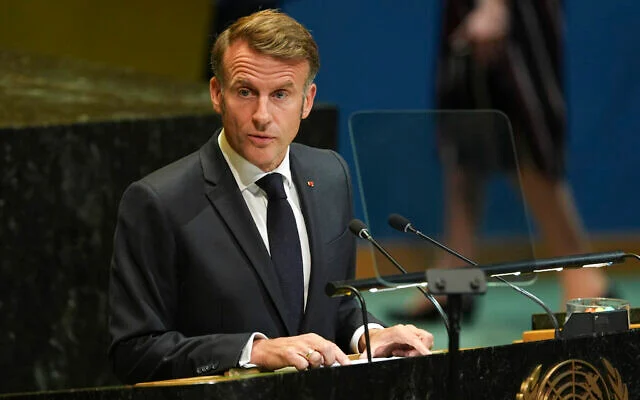
Macron placed the confrontation inside a longer argument about recognition. France recognized a Palestinian state in September 2025, during a period in which about a dozen states made or highlighted recognition moves. Critics said the declaration changed little on the ground. Macron acknowledged the charge directly: “I hear the cynicism of some people: ‘Recognition is just a piece of paper, look at the reality’.”
His answer was that inaction carries its own credibility cost. “What credibility do we have if we continue to remain inactive in the face of Gaza?” he asked. The logic is important. Macron was not claiming that recognition alone reopened borders, delivered food or created a viable Palestinian government. He was arguing that recognition established a political position from which France must now demand consequences.
Some French politicians and activists remain unconvinced. Reuters reported that critics say Macron has done little since recognizing Palestine. Their complaint exposes a vulnerability in his legacy argument: if recognition was a meaningful act, they ask, where are the material changes it produced? The speech may strengthen Macron’s record as a critic of the status quo, but it also invites a retrospective audit of French leverage and follow-through.
The West Bank widens the dispute
Macron did not confine his criticism to Gaza. “Look at what is happening in the West Bank, where every day violations are committed. In whose name? Hamas has never operated in the West Bank,” he said. His argument was that security claims tied to the war with Hamas cannot explain or justify every action affecting Palestinians in territory governed by a different political and military reality.
Paris has toughened its position by imposing national sanctions related to settler violence and starting a process to ban products from Israeli settlements in the occupied West Bank. Those measures are more concrete than recognition but still limited compared with broad trade or diplomatic sanctions. Their significance is directional: France is connecting the Gaza implementation dispute to European policy on settlements, violence and commercial ties.
That linkage creates a second front for Trump’s plan. A Gaza framework may stabilize one theatre without resolving the West Bank. If European governments conclude that peace claims are being used to lower diplomatic pressure while settlement-related violations continue, they may move toward targeted sanctions and product restrictions even while supporting the ceasefire architecture.
The 20-point plan and the Board of Peace
The White House’s strongest institutional evidence is the Security Council’s unanimous approval of the 20-point plan and the creation of a Board of Peace. International endorsement matters: it gives the plan a legal and political foundation, encourages states to contribute money or personnel and makes it harder for parties to dismiss the framework as a unilateral U.S. project.
But endorsement is an input, not an outcome. The Council can approve a plan; it cannot by vote alone move aid trucks, staff crossings, repair water systems or guarantee safe passage. The Board of Peace can coordinate reconstruction and governance; its credibility still depends on access, authority, consent and implementation.
That distinction is the core of Macron’s challenge. Trump’s evidence is numerical and institutional: a 20-point plan, a unanimously approving Council and a new international board. Macron’s phrase “not for a single second” is operational and absolute. If accurate, it means the diplomatic machinery has produced no observable reopening of humanitarian access during the period he described. A unanimous vote does not cancel that result. Equally, one speech cannot by itself establish the full humanitarian picture; access can vary by crossing, cargo, day and security condition. Independent, route-by-route reporting is therefore essential.
The dispute over access should not be treated as settled merely because each government states its case with certainty. Macron’s assertion is a direct claim about conditions on the ground. The White House’s response is a claim about the war’s end, the hostage outcome and an implementation process now under way. The next serious test is evidence: which corridors are open, for how long, under whose supervision, with what volume of aid and what interruptions.
The eight-nation statement raised the same implementation test
Macron’s speech followed a joint statement from Egypt, Qatar, Jordan, the United Arab Emirates, Indonesia, Pakistan, Türkiye and Saudi Arabia. As Signal Post News reported earlier on September 22, the eight governments endorsed a road map for the plan’s second phase while demanding that the remaining first-phase commitments be completed.
Their framework links humanitarian access and early recovery to later steps: withdrawal, an international stabilization force, Palestinian administration and reconstruction. That is more supportive of Trump’s architecture than Macron’s rhetoric sounded, but the practical standard overlaps. Both insist that declarations must produce verifiable change before later institutions can claim success.
The alignment matters because it separates criticism of implementation from rejection of the plan itself. European critics and regional partners can support the 20-point framework while demanding harder conditions and public benchmarks. That may pressure Washington, but it may also strengthen the plan if the administration converts the criticism into enforceable steps.
Who gains—and who loses—from the confrontation
Macron’s legacy gains if the speech is remembered as the moment he used a final global platform to defend humanitarian access and Palestinian statehood without diplomatic euphemism. He also gives European governments political cover to argue that alliance with Washington does not require accepting every White House success claim.
Palestinians and advocates for access gain visibility because the argument moves from abstract peace diplomacy to crossings, corridors and supplies. That does not itself deliver aid, but it raises the reputational cost of a plan that cannot demonstrate access.
European critics of the plan gain leverage if they can point to France’s position while pressing for national sanctions, tighter treatment of settlement goods or clearer conditions on reconstruction support. Their influence will depend on whether other capitals follow Paris.
Trump’s peacemaker narrative loses clarity. The administration can still cite the end of open war, hostage returns and Security Council backing. What it can no longer do without challenge is treat those achievements as complete proof of success. The same is true of the Board of Peace: its name and mandate create expectations that become liabilities if civilian access remains blocked.
Macron’s critics also gain an opening. They can praise the words while asking why France did not act more forcefully during the year after recognition. A farewell speech is a strong instrument for defining a legacy; it is a weak substitute for policy if sanctions, trade measures and coalition-building do not follow.
Three paths from here
The clash forces implementation. Washington and the Board of Peace publish corridor data, secure sustained access and attach dates and responsibilities to the 20-point plan. In this scenario, Macron’s criticism helps the U.S. framework by making its operational weaknesses impossible to ignore. Trump retains the larger diplomatic claim while France can say pressure produced movement.
The alliance fractures around the plan. If access remains disputed and the White House treats criticism as an attack on the peace itself, European governments could move toward national sanctions or settlement-product bans. The Board of Peace would then operate with formal authorization but declining political trust among some of the allies expected to fund or defend it.
The plan survives as an interim shell. The ceasefire and hostage outcome remain in place, but humanitarian, governance and reconstruction disputes persist. That would allow both sides to maintain their narratives: Trump could say the war ended; Macron could say peace never reached civilians. The danger is that a prolonged gap between those claims normalizes stagnation.
What to watch next
The first indicator is humanitarian access measured over time, not a single convoy or announcement. The second is whether the Board of Peace publishes responsibilities, timelines and evidence of implementation. The third is European policy: France’s sanctions over settler violence and its settlement-product process could remain national signals or become templates for broader action.
The fourth is political succession in France. Macron’s term ends in May 2027, so the durability of his position will depend on whether the next president treats recognition and the tougher West Bank line as national policy rather than a departing leader’s legacy. The fifth is Washington’s response to allied criticism: pressure can either fracture a coalition or make an incomplete plan more credible.
The UN speeches created a sharp contrast but not a final verdict. Trump described a diplomatic breakthrough anchored by a 20-point plan, returned hostages and unanimous Council support. Macron demanded proof that peace reaches Gaza’s civilians and warned that recognition without action undermines international credibility. The future of the plan—and of the Board created to carry it—will be decided by which account the next weeks of evidence support.
Sources
- Reuters: Macron’s UN farewell, Trump’s Gaza claims and the White House response
- UN Photo: Macron addressing an earlier General Assembly debate
- Signal Post News: Eight nations endorse a Gaza Phase Two road map and demand Phase One implementation
This article is a fixed September 22, 2026 reporting snapshot. Direct quotations, the White House statement from spokeswoman Anna Kelly and the State Department’s description of Trump’s X post are attributed to Reuters. Claims about humanitarian access remain disputed between Macron’s account and the White House’s implementation narrative; corridor status should be assessed through independent, route-specific evidence.