A France looter video stitched together from a single Snapchat account has become the other defining clip of France's riot weekend: thirty-five seconds of a masked man filming himself in the street, holding a camera up to the lens and offering to take theft orders from his followers — followed by a second clip of helmeted police ordering a group of young men onto their knees in a hallway.
He offered to steal to order. The edit ends with police shouting 'On your knees'
What the first video shows
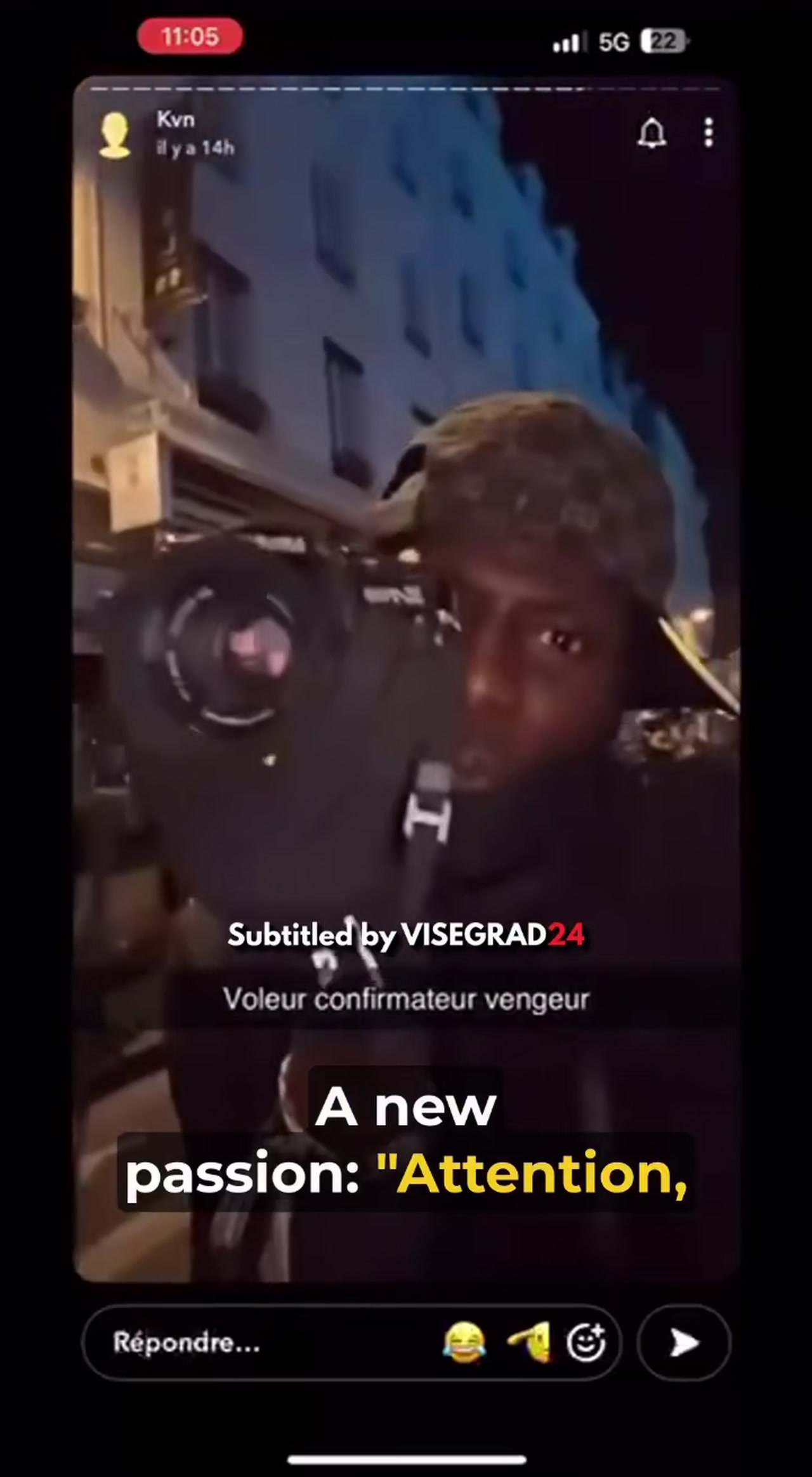
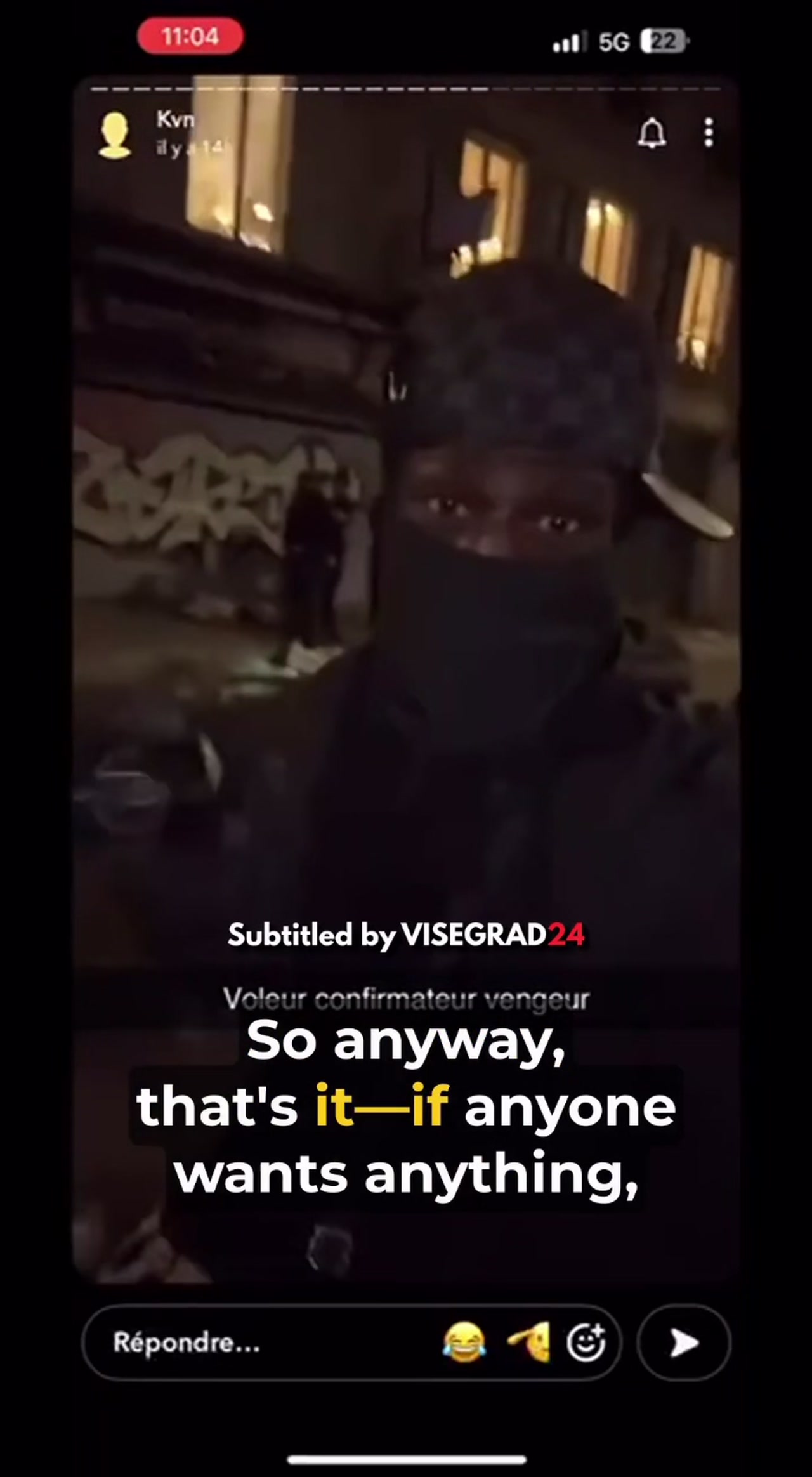
PARIS — The footage is a screen recording of a Snapchat story, posted by an account named "Kvn" and timestamped, in the story's own display, as being from the night of October 17. It opens on the man's own framing of the night — on-screen text in French calls it, in effect, the best story of October 17 — and for the next thirty-five seconds he is rarely off camera. His face is covered by a black balaclava, a patterned cap worn over it. Behind him are the ordinary props of that Saturday night in France: lit apartment windows, a wall covered in graffiti, other figures moving in the dark.
What makes the clip more than another riot selfie is the pitch. In the English subtitles added by the account that reposted the video, he tells his followers that if anyone wants anything, they should simply ask — singling out small items — and that he can be reached because he will be out until midnight. It is, in plain terms, an offer to steal to order, delivered to camera in the middle of a looting wave. Twice he raises the camera he is carrying — a stills camera with a large lens — and plays with it for his audience: a new passion, he says; "I'm your photographer." Whether the camera was itself stolen property, as the reposting account asserts, cannot be told from the footage. Cameras were, separately and verifiably, among the night's loot: near Place de la République in Paris, masked looters who robbed an Intermarché supermarket attacked a Euronews crew the same evening and took their camera, which was later returned without its memory card. That was a different crew, a different camera and a different street — but it is the documented backdrop against which the bragging clip is being read.
What the second video shows — and what it does not prove
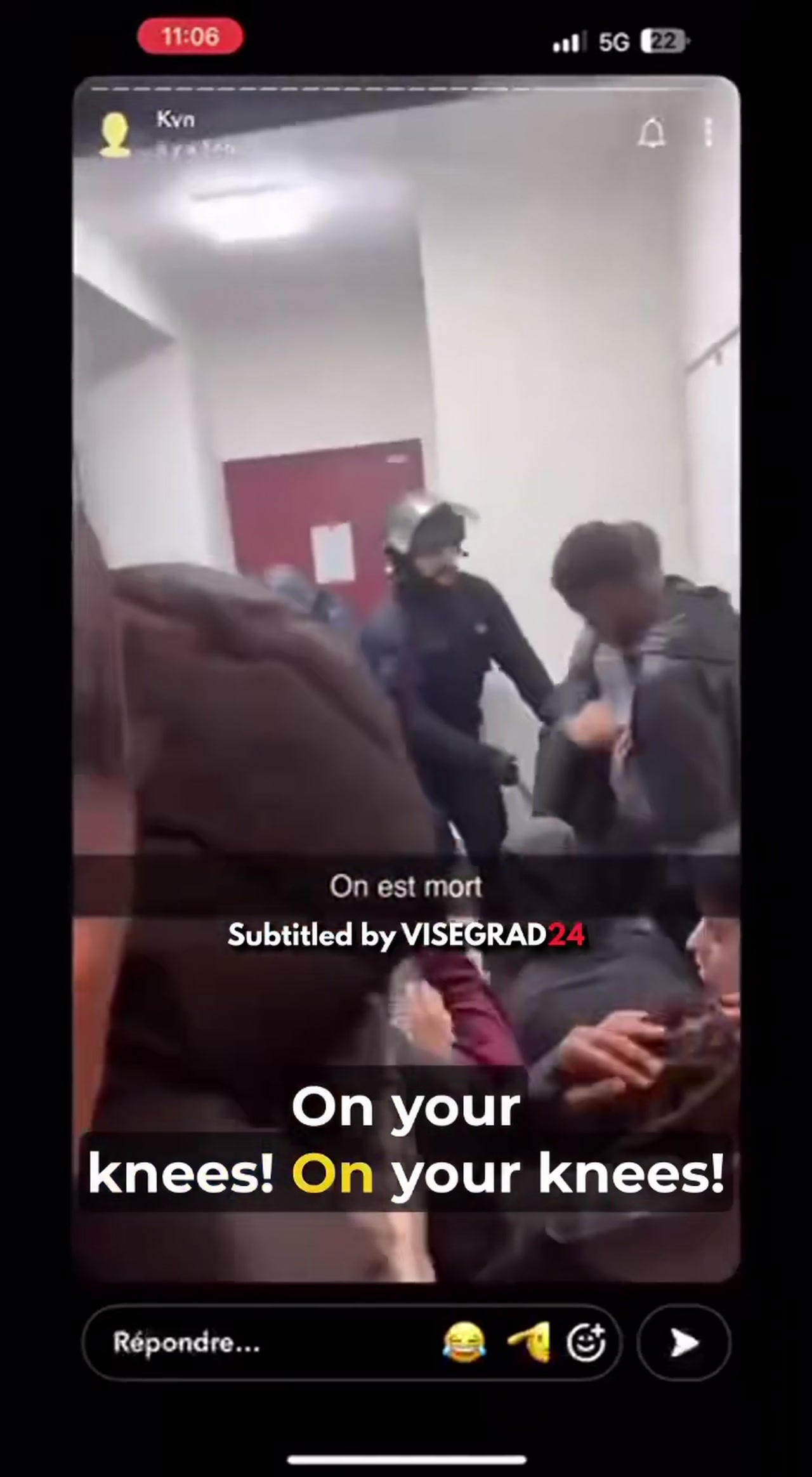
The edit then cuts, without any transition card, to a second story from the same account, captioned in French "On est mort" — "we're done for." The camera is inside a bright hallway or stairwell. A crowd of young men is pressed together; at least two police officers in helmets and dark uniforms are working through them, and an officer's voice repeats the order: "On your knees! On your knees!" A young man's voice answers, half protesting, that he is getting on his knees. Faces are visible — none of them masked the way the man in the first clip is masked, because the first clip's subject never shows his full face at all. That is precisely the problem with the viral version of this story: the bragging man is identifiable by a cap, a balaclava and a voice; the detained men are identifiable by their faces; and matching the two requires evidence the edit does not contain.
So the honest account is narrower than the caption. Two clips exist, posted under one account name, one showing a man soliciting theft orders during the unrest, the other showing a police detention in which a group is ordered to kneel. Posts sharing the edit say they are the same man, and that he cried and begged. The footage shows no tears and records no begging — it records shouting, crowding and compliance. Signal Post News is describing what the videos show and attributing the rest, because on a weekend when a fabricated, AI-generated video of a celebrity chef "defending" his restaurant also went viral in France before fact-checkers debunked it, the gap between a caption and a clip is where this story actually lives.
A weekend of self-filmed looting
To understand why this clip travelled, start with the weekend it came from. On Saturday, October 17, marches against the cost of living, fuel prices and the state of schools and public services drew around 550,000 people by the authorities' count — organisers said 800,000 — in what unions, student groups and revived yellow-vest networks had called as a national day of action. Most of it was peaceful. Alongside it, and in some places swallowing it, came the worst looting France has seen in years: by Prime Minister Sébastien Lecornu's figure, some 3,000 businesses were looted or vandalised, town halls were attacked and burned, and by the end of the weekend roughly 2,400 people had been arrested, 855 of them in Paris. Interior Minister Laurent Nuñez put police custodies at 2,331. Close to 1,000 police and firefighters were injured across the weekend. (Our running coverage: how the nationwide marches turned into a weekend of fires, and the viral balcony video from the café that was looted and burned the same night.)
What was new about this wave, French coverage has stressed for three days, is how thoroughly the looters documented themselves. "People were filming themselves — it was a free-for-all," ran the headline of Le Monde's account of the Paris looting. On Snapchat, TikTok and Instagram, participants posted inventories of what they had taken — trainers, clothes, phones, jewellery — faces uncovered, in the open, in real time. The bragging clip is one specimen of a genre: the looting was not just committed but broadcast, and in this case monetised in advance, with orders taken like a shop. The two sides of the weekend read that fact differently. Protest organisers and many marchers have condemned the looting as the work of a minority that hijacked a movement about prices and schools. The government — Lecornu, Nuñez, and prefects such as Jacques Witkowski, who said the looters "did not come to demonstrate, they came to loot" — has blamed far-left groups and organised criminals, and points to the self-filmed bravado as evidence the violence was opportunistic rather than political. Both readings were on the streets the same night; the argument over which defines the weekend is now the central fight in French politics, and it is the argument that produced the curfews imposed on Paris and four other cities.
The hunt: investigators are combing the looters' own footage
The second reason the clip matters is what happens to people who film themselves committing crimes in France this week. On Monday, Paris prosecutor Laure Beccuau announced preliminary investigations into the gravest acts of the weekend, and pointedly reminded those who took part that investigators would be asking whether they had left blood, DNA or fingerprints on the shop windows they cut. The Paris police prefect, Patrice Faure, announced a dedicated task force to comb through every available image — CCTV, shop cameras and social media alike — and appealed to witnesses to send in their videos. In Lyon, forensic teams have been taking DNA and fingerprint samples inside looted shops since Sunday. And the courts have already begun: in fast-track hearings on Monday, a Lyon court handed suspended prison sentences of twelve and eight months to two women caught in the night with goods taken from a JD Sports store — described by their own lawyer as "opportunistic looters" and by the prosecutor as profiteers of chaos. Across the country, around 149 people had already been convicted in the first wave of expedited trials, with sentences reported from eight months to two years.
That machinery is why a Snapchat story is evidence, not just content. French legal reporting this week has laid out the mechanics: a story disappears from the app in 24 hours, but platforms preserve account data for 90 days on a police freeze request, renewable once — and the account itself, its email, phone number and connection addresses, becomes the trail. The masked man in the clip is, at the time of writing, unidentified in any public reporting. If investigators want him, his own broadcast is the first thing they will subpoena.
Why this matters: the theft-order economy
The detail that lifts this clip out of the riot montage is the offer to steal to order — theft as a service, arranged by direct message, fulfilled the same night. It describes a market, and on Monday the French government moved against the market's other end. Commerce Minister Serge Papin announced that resale platforms — Vinted, Amazon, eBay, Leboncoin, Meta and TikTok among them — had agreed to trace suspected stolen goods, with a 48-hour window to investigate listings and report them to police, after the Digital Minister demanded that goods looted at the weekend be pulled from sale. Vinted told AFP it had spent the weekend identifying and removing suspect listings. Put the two ends together and the weekend's looting looks less like a spasm and more like a supply chain: orders solicited on Snapchat at midnight, goods fenced through mainstream resale apps by Monday. That is the system ministers are now trying to break, and it is why a 35-second brag — whoever exactly is in the second clip — has become evidence in an argument about platforms, policing and the speed at which a riot becomes a marketplace.
What happens next
Three things to watch. First, identification: French prosecutors are working through thousands of hours of footage, and the weekend's most-shared self-filmed clips are the obvious first files; whether the "Kvn" account is among them will say a lot about how the investigation is being prioritised. Second, the courts: fast-track trials are continuing, and the gap between the first suspended sentences and the two-year terms being reported elsewhere will set the real tariff for looting-by-livestream. Third, the politics: curfews are in force, the interior minister remains in post only because the president refused his resignation, and the fight over whether October 17 was a protest hijacked or a riot with a march attached will run into the 2027 election season. The man in the balaclava told his followers he would be around until midnight. The investigation into that night will be around considerably longer.
Sources
Video: the edit and both clips as posted by Visegrád 24 (@visegrad24) on X, October 20, 2026; underlying stories posted to Snapchat under the account name "Kvn," dated October 17, 2026. Weekend scale, arrests and official responses: wire reporting on the curfew orders and the Interior Ministry figures; France 24 reporting via ANI (march sizes, resignation, Macron statement). Self-filmed looting: Le Monde, October 18. Investigation, task force and prosecutor's remarks: HuffPost France. First convictions: Le Figaro, Lyon, October 20. Resale-platform agreement: Le Monde reporting via Finchannel, and Politico's account of the government's demands. Euronews crew robbery: Euronews' own account of the October 17 attack near Place de la République.
Reporting note: the identification of the detained men in the second clip with the masked man in the first, the claim that he cried and begged police, and the claim that the camera he carries was stolen all come from the social-media posts sharing this edit. None has been confirmed by French police, prosecutors or any reputable news organisation as of publication, and this article does not assert them.