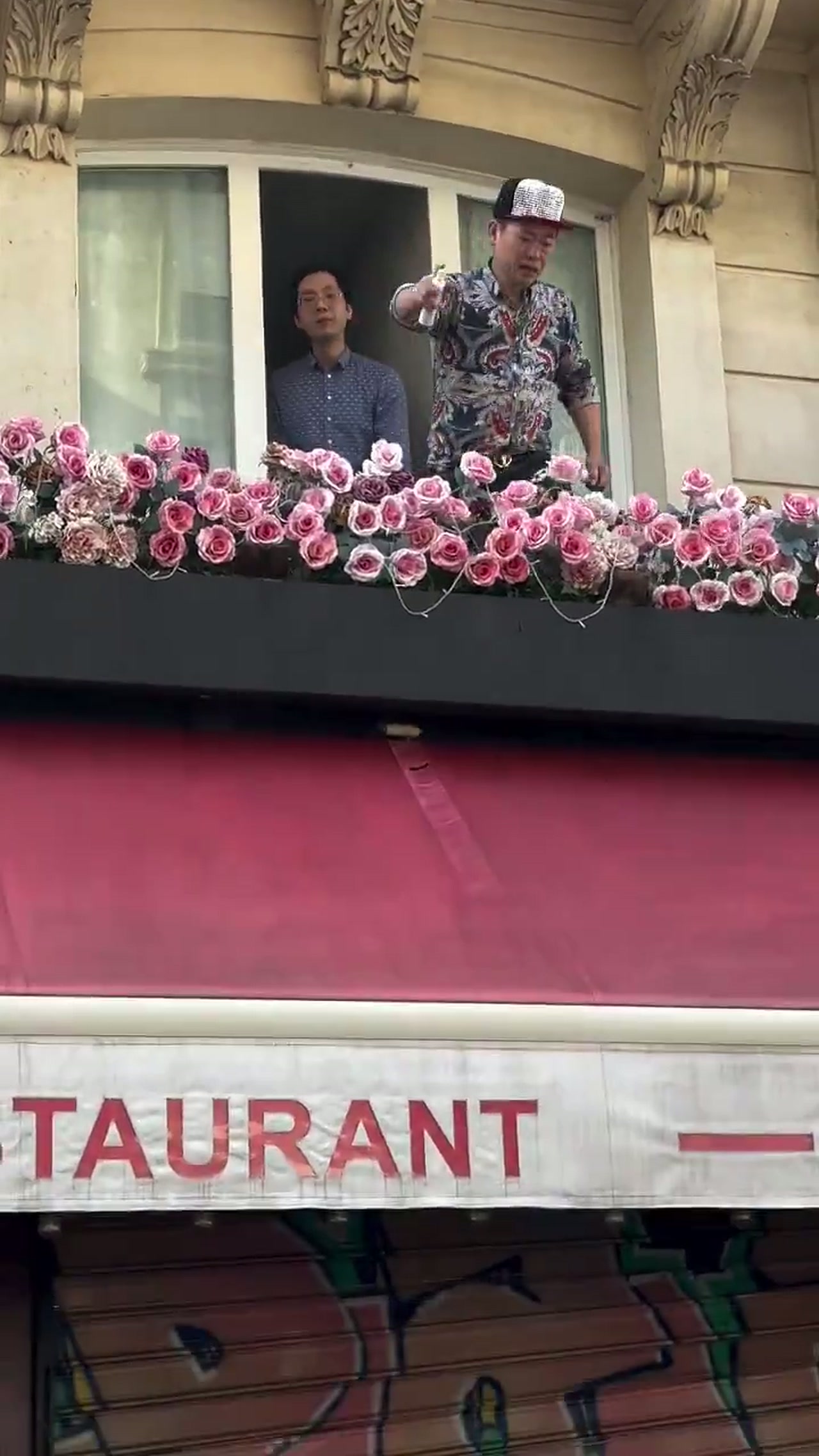
A Paris café perfume video shot from a first-floor balcony above La Barrique restaurant has become the defining clip of France's riot weekend: twenty-eight seconds of a man spraying an aerosol down at a crowd pressed against the café's graffitied shutters, filmed hours before the same café was looted and burned.
Perfume against a mob: the 28 seconds that summed up Paris's weekend
What the video actually shows
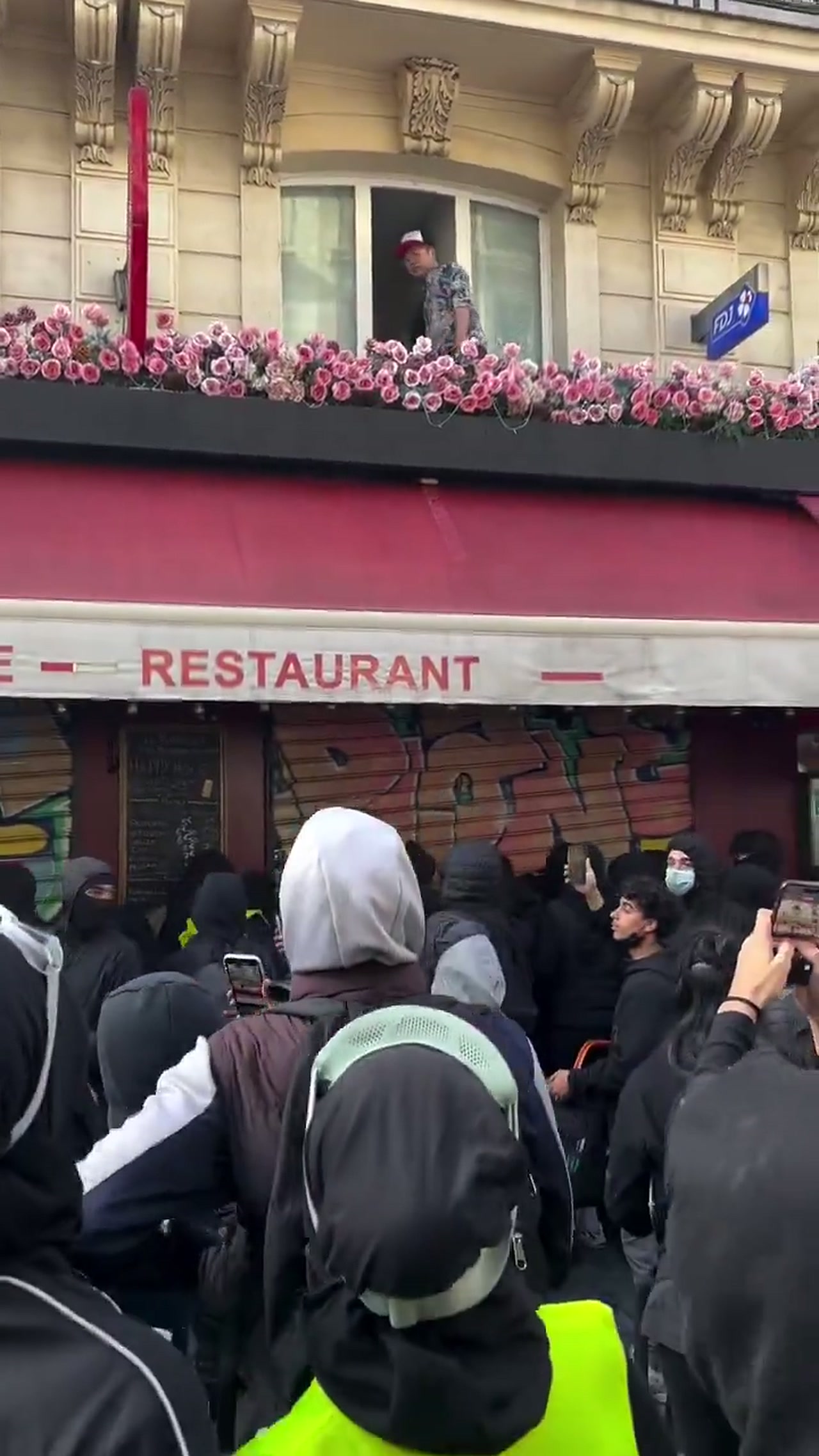
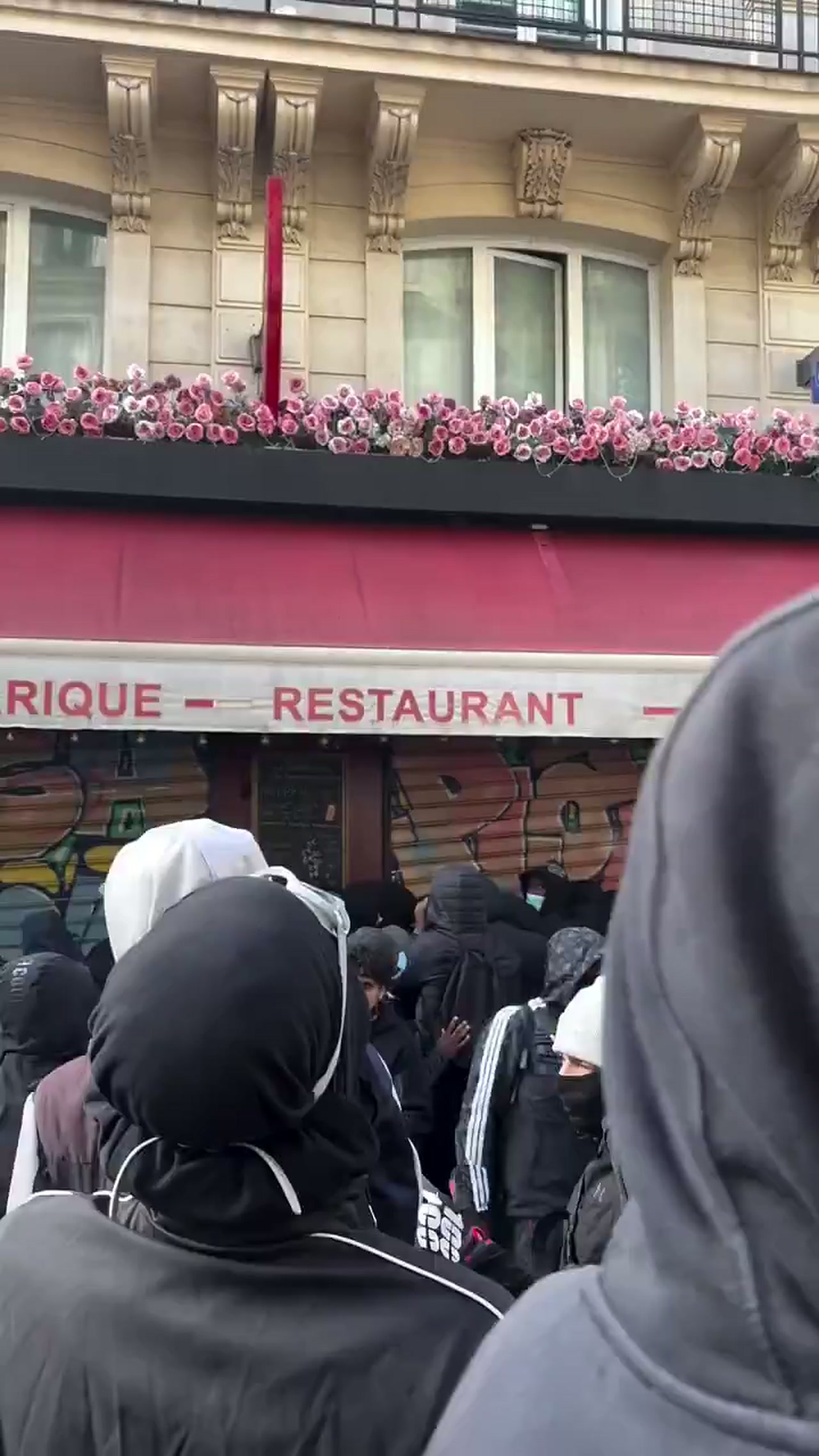
PARIS — The footage, shot from inside the crowd at street level, looks up at the first-floor balcony of a Haussmann building on Rue Beaurepaire, in the 10th arrondissement a few streets from Place de la République. The balcony is lined with pink flower boxes. Below it, a red awning carries the name "La Barrique — Restaurant," and behind the crowd the café's metal shutters are already covered in graffiti. The man in the patterned shirt leans over the flowers and sprays, again and again, in short bursts toward the people below. Many in the crowd are hooded or masked; several hold phones up and film back. Nobody in the twenty-eight seconds throws anything, and the shutters — at the moment the clip was shot — are still closed.
The video spread worldwide after it was posted by the news account Visegrád 24, whose caption describes the man as "a third-generation Chinese immigrant" who "barricaded himself in his Paris restaurant and sprayed perfume on the looters trying to break in because they stink." That caption is the source of almost everything the internet now "knows" about the clip — and it needs to be handled with care. The perfume detail, the man's identity, his immigration background and his motive all come from the circulating posts, not from any official statement or French newsroom report. French coverage of La Barrique — by Le Monde, franceinfo, Le Parisien and BFMTV — documents the attack on the café in detail but does not describe a perfume spray, and no owner or police statement confirming the caption's version had been published as of Tuesday. What the video alone establishes is narrower: a man, a balcony, an aerosol can, and a crowd at the shutters of a café that would not survive the night.
That gap between a viral caption and the verified record is itself part of the story of this weekend. French fact-checkers spent the same days debunking a slick fake video — generated with AI — that appeared to show celebrity chef Philippe Etchebest defending his restaurant from rioters. The La Barrique balcony clip is real footage of a real place; but the weekend proved how quickly a true image can acquire an unverified story, and how far the story travels before the facts catch up.
The night La Barrique was destroyed
La Barrique is a café-tabac — the combination bar, café and licensed tobacco shop that anchors Parisian street corners — run by Aline Li, 50, and her husband, Kévin. In her account to franceinfo on Sunday, retold by The Times, the couple had closed the metal shutters, locked up and were about to eat when they heard people outside shouting "tabac" — tobacco — the word that marked their shop as a target. "They all pulled the shutters together and they gave way," Li said. She estimated that between 200 and 300 people, most of them masked and dressed in black, rushed in. They shoved her and struck her with what she believes was a metal bar. "I must have lost consciousness for a second or two," she said. Among the attackers at the front, she recalled, was "a boy of 12 or 13 at most," and girls too, carrying "big, sturdy backpacks to carry what they stole." The looters took the cigarettes, alcohol and scratchcards a tabac lives on — plus her computer and a mobile phone — and the café was set on fire. Firefighters extinguished the blaze before it spread through the building, but the interior was destroyed.
Li needed stitches for a head wound and was taken to hospital with her husband, who had a large bruise on his forehead and also had his phone stolen. Their son Lionel, 27, stood guard over the burned-out premises the next day, Le Monde reported, as black-clad men still drifted back looking for cigarettes, alcohol or things to smash. Standing outside the shell of the café two days later, Aline Li told The Times: "We were there to serve people. We didn't harm anyone. Why were we attacked?" She said she does not know whether she can ever face reopening.
Rue Beaurepaire was a corridor of the same story. The Franprix supermarket next door was emptied, its stock stolen or crushed underfoot; the pharmacy across the street lost its windows, cash register and computers. A few streets away on Boulevard Magenta, phone-shop owner Jahirul Azam told Le Monde he and an employee tried to hold his shop's shutter against about twenty attackers and were assaulted; he says he called the police five times in an hour. The UNSA-Police union said officers were "completely overwhelmed" that night. None of this was an argument conducted at a distance: it was shopkeepers, alone, in doorways and on balconies, in front of their own shutters.
Why this matters: the shopkeepers' weekend
The balcony clip resonates because it compresses the whole weekend into one frame: an ordinary business owner, absurdly outmatched, defending his livelihood with whatever was at hand. Prime Minister Sébastien Lecornu put the national toll at roughly 3,000 businesses looted or vandalised; the Interior Ministry counted around 2,400 arrests across the weekend — 855 of them in Paris — and close to 1,000 police officers and firefighters injured. More than half a million people marched nationwide on Saturday in protests driven first by education cuts, overcrowded classrooms and the cost of living. The overwhelming majority marched peacefully; the looting was the work of a minority who, in the words of Paris prefect Jacques Witkowski, "did not come to demonstrate, they came to loot."
The economic argument cuts in two directions, and both are real. For the government, every burned café is evidence that the violence was criminal opportunism riding on a legitimate protest — Interior Minister Laurent Nuñez blamed "far-left groups" and criminals who joined to loot, and President Emmanuel Macron insisted: "There is no place for violence in our Republic." For small-business owners, the same images prove something else: that when the crowd turned, the state was not there. Li's five-minutes-from-République café was forced open in front of hundreds of people; Azam's five unanswered calls became a symbol in French coverage of the weekend. The government's answer — curfews imposed Monday in Paris and four other northern cities, a partial ban on protests in the capital, and promises of prosecution, as Signal Post News reported in its coverage of the curfews imposed after the weekend riots — is aimed at the next weekend. The shopkeepers' question is about the last one.
Two accounts of the same weekend
France is arguing about what Saturday was. Protest organisers and many marchers say the day belonged to a genuine, peaceful revolt against education cuts and squeezed living standards, hijacked after dark by casseurs — breakers — who had nothing to do with the cause; in one widely shared Paris clip, a woman who had marched is filmed shouting "this isn't the cause" as looting begins, and is brushed aside. The government and police unions describe organised far-left networks and criminal gangs exploiting the marches as cover, and point to the targeting pattern — tabacs for cigarettes and scratchcards, phone shops, luxury boutiques, supermarkets emptied with backpacks brought for the purpose — as evidence of planning, not protest. The record supports parts of both accounts: the marches were enormous and largely peaceful, and the looting was systematic and, at La Barrique, led in part by children. What neither account disputes is the bill now landing on people like the Lis, and on the roughly 1,500 Paris municipal workers who spent Sunday clearing the streets around them.
What happens next
Three things now decide whether La Barrique becomes a footnote or a turning point. First, prosecutions: Macron has promised that those who looted and burned "will be prosecuted and punished," and the credibility of that promise will be measured in the cases of the highest-profile victims — a beaten café owner whose attack was filmed from a dozen angles is an obvious test. Second, compensation: for the roughly 3,000 damaged businesses, the fight moves to insurers, state aid and the question owners like Azam are already asking in print — "who is going to pay for this?" — with losses at single shops estimated in the hundreds of thousands of euros. Third, the streets: with curfews in force and further national action already being discussed, the government is betting that a visible crackdown deters a second weekend; shopkeepers across Paris spent Monday boarding windows anyway, which is its own verdict. As for the balcony video, it will keep travelling — now attached, as it should be, to the names of the people who actually paid for the night it was filmed. Aline Li is out of hospital. Her café is a shell. Whether it reopens, she says, she does not yet know.
Reporting note: the balcony video's key characterisations — that the spray was perfume, that the man is the café's owner, that he acted "because they stink" — come from the social-media posts that spread the clip and are attributed as such above; they had not been confirmed by the owners, police or French newsrooms as of publication. The account of the attack on La Barrique is drawn from the owners' own interviews with franceinfo and Le Monde, and from The Times.
Sources
Owner interviews and attack account: The Times — "'Looters laughed and filmed as they beat me and destroyed my shop'"; Le Monde — "Paris shops ruined by looters on October 17"; franceinfo reporting via The Rothman Report. Weekend scale and official response: Fox News — "McDonald's ransacked and wrecked as stores, restaurants suffer from violence and rioting"; AFP reporting on the Rue Beaurepaire aftermath. The video: eyewitness clip circulated on X, including by Visegrád 24 (@visegrad24). Context: Signal Post News on the curfews imposed after the riots and on the nationwide protests that preceded them.