
Primary topic: Rays Yankees ALDS Game 1
ST. PETERSBURG, Fla. — The first game of the American League Division Series was supposed to be a heavyweight fight. It became a one-man show. Tampa Bay Rays right-hander Drew Rasmussen carved up the New York Yankees for eight scoreless innings on Saturday night, October 3, carrying a no-hitter into the eighth before settling for a combined one-hitter in a 1-0 victory that staked the Rays to a 1-0 lead in the best-of-five series. Rays-Yankees ALDS Game 1 drew a raucous sellout crowd of 40,542 to Tropicana Field — the loudest October atmosphere the building has hosted in years.
Austin Wells finally broke the spell with two outs in the eighth, driving a double down the right-field line. Then the Yankees' first hit became their most painful out. Wells ran through third-base coach Luis Rojas' stop sign while trying for a triple and was cut down easily on the relay from right fielder Victor Mesa Jr. to shortstop Taylor Walls to third baseman Junior Caminero. “We didn't really have much going on there in the game, so every 90 feet matters,” Wells said. “I was committed to being there and thought I had a good chance to get there. Can't hang your head too much. They pitched incredible tonight and just trying to make something happen.”
The eighth inning that broke the Yankees' night
New York was four outs from becoming only the fourth team in postseason history to be no-hit. Wells prevented that indignity, but the emotional release lasted only seconds. Once he rounded second, the play ceased to be about ending Rasmussen's bid and became a test of October judgment. Rojas had the stop sign up. Wells had already made his choice.
The out ended the inning with Ryan McMahon waiting on deck as the potential tying run. That is what makes the sequence sting: Wells produced the one swing New York needed, then removed the chance to cash it. Rasmussen walked back to the dugout after eight innings and 101 pitches. The no-hitter was gone; Tampa Bay's command of the night was not.
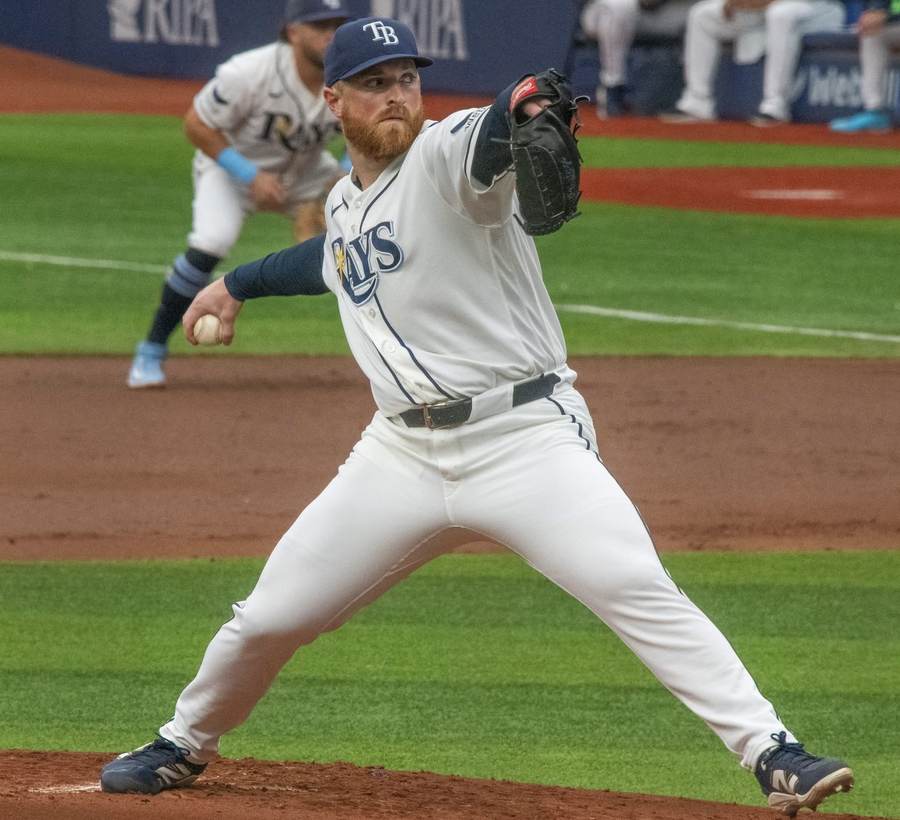
Rasmussen's masterpiece: 7⅔ hitless innings
How close to history?
Rasmussen's 7⅔ hitless innings tied Washington's Aníbal Sánchez in 2019 for the longest individual postseason no-hit bid since Roy Halladay no-hit Cincinnati in the 2010 NLDS. His 10 strikeouts tied the Rays' franchise record for a postseason game. This was his first postseason appearance since 2022, and the calm visible from the stands did not match the churn within. Rasmussen admitted that “my heart rate was at a thousand beats per minute.”
The performance had one wonderfully human interruption. Rasmussen missed Aranda's home run, the only scoring play of the night. “Unfortunately, I was in the bathroom,” he said. By the time he returned, his offense had supplied all the support he would receive. Manager Kevin Cash reduced the rest of the analysis to one question: “What wasn't elite?”
The line
8 IP, 1 H, 2 BB, 10 K, 101 pitches. The numbers describe domination, but the shape of the outing mattered just as much. Rasmussen challenged the strike zone without giving the Yankees the predictable pitch they needed. He moved efficiently enough to reach the eighth, missed bats when traffic threatened and never let the moment rush his delivery.
One swing decided it: Aranda's 417-foot homer
Jonathan Aranda launched a 417-foot solo homer off Gerrit Cole in the third inning. It was the only run either team scored, one clean mistake magnified by everything New York failed to create around it. In another game, a third-inning solo shot is a footnote. On this night it became the full scoring summary.
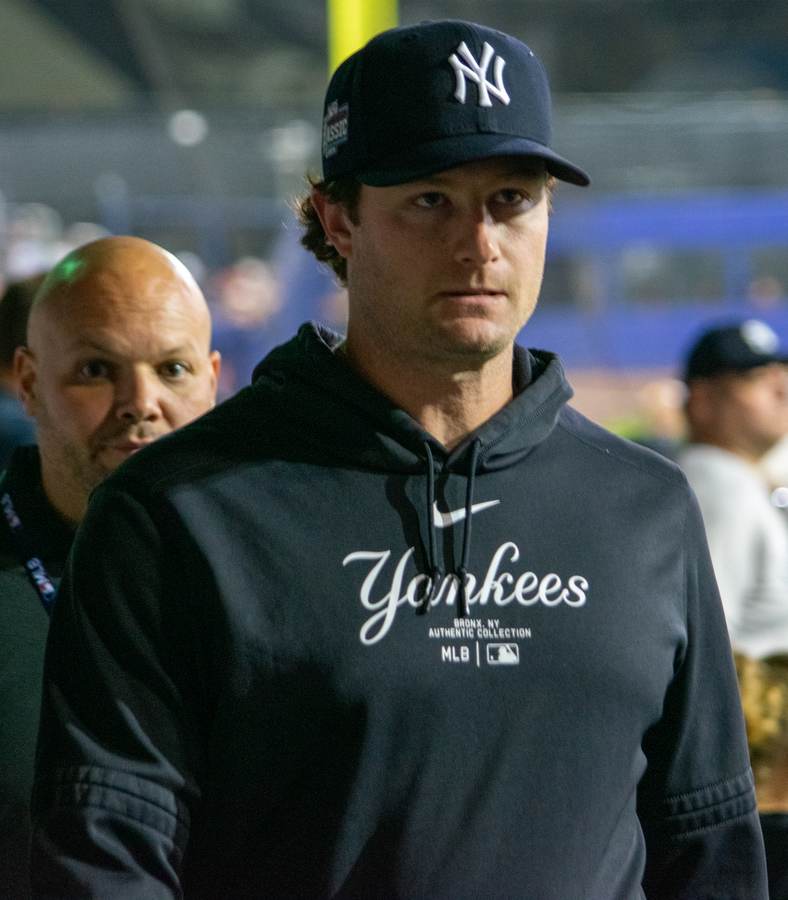
Cole worked five innings, allowing five hits and one run with one walk and five strikeouts on 82 pitches. It was the line of a hard-luck loser: good enough to keep New York within one swing, not flawless enough to survive a lineup that offered him nothing. The Yankees' ace lost because one ball traveled 417 feet and no teammate brought a runner home.
Baker slams the door
Bryan Baker inherited a one-run lead and removed any suspense from the ninth. He struck out pinch-hitter Giancarlo Stanton, struck out Ben Rice and got Cody Bellinger to ground out in a 1-2-3 inning for the save. Three batters, three outs, no crack through which New York could manufacture a late tie.
Cash's choice to pull Rasmussen at 101 pitches invited the familiar October argument about history versus winning. Baker made the argument disappear. Tampa Bay protected its starter, trusted a rested reliever and completed the combined one-hitter without allowing the tying run to reach base.
Why this matters
Game 1 of a best-of-five is the highest-leverage game of the series. Teams that win the opener have historically closed out roughly seven in ten of these series, and the Yankees' margin for error is now gone. New York does not merely need a better at-bat or two on Monday; it needs to prevent Tampa Bay from turning a narrow lead into an 0-2 hole that would leave almost no room for recovery.
The deeper story is the exposure of an Aaron Judge-less lineup. The same group that hung 18 runs on Boston in the wild-card round managed one hit against Tampa Bay pitching. That collapse says as much about October pitching as it does about New York's volatility. A lineup can look complete against one opponent and suddenly appear one-dimensional when another staff refuses to surrender the middle of the plate.
Rasmussen also appears to own this matchup. Fox Sports' OutKick report noted that he nearly no-hit the same lineup in Tampa Bay's division-clinching win at Yankee Stadium late in the regular season. The Rays' player-development machine keeps beating the Yankees' payroll where it counts: in preparation, matchup execution and the production of pitchers who can silence expensive lineups.
Background: how we got here
The Yankees swept the Red Sox in the wild-card series, scoring 18 runs and arriving with the confidence of a club whose offense had traveled. Tampa Bay's route ran through a division race built on prevention, depth and a refusal to concede the resource gap. Game 1 compressed those competing identities into nine innings: New York carried the larger names, Tampa Bay controlled the game.
The building mattered, too. Tropicana Field held 40,542 after the club opened its third tier, a sharp contrast with the barely 19,000 who attended its previous home playoff opener. For a franchise forever drawn into arguments about attendance and market strength, a genuine October sellout was more than scenery. It gave every two-strike pitch consequence and supplied a reminder that urgency can still fill the Trop when the baseball earns it.
Who benefits, who loses, what the critics say
The Rays gain rotation credibility, home-field leverage and validation for Cash's bullpen management. Pulling Rasmussen after 101 pitches left the final inning to a rested Baker, who rewarded the decision. Aranda gains the October moment every young hitter wants: one swing that survives as the entire scoreboard.
The Yankees lose the cushion their wild-card sweep created, and Wells becomes the face of a mistake that could follow him all winter if the season ends this week. Game 2 is not mathematically an elimination game, but it will feel close. New York has to prove that its one-hit night was a great pitcher's masterpiece rather than a revealing limit.
The criticism begins with baseball's oldest baserunning rule: never make the third out at third base. Wells' defense is situational. With nothing happening offensively and Baker looming in the ninth, he believed the extra 90 feet was worth the risk. But Rojas had the stop sign up, and Wells conceded he was “already committed” before he saw it. October does not grade intention. It preserves the out.
What the numbers say
One hit: the Yankees were four outs from becoming the fourth postseason team ever no-hit. Ten strikeouts: Rasmussen tied the franchise postseason mark. 417 feet: Aranda supplied every run in the game. 40,542: a crowd that transformed the Trop into the loudest building of the night.
Then there is the series-to-series swing: New York went from 18 runs against Boston to zero in the ALDS opener. That is October's cruelty in one comparison. Production does not carry over like credit. Every series resets the problem, and the Rays presented a version the Yankees did not solve.
What happens next
Game 2 is Monday back at Tropicana Field. The Yankees need length from their starter and traffic against a Rays staff that now smells blood. An 0-2 hole in a best-of-five has historically been close to a death sentence, so New York must play with urgency without chasing the game. The Rays need only more of the same: early leverage, precise pitching and a bullpen plan that reduces the number of decisions left to chance.
Elsewhere Saturday, the Brewers edged the Padres 3-2 in their NLDS opener. William Contreras hit a go-ahead 406-foot homer in the seventh, while Jackson Chourio's homer became his fifth career postseason blast, a franchise record. The margins were narrow across the bracket. Tampa Bay's was narrowest of all — one run, one hit allowed and one baserunning decision that will be debated until Game 2 begins.
Related coverage
Sources
- New York Post — “Yankees get one-hit in brutal Game 1 ALDS loss to Rays”
- USA Today — “Drew Rasmussen gem puts Rays up 1-0 in ALDS”
- Fox Sports / OutKick — “Yankees lose ALDS Game 1 to Rays as Austin Wells is thrown out at third after breaking up no-hitter”
- Field Level Media via WIXX — “MLB roundup: Rays flirt with no-hitter, blank Yankees in ALDS opener”
Method: Game details, quotations and pitching lines were cross-checked against the linked reports; historical comparisons are described with their stated scope.