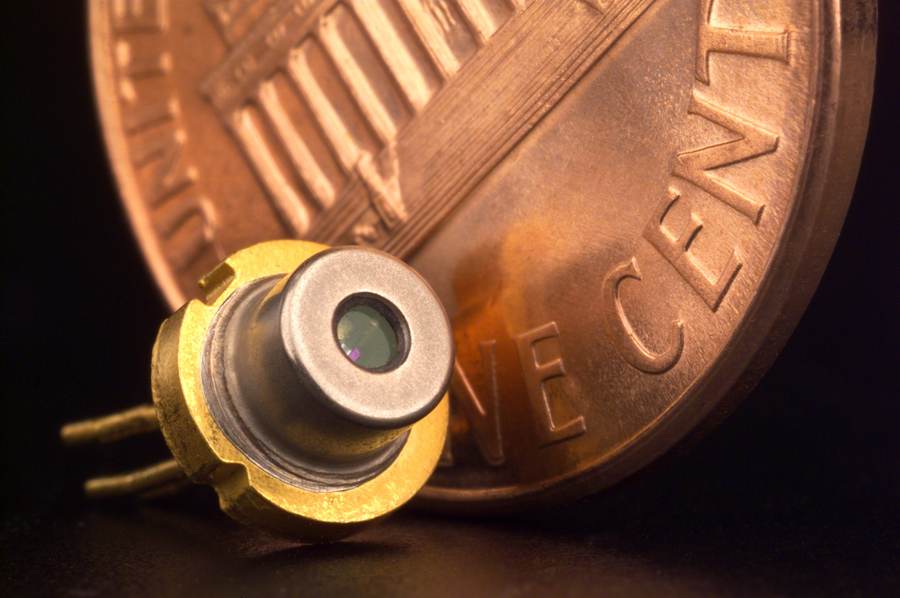
SAN FRANCISCO — The Volantis laser AI chip interconnect is built around a simple diagnosis: the industry has spent years making processors faster while the paths feeding them data remain physically constrained. The semiconductor startup has raised $88 million in venture capital to attack that imbalance with tiny lasers that transmit information between processors and memory.
Chief executive and co-founder Tapa Ghosh told Reuters that leading accelerators from Nvidia and AMD can typically be surrounded by about eight high-bandwidth-memory chips because electrical wires work reliably only across short distances. Volantis proposes using vertical-cavity surface-emitting lasers, or VCSELs, to extend that reach. The company says the design could connect one GPU to as many as 220 memory chips.
Why this matters
Artificial-intelligence systems do not run on arithmetic alone. A processor must constantly retrieve model weights, intermediate results and training data. When the chip can perform calculations faster than memory can supply them, expensive compute units sit idle. The industry calls this the memory wall, and it has become one of the defining limits on AI performance and cost.
Adding more GPUs does not automatically solve the problem. Each accelerator brings its own demand for memory, networking and power. If the links between those components cannot keep up, a larger cluster can spend more time coordinating and less time computing. A successful optical interconnect would attack the bottleneck inside the package and rack rather than asking software to work around it.
From eight HBM stacks to a claimed 220 memory chips
Today's high-end accelerators place stacks of high-bandwidth memory close to the processor through advanced packaging. Proximity minimizes delay and increases data flow, but it also limits how many memory devices can fit around the compute die. Volantis's claim is that light can travel farther and carry more data without the signal degradation and power costs that constrain copper traces.
The jump from roughly eight nearby memory stacks to 220 reachable memory chips would be substantial, but the numbers are not perfectly interchangeable. A chip that can address more memory still needs enough optical bandwidth, efficient controllers and software capable of using the capacity. Latency, error rates, heat and package yield will determine whether the practical gain matches the architectural promise.
Why VCSEL technology changes the risk calculation
VCSELs are not laboratory curiosities. Related lasers are used in Apple's Face ID system, and Apple's scale helped build a supply chain capable of producing them in volume. Volantis is betting that an established component ecosystem can lower the manufacturing risk of bringing optical links into AI systems.
That is different from claiming packaging is easy. Aligning optical components, controlling heat and manufacturing at acceptable yields remain difficult. Ghosh acknowledged the challenge while emphasizing that the underlying work is familiar: “Advanced packaging is always to be respected – it's never trivial – but it's not necessarily a new thing to do.”
His second line distilled the company's pitch: “No one is going to win a Nobel Prize if our project works, but the good news is, they won't need to.” In other words, Volantis is selling execution rather than a physics breakthrough. The components and principles already exist; the task is integrating them economically into a high-volume semiconductor system.
Silicon photonics and VCSELs take different routes
The broader industry is already exploring optical connections through silicon photonics, co-packaged optics and optical networking. Volantis's use of VCSELs reflects a pragmatic route based on a mature laser type. The relevant comparison will not be which technology sounds more advanced, but which can deliver sufficient bandwidth per watt at the yield and price demanded by data-center customers.
That contest will unfold across several layers. Chip designers control the accelerator architecture; memory suppliers control HBM road maps; packaging companies determine what can be assembled reliably; and cloud operators decide which systems are worth deploying. A startup must convince all four groups that its interface will remain supported for more than one product cycle.
The $88 million raise buys a manufacturing test
Venture funding can pay for engineers, prototypes, tape-outs and customer trials. It cannot guarantee a production-worthy chip. Semiconductor startups face long development cycles and unforgiving economics: a design can work in a laboratory and still fail because it is too difficult to manufacture, too expensive to package or too late for a customer's road map.
Volantis says its first chip is due next year and will target AI coding. That workload is a revealing choice. Coding agents must work with large repositories, tool outputs and long sequences of revisions, creating heavy demand for memory capacity and data movement. If the product can show a measurable improvement on useful coding tasks, it may give customers a clearer business case than a synthetic bandwidth benchmark alone.
The timeline is aggressive. A 2027 target requires not just finished silicon but packaging partners, memory compatibility, system integration, software support and customers willing to test a new component in costly infrastructure. Any delay could collide with rapid improvements from Nvidia, AMD and memory suppliers using more conventional approaches.
Who wins and who loses
AI developers could win usable context and throughput. More accessible memory could let models process larger codebases or batches without shuttling data across slower tiers. Cloud operators could win efficiency if accelerators spend less time waiting. Memory makers could win volume because an architecture designed around many more chips expands the addressable content per system.
Incumbent packaging and interconnect approaches would face pressure if Volantis proves a cheaper or more scalable path. But those incumbents also have the resources and customer relationships to adopt similar ideas. The startup's intellectual property and speed must be strong enough to prevent a successful demonstration from becoming a road map for larger rivals.
Investors bear the familiar hardware risk: $88 million is meaningful but modest compared with the capital required to build advanced fabrication plants or data centers. Volantis can remain fabless and rely on partners, yet it still has to reserve capacity and meet qualification standards. Customers will not redesign systems around a component that lacks dependable supply.
Data context: memory has become the AI market's second center
The surge in demand for HBM has already lifted memory producers and made memory availability a board-level concern for accelerator vendors. The market rally after Micron's earnings reflects the belief that AI memory demand can stay stronger for longer. Volantis is effectively betting that capacity alone is not enough; the connection between compute and memory must be redesigned too.
The company's opportunity also sits inside a much larger spending wave. Reported leases such as Tencent's proposed $7 billion Oracle chip agreement show how much customers will pay to secure computing access. Meanwhile, TSMC's first Arizona chips for Apple, AMD and Nvidia show the geographic and packaging complexity behind that supply.
What happens next
The first milestone is silicon. Volantis must show that its chip works across temperature, workload and manufacturing variation. The second is a system demonstration proving that the optical links produce real gains after controllers and software overhead are counted. The third is a customer commitment large enough to justify production.
Watch for disclosed bandwidth, energy per bit, latency, error rates and package yields—not only the 220-chip headline. Also watch which foundry, packaging and memory partners join the effort. Those relationships will say more about commercial readiness than the size of the funding round.
If the design works, it would not eliminate the memory wall; model size and data demand will keep expanding. It could, however, move the wall far enough to change how accelerators are built. That is the disciplined case for Volantis: not a Nobel Prize, but a better path between the chips doing the math and the memory holding the work.
Sources and reporting notes
- Reuters: Volantis raises $88 million for AI-memory interconnect technology
- Reuters syndication: Volantis funding and technical approach
Reporting note: The 220-memory-chip capacity and 2027 product target are company claims reported by Reuters. Commercial performance has not yet been demonstrated in the cited reporting.