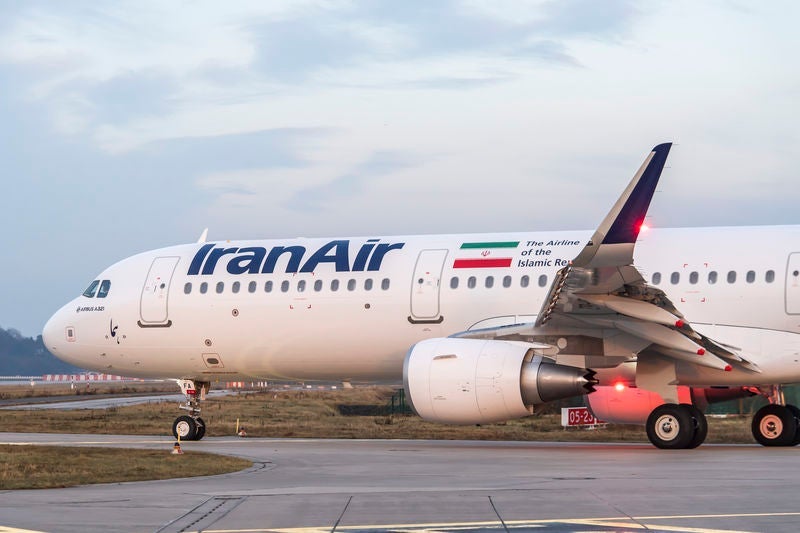
U.S. Treasury Secretary Scott Bessent told CNBC on Monday, September 21, that “on September 23, all the Iranian airlines will be shut down around the world,” describing a sanctions campaign intended to deny Iranian carriers the ordinary services required to operate abroad.
Bessent said the pressure would fall on foreign airports and businesses as well as on the airlines. “If they land, you cannot provide them with fuel, you cannot provide them with landing services, you cannot sell them tickets, or you will be knocked out of the dollar system,” he said.
The distinction between threat and outcome is essential. Washington is threatening secondary sanctions against companies outside the United States that continue servicing Iranian carriers. It is not issuing an aviation command with direct authority over every airport or aircraft in the world. The strategy relies on other businesses deciding that access to dollar-based finance is more valuable than maintaining commercial ties with sanctioned airlines.
How the September 23 pressure is meant to work
The announced pressure targets the network around a flight rather than only the aircraft. An international airline needs fuel, permission and handling on the ground, and a way to sell tickets. Bessent’s warning identifies each of those links and attaches a financial consequence to companies that keep them open.
Secondary sanctions are the mechanism behind the threat. They seek to influence foreign companies by putting their access to the U.S. financial system at risk even when the underlying transaction takes place outside the United States. In practice, Bessent is asking airports, fuel providers and ticket sellers to choose between servicing Iranian airlines and preserving access to dollar-based finance.
That leverage could sharply restrict international service if enough companies comply. But the result will depend on decisions made by governments, airport authorities, contractors and commercial intermediaries in individual markets. Bessent’s statement therefore describes the administration’s intended effect. It should not be read as proof that every Iranian airline will stop every flight at the same moment on September 23.
The September 8 action behind the warning
The warning follows a September 8 action by the Treasury Department’s Office of Foreign Assets Control. OFAC designated 27 Iranian airlines that had not previously been sanctioned, and Treasury said the action meant all active Iranian airlines were now under U.S. sanctions.
The newly designated carriers included Iran Air Tour, Iran Aseman Airlines, Qeshm Air, Kish Airlines, Sepehran Airlines, Varesh Airlines, Taban Airlines, Zagros Airlines, Karun Airlines, Chabahar Airlines and Fly Persia. Treasury accused the wider aviation network of supporting the Iranian government and military, including the movement of weapons, personnel and illicit cargo. Those are Washington’s stated allegations and rationale for the designations.
Treasury also suspended three aviation-related authorizations. They had covered certain overflights and the use of U.S.-origin or U.S.-controlled commercial aircraft on flights involving Iran. A temporary license covering overflight, refueling and emergency repairs is due to expire in the early hours of September 23. Treasury said aviation-safety requests would be reviewed case by case.
The interaction between the designations and the expiring license matters. The September 8 action established the sanctioned status of the airlines; the September 23 deadline removes a temporary allowance for specified aviation activity. Bessent’s television warning then amplifies the risk for outside service providers whose cooperation determines whether international flights can continue.
What has happened so far
Some disruption was reported before the deadline. Two Iraqi sources said Baghdad would suspend Iranian airline flights. Georgia barred Iranian carriers. Mahan Air said it had suspended service to Turkey at the Turkish government’s request.
Those reports show that the threat was already changing access in some markets. They do not establish a complete global shutdown. The relevant test beginning September 23 will be whether comparable restrictions spread to other destinations and whether fuel, ground handling and ticket distribution remain available where governments have not formally announced a ban.
The distinction is more than semantic. A government can bar an airline from its territory. A supplier can refuse fuel. A ticketing company can stop sales. Each decision can constrain operations, but none by itself proves that every airline has been grounded everywhere. The wider outcome will emerge from the accumulation of those separate actions.
What the figures mean
Twenty-seven airlines measures the breadth of the September 8 designation round, not the number of carriers that will necessarily stop flying. Treasury’s larger claim is that, after that action, every active Iranian airline is under U.S. sanctions. The operational effect still depends on compliance by companies and jurisdictions outside Iran.
Three suspended authorizations indicate that the pressure extends beyond airline names to the legal permissions surrounding aircraft and overflight activity. The temporary license’s expiration creates a specific September 23 transition point, while case-by-case safety review leaves a narrow channel for requests tied to aviation safety.
September 23 is therefore a sanctions deadline, not evidence of a synchronized worldwide grounding. It is the date on which the temporary allowance expires and on which Bessent says the service-denial pressure will take effect. Measuring the policy requires tracking actual flights, airport access and commercial services after that point.
Who gains leverage—and who bears the risk
Washington gains a tool that reaches beyond U.S. territory. By tying aviation services to the dollar system, the administration can seek compliance from companies that may have little direct exposure to the United States other than their need for international finance. The approach expands pressure without requiring the United States to control foreign airports directly.
Governments and aviation companies face a costly choice. Continued service to Iranian carriers could bring sanctions exposure; cutting those services can disrupt routes, contracts and passenger travel. The pressure is strongest where commercial participants depend heavily on dollar clearing and weakest where governments or firms are prepared to accept the financial consequences.
Iranian airlines lose access and flexibility. Even if aircraft remain technically able to fly, uncertainty over fuel, landing support and ticket sales can make routes commercially and operationally difficult. The threat also compounds the effect of the September 8 designations by warning foreign counterparties directly.
Passengers and aviation workers face the immediate disruption. Suspended routes can strand travelers, remove ticket options and interrupt the work of crews and ground-service providers. The case-by-case safety process may address some urgent operational needs, but Treasury has not described it as a general substitute for the suspended authorizations.
The war and the China channel
The aviation pressure is unfolding during an armed conflict between the United States and Iran that began in late February 2026. U.S.-Israeli strikes at the start of the war killed Iran’s supreme leader and senior military officials, according to reporting cited in the accounts of Bessent’s remarks. Iran then blocked the Strait of Hormuz.
That context raises the stakes of a measure aimed at civilian aviation. Washington presents the airline designations as pressure on a network it accuses of supporting the Iranian government and military. At the same time, the sanctions can affect passenger routes and companies whose role is commercial rather than military. Distinguishing designated entities, alleged conduct and demonstrated effects will remain necessary as enforcement develops.
Bessent also said Washington had discussed Iran sanctions and financial pressure with China. He did not, in the facts available for this report, announce a Chinese commitment or a specific enforcement step. The statement establishes that talks occurred; it does not establish how Beijing or Chinese companies will respond.
What remains uncertain
The main uncertainty is the gap between a declared worldwide effect and the distributed decisions needed to produce it. The United States can impose penalties and restrict access to its financial system. Foreign authorities and businesses must then decide how they will apply the risk to flights, contracts and services under their control.
It is also not yet clear how broadly aviation-safety exceptions will be granted, whether additional governments will formally bar Iranian carriers, or how Iranian airlines will adapt their schedules. The early moves reported in Iraq, Georgia and Turkey point toward disruption, but they are not yet a complete map of international compliance.
Finally, Treasury’s allegations about movement of weapons, personnel and illicit cargo explain the U.S. rationale for targeting the network, but this article does not independently establish those allegations. The designations are documented U.S. actions; the underlying claims remain attributed to Washington.
What happens next
- Airport and supplier decisions become visible. Refueling, landing and ticketing arrangements after the deadline will show how widely companies accept the sanctions risk.
- More governments may announce restrictions. The actions reported in Iraq, Georgia and Turkey provide early evidence of fallout. Further official notices would indicate whether the pressure is becoming broadly coordinated.
- Safety requests will test the remaining exception. Case-by-case decisions will show how Treasury balances pressure with the need to handle overflights, refueling or emergency repairs safely.
- China’s response will matter. Bessent said sanctions and financial pressure had been discussed with China, but the available record does not establish a specific Chinese policy change.
- The claim of a global shutdown will be tested against operations. Actual departures, arrivals, service refusals and ticket availability—not the phrase alone—will determine the scale of the impact.
The policy’s immediate objective is clear: make it prohibitively risky for foreign companies to keep Iranian airlines connected to international airports and markets. Its actual reach will be determined outside the television interview, one airport, supplier and jurisdiction at a time. September 23 is the start of that test, not proof in advance of its result.
Sources and reporting notes
- CNBC interview with Treasury Secretary Scott Bessent, September 21, 2026: primary remarks on the September 23 deadline, prohibited services and access to the dollar system.
- Al Jazeera reporting, republished by The Business Standard: Bessent’s warning, the secondary-sanctions mechanism and China discussions
- The Hindu BusinessLine / ANI: the warning to airports, fuel suppliers and ticketing companies
Reporting cutoff: Monday evening, September 21, 2026. Bessent’s “shut down” language describes the intended effect of threatened secondary sanctions. This report does not treat it as a direct U.S. grounding order or as confirmation that every Iranian airline had stopped operating. Treasury’s allegations concerning weapons, personnel and illicit cargo are attributed to the U.S. government.