This Ukraine war Day 1705 briefing covers another night of mass drone attacks, a destroyed Kharkiv superstore, Ukrainian claims of heavy Russian losses, and a diplomatic track that is moving — slowly, and without agreed dates.
Track it live: Ukraine war map · Live Global Wars tracker

The Ukraine war Day 1705 briefing begins, as so many of these briefings now do, with the arithmetic of a single night. February 24, 2022 was Day 1 of Russia's full-scale invasion; Sunday, October 25, 2026 is Day 1705. Overnight from October 24 into October 25, Ukraine's Air Force said Russia launched 153 strike unmanned aerial vehicles, including 92 jet-powered types — among them the S8000 "Banderol/Dan-T" systems and decoy drones — from the Bryansk, Oryol, Kursk and Millerovo regions of Russia, from occupied Donetsk, and from Hvardiiske in occupied Crimea. By 08:00 local time, the Air Force said, 119 of those drones, 64 of them jet-powered, had been shot down or otherwise neutralised. Impacts were recorded at 15 locations and falling debris at nine more. Those figures are Ukrainian official claims; they have not been independently verified, and that caveat applies to every battlefield number in this briefing.
Kharkiv: a death, and the last Epicentr gone
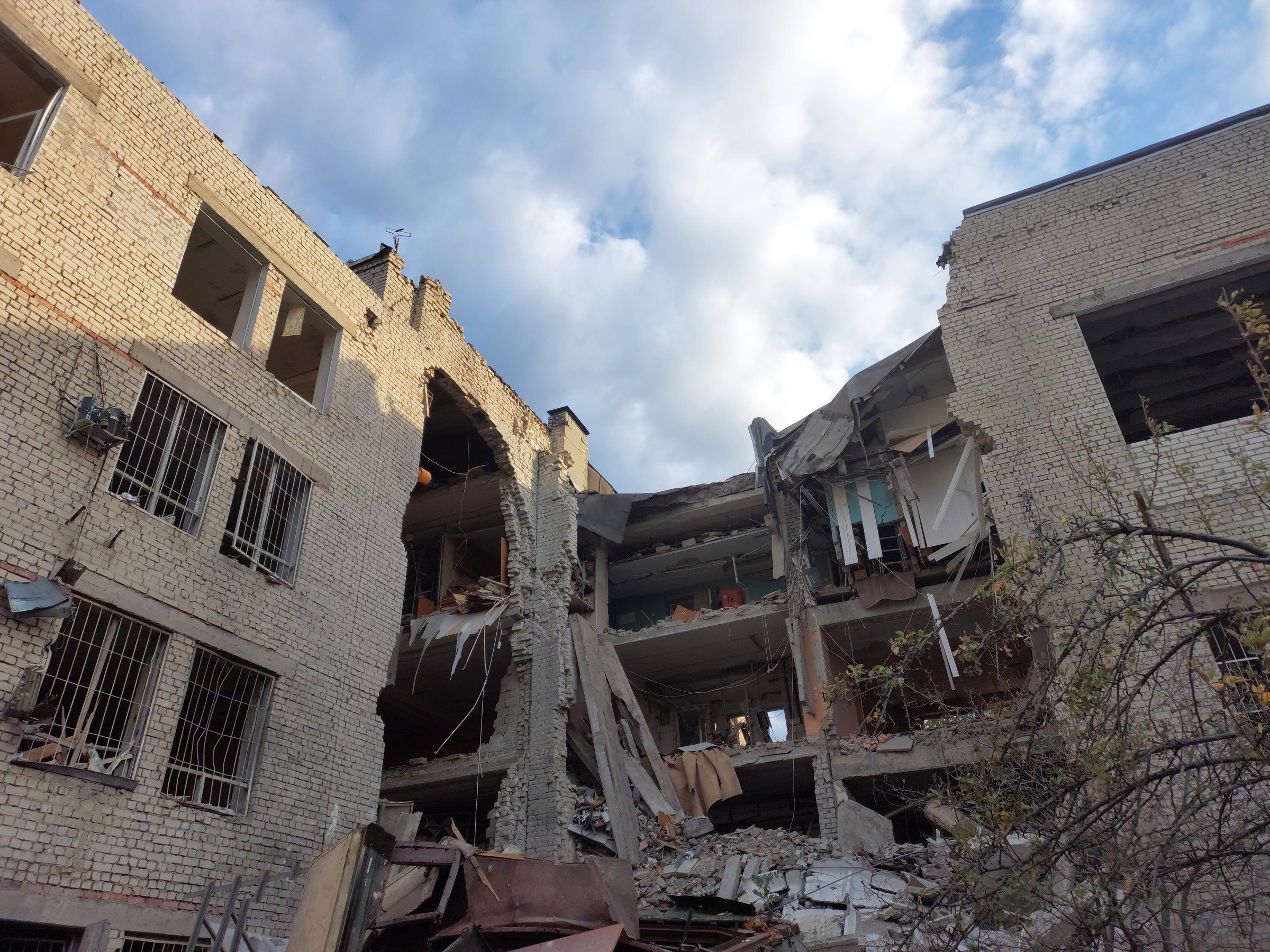
The night's deadliest reported strike hit Kharkiv, Ukraine's second city, which has endured nearly five years of bombardment from across a border barely 40 kilometres away. A drone struck the Novobavarskyi district, killing one person and injuring four, according to Ukrainian officials. Separately, Russian missiles destroyed the last remaining Epicentr store in Kharkiv, in the Osnovianskyi district. Epicentr, the Ukrainian home-improvement chain, has become an unlikely symbol of this war: its cavernous stores sell everything from paint to generators, and they have been hit repeatedly. The Kharkiv store had been damaged before. This time, staff and customers were evacuated before the strike, officials said, and there were no casualties — but the building caught fire and was destroyed. In the Bezliudivka community outside the city, the Vasishchevo logistics terminal was also hit and set ablaze, underlining a pattern Kyiv has long alleged: Russia is not only striking the front line, it is systematically working through the warehouses, depots and retail infrastructure that keep a wartime economy functioning.
Chernihiv and Crimea: the war's two-way traffic
Further north, in the Chernihiv region, two young women were injured in the overnight attacks, a strike set a building on fire in Chernihiv city itself, and the agricultural enterprise of the Koriukivka community was struck twice, damaging a farm building. Agriculture is not a soft target in Ukraine; it is the backbone of the country's exports and a deliberate focus of Russian strike planners, Ukrainian officials argue, because every burned grain facility tightens the economic noose. The traffic, however, runs both ways. In occupied Crimea, a Ukrainian attack on Saturday caused water and power cuts after strikes on local power grids, according to Sergei Aksyonov, the Moscow-installed head of the peninsula, writing on Telegram — an account reported in the Guardian's Day 1705 briefing on October 25. Kyiv rarely comments in detail on strikes inside Crimea, but the pattern is consistent with its long campaign to degrade the logistics and energy infrastructure Russia uses to sustain its forces in the south.

The front line by the numbers Kyiv publishes
The General Staff of the Armed Forces of Ukraine reported 193 combat engagements over the past day. In its account, Russia launched 83 air strikes dropping 281 guided aerial bombs, employed 10,010 kamikaze drones and carried out 3,276 shellings, 24 of them by multiple-launch rocket systems. The General Staff further claimed Russian losses for the past day of 1,850 personnel, three tanks, 49 artillery systems and 1,738 operational-tactical drones. Its claimed cumulative totals to October 25 stand at 1,578,450 personnel, 12,447 tanks, 51,614 artillery systems and 580,802 operational-tactical drones. Every one of those figures is a Ukrainian claim. Russia does not publish comparable running totals, independent analysts treat both sides' loss claims with caution, and the true figures are unknowable while the war continues. What the numbers do reliably show is intensity: nearly 200 engagements and more than 10,000 one-way attack drones expended in a single day describe a war of industrial attrition, not a frozen conflict winding down.
Reading the drone war: what changed overnight
The composition of the overnight salvo matters as much as its size. Ninety-two of the 153 drones were jet-powered types, a far higher share than the propeller-driven Shahed-style drones that defined the air war in 2023 and 2024. Jet drones fly faster and higher, compressing the reaction time of Ukraine's mobile air-defence groups and forcing Kyiv to spend scarcer, more expensive interceptors. Reuters' satellite-imagery analysis, reported on October 25, identified a Russian jet-drone launch complex near Millerovo — evidence, analysts say, that Moscow is building permanent infrastructure for this newer generation of strike drones rather than improvising launches. Ukraine still claims to have neutralised roughly three-quarters of the incoming salvo, but the economics are punishing: a decoy that costs little can draw fire meant for a jet drone that costs more, and even a 78 percent interception rate leaves dozens of impacts, as the 15 recorded strike locations overnight attest. Our previous Ukraine war Day 1704 briefing tracked how this drone campaign has escalated week by week, and President Zelenskyy's warning about the sheer scale of it — detailed in our report on how Russia fired 2,300 drones in a single week — now reads less like rhetoric and more like a trend line.
Diplomacy: a pause at Oleshky, talks in November
Against that backdrop, diplomacy is inching forward on two tracks. Reuters reported on October 23 a planned local humanitarian pause around Oleshky, in the Kherson region, intended to allow aid deliveries and evacuations. The White House estimates the town's remaining population at 1,700 to 2,000 people, down from about 24,000 before the war — a measure of what occupation and flooding and fighting have done to a community that once sat quietly across the Dnipro from Kherson city. Precision matters here: the start timing has been stated differently by different parties. An October 27 start has been reported; the White House previously pointed to October 29; the Kremlin has said the dates were still being worked out. The pause is therefore not jointly confirmed, and no single date should be reported as agreed. Separately, Reuters and the Associated Press reported on October 25 that Ukrainian, Russian and US representatives are expected to hold technical-level talks in the first half of November, with Abu Dhabi a possible venue — though arrangements could change. Territory and security guarantees remain the core disagreements, as they have been in every round so far. The European Union, meanwhile, adopted a further military-industry sanctions package, as reported on October 25, and the United Kingdom and France conducted a joint military exercise noted in the Guardian's briefing — signals that Europe is planning for a long war even as it talks about ending one.
Why this matters
Day 1705 matters because it captures the war's central paradox in a single 24-hour span. On the battlefield, the conflict is intensifying technologically: jet-powered drones, permanent launch complexes, five-figure daily drone expenditures. In the diplomatic arena, movement is real but microscopic — a humanitarian pause for fewer than 2,000 people that the parties cannot yet agree a start date for, and technical talks whose venue is still tentative. The gap between those two realities is where civilians live. A destroyed home-improvement store in Kharkiv is not a footnote; it is the war's strategy made visible, the steady erasure of the civilian infrastructure that makes normal life possible, store by store and warehouse by warehouse. And the Oleshky figures — 24,000 people reduced to perhaps 1,800 — remind us that the war's deepest damage is demographic, counted in emptied towns that may never refill. Readers should also hold the sourcing honestly: the most precise numbers in this briefing come from Ukrainian officialdom and are claims, not verified counts, while Russia's near-silence on its own losses is itself a choice. Both facts belong in any serious reading of Day 1705.
One restoration worth noting
There was one piece of unambiguously welcome technical news this week. Starlink and Starshield satellite connectivity speeds for Ukrainian users were restored above 400 kph after a week of restrictions that had hampered fast-moving units, a development covered in our Day 1704 briefing. In a war where drone teams and artillery batteries depend on satellite links, bandwidth is not a convenience; it is a weapon system, and its restoration matters operationally.
What happens next
Three things will test the coming days. First, whether the Oleshky humanitarian pause actually begins — and on whose date — will be an early measure of whether the parties can implement even the smallest agreed step. Second, the expected technical-level talks in the first half of November, possibly in Abu Dhabi, will show whether territory and security guarantees can move from slogans to text. Third, the air war: if jet-powered drones continue to make up the majority of Russia's nightly salvos, Ukraine's interception economics will worsen heading into winter, when energy infrastructure becomes the prime target. Signal Post News will publish the Day 1706 briefing tomorrow and update this story as casualty figures and the Oleshky timetable are confirmed or revised.