Trump fraud whistleblower program WHIP: President Donald Trump and Vice President JD Vance announced the Fraud Whistleblower Incentive Program in the Oval Office on Tuesday, October 20, 2026. The Justice Department program pays up to $30,000 for tips submitted through fraud.gov that lead to criminal charges — and Trump, on camera, added a promise of 1 percent of any money recovered, with no limit, naming himself the arbitrator of who gets paid.
The written program pays a bounty for charges. The president promised a cut of every dollar recovered — and made himself the judge.
What Trump announced
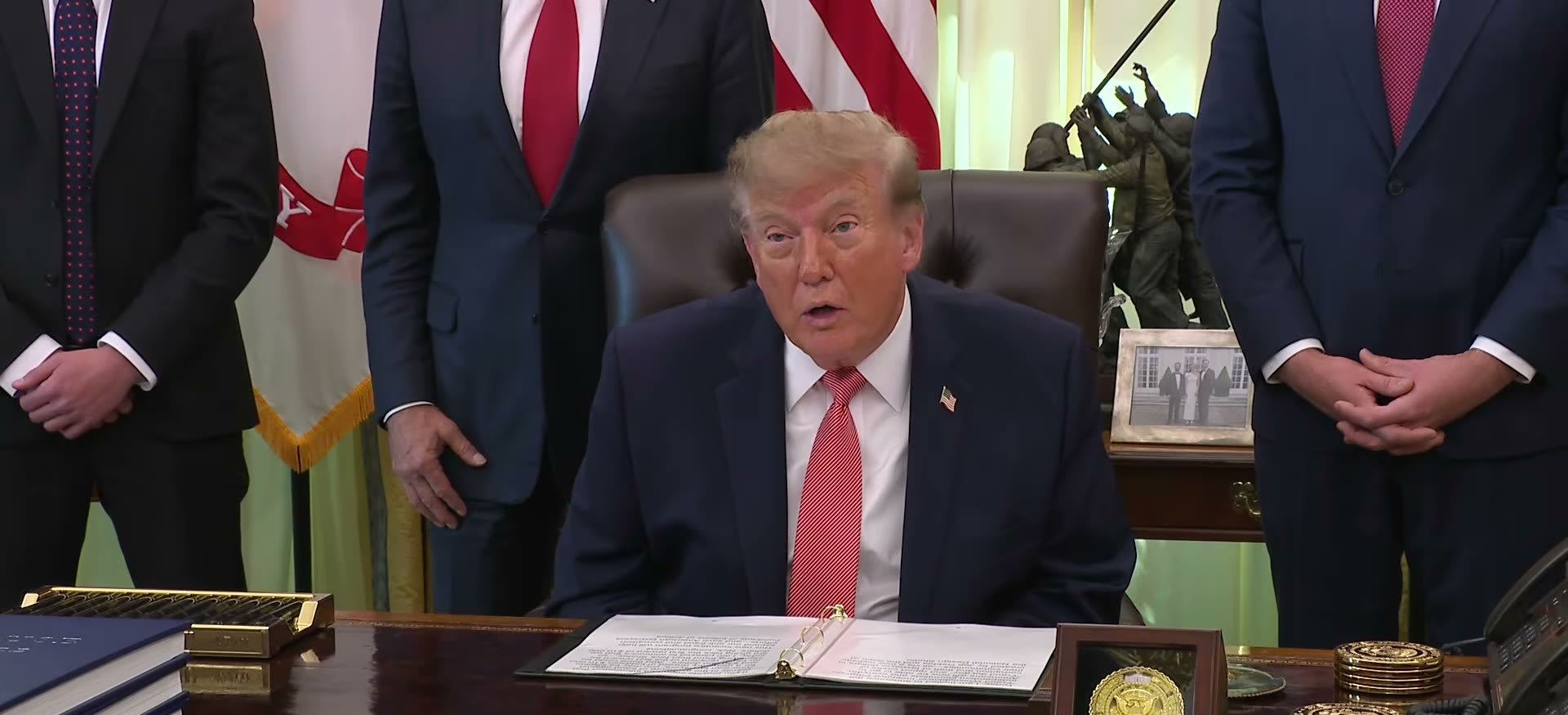
WASHINGTON — "Today I'm thrilled to announce the Fraud Whistleblower Incentive Program," Trump said, seated at the Resolute desk with Vice President JD Vance and the leadership of the Task Force to Eliminate Fraud standing behind him. "Independent journalists, and everybody, and all Americans, will now be able to go to fraud.gov and report cases of corruption and theft of taxpayer dollars in their communities."
Then he put a number on it that appears in no written guidance. "You, let's say, report and you find a billion dollars — we are giving a commission to that person of 1 percent," Trump said. "It's a lot of money. And if it's $10 billion, $200 billion, $400 billion, we're giving a 1 percent commission to that person. You have to prove that you were the one." He said journalists could qualify too, subject to their employers' approval and the law: "You know a lot of things that are happening, in many cases more than most others."
Asked what happens when two people claim the same tip, Trump appointed himself the referee. "Sometimes there's a dispute as to who turned them in and who didn't turn them in," he said. "I will be the arbitrator of all of these decisions. In other words, I'll determine whether or not the person is deserving — and I will be very generous, believe me. I promise you, I'll be fair... It'll be a binding arbitration. You'll get your money immediately, but I'll make the determination."
The written program: a $30,000 bounty for tips that produce charges
The formal program underneath the president's remarks is narrower. The Justice Department announced its Whistleblower Rewards Program about an hour before the Oval Office event, and the guidance posted on the government's fraud-reporting portal says tipsters can earn up to $30,000 if their report — submitted with contact information — leads to criminal charges. The White House had briefed the program in advance as a $25 million fund, administered by the Justice Department, paying up to $30,000 where a tip leads to a fraud conviction or a significant federal enforcement action. Eligibility, per the Justice Department, requires voluntary, truthful and original information, provided in writing, from someone not involved in the wrongdoing, in areas including health care fraud, food-stamp (SNAP) fraud, unemployment fraud and student-aid fraud.
Reporters in the room pressed the obvious question: is the reward the written $30,000, or the president's 1 percent? FTC Chairman Andrew Ferguson, the task force's vice chair, answered: "It's 1 percent. There's no limit." And must there be criminal charges first? "No," Trump said. "If we recover the money, that's what it is — you get 1 percent... Our plan is not to limit this just to criminal prosecutions. It's, as the president said, if you find the money and you help us recover it, then you benefit from the program," Ferguson added. As of Tuesday afternoon, the 1 percent commission had not appeared in the program's written guidance — a gap the administration will have to close on paper, because the two versions pay for different things: the Justice Department's bounty rewards tips that produce charges; the president's commission rewards tips that produce recoveries, at a rate that is uncapped.
The first payout: $10,000 to Nick Shirley
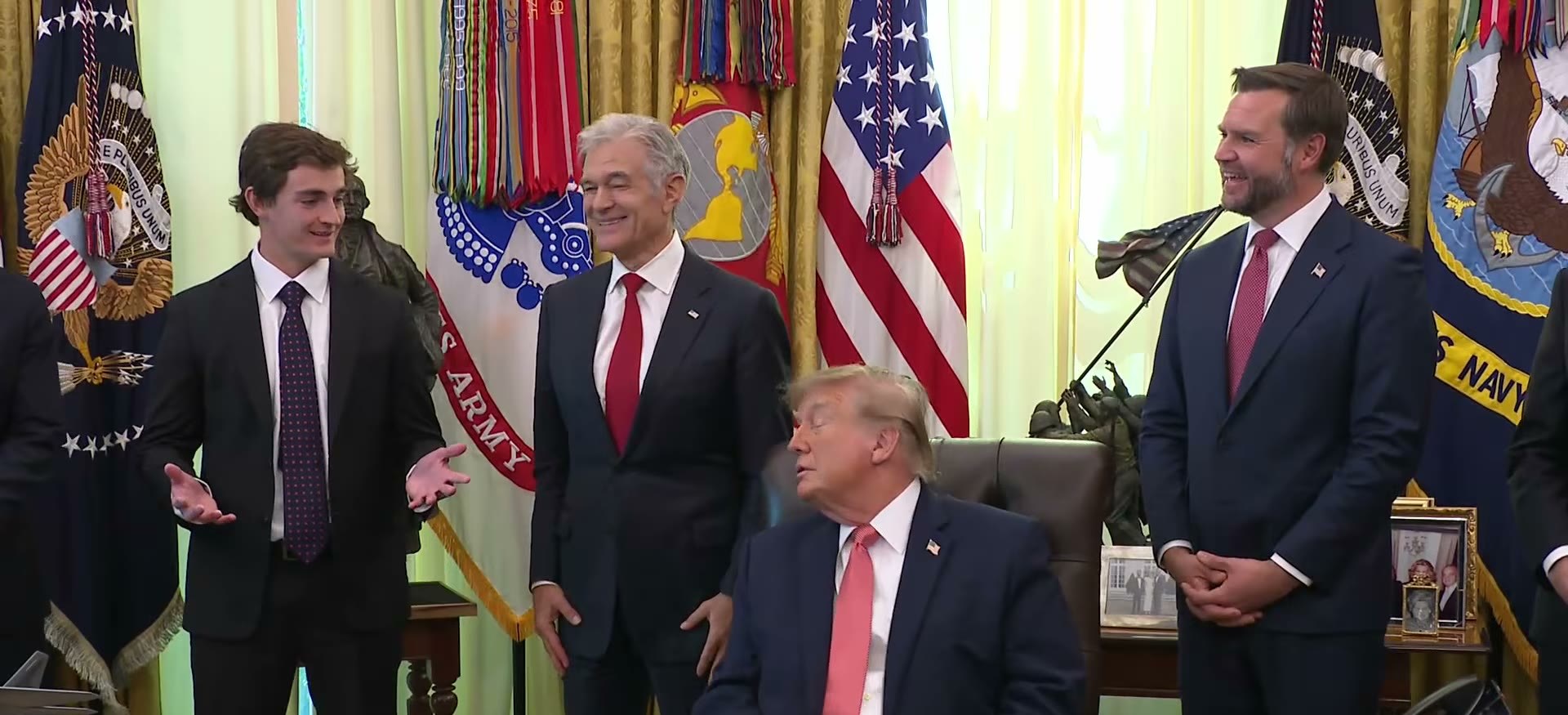
The program's first beneficiary was standing in the room. Nick Shirley, the 24-year-old independent journalist whose December video alleging fraud at Somali-run childcare centers in Minneapolis became a national story, received the program's first payout — $10,000. "Nick is going to get a financial reward for doing so," Vance said. "I know that's not why he did it." Shirley told the room that after his video, "instead of the mainstream media investigating the fraud, they investigated me," and urged viewers to expose fraud in their own communities: "When you expose fraud, you help save America."
Trump used the occasion to attack Minnesota's leadership in terms that go well beyond anything prosecutors have alleged against them. "The governor is 100 percent guilty. He's 100 percent guilty. He's a fraud. He's a thief. He's a crook, and he's getting away by just getting out of office," Trump said of Gov. Tim Walz, who has dropped his bid for a third term amid the scandal. Of Rep. Ilhan Omar, he said: "She knew. They all knew." Neither Walz nor Omar has been charged with any crime in connection with the fraud cases, and both have denied wrongdoing; the president offered no evidence for the accusation in the room. The underlying cases are real but narrower than the rhetoric: Trump cited 115 arrests and charges in Minnesota since he took office and 75 convictions, and one woman who appeared in Shirley's video, Fahima Mahamud, pleaded guilty in July to wire fraud and conspiracy to defraud the United States over inflated meal-reimbursement claims, according to the Justice Department. State inspectors who visited the childcare centers in Shirley's video said at the time that the centers were operating as expected, and some of his broader allegations were challenged by Minnesota news outlets — a dispute Trump and Shirley both returned to on Tuesday, with Shirley arguing that a California privacy law, AB 2624, which critics have nicknamed the "Stop Nick Shirley Act," was written to stop his reporting. The law, signed by Gov. Gavin Newsom in August and effective in October 2027, extends confidentiality protections to immigration-services workers; Newsom's office says it is an anti-doxxing measure with nothing to do with Shirley, who has sued to block it on First Amendment grounds.
The task force scoreboard — and two new asks of Congress
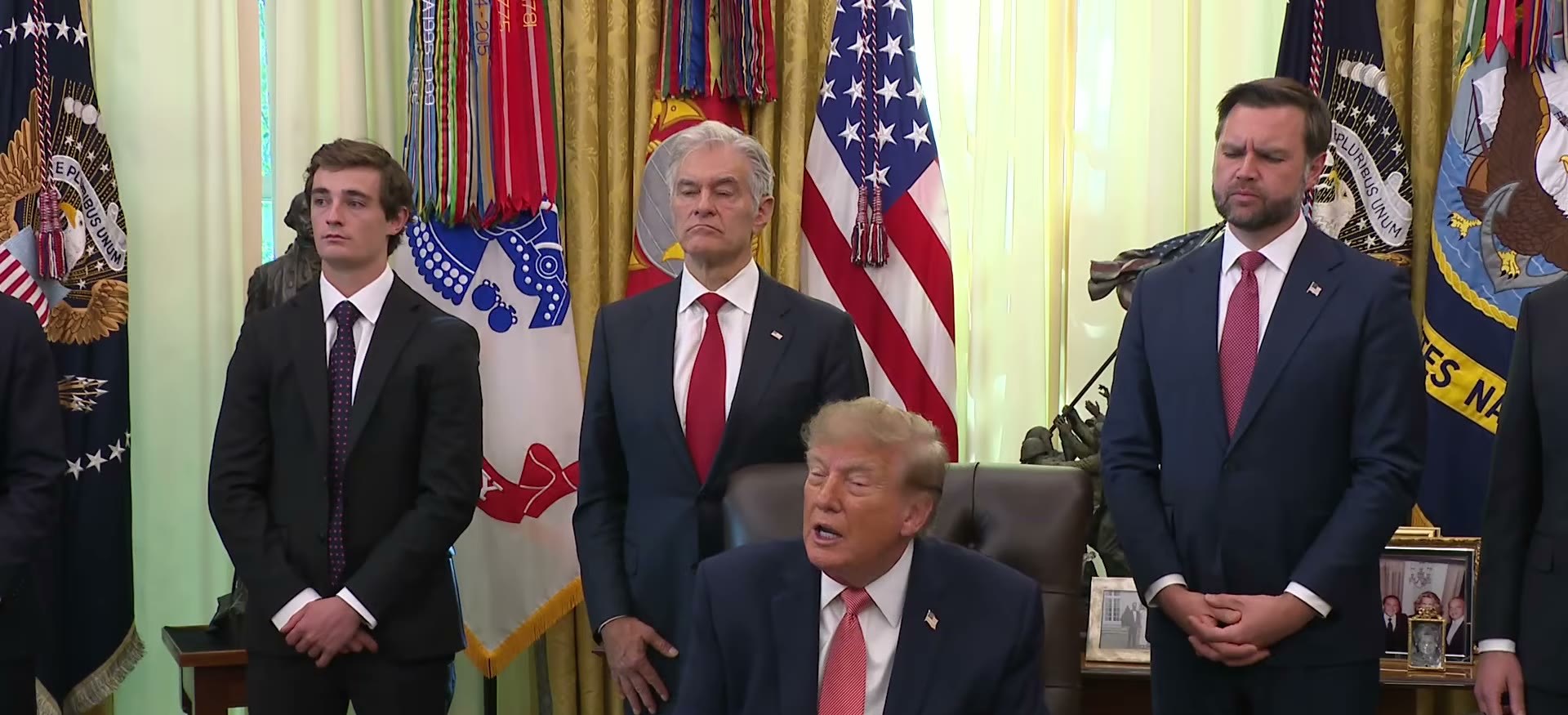
The event doubled as a progress report from the Task Force to Eliminate Fraud, which Trump created in March and put Vance in charge of. Ferguson said the Justice Department's new National Fraud Division, led by Colin McDonald, had filed a civil forfeiture complaint this week to seize half a city block in Minneapolis allegedly bought with food-stamp money. McDonald put the administration's central claim at "upwards of $800 billion of taxpayer money that is stolen by fraudsters" a year — an administration figure, not an audited one. Dr. Mehmet Oz, who runs the Centers for Medicare and Medicaid Services, said his agency had deferred $500 million in payments to Minnesota after finding a third of providers in 14 high-risk categories could not be validated, and announced a further deferral of $1.2 billion in federal Medicaid payments to California on Tuesday, aimed at personal-care services he said had grown 24 percent in three years. The task force's work so far also includes last month's removal of roughly 760,000 Affordable Care Act enrollees the administration said were fraudulently enrolled, and a Labor Department investigation into alleged visa fraud at nine universities.
Ferguson also laid out two pieces of legislation the president wants from Congress: mandatory minimum prison sentences for everyone convicted of benefits fraud — "it shouldn't be up to a district judge to decide whether the fraud is bad enough" — and civil liability for state officials who knew about fraud in their states and did nothing. Both would have to pass a Congress that returns, after the midterm elections, in a matter of weeks.
Why the 1 percent matters: the False Claims Act question
The sharpest exchange of the afternoon came when a reporter pointed out that the government already pays whistleblowers far more than 1 percent: under the False Claims Act, on the books since 1863, whistleblowers who sue on the government's behalf keep between 15 and 30 percent of what is recovered. "That's actually worse," the reporter said of the 1 percent. Trump's answer was about scale: "You could have stolen $2 trillion, or whatever the ultimate number is going to be, and at 1 percent people will make millions and millions of dollars for turning in what actually is a somewhat routine crime."
Vance went further. "I think that's a fundamentally dishonest question, because over 99 percent of the fraud that we're finding in the federal government isn't covered by the False Claims Act," he said. "What the president is saying is he wants all fraud to be the sort of thing where, if you find it, if you uncover it, you should be able to benefit — not just the very narrow slice that's covered by the False Claims Act."
That is the program's real theory, and its real legal problem. The False Claims Act covers fraud against government programs by people billing the government; much of what the task force describes — benefits claimed by ineligible individuals, identity-based enrollment fraud, theft inside state-administered programs — sits outside it, and the IRS's separate whistleblower program, which pays 15 to 30 percent of recouped tax, covers only tax. A general 1-percent-on-recovery bounty would reach further. But paying it raises questions the Oval Office remarks did not answer: what legal authority and appropriation fund an uncapped commission, how a tip is proven to have caused a recovery, what stops fabricated or malicious tips when the standard is recovery rather than conviction, and how a president acting as personal "arbitrator" of payouts fits the Justice Department's written criteria. Supporters of the design argue that is precisely the point — that fraud at the scale the administration alleges will only be surfaced by paying the people positioned to see it, and that Shirley's video did more than years of inspector-general reports. Critics of bounty programs generally warn that paying for tips rewards volume over accuracy and can taint witnesses in the very prosecutions the $30,000 tier is meant to produce. The administration has promised speed — "we're going to make it very easy and very quick," Ferguson said — and the first test will be whether the written guidance catches up with the president's arithmetic.
The wider news from the same hour
As Oval Office announcements do, the event ranged well past its subject. On Russia, Trump said he has spoken directly to President Vladimir Putin about freeing Stephen Hubbard, the American teacher held in Russia: "I've been talking to President Putin about Mr. Hubbard. I've been talking to him at length. I've asked him to release him. I'll see what happens." Pressed on the Ukraine peace process after talks in Oslo and ahead of envoy Steve Witkoff's trip to Russia, he said Ukraine "has to want to settle this war," repeated that Russia "just keeps grinding forward," and said Presidents Putin and Zelenskyy would not necessarily have to be in the same room to sign an agreement. On trade, he said a deal with India is "pretty close." On France's unrest, he called it "a full-on revolution," blamed immigration, said he had not decided whether to endorse Marine Le Pen — "I haven't met her, but I thought she was badly treated" — and warned Europe that "there won't be a Europe left" unless it removes people. On Iran and fuel prices, he said oil would "drop like a rock" once "that war" ends, calling high prices "a small price to pay for not letting Iran have a nuclear weapon." Asked whether he would endorse Vance for 2028, as Vance had suggested in an interview, Trump declined: "He's a very talented person... We have to get through the midterms." And he said he would use the pardon power to protect people like Shirley if a future Democratic administration targeted them: "If I have to use it to protect people like Nick, I'll use it very openly, very gladly."
What happens next
Three things will decide whether WHIP becomes a durable program or a one-afternoon headline. First, the paperwork: the Justice Department's written terms — up to $30,000, charges required, defined subject areas — and the president's spoken terms — 1 percent, uncapped, recovery-based, personally arbitrated — cannot both be the program, and the reconciliation will likely come in updated guidance on the reporting portal at fraud.gov and america.gov. Second, the money: the pre-briefed $25 million fund covers a lot of $30,000 bounties and very little 1-percent commission on a single large recovery, so the first big claim will force the funding question into the open. Third, the politics: the announcement landed exactly two weeks before the midterm elections, in a campaign season where the administration has made fraud its domestic centerpiece — Trump left the Oval Office for a rally in North Carolina the same evening — and where Democrats will argue the program pays bounties first and writes rules later. The tips, meanwhile, are already being invited. "If you want to help us stop it," Vance said, "you get to share in the rewards now."
Sources
Official White House video and Signal Post News transcript of the Oval Office announcement, October 20, 2026; Associated Press (Darlene Superville), advance report on the Fraud Whistleblower Incentive Program, October 20, 2026; Fox News, first report on the program and post-event coverage, October 20, 2026; Washington Examiner, "Trump announces fraud whistleblower program with 1% commission and awards Nick Shirley its first payout," October 20, 2026; New York Post, post-event reports, October 20, 2026; USA Today, "Trump offering $30,000 ahead of election for fraud tips that check out," October 20, 2026; Wall Street Journal, "Trump to Offer Up to $30,000 for Tips That Expose Government Fraud," October 20, 2026; Justice Department program guidance via America.gov/fraud and the Floridian Press report on the DOJ Whistleblower Rewards Program, October 20, 2026; California AB 2624 (2026) and America First Legal, Shirley v. Bonta filing, September 2026.