War · Gulf Security · Syria · Saudi Arabia
Syria Mecca defence pact talks are under way, Foreign Minister Asaad al-Shaibani said in Manama, as the Saudi-Türkiye-Pakistan alliance opens its doors.
Syria is formally evaluating whether to join the Mecca Joint Defence Agreement, the mutual-defence pact that binds Saudi Arabia, Türkiye and Pakistan, Foreign Minister Asaad al-Shaibani said on Saturday at the IISS Manama Dialogue in Bahrain — the clearest signal yet that the alliance built around the war in Yemen could soon gain a fourth member.
Track it live: Syria conflict map · Live Global War Tracker
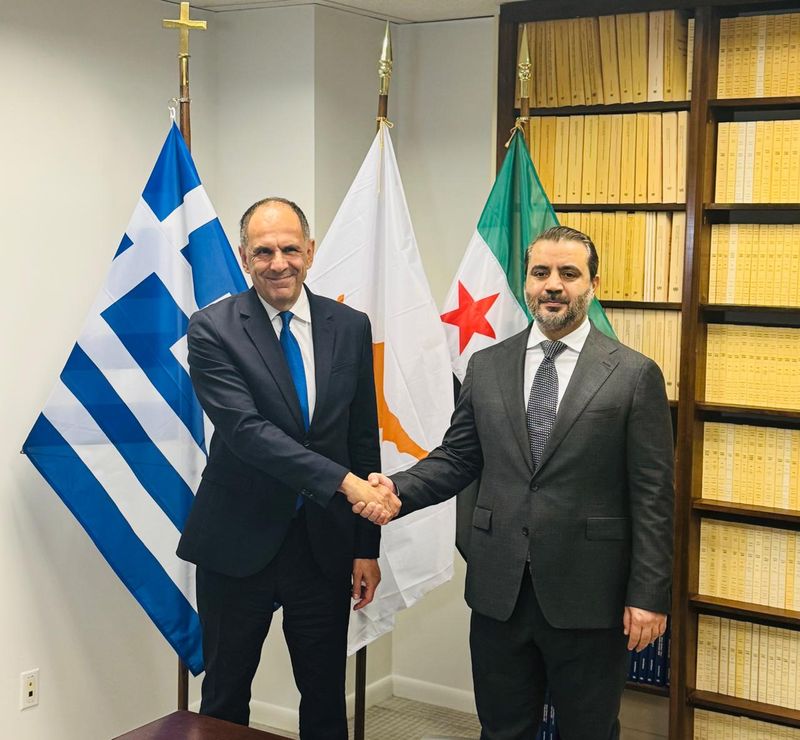
'Discussions are under way'
“Discussions are currently underway to evaluate Syria’s entry into the Mecca alliance,” al-Shaibani told the conference, according to Al Jazeera and the New York Times. He framed Gulf security as a Syrian interest in its own right, saying Damascus considers defending the Arab Gulf states a vital component of its own national security and that “Syria will stand alongside all Gulf states” against what he described as cross-border militias. He also condemned missile and drone attacks on regional states and pledged support for Bahrain, Saudi Arabia, Qatar, Oman and Jordan. No formal application has been submitted and no timetable for a decision was announced.
The timing was pointed. On the same Saturday, the Saudi-led coalition said it had intercepted three drones in Saudi airspace, one of them near the capital, Riyadh — the latest in the campaign of Houthi missile and drone attacks from Yemen that gave the pact its purpose. The United Nations said on Friday that renewed fighting in Yemen has displaced more than 290,000 people since August, on top of 5.2 million already displaced.
What the Mecca Joint Defence Agreement actually is
The pact was signed in Mecca on August 7 by Saudi Crown Prince Mohammed bin Salman, Turkish President Recep Tayyip Erdoğan and Pakistani Prime Minister Shehbaz Sharif. Its central clause mirrors NATO’s Article 5: an armed attack on one member is to be treated as an attack on all, with the members invoking collective self-defence under Article 51 of the UN Charter. It also provides for intelligence sharing, joint exercises, counterterrorism coordination and defence-industry cooperation. A Strategic Political and Defence Committee oversees the alliance from a permanent secretariat in Riyadh, whose first secretary-general is Pakistan’s retired Lt. Gen. Nauman Mahmood. The arrangement builds on the bilateral mutual defence agreement Saudi Arabia and Pakistan signed in September 2025, and membership is open to other states with the unanimous approval of the three founders.
Ratification is at different speeds: Saudi Arabia and Pakistan have completed theirs, while Türkiye’s is still moving through parliament, where the foreign affairs committee approved the ratification bill this week. In October the three founders announced they had begun implementing their commitments, preparing for the rapid deployment of forces and capabilities to Saudi Arabia as Houthi attacks intensified — work the alliance’s Riyadh committee has been coordinating since. Turkish officials have been careful to add that Ankara’s support would not extend to deploying Turkish troops to fight in Yemen or to attack the Houthis directly.
A courtship that has been building since August
Saturday’s statement was the third step in a visible sequence. Damascus first acknowledged its interest in late August, when al-Shaibani visited Islamabad — the first trip to Pakistan by a Syrian foreign minister in years — and said Syria had reviewed the agreement but had made no decision. On October 6, President Ahmed al-Sharaa travelled to Riyadh to meet Crown Prince Mohammed bin Salman; the Saudi Press Agency said the talks covered bilateral ties and regional security, and Syria’s state agency SANA said reconstruction featured prominently. Syrian officials have since denied reports that Riyadh asked Damascus to deploy troops, insisting any cooperation would run through established bilateral channels. Then, on Friday, Pakistan’s military spokesman, Lt. Gen. Ahmed Sharif Chaudhry, told Reuters the pact was open to newcomers: “There is no bar on anybody joining or not joining. Anyone who has a shared vision of collective deterrence and regional peace, why not? Everyone is most welcome.” Bangladesh has also expressed interest, and Egypt has been identified as another potential participant.
The Israel dimension al-Shaibani put on the record
Al-Shaibani used the same Manama platform to press Syria’s other security grievance. He said Syrian territory has been subjected to more than a thousand Israeli attacks in less than two years, killing dozens, and demanded a return to the 1974 disengagement agreement between Syria and Israel. The figure is Damascus’s own count and Israel does not publish a matching tally; Israel has said its operations in Syria target weapons transfers and hostile build-up near its border. The juxtaposition mattered: in a single appearance, Syria’s foreign minister offered solidarity to the Gulf while accusing a US partner of violating Syrian sovereignty — a reminder that any Syrian accession would import the pact’s hardest unresolved question, which is what collective defence would mean on Syria’s border with Israel.
Why this matters
Alliances are usually judged by their membership arithmetic, and the arithmetic here is shifting. A three-member pact organised around one war — the Houthi campaign against Saudi Arabia — is testing whether it can become the standing security architecture of a wider region. Syria’s entry would extend the pact’s geography from the Red Sea to the Levant, put a founding member’s neighbour inside the tent, and give the alliance a member whose territory is itself struck regularly by a state outside it. For Damascus, the attraction runs the other way: membership would convert Saudi goodwill — Riyadh has been the Sharaa government’s most important Arab backer since the fall of Bashar al-Assad in December 2024 — into a formal security relationship, and would do so at the moment Syria is rebuilding an army from the remnants of a civil war.
Who gains and who is exposed is not symmetrical. Saudi Arabia gains depth: another partner publicly committed to its defence while drones are intercepted over its capital. Pakistan gains relevance as the alliance’s broker and secretariat host. Türkiye gains a framework in which its Syria policy — its most sensitive foreign file — is multilateral rather than bilateral. Syria gains a deterrent umbrella it cannot yet provide for itself. The exposure sits with the same parties: a collective-defence clause is easy to sign in a conference hall in Manama and hard to honour on a bad night in Riyadh, Taiz or Damascus, and every new member multiplies the scenarios in which the clause could be invoked by someone else’s war.
The numbers frame the test. The pact’s founding war has displaced 290,000 Yemenis in three months and drawn British air-defence deployments to Saudi Arabia; Syria says it has absorbed more than 1,000 Israeli strikes in under two years. A mutual-defence commitment written for the first set of figures will inevitably be read against the second.
What happens next
Three scenarios follow from Saturday’s statement. In the first, evaluation becomes application: Damascus formally asks to join, the three founders approve unanimously, and Syria signs an accession protocol — most likely with language, similar to Türkiye’s public caveats, limiting any Syrian role in Yemen. In the second, talks stall on exactly that question of scope, and Syria settles for the bilateral Saudi channel it already has, using the Manama statement as leverage rather than intent. In the third, the file is overtaken by events — a major Houthi strike on Saudi Arabia or a new Israeli campaign in Syria forces every capital to define, in public and under pressure, what the pact actually obliges. Watch three signals: whether the founders’ Strategic Political and Defence Committee names Syria in its next Riyadh communiqué, whether Türkiye completes ratification (which would free Ankara to sponsor an accession), and whether Damascus repeats the ‘evaluating’ formula or replaces it with the language of application.
Related coverage
- Inside the Mecca Defence Pact: Turkey, Saudi Arabia and Pakistan Hold Their Biggest Test Yet in Riyadh
- Turkey Prepares a Parliament Mandate to Send Military Personnel to Saudi Arabia Under the Mecca Defence Pact
- Fighting Rages in Yemen’s Taiz as UN Says Nearly 260,000 Have Fled Their Homes Since August
Sources
Sources: Al Jazeera, ‘Syria considering entry into Mecca defence pact, says foreign minister’ (October 31, 2026); The New York Times via Yemen Monitor (October 31, 2026); Reuters interview with Pakistan ISPR Director-General Lt. Gen. Ahmed Sharif Chaudhry (October 30, 2026); Saudi Press Agency and SANA on the October 6, 2026 al-Sharaa–Mohammed bin Salman meeting; UN OCHA Yemen displacement update (October 30, 2026).
Photos: Ministry of Foreign Affairs of Greece, Zairon (CC BY-SA) and Ben Dance / FCDO, via Wikimedia Commons, as credited in the captions. All three are file photographs, not photographs of Saturday’s Manama session.