stock market today
Stocks recovered from their morning lows but finished lower after a surge in Treasury yields challenged record valuations, raised borrowing costs and sharpened the Federal Reserve's next decision.
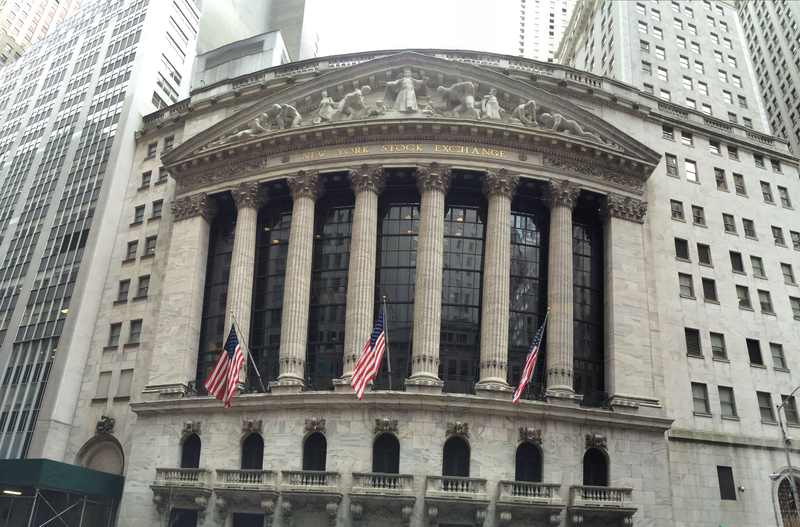
Stock market today: The Dow Jones Industrial Average closed at 51,179.87, down 341.41 points, or 0.66%, after falling more than 550 points and briefly slipping below 51,000. The S&P 500 and Nasdaq Composite each lost 0.22%, retreating from record territory as the 10-year Treasury yield surged to 5.361% — its highest level since January 2002 — before a strong government debt auction pulled the yield back toward 5.27%.
The late recovery mattered, but it did not erase the message from the bond market. Investors are again being offered more than 5% on benchmark government debt, while households face mortgage rates around 7.52% and companies must refinance at much higher costs. Wednesday's pullback was modest at the index level; underneath it, small companies, homebuilders and other rate-sensitive groups absorbed much larger losses.
The numbers: Dow Jones today, S&P 500 today and Nasdaq today
Major indexes close off their lows
The Dow Jones today finished at 51,179.87, down 341.41 points, or 0.66%. It touched 50,917 at the session low, more than 550 points below Tuesday's close, before buyers returned in the afternoon. Caterpillar's roughly 6% decline exerted the heaviest pressure on the price-weighted index.
The S&P 500 today closed at 7,801.77, down 17.16 points, or 0.22%. That put the broad benchmark just below Tuesday's record close of 7,818.93. It had fallen as far as 7,763 in the morning, so the final loss concealed a wider intraday swing.
The Nasdaq today ended at 27,538.69, down 61.20 points, or 0.22%. The technology-heavy index was down about 1% at its morning low of 27,341 before recovering. Apple rose about 0.9% and Micron gained roughly 4%, helping blunt the pressure from higher bond yields.
The Russell 2000 fell 1.3% to 2,793.20. It now sits roughly 9% below its earlier record high, close to the conventional 10% threshold for a Russell 2000 correction. That gap between small caps and the biggest indexes was one of the clearest signals of the day: investors did not abandon equities altogether, but they demanded more protection from companies most exposed to financing costs.
Why this matters: a 5.27% risk-free alternative reprices everything
The 10-year Treasury yield becomes the market's measuring stick
A stock's price reflects the value investors place on profits expected in the future. When the return available on Treasury debt rises, those future profits are worth less in today's dollars, all else equal. A 10-year Treasury yield above 5% also gives investors a credible alternative to stocks: they can earn a high nominal return from debt backed by the U.S. government without accepting the same earnings risk.
That does not mean every stock must fall whenever yields rise. Strong earnings can still outweigh a higher discount rate, and companies with abundant cash or durable pricing power can absorb expensive credit better than highly indebted rivals. But the hurdle rises. A richly valued growth company must now persuade investors that its future profit growth is worth giving up a Treasury yield around 5.27%.
The speed of Wednesday's move intensified the pressure. The yield touched 5.361%, a 24-year high, before demand at a $39 billion Treasury auction helped bring it back to roughly 5.276% by the close. The 30-year yield traded in a range around 5.66% to 5.724%, while the two-year yield was near 4.762%. The afternoon reversal showed that buyers still appear when government debt becomes cheap enough, but it also left the entire rate structure at levels restrictive enough to affect mortgages, business loans and stock valuations.

Why small companies and homebuilders felt more pain
Small companies typically depend more on bank loans, floating-rate credit and periodic refinancing than the largest corporations. They also tend to have less cash and narrower margins. That makes each increase in market rates more immediate, which helps explain why the Russell 2000 lost about six times as much as the S&P 500 on a percentage basis.
Housing is even more directly linked to long-term yields. The SPDR S&P Homebuilders ETF fell 2.6% and is down more than 8% for the year as a 30-year mortgage rate of 7.52% weighs on affordability. Higher borrowing costs can reduce buyer demand, slow new construction and pressure companies across the chain from builders to materials suppliers and brokers.
What the Fed divide means for a possible rate hike
Most officials saw another increase, but not for the same reason
Minutes from the Federal Reserve's September 15–16 meeting, released Wednesday, showed that most policymakers expected another increase in the federal funds rate would probably be appropriate before year-end. The important detail is that officials remained divided over the logic and timing. Some focused on inflation risks and the danger of easing too soon; others were more concerned that additional tightening could overcorrect as previous increases continue working through the economy.
That split complicates the usual market shorthand. A Fed minutes rate hike signal is not the same as a guaranteed decision. Officials will enter the October 28–29 meeting with new inflation, employment and financial-conditions data, plus a bond market that has already tightened credit on its own. If long-term yields stay near multidecade highs, the market itself may do part of the Fed's work. If yields retreat while inflation remains stubborn, the argument for another policy-rate increase strengthens.
The distinction matters for households and investors because the federal funds rate influences short-term borrowing and deposit rates, while mortgages and stock valuations respond more directly to longer-term Treasury yields. The Fed could pause and still leave financial conditions tight. It could also raise rates and see long yields fall if investors interpret the move as restoring inflation credibility.
Winners and losers in Wednesday's stock market news
Biotech, selected technology and defensive growth held up
Moderna gained about 5%, Micron rose 4%, Eli Lilly climbed 2.7% and AbbVie added roughly 1.75%. Apple advanced 0.9%. Constellation Energy slipped about 0.3% but retained much of its recent strength, showing relative resilience as investors continued to favor businesses with visible demand or company-specific catalysts.
Those gains do not amount to a single sector-wide verdict. They show that a rising-rate session can still reward companies with compelling earnings momentum, product news or defensive cash flows. Micron's move also helped the Nasdaq recover from its morning decline even as the broader valuation backdrop became less forgiving.
Industrials, small caps, homebuilders and speculative names were hit
Caterpillar fell about 6%, magnifying the Dow's loss. Webull, trading under BULL, dropped roughly 20% after a House report focused new attention on China-related risks. SpaceX lost about 2.6% as investors weighed reports of a $40 billion financing plan tied to Nvidia chips. The homebuilder ETF's 2.6% slide captured the direct pressure from higher mortgage rates.
The losers share a common vulnerability: either financing conditions matter heavily to the business, or the stock's price depends on investors assigning a large value to future growth. When safe yields jump, the market becomes less patient with both.
Oil, gold, bitcoin and the dollar add crosscurrents
Brent crude held around $101 to $102 a barrel as attacks around the Strait of Hormuz kept a geopolitical premium in the market. West Texas Intermediate eased about 0.6% to 1% toward $89. Gold fell roughly 1% to about $4,145 an ounce, while bitcoin traded near $83,600. The U.S. dollar remained near multiyear highs and the euro hovered around a 17-month low.
Those moves matter because expensive oil can keep inflation pressure alive, a strong dollar can reduce the value of overseas earnings for U.S. multinationals, and weakness in gold despite market stress suggests that high real yields and dollar strength are competing with demand for traditional havens.
What it means for your money
For a 401(k), one down day matters less than the rate regime
A 0.22% decline in the S&P 500 or Nasdaq is not, by itself, a reason for a long-term investor to overhaul a retirement plan. The more important development is the changed trade-off between stocks and high-quality bonds. After years when yields were near zero, bonds can again contribute meaningful income to a diversified portfolio. At the same time, stocks face a higher valuation hurdle and may react more sharply to inflation or Fed surprises.
Age, time horizon and risk tolerance still matter more than a single closing bell. Workers decades from retirement generally have more time to absorb volatility. People near withdrawals may care more about the sequence of returns and the stability that cash or high-quality bonds can provide. The useful question is not whether Wednesday was the start of a crash; it is whether a portfolio built for lower rates still matches the investor's actual timeline.
Mortgage rates today change the housing math immediately
At 7.52%, a 30-year fixed mortgage produces a much larger monthly payment than the same loan at 6% or 5%. That can reduce the price a buyer can afford even if home values do not fall. Existing owners with much lower fixed rates may be reluctant to sell, limiting supply and making the market harder for buyers in a different way.
For shoppers, the headline rate is a benchmark rather than a universal quote. Credit score, down payment, points, loan type and lender fees can materially change the offer. Comparing annual percentage rates and total closing costs is more informative than comparing advertised rates alone.
Savers finally have real competition for cash
Higher Treasury yields can benefit savers, but the 10-year yield is not the rate on a checking or savings account. Bank deposits, certificates of deposit, Treasury bills and money-market funds reset on different schedules and carry different liquidity, tax and insurance features. Some banks may keep deposit rates low even when market yields rise, so the spread between an idle account and a competitive cash option can become substantial.
The same rate environment is painful for borrowers and useful for savers. That is why the day's market story cannot be reduced to stocks falling: it is a transfer in bargaining power from borrowers toward lenders and cash holders.
What happens next
Scenario one: yields keep climbing
If the 10-year yield moves decisively above Wednesday's 5.361% peak, the pressure would likely remain greatest on small caps, homebuilders, real estate and highly valued growth stocks. A sustained move could also tighten lending standards and slow investment. The risk is not simply another bad day on Wall Street; it is that expensive capital gradually weakens hiring and demand.
Scenario two: the auction reversal becomes a ceiling
If buyers continue stepping in near the highs and inflation data cool, Wednesday's late recovery could prove more important than the morning spike. Stable or lower yields would ease the discount-rate pressure on stocks and give rate-sensitive sectors room to rebound. The S&P 500's ability to hold near Tuesday's record despite the shock suggests investors have not abandoned the bull case.
Three dates and risks to watch
The next major checkpoint is the Fed's October 28–29 meeting. Before then, inflation and labor-market releases will test whether another increase is necessary. Treasury auctions will show whether investors still demand unusually high yields to absorb government borrowing. Oil remains the wildcard: further disruption around Hormuz could lift energy prices, complicate the inflation picture and weaken consumers at the same time.
For the next stock market today close, watch the 10-year yield first, then the Russell 2000 and homebuilders. If yields rise while those groups stabilize, risk appetite may be improving. If yields rise and the gap widens again, the indexes could be understating the strain underneath the market.
Sources
- The Wall Street Journal — index closes, intraday moves and Treasury-yield context.
- Reuters — market drivers, oil, currencies and the Federal Reserve outlook.
- Reuters — Treasury-yield highs and the long-bond move.
- Investor's Business Daily — closing levels, volume, sector and company moves.
- Investopedia — Treasury auction, assets and sector performance.
Reporting note: Market prices and yields are the October 7, 2026 close or late-session readings cited by the sources above. Percentages are rounded where noted. Analysis and framing are by Signal Post News.