What happened
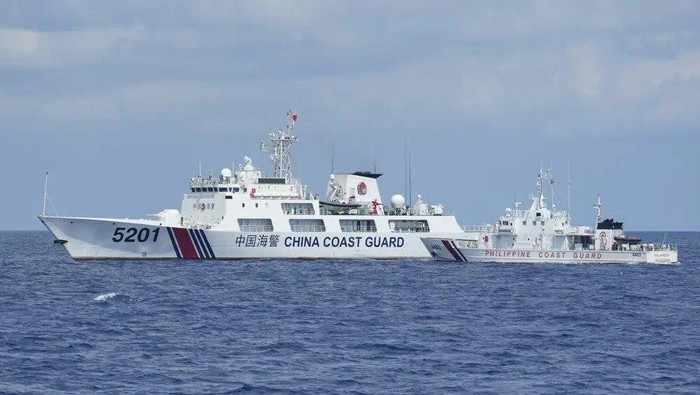
According to the Philippine Coast Guard, the Bureau of Fisheries and Aquatic Resources vessel BRP Datu Magat Salamat was on a mission to distribute fuel assistance to Filipino fishermen about 54 nautical miles off the coast of Palawan province on Friday morning, September 18, when a China Coast Guard vessel carried out a series of dangerous maneuvers and made contact with the Philippine ship.
"The China Coast Guard deliberately rammed a civilian government vessel on a humanitarian and livelihood mission," the Philippine Coast Guard said in a statement. Video released by the Philippine side showed crew members shouting "brace for impact!" moments before the collision, which took place at 11:13 a.m. local time. Photographs taken afterward showed bent and detached railings, deformed metal supports and debris scattered across the deck of the Philippine vessel's starboard side. No injuries were reported. Philippine Coast Guard Commandant Adm. Ronnie Gil Gavan ordered additional ships and aircraft to the area to check on the crew and ensure the vessel could continue safely.
China's account differs fundamentally. The China Coast Guard said it was carrying out law enforcement operations in waters near Sabina Shoal when the Philippine vessel "disregarded repeated solemn warnings, deliberately altered its course and suddenly accelerated to cut across the bow of our vessel." Beijing said its cutter had operated professionally and placed the blame for the collision squarely on the Philippine side.
A pattern, not an incident
Friday's collision was the latest in a series of confrontations that have grown steadily more physical through 2026. In July, Manila accused Beijing of firing water cannon at government vessels near Scarborough Shoal and of striking a Philippine Navy staff member on the head with a wooden baton during an encounter at Second Thomas Shoal — the latter an unusually personal form of violence in a dispute usually fought with hulls and hoses.
The ramming also followed a remarkable diplomatic episode in Seoul. On September 8, as Philippine Defense Secretary Gilberto Teodoro Jr. was delivering a speech at the Seoul Defense Dialogue discussing the 2016 Hague arbitral ruling, a note from the military attaché at the Chinese embassy in Seoul was passed to him instructing him to stop speaking. Teodoro instead read the Chinese message aloud to his audience, calling it "actual coercion, bullying and aggression." The episode prompted calls at home for Teodoro to seek higher office, and it followed China's decision in June to sanction Teodoro, his wife and his child — barring them from travel to China or dealings with Chinese organizations.
How we got here
The South China Sea dispute is among the world's most intractable. China claims the vast majority of the sea within its so-called nine-dash line, a claim that overlaps with the exclusive economic zones of the Philippines, Vietnam, Malaysia, Brunei and Taiwan. In 2016, the Permanent Court of Arbitration in The Hague ruled that Beijing's claims to historic rights within the nine-dash line had no legal basis under the UN Convention on the Law of the Sea. China rejected the ruling and has continued to build, patrol and enforce its presence across the disputed features.
Sabina Shoal, near where Friday's collision occurred, was the site of a tense months-long standoff in 2024, when the Philippines anchored the BRP Teresa Magbanua there to monitor Chinese activity. The shoal sits well within the Philippines' 200-nautical-mile exclusive economic zone — 54 nautical miles from Palawan is not a gray area under UNCLOS — but China treats its presence there as routine law enforcement in its own claimed waters. The two legal universes do not intersect, which is why the encounters keep happening.
Under President Ferdinand Marcos Jr., the Philippines has pursued a "transparency strategy": publicizing each encounter with video and photographs, naming Chinese vessels, and inviting international scrutiny. Friday's release of the "brace for impact" video is that strategy working as designed — it converts a distant maritime shoving match into visible evidence for audiences in Washington, Tokyo, Canberra and Brussels.
Why this matters
A ramming is qualitatively different from a water-cannoning. Water cannon damage equipment and intimidate crews; a hull-to-hull collision between steel vessels risks lives, even when — as on Friday — no one is hurt. The progression from hoses to batons to ramming within a single year describes an escalation ladder being climbed one rung at a time, with each new tactic establishing a precedent for the next encounter.
The target matters too: the BRP Datu Magat Salamat is a civilian fisheries support vessel, not a warship — and Manila's choice to frame the mission as humanitarian was deliberate, since a fuel-delivery boat is harder to justify ramming than a naval patrol.
Who gains, who loses
Beijing's calculation appears to be that sustained physical pressure will eventually exhaust Manila's willingness to contest the waters — that the Philippines will quietly reduce its presence rather than absorb an endless series of collisions. The risk in that calculation is that each incident strengthens the Philippine public's support for confrontation, deepens US-Philippine military cooperation, and pushes Southeast Asian neighbors toward harder positions.
Manila gains international sympathy and alliance solidarity with every documented incident, but pays in hull damage, crew risk and the slow erosion of its practical control over its own claimed waters. The fishermen lose most directly: their fishing grounds become a geopolitical theater.
The United States, which was not party to Friday's encounter, is nevertheless central to its meaning. Washington has repeatedly condemned Chinese coercion in the South China Sea and expanded joint patrols and base access with Manila. Each ramming tests the credibility of those commitments without quite triggering them — the gray zone working exactly as its practitioners intend.
What the numbers tell us
Fifty-four nautical miles: roughly 100 kilometers from the Palawan coast, about a quarter of the way to the 200-nautical-mile limit of the Philippine exclusive economic zone. There is no plausible reading of UNCLOS under which this location is anything but Philippine waters — which is why Manila's legal position is strong and why Beijing's operations there depend on rejecting the legal framework entirely rather than arguing within it.
The timeline of 2026 tells its own story: water cannon in July, a baton strike in July, an attempted silencing of a defense secretary's speech in September, and a ramming in September. Four qualitatively different forms of pressure in under three months. Whatever Beijing's long-term objective, the short-term tempo suggests a campaign being intensified, not a series of isolated misunderstandings — though China would dispute that characterization, as it disputes the Philippine account of each individual encounter.
What happens next
Watch for three things. First, whether the United States conducts a freedom-of-navigation operation or joint patrol near Sabina Shoal in the coming weeks; that would be the concrete measure of Washington's response. Second, whether ASEAN — whose members are divided on how to handle Beijing — manages any collective statement; silence would itself be a signal. Third, whether the physicality continues to escalate: the step beyond ramming a civilian vessel is difficult to contemplate, which is precisely why Friday's collision should be read as a warning about where the current trajectory leads if nothing changes.
Sources
Reuters, "China vessel rams and damages Philippine fishing boat, coast guard says," September 18, 2026: Read the report
USNI News, "VIDEO: China Coast Guard Rams Philippine Fisheries Vessel in South China Sea," September 18, 2026: Read the report
Defence Blog, "China Coast Guard rams Philippine ship near Palawan," September 2026: Read the report
World Ports Organization, "After Diplomatic Dustup, China Coast Guard Rams a Philippine Patrol Vessel," September 2026.