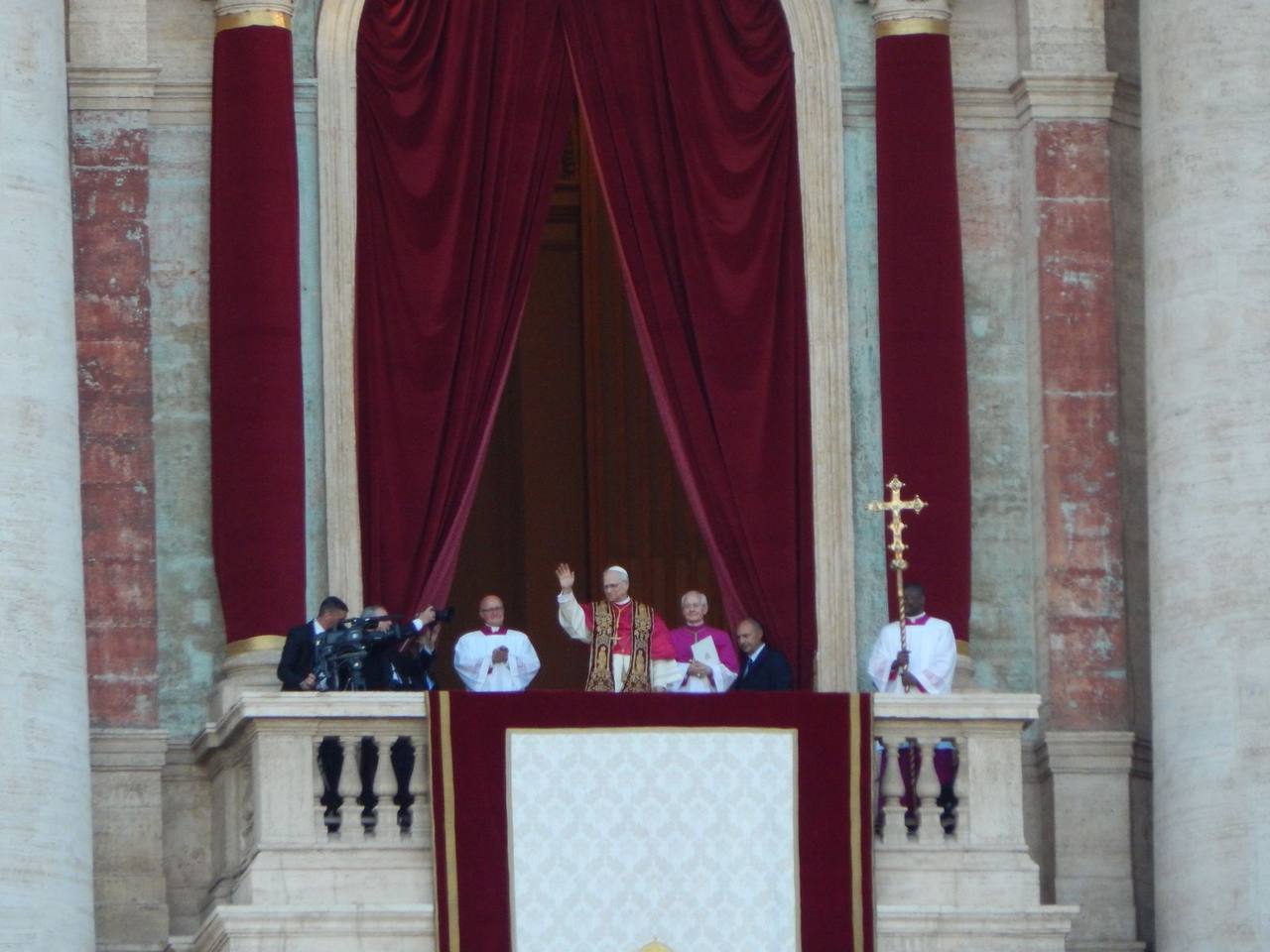
The Pope Leo XIV Paris Mass on Saturday was supposed to be big. Nobody — not the Archdiocese of Paris, not the Vatican, not the Paris police — expected it to be this big. Roughly 800,000 people packed the Champs-Élysées and Place de la Concorde for the open-air Mass, about 200,000 more than had registered in advance, forcing authorities to open two overflow sites as central Paris shut down to road traffic. It was the largest Catholic gathering France has seen in years, and the single clearest piece of evidence yet that the country's much-discussed Catholic revival is not a statistical mirage.
The numbers alone would make this a remarkable day. What makes it a significant one is the context: a officially secular republic, eighteen years without a papal visit, and a Church across Western Europe that has spent decades managing decline. On Saturday, the arithmetic of decline broke down in public.
A Saturday Paris had not seen in a generation
The day began with a two-kilometre (1.2-mile) popemobile parade down the Champs-Élysées, the American-born pope greeting flag-waving, cheering throngs on the grand boulevard leading to Place de la Concorde — the vast square at the heart of Paris, and a potent symbol of the French republic. People brought babies and young children from the crowd for Leo to bless as he rode slowly past. Despite a massive security operation that closed central Paris to traffic, the Associated Press reported a party-like atmosphere that drew people of multiple faiths and of no faith at all, the fervour spanning generations.
Leo delivered his homily in French — itself a statement, from a pope born Robert Francis Prevost in the United States and elected only last year. “Only God can fill the emptiness within us,” he told the crowd, according to Vatican News. To the young people present in enormous numbers, he declared: “You are today's church.” And in the line already travelling furthest, he asked the faithful not to keep their faith to themselves: “Let it overflow, so that those you meet may be refreshed and their thirst satisfied.” “From this beautiful city of Paris,” he added, “I pray fervently that the living water of the Holy Spirit may flow throughout France.”
The human texture of the day is worth recording. Sixteen-year-old Léa Mortier travelled from Lille with her mother and friends and waited more than five hours in the square for what she called a once-in-a-lifetime chance to attend Mass with the pope. Six young people with Down syndrome served at the altar. Leontine Joseph, 42, a fervent Catholic, came with two friends of Moroccan origin raised in Muslim culture — and told the AP the draw was broader than doctrine: “The message of Pope Leo goes well beyond Catholic people; he speaks about social justice, for example.” Parisians queued for hours, at times in drizzling rain, for a place in the square.
Saturday was the second day of a four-day apostolic journey — the first official papal visit to France in 18 years — built around themes of peace, artificial intelligence and Europe's future. It followed a Friday-night youth vigil that drew about 80,000, and it precedes a planned pilgrimage stop at the shrine in Lourdes.
Why this matters: the numbers behind France's Catholic revival
Set the figures side by side and the scale of the shift becomes unavoidable. Benedict XVI's 2008 Mass in Paris — the last papal visit — drew 250,000. Saturday drew roughly 800,000: more than triple, eighteen years on, in a country whose churches have supposedly been emptying the whole time. Turnout exceeded advance registrations by about 200,000, which means this was not a crowd manufactured by diocesan mailing lists; it was demand the organisers themselves failed to predict.
The Mass did not arrive from nowhere. About 13,000 adults were baptised in France this year, a record; some 21,000 people entered the Church at Easter; the Friday youth vigil pulled roughly 80,000. Each number on its own can be explained away. Together, and now crowned by 800,000 in the Concorde, they describe a genuine movement — one concentrated, strikingly, among the young. That is the detail that should unsettle every confident narrative about European secularisation: the revival is not the old faithful turning out once more, but a generation with no memory of a Catholic France choosing it anyway.
The honest caveat, and a serious analyst states it plainly: a single spectacular turnout is not the same as sustained weekly practice, and experts rightly caution that long-term Mass attendance in France remains far below its historic levels. A crowd of 800,000 on a sunny Saturday proves that the Church can still summon France; it does not prove France will come back next Sunday. What it does prove is that the ceiling on Catholic mobilisation in France is far higher than the secular consensus assumed — and that the Vatican, which has been quietly betting on France as the laboratory of a European Catholic revival, has read the moment better than its critics.
An American pope who speaks France's language
There is a particular irony in the instrument of this revival: an American pope, preaching in fluent French, to a republic that once exported revolution against the altar. Leo XIV's personal register — calm, listening, precise — keeps surfacing in the testimony of those who turned out. “He is a pope who is young, 71, and he moves the young people forward; he is calm, a good-listener and he has very precise ideas and is able to express them clearly and in an engaging way,” Paris native Philippe Baptiste told the National Catholic Reporter. “All the young people and the crowds here show that.”
The homily's governing metaphor — overflow, living water, wells and springs for others — is not decorative. It is the programme: a Church that grows by accompaniment rather than command, aimed explicitly at the young and the searching. Whether that programme can convert a Saturday crowd into Sunday parishes is the question the next decade will answer. But as a piece of public persuasion, delivered in the language of the republic to a crowd that included the non-believing curious, it was close to flawless.
The laïcité objection — and why the square was chosen anyway
Not everyone applauded. Holding a giant religious ceremony on Place de la Concorde — the square where the Revolution staged its guillotine, among the most freighted symbols of the French republic — drew criticism from defenders of the 1905 laïcité law separating church and state. The objection is principled and worth stating in full: the republic's symbolic heart should not be lent, even temporarily, to a religious confession.
The organisers' answer was practical rather than philosophical: the Concorde was the only site in central Paris large enough to hold the crowd they expected — and even it proved too small. And the day's own evidence complicates the “clerical takeover” narrative: the crowd was multi-generational, included people of other faiths and none, and conducted itself, by all reporting, as a festival rather than a demonstration. A republic confident in its secularism can survive 800,000 of its citizens praying in its grandest square; a republic frightened by it might ask itself why.
What happens next
The immediate future is liturgical: the Lourdes leg of the pilgrimage, where the emotional register will be quieter and the cameras fewer, and the remainder of a visit agenda built around peace and the governance of artificial intelligence. But the strategic consequences will outlast the trip. Bishops across Europe — many of them managing the same decades-long decline France was supposed to exemplify — will study Paris as a playbook: the youth vigil, the French-language preaching, the deliberate courting of the curious rather than the convinced.
And political France, whatever its professed secularism, will read the number. Eight hundred thousand citizens gathering peacefully in the capital is a datum no party, no government and no presidential hopeful — with the country's politics in visible flux — can afford to ignore. The Church has not re-entered French politics; but on Saturday, French politics was reminded that the Church never entirely left the French street. Whether this was a high-water mark or a turning point will be decided not in the Concorde but in the parishes, the baptismal fonts and the voting booths of the years ahead.
Sources and further reading
- Associated Press (Nicole Winfield, Samuel Petrequin, Sylvie Corbet and John Leicester), “Pope Leo draws 800,000 people to central Paris for open-air Mass on iconic square” — 990 The Answer, September 26, 2026
- New York Post, “Pope Leo draws record-breaking crowd of 800K and rallies young people for historic Paris Mass” (reporting via AFP/Getty Images, Vatican News and the National Catholic Reporter) — nypost.com, September 26, 2026
- OSV News, “Pope Leo draws 800,000 to Mass in the heart of Paris” — The Catholic Sun, September 26, 2026
- The Letters from Leo, “Drawing 800,000 in Paris, Pope Leo XIV Calls on the Church to ‘Make Room’ for Migrants and the Poor” (photographs: Sarah Meyssonnier / Reuters; Alberto Pizzoli / AFP) — thelettersfromleo.com, September 26, 2026
- Le Monde, “Pope Leo XIV's visit shines a light on France's Catholic revival and its divisions” — lemonde.fr, September 24, 2026
Reporting basis: Fixed September 26, 2026 snapshot. Attendance figures are Vatican and Archdiocese of Paris estimates reported by wire services; some wire versions cited approximately 700,000 rather than 800,000.