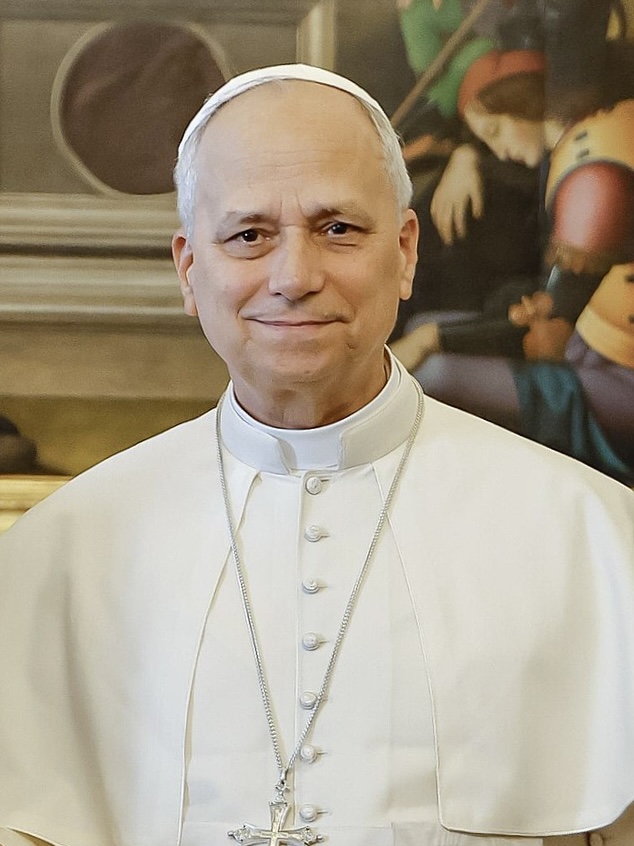
Pope Leo Putin Oleshky call: Pope Leo XIV telephoned Russian President Vladimir Putin on Friday and asked him to agree to a ceasefire around the occupied Ukrainian town of Oleshky, so that food and first aid can get in and civilians who want to leave can get out — and, according to the Kremlin, Putin said he supported a Vatican effort to do exactly that.
From a Hospital Room, a Pope Asks Putin for a Truce to Feed One Town
Track it live: Ukraine war map — follow the front lines on the live map, and see all active conflicts on the live war tracker.
ROME AND MOSCOW — Start with what each capital says happened, because on this occasion the two accounts overlap more than they conflict. The Vatican said the pope expressed deep concern about the grave humanitarian situation in Oleshky, in Ukraine's Kherson region, and called for a ceasefire to allow food and medical assistance in and a voluntary, safe evacuation of the civilian population out. He also reaffirmed, the Vatican said, the Holy See's commitment to dialogue and peace. The Kremlin, in its own statement, said Putin supported the Vatican's intention to help create the conditions needed to keep the town's population safe and to organise vital supplies, and that the two sides had agreed to cooperate. Two statements, one town, and — unusually — no immediate public contradiction between them.
The setting gave the call a second layer of meaning that neither statement needed to spell out. Leo, who is 71, is recovering at Rome's Gemelli hospital after surgery earlier this week in which part of a lung was removed. On Friday the Vatican said he was showing steady improvement, was able to work and carry on normal daily activities, had undergone blood tests and a chest X-ray that morning, and had celebrated Mass at midday in a makeshift chapel on the hospital's tenth floor for off-duty medical staff. He is expected to recite the Angelus prayer on Sunday, his first public appearance since the operation. A pope well enough to say Mass and work the phones is also a signal — to the Kremlin, to Kyiv, and to his own church — that the surgery has not sidelined the one diplomatic channel both warring capitals still answer.
Why Oleshky, and why now
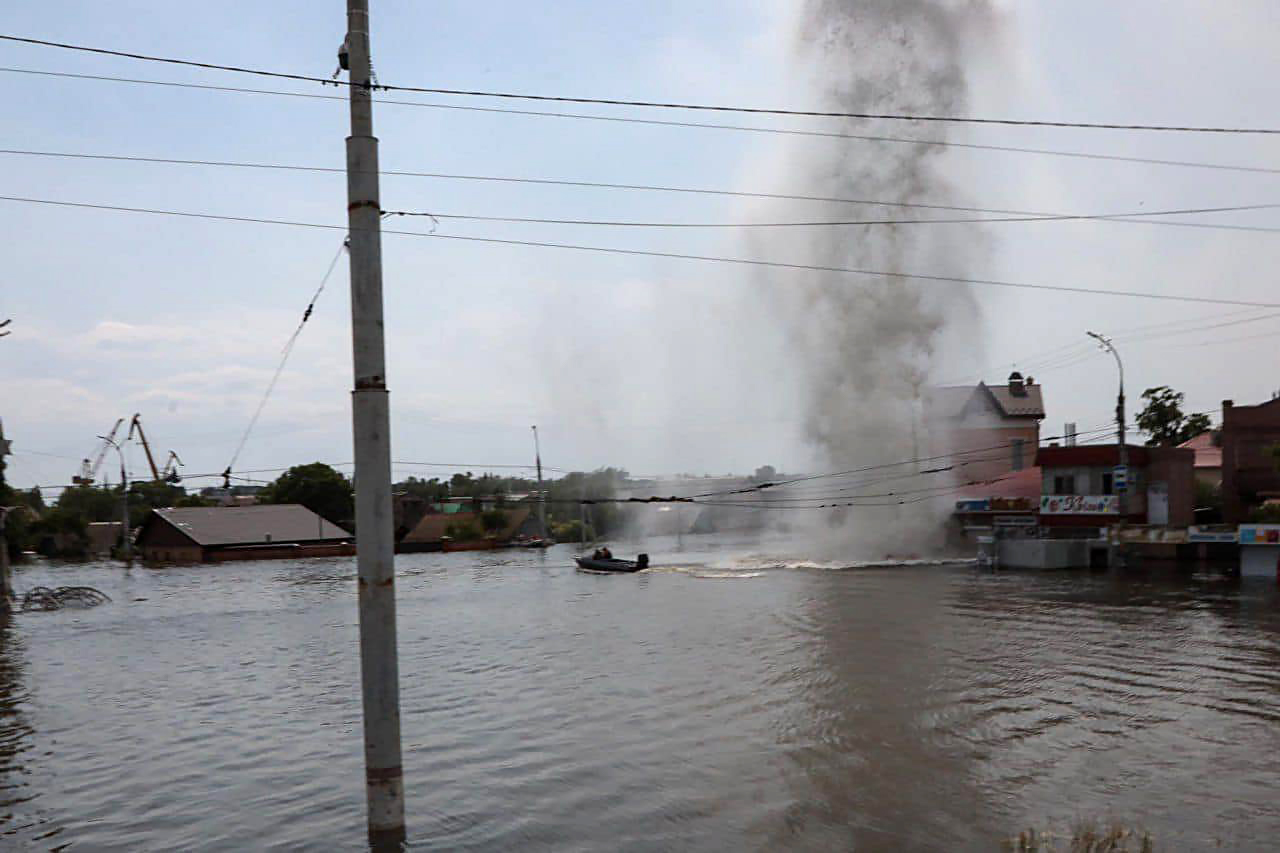
Oleshky sits on the eastern bank of the Dnipro, across the river from Ukrainian-held Kherson city, and it has been occupied since the first days of the full-scale invasion in February 2022. Before the war it was home to roughly 24,000 people. Today, according to Danielle Bell, who heads the UN Human Rights Monitoring Mission in Ukraine, about 1,700 remain, including 47 children. That arithmetic — a town reduced to about one resident in fourteen — is the background against which Friday's call has to be read, and this site has tracked how it happened: first in our account of Ukraine's drone food deliveries to the town, flown in because no road convoy could get through, and then in our reporting on the humanitarian crisis along what residents call the road of death, the mined route out.
The deterioration since the summer is documented by several independent voices, which matters because Friday's diplomacy rests on it. UN human rights chief Volker Türk condemned conditions in the town on October 2, describing residents as living without running water, electricity or gas. The European Union has called the situation horrific and said it is using every available avenue to facilitate assistance. The Council of Europe's human rights commissioner said in late September that he was alarmed by the rapidly deteriorating crisis and called for an immediate ceasefire, unhindered access and safe evacuation — the same three asks, in nearly the same order, that the pope put to Putin on Friday. Ukrainian regional officials say food deliveries by bus stopped after roads were mined and buses were hit; residents subsisted over the summer partly on locally grown produce, an option that ends with the season. Ukrainian forces have twice in recent weeks delivered food by drone — nearly four tonnes to about 100 locations on September 27, and nearly six tonnes more on October 4 — an extraordinary method that its own organisers concede can save lives but cannot substitute for a corridor.
What each side says — and what each side means
Russia's position, stated again around Friday's call, is that it acknowledges critical problems with food and medical supplies in Oleshky, that its military is working to resolve them, and that Ukraine is obstructing supplies from reaching the town. Ukraine's position is the mirror image: Kyiv accuses Russia of deliberately creating a humanitarian catastrophe, points to the mined and drone-watched roads as Russian work, and notes that the September aid convoy attempt from the Ukrainian side was turned back after an explosion on the road and drone strikes — events each side attributes to the other, and which have not been independently adjudicated. Both accusations cannot be wholly true; both contain the same admission, which is the only fact Friday's call actually needed: the town is not being supplied, and everyone with the power to change that knows it.
Into that deadlock, the Vatican offers something neither belligerent can offer the other: a channel that is not a surrender. A corridor agreed with Kyiv alone would require Russian consent at every checkpoint anyway; a corridor announced by Moscow alone would be read in Kyiv as a propaganda exercise and, potentially, as a military risk. A Vatican-brokered arrangement — with the International Committee of the Red Cross, which has already indicated readiness to help people leave, as the obvious operational partner — lets each side tell its own public that it cooperated with the pope, not with the enemy. That is not a cynical reading. It is how humanitarian access has actually been extracted from this war before, most visibly in prisoner exchanges, where third-party mediation succeeded precisely because it gave both capitals a counterpart they could afford to be seen helping.
Why this matters
The significance of the call is not that a pope asked for peace; popes do, and Leo has, repeatedly, including in his only previous conversation with Putin, in June 2025, after a round of direct Russia–Ukraine negotiations had just failed. The significance is the specificity. Friday's ask was not a general ceasefire, a peace plan or a summit. It was one town, one corridor, one evacuation — small enough to be deliverable within days, concrete enough that success or failure will be visible from a drone feed, and chosen, not coincidentally, at the moment when the town's own food calendar runs out: the gardens that carried residents through the summer are done, and winter on the lower Dnipro is not a metaphor.
There is a second significance, about the pope himself. Leo's lung-cancer diagnosis and surgery this month — covered in our reporting on his diagnosis and on the Gemelli operation — raised an obvious question about how much of his pontificate's diplomatic programme would pause. Friday answered it in the most legible way available: not with a statement about his health, but with a working call to the Kremlin, a Mass for the staff treating him, and a scheduled public appearance on Sunday. For a Vatican whose Ukraine diplomacy depends on being taken seriously as a continuing institution rather than a personality, demonstrating continuity from a hospital room is itself a diplomatic act.
And there is a third, colder significance. The same Friday brought a reminder of the war's other trajectory: President Putin, in military uniform at a command post, described a border security zone inside Ukraine as non-negotiable in any future talks — a maximalist territorial position restated on the very day he agreed, in principle, to a humanitarian favour. Both things are true at once, and holding them together is the honest way to read the call. Moscow can concede a corridor in Oleshky without conceding anything it values strategically; the town's military significance is limited, its humanitarian visibility is enormous, and cooperation costs the Kremlin little while purchasing a rare headline in which it appears as a partner of the Vatican rather than a defendant before it. Kyiv, for its part, gains the possibility of feeding or extracting its own citizens from a town it cannot currently reach by road — and loses nothing it currently has, because what it currently has in Oleshky is a catastrophe unfolding in view of its own positions across the river.
The numbers, in context
Put the town's figures against the war's. About 1,700 people remain of 24,000 — a 93 percent emptying, achieved not by a single battle but by four and a half years of occupation, flood, shelling and slow strangulation of supply. The 47 children among them are a statistic that does its own arguing: families with the means and the chance to leave, left. Ukraine's two drone operations delivered about ten tonnes of food combined — enough, at subsistence rations, to matter for days, not months, for 1,700 people. A single modest truck convoy, of the kind that moves through functioning corridors elsewhere in this war every week, would carry more than both drone operations together. The gap between what drones can do and what one open road would do is the precise measure of what Friday's agreement, if it is real, is worth.
What happens next
Three tests will decide whether this call joins the war's long list of unimplemented goodwill statements or becomes one of its few functioning humanitarian arrangements. The first is a named mechanism: a date, a route, a guarantor and an operator — the ICRC or a UN agency — announced by someone. Vague cooperation has no convoy in it. The second is the evacuation's voluntariness, which the Vatican was careful to specify: residents who leave must be able to choose their destination, including Ukrainian-held territory across the river, and residents who stay must not be treated as having consented to anything. Ukraine has accused Russia, in other occupied areas, of using evacuations to move populations in one direction only; the design of this one will be scrutinised accordingly, and should be. The third test is simpler and will arrive first: whether food and medicine physically enter the town in quantities larger than a drone can carry, within days rather than weeks, while the pope is still in hospital and the world's attention is still on the promise.
None of that diminishes what happened on Friday; it defines it. A 71-year-old man, three days past having part of a lung removed, spent some of his first working hours back on the telephone asking the president of Russia to let a starving town eat. The president, by his own government's account, said yes to helping. Wars are not ended by such calls. But towns, occasionally, are fed by them — and 1,700 people on the wrong bank of the Dnipro are now waiting to find out whether Oleshky is one of those occasions, or merely the subject of two well-written statements, issued in Rome and Moscow, on the same autumn Friday.
Sources: Reuters, October 16, 2026 (the Vatican's account of the call; the Kremlin's account of Putin's response; the Vatican's Friday health update; UN Human Rights Monitoring Mission figures via Reuters); CNN, October 16, 2026 (the call, the hospital Mass and Sunday Angelus plan, and Ukraine's stated position); Rome Reports, October 16, 2026; Le Monde, October 2026 (conditions in Oleshky, UN and Council of Europe statements, drone food deliveries). Russian and Ukrainian claims about who obstructs supplies to Oleshky are each reported as that side's position; the September convoy incident has not been independently adjudicated, and no corridor, date or operator had been announced at publication.