Pakistan train derailment: the Karachi-to-Peshawar Rehman Baba Express left the tracks near Sher Shah, Multan, in the early hours of Tuesday, October 13.
Rehman Baba Express Derails Near Multan: 5 Dead, 35 Hurt on the Karachi-to-Peshawar Run
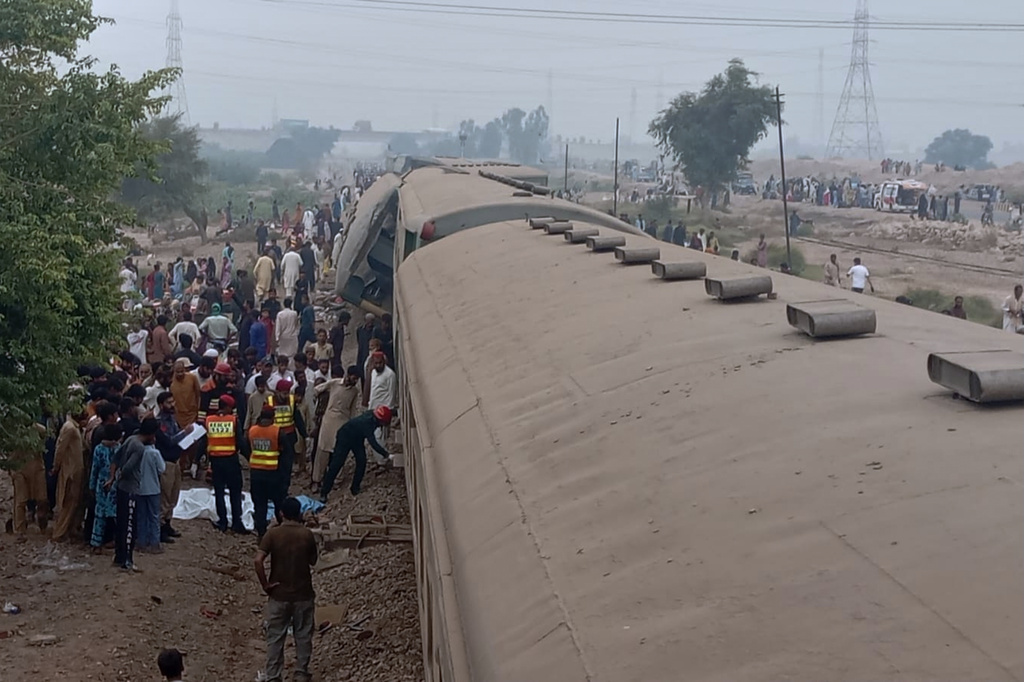
A passenger train derailed in central Pakistan in the early hours of Tuesday, killing at least five people and injuring 35 others, police and a Pakistan Railways spokesman told the Associated Press. The Rehman Baba Express was travelling from Karachi, the southern port city, to Peshawar in the northwest when it came off the tracks near Sher Shah, in Punjab's Multan district, at around 5:15 a.m. local time. All 14 of the train's cars were involved, according to railway spokesman Kaleem Akhtar.
Rescuers pulled the dead and injured from the wreckage through the morning. Akhtar said rescue teams recovered the bodies at the scene and evacuated the injured passengers; one of the injured died before he could be taken to hospital, rescue officials said. The injured were taken for treatment, with Multan's Nishtar Hospital receiving casualties, and emergency responders and paramedics were dispatched from across the district. Some Pakistani outlets later put the death toll at six — a reminder that early counts in a dawn derailment, with coaches scattered off the line, often move before they settle. The figure confirmed by police and the railways spokesman to AP is five dead and 35 injured.
Why this matters
This was not a remote branch line. The Karachi–Peshawar line is Pakistan's north–south spine — the route that ties the country's biggest port to its capital region and its northwest, carrying the long-distance expresses that millions of Pakistanis who cannot afford to fly depend on. The Rehman Baba Express is one of its flagship named trains. When a flagship train leaves the track on the main line, in clear operating conditions, with the driver reporting a green signal, the question stops being about one bad morning and becomes about the condition of the track itself. Pakistan's railways have been saying for years, in budget documents and ministerial statements, that the network is old, underfunded and overdue for renewal. Tuesday's wreck is what that sentence looks like when it stops being a budget line.
What the driver says happened
The train's driver, Rizwan Abbas, told Dawn the express was travelling at roughly 100 kilometres per hour — a normal main-line speed — and that the signal was clear as it passed the Sher Shah station area when he felt a sudden, strong jolt. He braked and brought the locomotive to a stop, then found that the passenger coaches behind him had derailed and were lying off the tracks. He said the train had been in working condition before the incident. That account, if the inquiry confirms it, points investigators away from the cab and toward the track, the coaches, or both: a train at line speed, on a clear signal, does not leave the rails without something failing underneath or within it. One passenger account carried in local reporting claimed repair work had been done on a coach before the journey — an allegation officials have not confirmed and that has not been established as a factor. It should be treated as a claim for the inquiry to test, not a cause.
The official response
President Asif Ali Zardari and Prime Minister Shehbaz Sharif issued separate statements of grief and directed authorities to give the injured the best available medical care, AP reported. Railways Minister Hanif Abbasi travelled to the site, expressed sorrow over the deaths, and ordered the inspector of railways to investigate the cause, according to the ministry's statement reported by Dawn. Compensation for the dead and injured is to be paid under Pakistan Railways' insurance arrangements, the ministry said. Train operations through the affected section were reported restored later in the day after the line was cleared. None of that is unusual — it is the standard choreography after a Pakistani rail disaster, and it has been performed many times. What will matter is whether the inquiry's findings are published, and whether anyone is held responsible for what they find.
A pattern, not an aberration
AP's reporting put Tuesday's derailment in the context every Pakistani rail passenger already knows: train accidents are relatively common in Pakistan, on a system worn down by decades of underinvestment, outdated track and ageing signalling. In 2023, ten cars of an express derailed in southern Pakistan, killing 30 people and injuring more than 90 — a death toll six times Tuesday's, on the same broad network, for the same broad reasons investigators cited then. The pattern has a grim arithmetic to it. Pakistan Railways moves enormous numbers of people on infrastructure much of which dates, in alignment and in places in substance, to the colonial era, while successive governments have announced upgrade programmes — most prominently the long-discussed Main Line-1 modernisation with Chinese financing — that have repeatedly stalled over cost and debt. Until the track is renewed, the system's safety margin rests on inspection and maintenance catching failures before a train at 100 kilometres per hour finds them. On Tuesday morning near Sher Shah, something was not caught.
Who bears the cost
The passengers on trains like the Rehman Baba Express are, disproportionately, the people with the fewest alternatives: workers travelling between Karachi's jobs and family homes up-country, students, patients heading to big-city hospitals, families for whom the fare difference between rail and air is the difference between going and not going. They cannot respond to a derailment by switching to a safer competitor; there is no competing railway. The state railway is a monopoly provider of an essential service to the people least able to absorb its failures — which is why the compensation announcements, welcome as they are to bereaved families, are the smallest part of the state's obligation here. The larger part is a published, credible account of why a main-line express left the track, and a fix that survives longer than the news cycle. Our wider Pakistan coverage, including Pakistan's emergency-rule crisis in Khyber Pakhtunkhwa and Pakistan's airstrikes inside Afghanistan, shows a state under strain on several fronts at once; the railway inquiry will test whether it can still do the unglamorous work of maintaining what it already has.
What happens next
Three things will tell whether Tuesday changes anything. First, the inspector of railways' inquiry: its timeline, its findings on track condition, coach maintenance and speed, and whether it is released in full. Second, the toll and the injured: hospitals in Multan will confirm over the coming days whether the count settled at five, as AP reported, or the higher figure some local outlets carried. Third, the money: whether the derailment moves the stalled main-line upgrade debate in Islamabad, or whether — as after 2023's far deadlier wreck — the statements of grief are followed by business as usual. For now, the confirmed facts are these: a Karachi-to-Peshawar express derailed near Sher Shah at about 5:15 on Tuesday morning, at least five people are dead, 35 are injured, the driver says the signal was clear and the jolt came without warning, and the cause is officially unknown. Sources: Associated Press; Dawn reporting via Daily Metro Time; Euronews.