World · Hong Kong · National Security
Joshua Wong sentenced 10 years by Hong Kong's High Court on Thursday for conspiring to collude with foreign forces — a second national security conviction that cancels the freedom he was due in January and keeps one of the city's best-known democracy activists in prison until late 2036, when he will be 40.
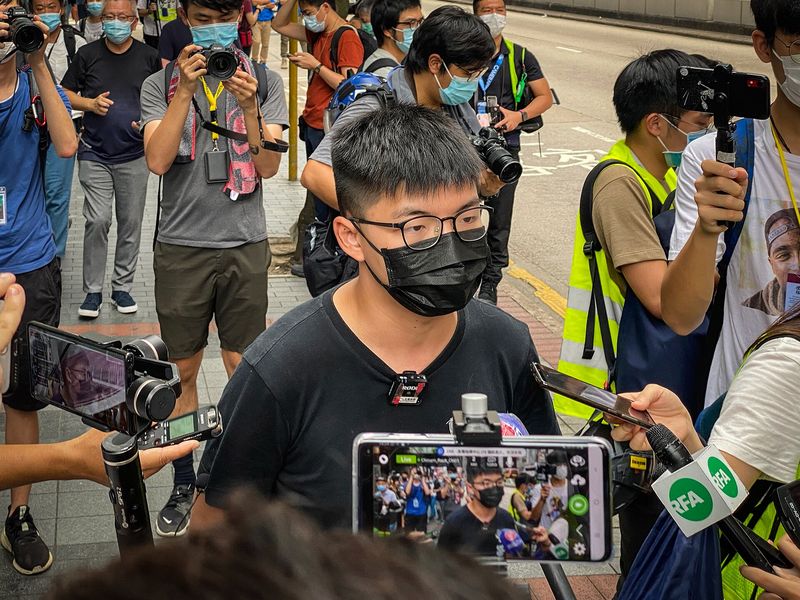
HONG KONG — Joshua Wong sentenced 10 years in prison by Hong Kong's High Court on Thursday, November 5, 2026, after the democracy activist pleaded guilty to conspiring to collude with foreign forces under the National Security Law Beijing imposed on the city in 2020. It is Wong's second conviction under that law. Judge William Tam Yiu-ho ruled the offence was of a grave nature — the category that carries 10 years to life — set a starting point of 13 years, and reduced the term to 10 years to reflect Wong's guilty plea, entered on September 2, 2026.
The Joshua Wong prison sentence lands at the moment his punishment was supposed to end. Wong, 30, is already serving four years and eight months for subversion in the Hong Kong 47 case, has been in custody since November 2020 — more than 2,100 days — and was due for release in January 2027. About two months of the new 10-year term will run concurrently with his existing sentence; the rest extends his imprisonment to late 2036. A Hong Kong democracy activist jailed as a teenager's contemporary a decade ago will now spend his entire thirties behind bars.
The charge: a Nathan Law sanctions conspiracy
The case turned on advocacy, conducted in the open. Wong pleaded guilty to conspiring with Nathan Law — the fellow former student leader now living in self-imposed exile — and others between July 1 and November 23, 2020, to request that foreign countries and institutions impose sanctions or blockades, or engage in other hostile activities, against the Hong Kong and Chinese governments. In the shorthand of the case, it was a Nathan Law sanctions conspiracy: an agreement, prosecutors said, to lobby the outside world to pressure Hong Kong and Beijing.
That framing is what makes the sentence a landmark. The conduct alleged was not violence, espionage or sabotage; it was the kind of international lobbying — meeting foreign lawmakers, urging sanctions legislation, speaking to overseas audiences — that Wong and Law had practised publicly for years before the National Security Law existed. The law, imposed on June 30, 2020, criminalised that advocacy as collusion, and Thursday's sentence sets the price the courts will attach to it when the defendant is the movement's most recognisable face.
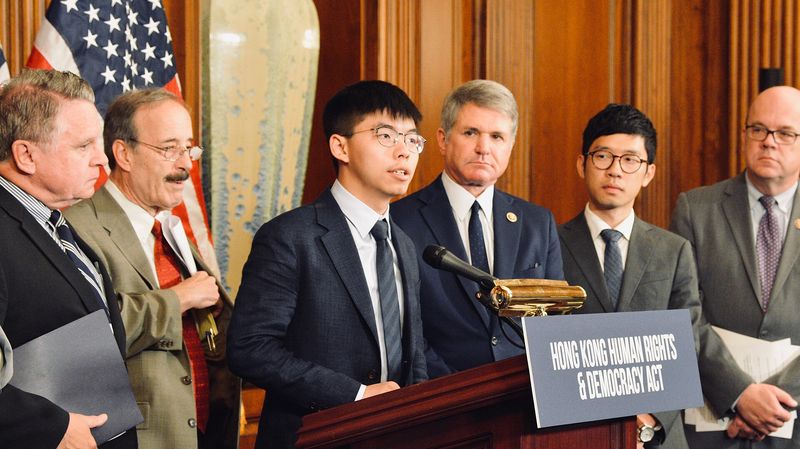
From the Umbrella Movement to a prison cell
Wong's public life began before he could vote. He rose to prominence as a teenage student leader during the 2014 Umbrella Movement, when weeks of street occupations demanding freer elections made the bespectacled schoolboy one of the most recognisable faces of Hong Kong's democracy movement — a prominence that never left him, and that prosecutors and judges have had in view in case after case since.
When far larger protests swept Hong Kong in 2019, initially over a proposed extradition bill and then into a broader movement against Beijing's tightening control, Wong was again a central figure, travelling abroad to urge foreign governments to act. Beijing's answer to that unrest was the National Security Law, imposed in 2020, which created offences of secession, subversion, terrorism and collusion with foreign forces, and which Hong Kong's government credits with restoring stability to the city. The law also began the process that has kept Wong in custody, without interruption, since November 2020.
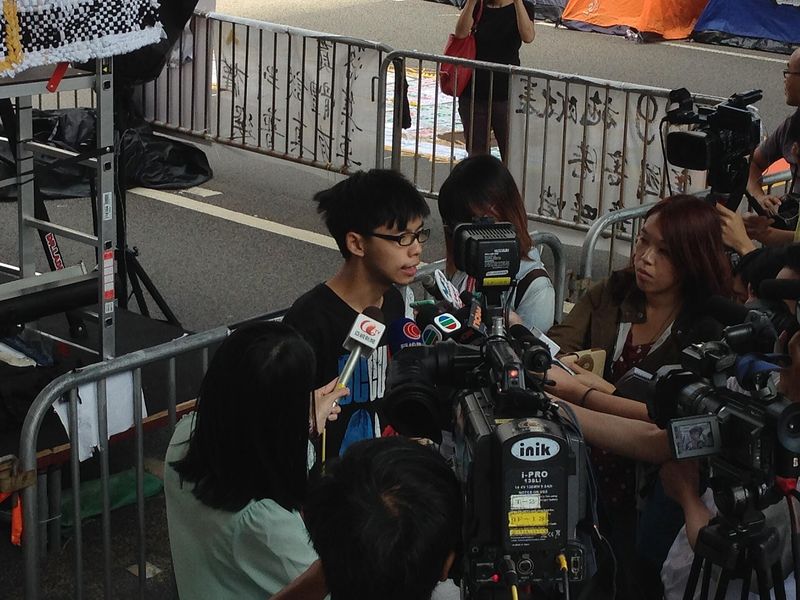
The Hong Kong 47 case: Joshua Wong's first long sentence
The sentence Wong is currently serving came from the largest national security prosecution Hong Kong has brought. In the Hong Kong 47 case, dozens of opposition figures were prosecuted over an unofficial primary election held to choose candidates for the legislature — an exercise the authorities characterised as a conspiracy to subvert state power. Wong was among them, and the Hong Kong 47 case Joshua Wong entered in the public record ended with a term of four years and eight months for conspiracy to commit subversion. It is that sentence — due to expire in January 2027 — that Thursday's ruling now overtakes, making Wong a defendant convicted under the National Security Law not once but twice.
The court, and the arithmetic of the sentence
The sentencing framework explains both the number and its limits. For collusion offences, the National Security Law provides a band of three to 10 years for ordinary cases, rising to 10 years to life where the offence is of a grave nature. Judge Tam placed Wong's case in the grave band, which set the floor at a decade, then fixed 13 years as the starting point before applying the discount for the guilty plea — producing 10 years, the lowest term the grave band allows. The plea, in other words, is the only reason the Joshua Wong prison sentence is not longer; the grave classification is the reason it could not be shorter.
In mitigation, Wong submitted a letter to the court in which he wrote that his activism was never driven by hatred. The court was not moved to go below the grave band's floor, but the letter now stands as his own account of motive in a case that was otherwise argued entirely in the language of security: what he asked foreign governments to do, and what that asking was for.
Why this matters
Analysis, labelled as such. Start with the scale of the system this sentence sits inside. More than 180 people have been convicted of national security offences in Hong Kong since 2020, according to the city's Security Bureau — a caseload that has worked through the organised opposition methodically: lawmakers, publishers, union organisers, student leaders. Thursday's ruling matters because Wong is the movement's most internationally recognisable name, and because a second conviction, laid on top of a first that was weeks from expiring, demonstrates a mechanism as much as a punishment: a prominent prisoner approaching release can be charged again under the same law, on conduct from the same period, and kept inside. Whether one regards that as the law working as designed or as its central abuse depends on the argument below — but the mechanism itself is now a matter of court record.
Second, the sentence prices a specific activity. Wong's case was not built on clandestine contact with foreign agents; the conspiracy alleged was to request sanctions and blockades — public advocacy, of the kind he and Law performed at podiums abroad. A grave-band sentence for that conduct tells every Hong Kong activist, journalist and academic exactly where the line now sits: contact with foreign governments aimed at pressuring Hong Kong or Beijing is treated, at its most serious, on a scale that starts at ten years. The city's remaining opposition — already reduced by emigration, disbanded parties and earlier convictions, as we noted in our recent coverage of Hong Kong's government — receives that message with Wong's release date attached to it: late 2036.
Who benefits, who loses — and what each side says
Hong Kong's government was direct about its view. Chief Executive John Lee said Wong and Law had committed extremely serious offences undermining national sovereignty, security and development interests. The broader official position, held in both Hong Kong and Beijing, is that the National Security Law restored stability after the chaos of the 2019 protests, that it targets a narrow set of acts — collusion with foreign forces among them — and that a resident who campaigns for foreign sanctions against his own city has crossed a line every state is entitled to draw. On that account, Thursday's sentence is the law doing precisely what it was written to do, and doing it through a court, after a guilty plea.
The critics' account is the mirror image. Human Rights Watch condemned the sentence, calling it cruel and unjust, and Amnesty International likewise condemned it — the two organisations' shared position being that the case criminalises peaceful advocacy: that requesting sanctions, however one judges the tactic, is political speech, and that a decade in prison for it reveals the law's purpose as the suppression of dissent rather than the protection of security. The same divide runs through the wider argument over Hong Kong's political prisoners — the issue at the centre of our coverage of calls for the release of jailed figures including Jimmy Lai — and through free-speech cases elsewhere in the region, such as Beijing's dismissal of an alleged attack on a Taiwan comedian. Both sides in the Wong argument claim the same word — security, freedom — and mean different things by it; what Thursday settled is only which meaning Hong Kong's courts will enforce, and for how long.
The losers, on any reading, begin with Wong himself: a January release converted into a Joshua Wong release 2036 horizon, a man of 30 facing freedom at 40, having spent the whole of his adult life either campaigning, on trial or in custody. The beneficiaries, on the authorities' reading, are a Hong Kong government that can point to a concluded case and a deterred offence category; on the critics' reading, the benefit flows the other way — to a prosecution model that no longer needs new conduct to extend an old imprisonment.
What happens next
For Wong, the calendar is now the story. Absent any change, he remains in prison until late 2036, completing a span that began in November 2020 — more than 2,100 days already served, with roughly a decade still to run. He will turn 40 inside the term the High Court set on Thursday. Nathan Law remains in self-imposed exile abroad, beyond the reach of the Hong Kong courts, and the conspiracy case against the pair closes with one man sentenced and the other beyond sentencing.
International reaction will test whether the case resonates beyond the courtroom. Human Rights Watch has urged foreign governments to denounce the sentence and to act against the officials it holds responsible for Hong Kong's repression; governments that legislated the sanctions Wong once lobbied for must now decide what, if anything, follows from his punishment for lobbying. And inside Hong Kong, the question the sentence leaves behind is what remains of organised opposition at all: with more than 180 national security convictions recorded since 2020 and the movement's best-known figure imprisoned into a fourth decade of life, the space the Umbrella Movement once occupied — the street, the podium, the foreign capital — has been closed off piece by piece. Thursday's ruling closed the calendar on its most famous occupant.
Sources
Reuters, November 5, 2026 — the High Court sentence, Judge William Tam Yiu-ho's grave-nature ruling, the 13-year starting point reduced to 10 years for the guilty plea, and the concurrent portion of the term. CNN, November 4–5, 2026 — the September 2 guilty plea, the July–November 2020 conspiracy period with Nathan Law, and Wong's existing Hong Kong 47 sentence and January 2027 release date. Associated Press, November 5, 2026 (via WMHT) — court reporting on the sentencing hearing and Wong's mitigation. Human Rights Watch, November 5, 2026 — condemnation of the sentence and the custody timeline to late 2036. Amnesty International, November 5, 2026 — statement condemning the sentence and calling for the national security convictions to be overturned. Hong Kong Security Bureau figures — more than 180 national security convictions since 2020.